Evidence-first case study · sports brand SEO + GEO series, part 3 of 20
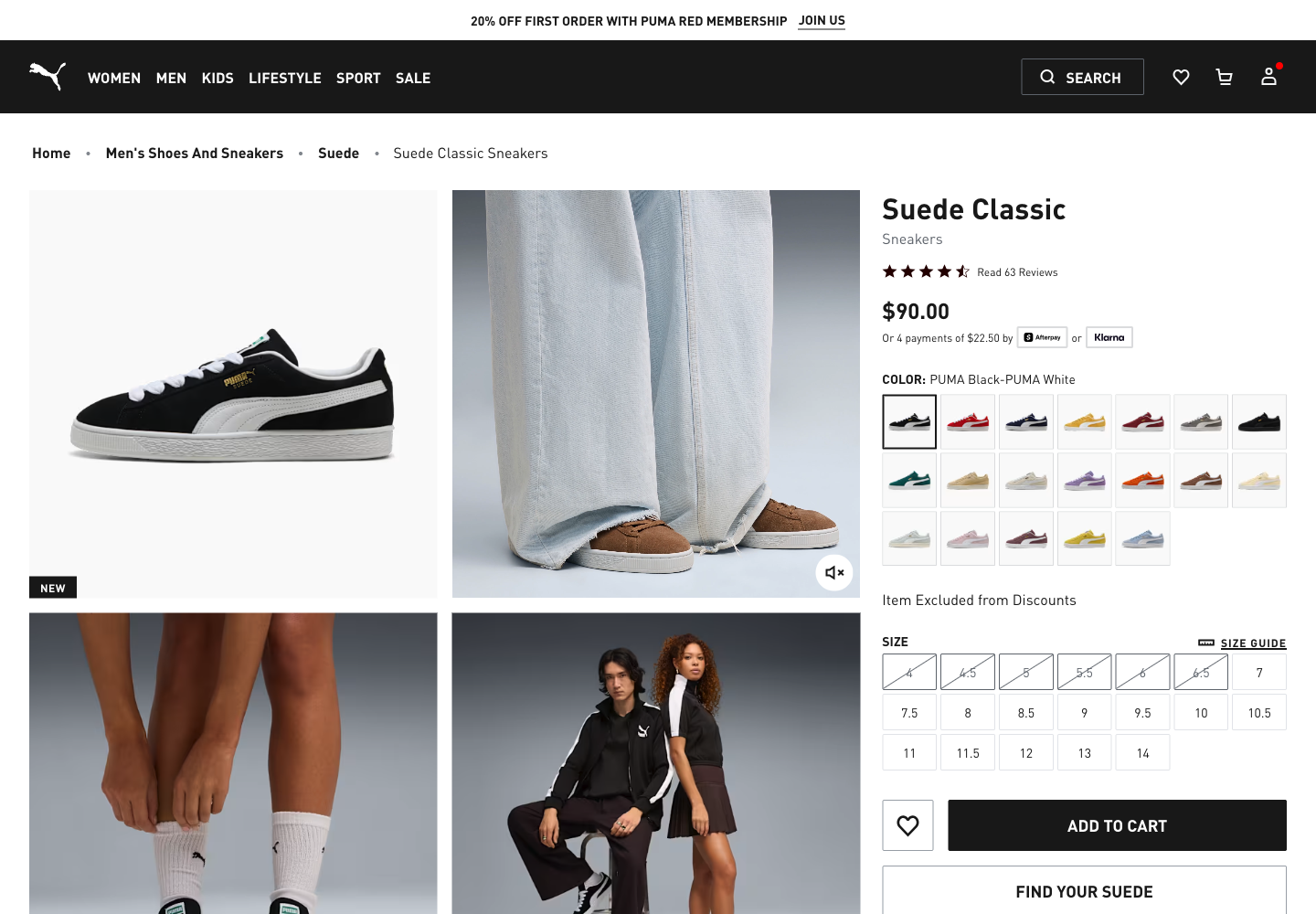
Puma’s flagship Suede Classic page displays a star rating and “Read 63 Reviews” to shoppers, but that signal doesn’t exist anywhere in the page’s own Product schema — no aggregateRating field at all, a gap neither Nike nor Adidas had. Puma scored the lowest 8-pillar G-score of the series so far (0.354 across six pages, vs Nike’s 0.4375 and Adidas’s 0.6458) while still landing in the middle on AI citation (5/10 Google AI Mode queries, after we caught and corrected a false-positive match on a Reddit community literally named r/PUMA). The bigger locale finding: Puma Korea’s catalogue doesn’t carry the Suede Classic at all — searching “스웨이드” silently bounces back to the homepage with no “no results” message, and Puma US has this series’ first genuinely substantive llms.txt file, a 2,672-link, 695KB near-total category dump rather than a curated summary.
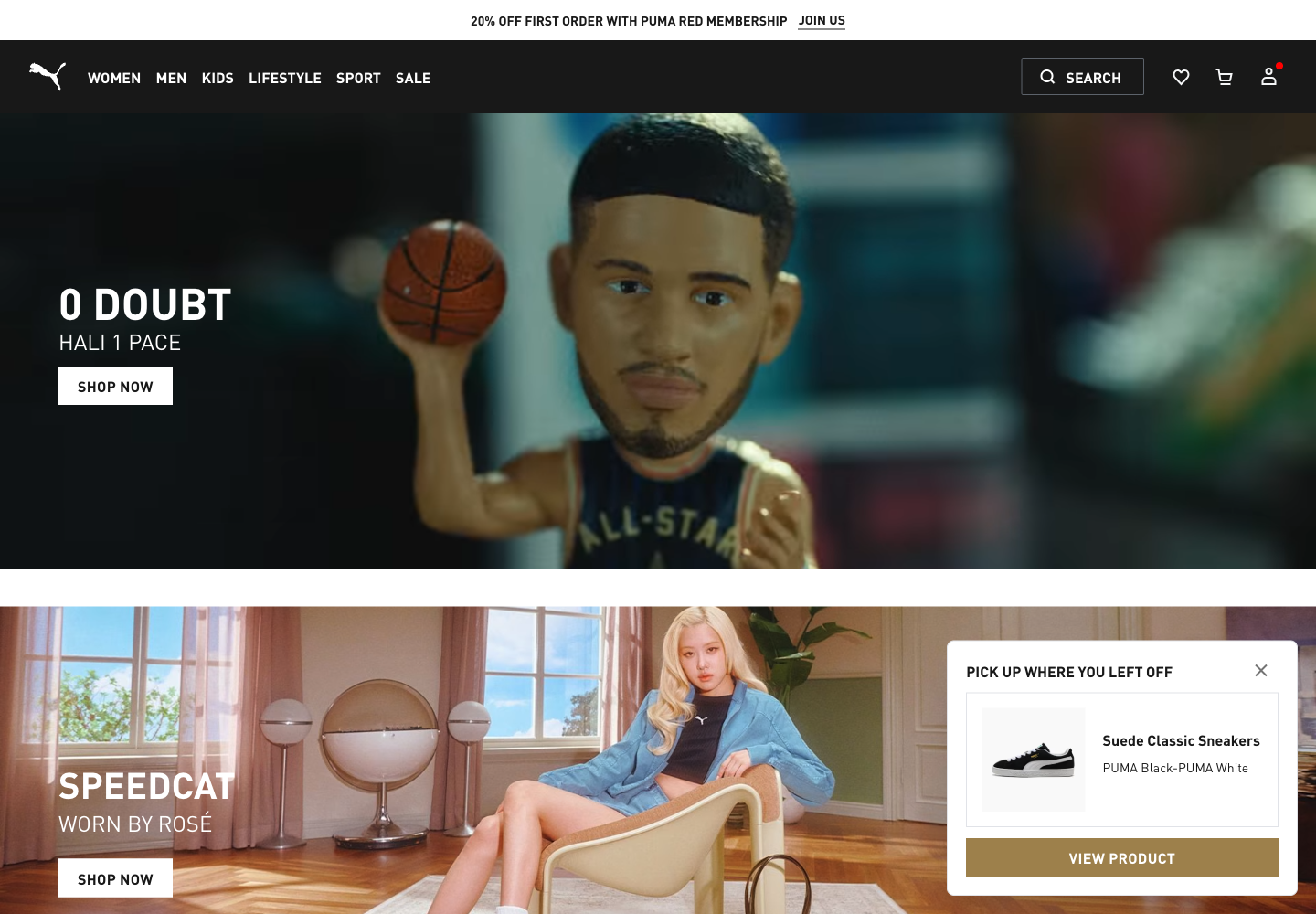
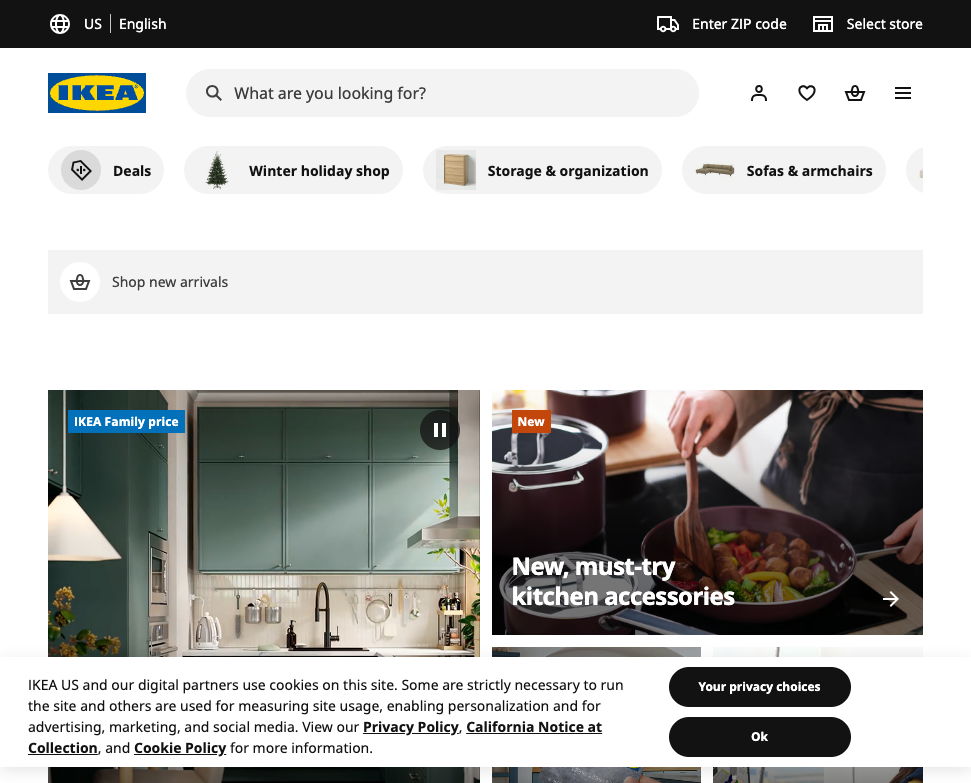
Actual public homepage captured during this audit, October 25, 2026.
What is Puma.com trying to do — and why audit it third?
This is part 3 of GeoParrot’s sports-brand series, running the same evidence-first method we used on Adidas and Nike. Puma is a natural third name: a direct global competitor to both, with its own flagship heritage silhouette, the Suede Classic, playing a comparable cultural role to Nike’s Air Force 1 and Adidas’s Samba OG — a decades-old shoe currently enjoying a lifestyle and streetwear resurgence.
Brand category Global athletic footwear, apparel and equipment retailer; collaboration-heavy catalogue (Jil Sander, Rosé/ROSÉ, HYROX).
Primary user job Find a shoe that fits a sport or style moment, trust a visible-but-unstructured review signal enough to buy, then get help via a separate Zendesk-hosted support site if something goes wrong.
SEO + GEO challenge A US product page that visibly shows review counts but doesn’t expose them in schema, a Korea site missing the flagship product entirely, and an unusually massive llms.txt that reads as an auto-generated link dump rather than a curated summary.
The product we tracked: Puma Suede Classic
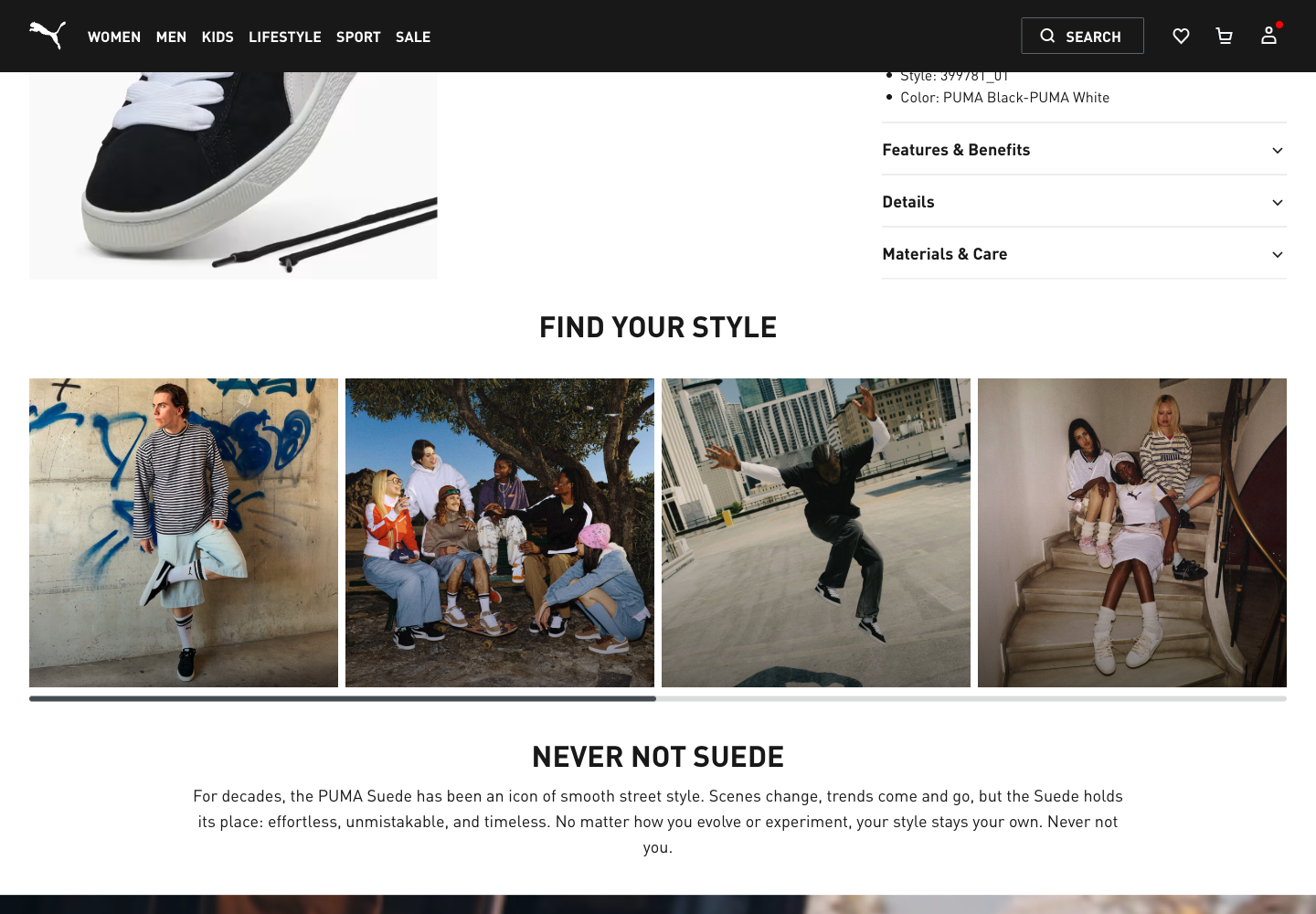
US product page: $90.00, a star-icon rating linking to “Read 63 Reviews,” a “NEW” badge, and 22 colour swatches.Scrolling past the fold surfaces collapsed “Features & Benefits,” “Details” and “Materials & Care” accordions and a “Find Your Style” lifestyle carousel — no visible customer-review text on this pass, just the rating link up top.
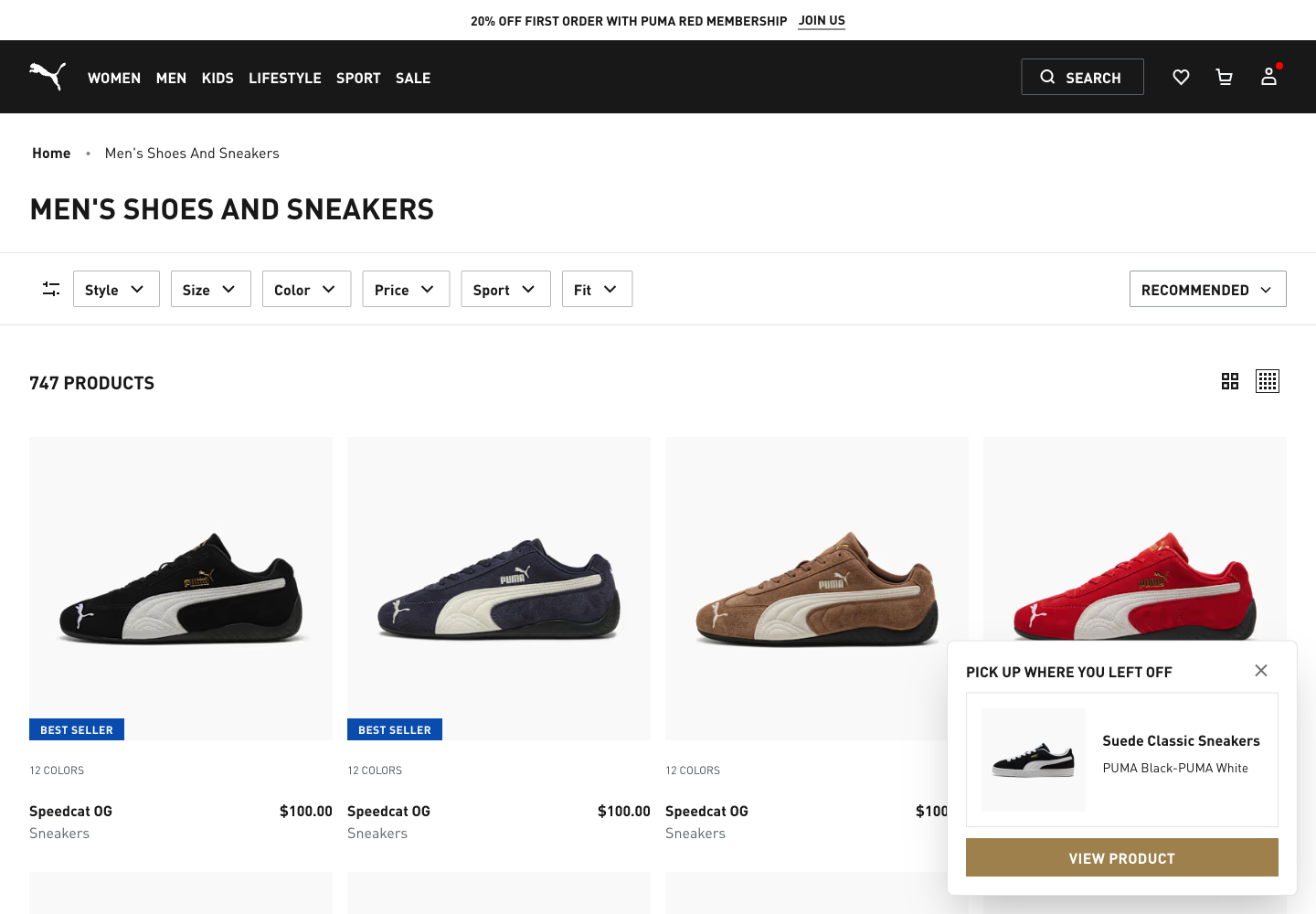
The category layer: “MEN’S SHOES AND SNEAKERS” at 747 products, with Style/Size/Color/Price/Sport/Fit facet filters — between Nike’s and Adidas’s category counts in this series.
AI citation snapshot: 10 real queries, Google AI Mode
We sent the same style of 10 verbatim queries used on Nike and Adidas to Google AI Mode (udm=50) and checked whether a cited source was labelled with the Puma brand name. Method note, reported honestly: our automated matcher’s first pass counted “puma suede classic review” as cited because one citation chip read “Reddit · r/PUMA” — a subreddit named after the brand, not puma.com itself. We caught this on manual review and excluded it, the same kind of false-positive catch we made auditing Adidas’s Korean-language chip label. Direct a[href] capture again returned almost no raw links this run, consistent with Nike and Adidas.
Unlabelled chips only — no publisher name extractable
puma suede history
❌ No
Wikipedia, YouTube, Sneakerjagers, Highsnobiety, Facebook, Medium
Result: puma.com cited in 5/10 queries — between Nike’s 5/10 and Adidas’s 4/10 on the same query style. The pattern holds across all three brands so far: direct policy, loyalty-program and head-to-head “vs” comparison queries skew toward citation, while a named-product review query and a direct silhouette-comparison query (“suede vs speedcat”) lose out to YouTube, Reddit, independent sneaker sites or go unlabelled. We did not attempt a ChatGPT read this run, given the composer-selector failure we hit on both Nike and Adidas and flagged originally in our Week 17 arc.
G-score audit: the 8-pillar hygiene checklist, six pages
We scored six representative Puma URLs with the same 8-pillar static-HTML checklist (JSON-LD present, FAQ content, visible date, author byline, concrete data points, table/list structure, 3+ subheadings, a 30–500 character early answer) used in our Week 17 quality-score experiment and on Nike and Adidas. Puma’s Zendesk-hosted FAQ center sits behind a Cloudflare JS challenge that blocks a plain HTTP fetch, so that one page was scored from the real-browser HTML captured alongside the evidence screenshots.
Page
G-score
Passes
Fails
US homepage
0.5
JSON-LD, data points, lists, subheadings
FAQ, date, author, early answer
Men’s Shoes category
0.5
JSON-LD, data points, lists, subheadings
FAQ, date, author, early answer
Suede Classic product page (US)
0.5
JSON-LD, data points, lists, subheadings
FAQ, date, author, early answer
Help/FAQ centre
0.25
Lists, subheadings
JSON-LD, FAQ, date, author, data points, early answer
Korea homepage
0.25
JSON-LD, lists
FAQ, date, author, data points, subheadings, early answer
Korea suede search (bounces to home)
0.125
Lists
JSON-LD, FAQ, date, author, data points, subheadings, early answer
Average G-score across six pages: 0.354 (Nike: 0.4375, Adidas: 0.6458) — the lowest in the series so far.
The gap versus Adidas traces to the same two pillars every time: no page we checked passes “date” or “author,” and critically, none pass “early answer” either, unlike both prior brands’ homepages. The Korea pages score worst of all six because they’re thin, JS-heavy shells with little static text for a plain-HTTP fetch to read — the suede-search bounce page in particular is barely distinguishable from the homepage it redirects to.
robots.txt — US blocks cart/checkout-adjacent query parameters (srule, cgid, demandware, style/sport/color/team facet params, wishlist) under a single generic User-agent: * block — no AI crawler is named, positive or negative, unlike Adidas’s explicit ClaudeBot rule. Korea’s robots.txt runs on an entirely different, older-looking template: it hard-blocks eight non-AI crawlers by name outright (MJ12bot, trendictionbot, MegaIndex.ru, dotbot, 360Spider, HaosouSpider, YandexBot, Baiduspider all get Disallow: /) and sets a 30-second crawl-delay for msnbot and bingbot — again, no GPTBot/ClaudeBot/PerplexityBot/Google-Extended mention either way.
llms.txt — The first genuinely substantive llms.txt we’ve found in this series. us.puma.com/llms.txt returns a clean HTTP 200, plain-text file: 2,696 lines, roughly 695KB, 2,672 markdown links organized under six headers (Products’ Categories, Products, Contact & Support, News & Press, Marketing Pages, Social Links). It reads as a near-total, bilingual (EN/ES) category and page dump rather than a curated summary of what the brand wants an AI assistant to know — the opposite failure mode from Adidas’s redirect-masquerading-as-200. kr.puma.com/llms.txt returns a clean 404. See our explainer on what llms.txt actually does before treating either behavior as a ranking issue — Google Search doesn’t read it.
Sitemap — US robots.txt lists two separate sitemap indexes: a URL sitemap index (40 sub-sitemaps) and a dedicated image sitemap index (8 sub-sitemaps) — a clean split we hadn’t seen on Nike or Adidas. Korea runs a visibly different platform: a single sitemap_index.xml with just 7 entries, split by content type via filename (sitemap_0 plus named custom sitemaps for other pages, categories, contents and folders) rather than Demandware-style numbered shards — further evidence the US and Korea sites run on different commerce platforms entirely.
Product schema — The Suede Classic US page carries two JSON-LD blocks: a Product type with name, SKU and an Offer (price, currency, availability, URL, seller), and a separate ProductGroup type with 22 hasVariant entries (variesBy color) — matching the 22 swatches visible on the page. Gap: neither block includes an aggregateRating field or any Review objects, even though the rendered page visibly links to “Read 63 Reviews” right next to the price. That review signal exists only as client-side UI, not as structured data a crawler or AI engine parsing JSON-LD would ever see — a different and arguably larger gap than what we flagged on Nike, and the opposite of Adidas, whose per-review schema was the richest in the series.
FAQ / Help center — No FAQPage schema anywhere we checked, including the dedicated FAQ center. That center itself is notable: it isn’t on puma.com at all but lives on a separate Zendesk-hosted subdomain, help.us.puma.com, organized into categories (Orders & Payment, Shipping & Delivery, Returns, Shopping) with real question-and-answer content — structurally a genuine FAQ, just not marked up as one.
Locale behaviour — the headline technical finding — Puma Korea’s catalogue does not carry the Suede Classic at all. Searching “스웨이드” (suede) on puma.com/kr/ko doesn’t return a “no results” page; it silently redirects back to the homepage, with no error messaging a shopper — or a crawler — could use to tell a dead search apart from an intentional redirect. The closest comparable product the Korea homepage actually surfaces is the Speedcat Croco Leather Wns at 159,000원, a different shoe entirely, with zero reviews (“이 제품의 첫 상품평을 남겨 주세요” — “be the first to review this product”). Unlike Nike and Adidas, where we could track the identical SKU across both markets, Puma’s US and Korea catalogues simply don’t overlap on the one product we set out to compare.
What works / What to verify
WHAT WORKS
A clean URL/image sitemap split, consistent ProductGroup variant schema that accurately mirrors the 22 colorways shown on-page, and a genuinely substantive (if unwieldy) llms.txt file that at least returns real content instead of a redirect or an empty 404.
WHAT TO VERIFY
Whether the missing aggregateRating/Review schema is specific to the Suede Classic page or systemic across Puma’s catalogue, whether the Korea “no results → silent homepage redirect” pattern holds for other missing products or was specific to “스웨이드,” and whether a product that does exist on both markets would show pricing/review parity the Suede Classic comparison couldn’t test this time.
Target query check — reported honestly, not inflated
We have not re-measured “puma seo” or “puma geo audit” query volume this session. Per the pattern already confirmed across seven earlier subjects in this series on October 20, 2026 (Keyword Planner, US) — the large majority showed no measurable search volume at all for “[brand] SEO/GEO audit” phrasing — we’re not claiming this title drives ranking-based traffic. The distribution case for this series rests on internal links, our own index, and readers already following the GEO Lab arc, not on search demand for “[brand] SEO audit” as a query.
Frequently asked questions
Does Puma’s missing review schema put it behind Nike and Adidas on AI citation?
Not in this snapshot — Puma was cited in 5/10 of our test queries, ahead of Adidas’s 4/10 despite Adidas’s much richer per-review schema, and essentially tied with Nike’s 5/10. The missing aggregateRating is a real structured-data gap, but it didn’t show up as a citation disadvantage here; it may matter more for product-comparison AI features that specifically parse review data, which our 10-query snapshot doesn’t isolate.
Why would a “no results” search silently redirect to the homepage instead of showing an error?
We can’t know Puma’s intent from the outside. What we can say is that the behavior is ambiguous in a way a clean “no results for 스웨이드” message wouldn’t be — a shopper (or a crawler) can’t distinguish “this product genuinely doesn’t exist here” from “the search broke” without separately confirming the catalogue gap, which is exactly what this audit had to do manually.
Does a G-score of 0.35 — the lowest in this series — mean Puma is less likely to be cited by AI engines?
Not reliably, and this audit is itself a data point against that idea, same as Nike and Adidas were. Our Week 17 experiment found hygiene/structure score was not a dependable predictor of AI citation. Here, Puma scored lowest of three brands on our 8-pillar checklist (0.354) but landed in the middle on citation (5/10, same as Nike’s 0.4375-scoring pages) — another data point suggesting G-score is not the lever.
Is the 2,672-link llms.txt actually useful, given Google doesn’t read it?
Probably not in its current form — see our full breakdown of what llms.txt actually does. A near-total link dump of every category and marketing page isn’t meaningfully different from a sitemap for any AI system that does choose to read it; the stated purpose of llms.txt (a curated, prioritized summary) is arguably better served by a shorter file than a longer one.
Audit evidence, scope and limits
Inspected: October 25, 2026, public logged-out access from a Korea-based IP (real browser session used throughout). Screens: US homepage, Men’s Shoes category, Suede Classic product page (top and detail accordions), US FAQ center, Korea homepage, a Korea “스웨이드” search (bounces to homepage), and the resulting Speedcat Croco Leather PDP — plus robots.txt, sitemap-index and llms.txt checks on both locales, a 10-query Google AI Mode citation snapshot, and an 8-pillar G-score scored on six fetched pages.
Not measured: rankings, Search Console performance, analytics, conversion, signed-in/member flows, ChatGPT citations (not attempted, given the composer failure on the prior two audits), or the complete product/locale catalogue beyond the one shoe family and six URLs sampled here. This is a public-signal snapshot, not a performance claim or a full-catalogue crawl.
This is part 3 of a daily series. Every day, GeoParrot runs this same evidence-first method — real screenshots, a 10-query AI citation snapshot, an 8-pillar G-score audit, and an honest target-query check — against one more major sports and athletic-wear brand. Tomorrow: Under Armour.

Leave a Reply