Evidence-first case study · sports brand SEO + GEO series, part 2 of 20
Adidas’s product schema is a clear step up from Nike’s — full AggregateRating plus individually authored, dated Review objects on the Samba OG page — but that richer markup did not translate into a higher AI-citation rate. Across the same 10-query Google AI Mode test, adidas.com was cited in 4/10 queries (Nike: 5/10), while its 8-pillar G-score averaged 0.65 across six pages (Nike: 0.44). Adidas is also the first brand in this series whose robots.txt explicitly names an AI crawler — ClaudeBot, with a 6-second crawl-delay — while GPTBot, PerplexityBot and Google-Extended go unmentioned, and plain HTTP requests (not routed through a real browser) are blocked outright by Akamai’s bot defenses, even for robots.txt itself.
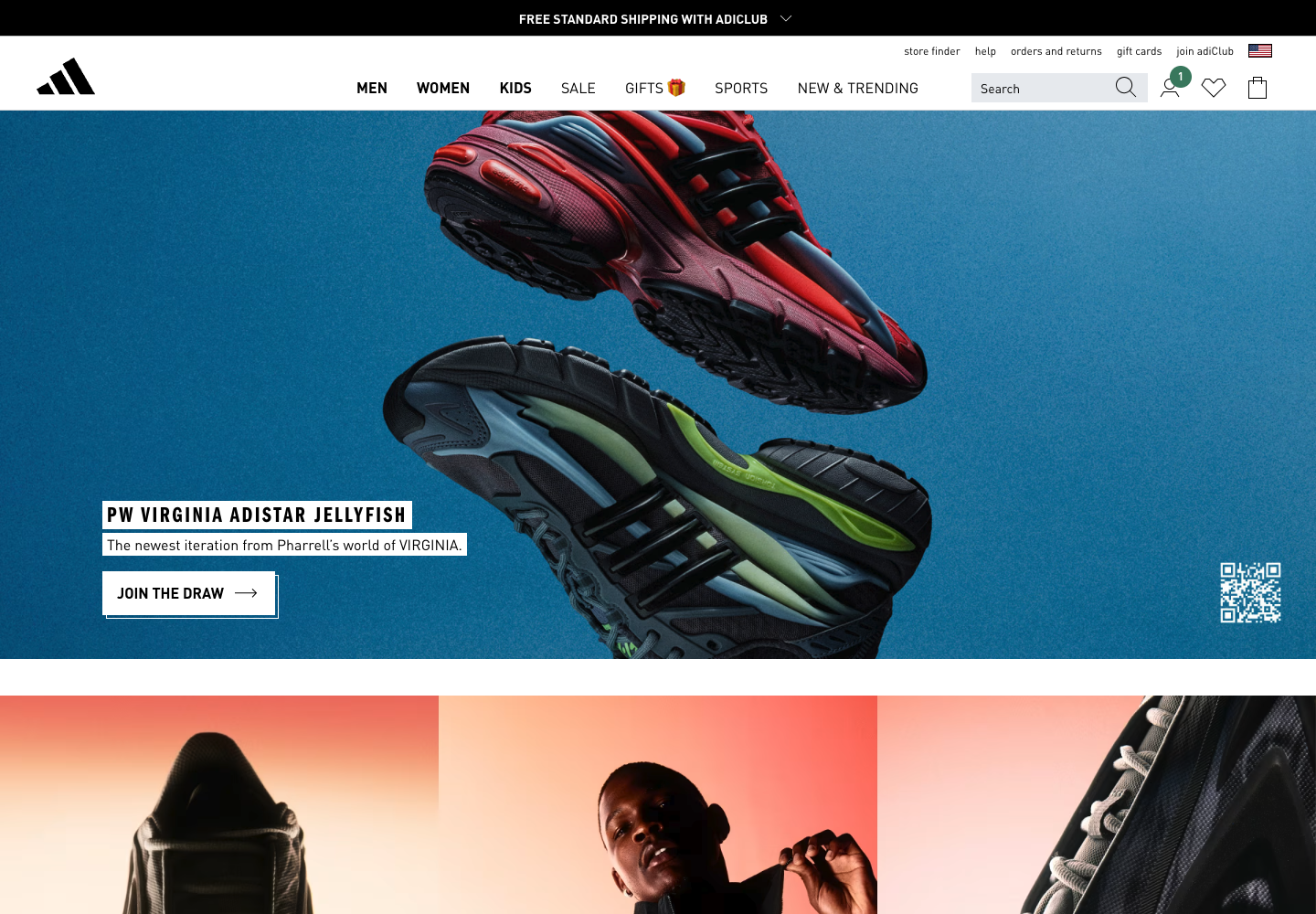
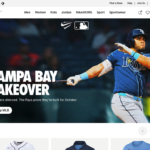
Actual public homepage captured during this audit, October 23, 2026.
What is Adidas.com trying to do — and why audit it second?
This is part 2 of GeoParrot’s sports-brand series, running the same evidence-first method we used on Nike and, before that, on IKEA. Adidas is the obvious next name — Nike’s closest direct competitor, with its own hybrid catalogue-plus-membership model (adiClub), and a flagship lifestyle shoe, the Samba OG, that plays the same cultural role Nike’s Air Force 1 does: a decades-old silhouette currently having a mainstream streetwear moment.
Brand category Global athletic footwear, apparel and equipment retailer; hybrid e-commerce + loyalty model (adiClub).
Primary user job Find a shoe that fits a sport, a silhouette or a style moment, trust the sizing and review signal enough to buy, then get help if it doesn’t work out.
SEO + GEO challenge Carry rich per-review schema and a shared global SKU through to AI answer engines, while a WAF (Akamai) aggressively screens non-browser traffic.
The product we tracked: Adidas Samba OG
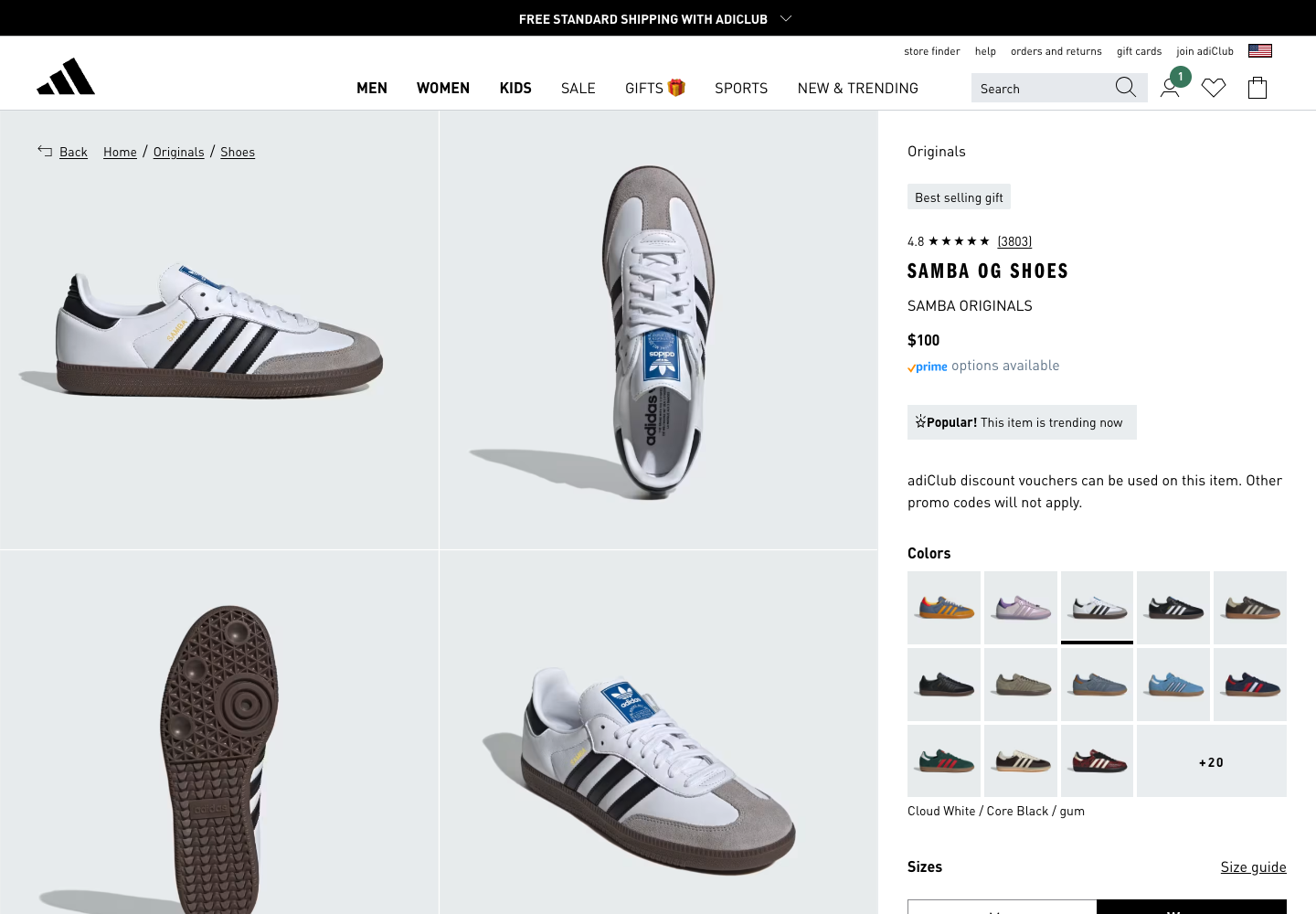
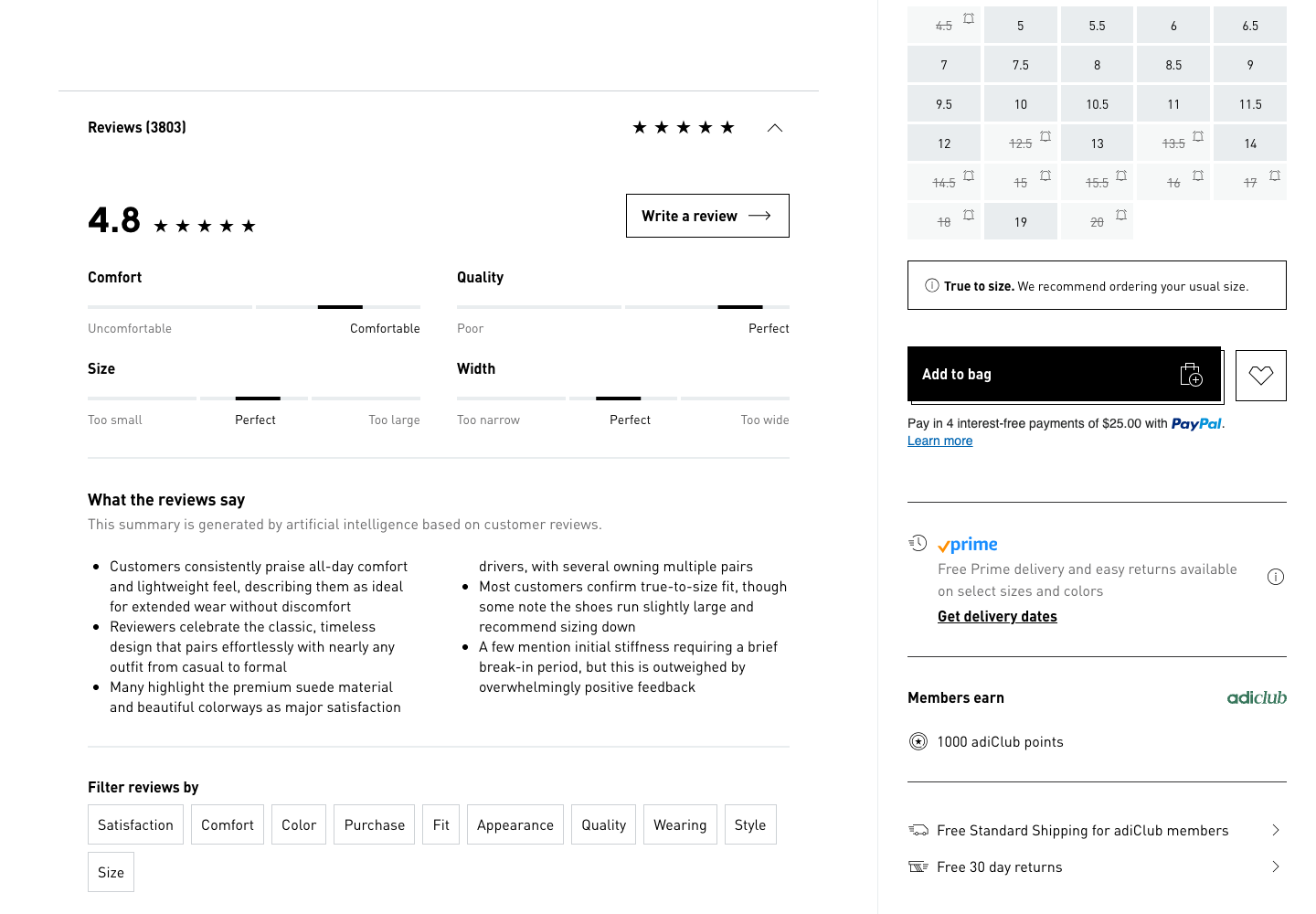
US product page: $100, 4.8 stars across 3,803 reviews, a “Popular! This item is trending now” badge, and 20+ colour swatches (15 shown plus “+20” more).Opening the Reviews panel surfaces “What the reviews say,” explicitly labelled: “This summary is generated by artificial intelligence based on customer reviews.”
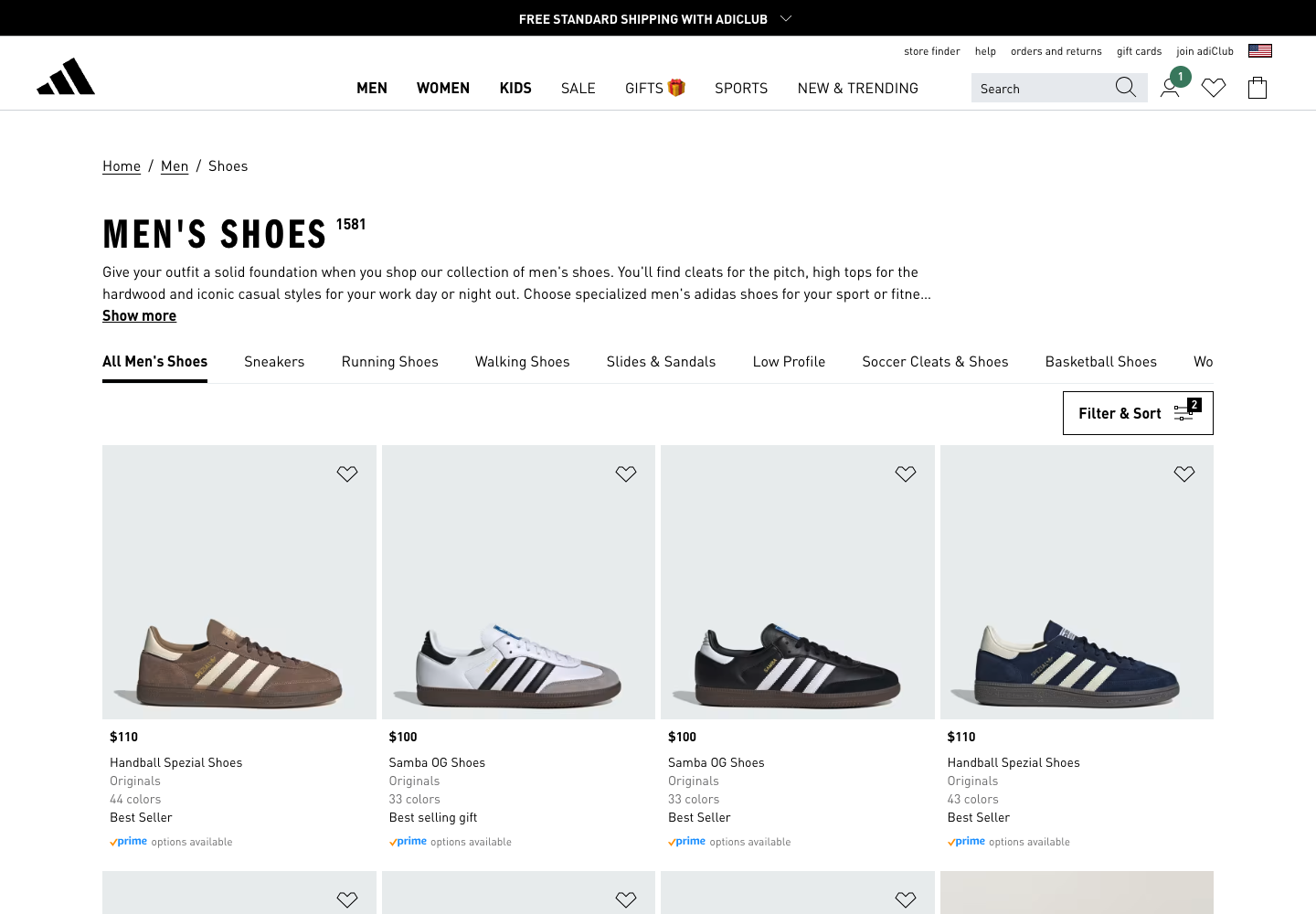
The category layer: “Men’s Shoes (1,581)” with a tabbed sub-filter (Sneakers, Running Shoes, Walking Shoes, Slides & Sandals, Low Profile, Soccer Cleats, Basketball) — a broader single-category count than anything we saw auditing Nike.
AI citation snapshot: 10 real queries, Google AI Mode
We sent the same style of 10 verbatim queries we used on Nike — brand, product and comparison intent — to Google AI Mode (udm=50) and checked whether a cited source was labelled with the Adidas brand name. Method note, reported honestly: one citation chip was initially labelled only in Korean (“아디다스 공식 온라인 스토어” — “Adidas Official Online Store”) and our first pass, which matched on the English string “adidas,” missed it; we caught it on manual review and corrected the count below. Direct a[href] capture again returned almost no raw links this run, consistent with what we found auditing Nike on October 22.
Query
adidas.com cited?
Who else showed up
best adidas running shoes 2026
✅ Yes
RunRepeat, YouTube (RUNpharmacist)
adidas return policy
✅ Yes
(adidas-dominated)
adiclub member rewards benefits
✅ Yes
Antavo (a loyalty-platform blog)
adidas samba history
✅ Yes
Wikipedia, WWD, Platypus Shoes, YouTube
adidas samba og review
❌ No
YouTube (Hes Kicks)
adidas vs nike running shoes
❌ No
Unlabelled chips only — no publisher name extractable
are adidas shoes true to size
❌ No
TikTok, BigShoes, RunRepeat
adidas samba vs gazelle
❌ No
Unlabelled chips only — no publisher name extractable
Result: adidas.com cited in 4/10 queries — slightly behind Nike’s 5/10 on the same query style, despite Adidas’s stronger page-level schema (see G-score section below). The pattern echoes what we found on Nike: direct brand, policy and loyalty-program queries get cited; every head-to-head comparison query (“vs nike,” “vs new balance,” “samba vs gazelle”) and the single named-product review query lost to independent publishers, Reddit or TikTok. We could not get a usable ChatGPT read this run — the web composer selector failed to load, the same failure mode we hit auditing Nike and flagged originally in our Week 17 arc — reported as a measurement failure, not a zero.
G-score audit: the 8-pillar hygiene checklist, six pages
We scored six representative Adidas URLs with the same 8-pillar static-HTML checklist (JSON-LD present, FAQ content, visible date, author byline, concrete data points, table/list structure, 3+ subheadings, a 30–500 character early answer) used in our Week 17 quality-score experiment and on Nike.
Page
G-score
Passes
Fails
US homepage
0.75
JSON-LD, date, data points, lists, subheadings, early answer
FAQ, author
Men’s Shoes category
0.5
Data points, lists, subheadings, early answer
JSON-LD, FAQ, date, author
Samba OG product page (US)
0.75
JSON-LD, date, author, data points, lists, subheadings
FAQ, early answer
Help centre
0.375
Data points, lists, subheadings
JSON-LD, FAQ, date, author, early answer
Korea homepage
0.75
JSON-LD, date, data points, lists, subheadings, early answer
FAQ, author
Samba OG product page (Korea)
0.75
JSON-LD, date, author, data points, lists, subheadings
FAQ, early answer
Average G-score across six pages: 0.646 (Nike’s equivalent audit: 0.4375).
The gap versus Nike comes almost entirely from two pillars: both Adidas product pages pass “date” and “author” because every individual Review object in the page’s JSON-LD carries a datePublished and an author field — something Nike’s Air Force 1 page had none of. FAQ schema is still absent everywhere on both sites, including the Help centre, which — like Nike’s — displays FAQ-style question links in the UI with no FAQPage structured data behind them.
robots.txt — A long, highly specific rule set blocking cart/checkout/account paths plus dozens of faceted-search query parameters (gender, size, colour, sustainability, etc.) and specific product-listing-page URL patterns — more aggressive duplicate-content blocking than we saw on Nike. Three crawlers are named explicitly: AhrefsBot (crawl-delay 10), Pinterestbot (crawl-delay 10), and — notably — ClaudeBot (crawl-delay 6). This is the first brand in our series whose robots.txt names an AI crawler by name; GPTBot, PerplexityBot, CCBot, Google-Extended and OAI-SearchBot are not mentioned at all, so it’s unclear whether that’s a deliberate AI-access policy or an artifact of whichever bot list the team copied from.
llms.txt — Not found, but the failure mode differs by domain in a way worth flagging. www.adidas.com/llms.txt, hit from our Korea-based session, silently redirects to the Korean homepage and returns HTTP 200 rather than a clean 404 — a crawler checking only the status code would wrongly conclude the file exists. www.adidas.co.kr/llms.txt does return a clean 404. See our explainer on what llms.txt actually does before treating any of this as a ranking problem — Google Search does not read it.
Sitemap — Unlike Nike’s single global sitemap index with 62 locale sub-sitemaps inside it, Adidas runs a separate sitemap-index URL per country (robots.txt lists distinct indexes for the US plus Bahrain, Kuwait and Oman). The US index alone lists 29 sub-sitemaps: one product feed, eight paginated category (PLP) feeds, 13 product-image feeds, one product-video feed, two blog feeds, one holiday feed and two store-locator feeds.
Product schema — The Samba OG US page carries a Product JSON-LD block with a full AggregateRating (4.8 stars, 3,803 reviews) and an array of individual Review objects, each with its own author name, star rating, review text and datePublished — schema elements entirely absent from Nike’s equivalent page. The Offer block also includes structured shipping cost/destination and a MerchantReturnPolicy (30-day window, free return by mail). Gap: the Korea page uses a different schema type, ProductGroup instead of Product, with its own separate AggregateRating (4.8 stars, but only 873 reviews) for the identical style code.
FAQ / GenAI disclosure — No FAQPage schema or visible FAQ accordion anywhere we checked. But the Samba OG Reviews panel carries its own explicit AI-content disclosure: a “What the reviews say” bullet-point summary labelled “This summary is generated by artificial intelligence based on customer reviews” — a different surface than, but the same spirit as, the AI-authored FAQ disclosure we found on IKEA’s product page.
Locale behaviour — Adidas reuses the same global style code (B75806) for the Samba OG on both the US and Korea sites — a cleaner pattern than Nike, which issued different style codes per market for the same shoe. Price was $100 (US) vs ₩149,000 (Korea, roughly in line once converted). But catalogue depth differs sharply: the US PDP offers 20+ colourways against just two on the Korean PDP, and the review count for the identical SKU is 3,803 (US) vs 873 (Korea) — a 4.4x gap that could reflect real market-size differences, a sync lag, or region-scoped review pooling; we did not verify which.
Bot access — New to this series: plain HTTP requests (curl, no real browser) to adidas.com are blocked outright by Akamai Bot Manager, returning HTTP 403 with a “high-traffic product releases… extra security” interstitial — even for robots.txt itself. A full browser session (the method we use for every screenshot and schema check in this series) passed through cleanly every time. Nike and IKEA both served plain HTTP requests directly.
What works / What to verify
WHAT WORKS
Rich per-review schema (author, date, rating and text) layered on top of a page-level AggregateRating, a structured MerchantReturnPolicy block, and a single global SKU code that keeps the same style trackable across at least two markets — all gaps we flagged on Nike’s audit that Adidas has closed.
WHAT TO VERIFY
This audit sampled one shoe family (Samba OG) and six URLs, against a Men’s Shoes category Adidas’s own site lists at 1,581 items. Whether the ProductGroup-vs-Product schema split and the 4.4x review-count gap hold across other shared-SKU products, and whether richer schema here ever converts into a higher AI-citation rate on a larger query sample, are open questions for a future pass.
Target query check — reported honestly, not inflated
We have not re-measured “adidas seo” or “adidas geo audit” query volume this session. Per the pattern already confirmed across six earlier subjects in this series on October 20, 2026 (Keyword Planner, US) — five of six showed no measurable search volume at all, and the sixth (IKEA) showed only roughly 10 monthly searches — we’re not claiming this title phrase drives ranking-based traffic. The distribution case for this series rests on internal links, our own index, and readers already following the GEO Lab arc, not on search demand for “[brand] SEO audit” as a query.
Frequently asked questions
Does Adidas’s richer review schema mean it’s better positioned for AI answers than Nike?
On paper, yes — AggregateRating, individually dated and authored Review objects, and a structured return policy are all present on Adidas’s Samba OG page and absent from Nike’s Air Force 1 page. But Adidas was actually cited in slightly fewer of our 10 test queries (4 vs Nike’s 5), so richer schema did not translate into a higher citation rate in this snapshot.
Why does Adidas name ClaudeBot specifically in robots.txt but not other AI crawlers?
We can’t know Adidas’s intent from the outside — robots.txt doesn’t explain itself. What we can say is that it’s an asymmetry: a 6-second crawl-delay is applied to one named AI crawler while GPTBot, PerplexityBot and Google-Extended aren’t mentioned at all, so they fall under the same general User-agent: * rule as every other bot.
Does a G-score of 0.65 mean Adidas is more likely to be cited by AI engines than a lower-scoring site?
Not reliably — and this audit is itself a small data point against that idea. Our Week 17 experiment found hygiene/structure score was not a dependable predictor of AI citation (cited pages in that test actually scored lower on average than non-cited ones). Here, Adidas scored meaningfully higher than Nike on our 8-pillar checklist (0.65 vs 0.44) but was cited in fewer of the same 10 test queries — directionally consistent with “G-score is not the lever,” not proof of it on its own.
Is the llms.txt redirect-instead-of-404 behavior something Adidas should fix first?
Probably not the priority — Google Search and Google AI Mode don’t read llms.txt either way; see our full breakdown of what llms.txt actually does. The more concrete, verifiable item from this audit is the ProductGroup/Product schema-type split between the US and Korea product pages for the same SKU, which is worth resolving before worrying about a text file Google doesn’t consume.
Audit evidence, scope and limits
Inspected: October 23, 2026, public logged-out access from a Korea-based IP (plain HTTP blocked by Akamai; a real browser session was used throughout). Screens: US homepage, Men’s Shoes category, Samba OG product page (top and Reviews panel), US Help centre, Korea homepage, and the matching Korea Samba OG product page — plus robots.txt, sitemap-index and llms.txt checks, a 10-query Google AI Mode citation snapshot, and an 8-pillar G-score scored on six fetched pages.
Not measured: rankings, Search Console performance, analytics, conversion, signed-in/member flows, ChatGPT citations (attempted, composer failed to load), or the complete product/locale catalogue beyond the one shoe family and six URLs sampled here. This is a public-signal snapshot, not a performance claim or a full-catalogue crawl.
This is part 2 of a daily series. Every day, GeoParrot runs this same evidence-first method — real screenshots, a 10-query AI citation snapshot, an 8-pillar G-score audit, and an honest target-query check — against one more major sports and athletic-wear brand. Tomorrow: the next name on the list.

Leave a Reply