
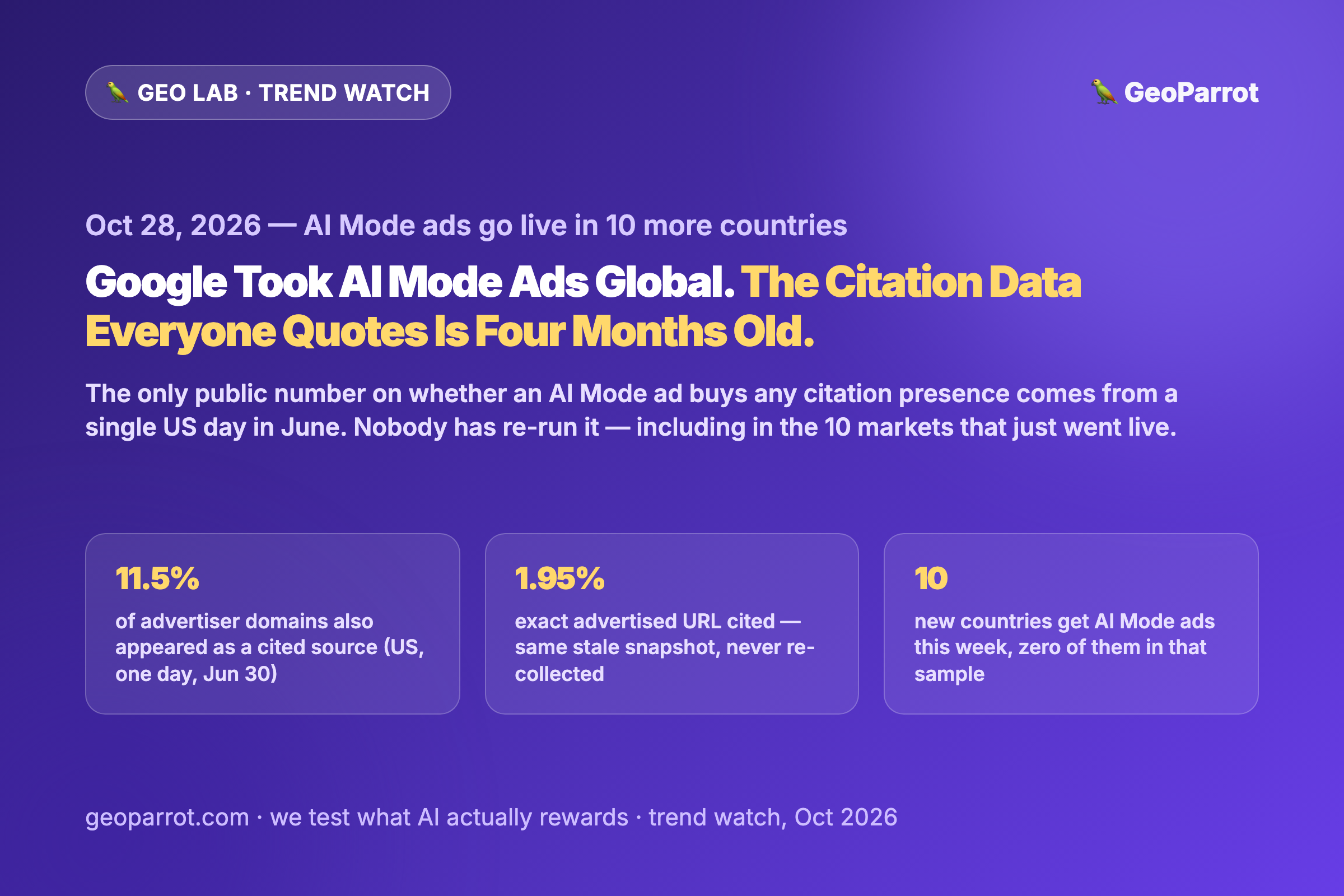
Quick answer: On October 28, 2026, Google took paid text ads inside AI Mode to 10 more countries — Australia, Canada, India, Kenya, Malaysia, New Zealand, Nigeria, Pakistan (text ads only), the Philippines, and Singapore — and added multiturn ads inside US follow-up questions, with the UK, Brazil, and Mexico due later this quarter. The one number almost every SEO blog quotes when asked whether paying for one of those ads buys any presence in AI Mode’s actual cited sources — 11.5% domain-level overlap, 1.95% exact-URL overlap — comes from a single day’s snapshot of US commercial keywords SE Ranking collected on June 30, 2026. Nothing we found has re-run it since, through a citation-count cut we covered Monday that shrank AI Mode’s average sources per answer by 74%, or through this week’s move into 10 brand-new markets. The structural story — ad auction and citation are different systems — probably still holds. Treating a four-month-old, one-market number as live evidence of that, in markets it never touched, is a separate claim nobody has tested.
Trend watch — published October 30, 2026, in the GEO Lab. We spend most days testing our own citation experiments; this is a day we instead checked whether a stat the industry keeps repeating is still describing the product it was measured on.
What did Google actually change in AI Mode ads this week?
Google’s ads team announced on October 28, 2026 that paid text ads inside AI Mode — previously live mainly in the US — are rolling out to 10 more countries: Australia, Canada, India, Kenya, Malaysia, New Zealand, Nigeria, Pakistan (text ads only), the Philippines, and Singapore, with the UK, Brazil, and Mexico scheduled later this quarter. Alongside the expansion, Google launched multiturn ads in the US: sponsored content can now appear inside the answers to follow-up questions within an AI Mode conversation, not just the first response. Existing advertiser campaigns and budgets carry over automatically — no separate sign-up or fee is required. Google frames the move partly around engagement: it says AI Mode queries run roughly three times longer than a typical search, which is also three times more conversational turns an ad can now attach to.
What’s the actual evidence that paying for an ad buys any citation presence?
One analysis, and it’s older than most coverage of it implies. SE Ranking pulled 50,032 commercial keywords across 20 niches, pre-selected to be likely to trigger a text ad, and checked AI Mode’s response to each. The snapshot was collected on a single day — June 30, 2026 — in the US market; SE Ranking published the writeup on July 14. A text ad showed up on 29.45% of keywords. Among those, the advertiser’s own domain also appeared among AI Mode’s cited sources only 11.5% of the time, and the exact advertised URL just 1.95% of the time. Ad frequency tracked CPC tier closely — 24% of sub-$2 keywords returned an ad versus 53.56% of $10-plus keywords — and separately, only around 2% of advertiser URLs ranked organically for the same keyword at all. Search Engine Journal covered the same numbers on July 21. Since then, a long tail of SEO blogs — several with no visible publish date, some labeled “2026” guides — have kept republishing the 11.5%/1.95% figures as a current description of AI Mode. We found no second collection round, from SE Ranking or anyone else.
Why does a four-month-old, one-market snapshot matter for this week’s expansion?
Because a lot has changed in AI Mode since June 30 that nobody has re-tested this stat against. We covered one such change Monday: a separate tracker found AI Mode’s average sources per answer fell 74% between summer and mid-October, overlapping a Gemini model swap we’d already flagged as invisible to every tracker we could find. A one-day ad-citation overlap measurement from before that cut isn’t automatically still accurate after it — it simply hasn’t been checked. This week adds a more direct gap: the 10 countries getting AI Mode ads for the first time on October 28 were never part of SE Ranking’s US-only sample. There is, as far as we can find, zero published data on whether advertiser domains in India, Nigeria, or the Philippines show up among AI Mode’s cited sources at any rate — 11.5%, 0%, or higher. What we can say, from our own citation work rather than from this stale ad study, is that the mechanism gap is plausible: ad auctions run on bid and a landing-page Quality Score, while our own hygiene-score verdict found citation tracked organic rank, not page-cleanliness — cited pages there actually scored lower on a hygiene metric than pages that weren’t cited. A separate tracker found pages ranked top 3 kept their AI Mode citation 46.2% of the time versus 8.3% outside the top 20. None of that is about ads, but it’s evidence the citation pipeline runs on its own signals, separate from an ad auction — which makes “ads probably don’t buy citations” a reasonable inference, not a tested fact in 10 new markets. It’s also a fifth door next to the three we mapped Wednesday (citation, agent action, app integration) — and what’s unverified isn’t whether it opens the citation door, but how wide the gap is in markets that, until this week, had no ad data at all.
What should an advertiser actually do before spending in the 10 new markets?
- Check the collection date before you cite the 11.5%/1.95% figures in a deck or brief. They describe US keywords on one day in June 2026 — useful as the only public evidence that exists, not as a current measurement, and not as evidence about any of the 10 new markets.
- If you’re advertising into AI Mode in any of the 10 new countries, track ad presence and citation presence as two separate metrics from day one. Don’t assume paid spend quietly lifts brand-mention frequency in AI answers over time — measure it directly with your own citation tracker, the same way you’d check presence versus traffic for an organic citation.
- Keep hygiene and schema cleanup work in its own budget line, separate from ad spend. Our quality-score verdict found cited pages scored lower on a hygiene metric than non-cited pages next to them — “clean up the landing page” is not a documented lever for citation, whatever it does for Ads Quality Score.
- If citation is the actual goal, organic rank is the lever with real (if correlational) support. Pages ranked top 3 kept their AI Mode citation more than five times as often as pages outside the top 20 in the tracker we covered this week — a far stronger signal than anything published about ad spend.
Frequently asked questions
What did Google change about AI Mode ads on October 28, 2026?
Google expanded paid text ads inside AI Mode to 10 more countries — Australia, Canada, India, Kenya, Malaysia, New Zealand, Nigeria, Pakistan (text ads only), the Philippines, and Singapore — and launched multiturn ads in the US, letting sponsored content appear in follow-up-question answers within an AI Mode conversation. The UK, Brazil, and Mexico are scheduled for later this quarter.
Does paying for an AI Mode ad help get my site cited in the answer?
The only public data on this — a single-day, US-only SE Ranking snapshot from June 30, 2026 — found advertiser domains appeared among AI Mode’s cited sources just 11.5% of the time, and the exact advertised URL only 1.95% of the time. That points toward “no,” but it’s a four-month-old test of one market, not a current or global measurement.
Is the 11.5%/1.95% citation-overlap stat still current?
It’s the only version of this stat we could find, but it was collected on one day (June 30, 2026) before a since-measured 74% cut in AI Mode’s average sources per answer, and before this week’s expansion into 10 markets it never covered. Many blogs still cite it as if it describes AI Mode today; we found no second collection round.
If not ads or page hygiene, what actually predicts an AI Mode citation?
The strongest correlate we’ve seen published is organic Google rank: pages holding a top-3 position kept their AI Mode citation 46.2% of the time versus 8.3% for pages ranked outside the top 20. A separate test we ran found page hygiene scores were not a positive predictor — cited pages scored lower on that metric than comparable non-cited pages.


Leave a Reply