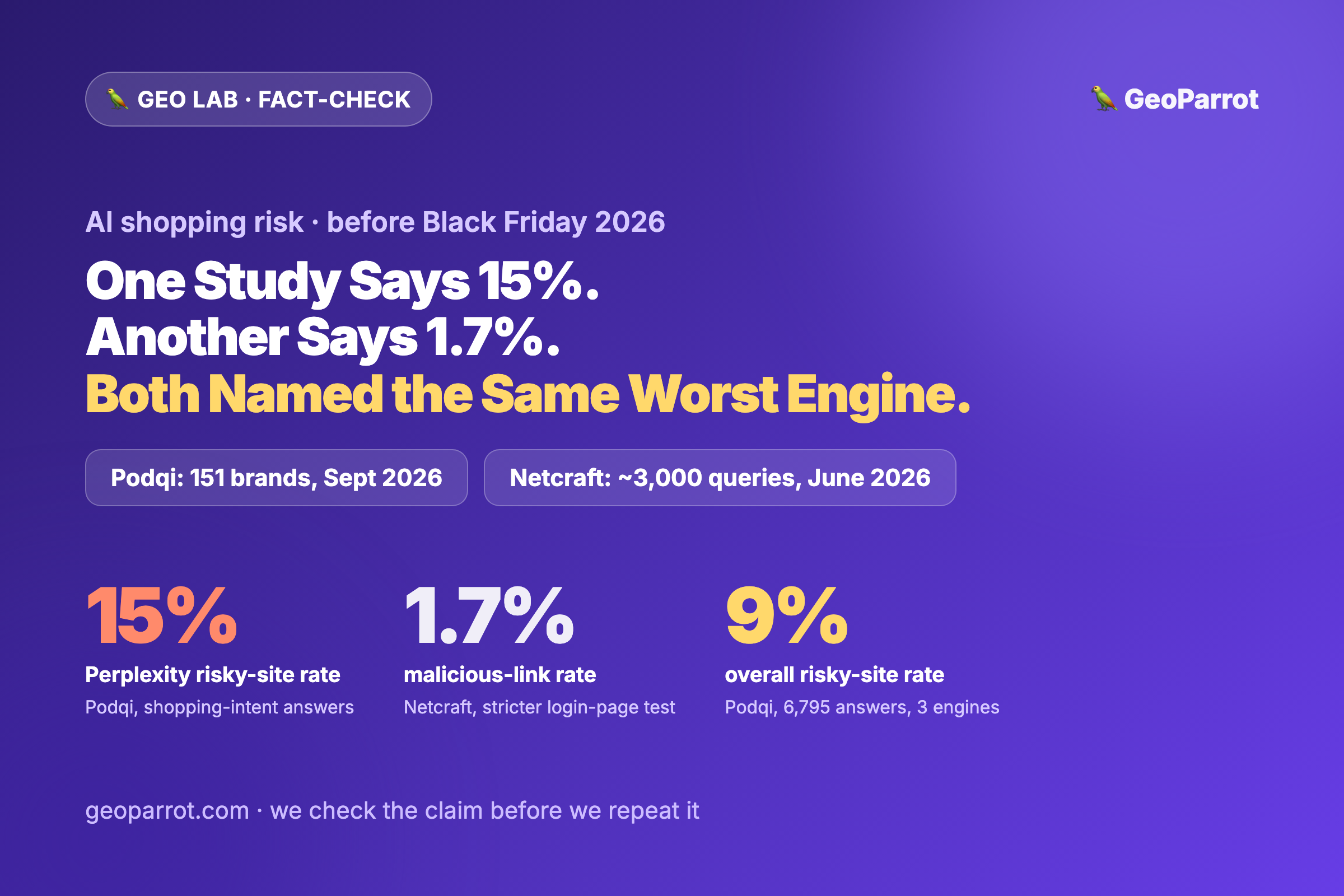
Quick answer: Brand-protection firm Podqi published a study on November 13, 2026 claiming that 9% of 6,795 AI shopping answers, across 151 brands and three engines, pointed to a risky site: an impersonator, a suspected counterfeit seller, or a dead domain. Perplexity was worst at 15%, ChatGPT was 8%, Gemini was 4%. A separate test from security firm Netcraft, run in June 2026 with a different method (brand login pages, not shopping questions, tested across ChatGPT, Copilot, Gemini, and Perplexity), found malicious links in only 1.7% of responses, yet it also flagged Perplexity as the worst performer. Neither headline number is independently verifiable from the outside: Podqi hasn’t published its brand list, its exact prompts, or its classification criteria, and it sells the exact brand-monitoring service its own finding would justify buying. The part that does hold up across both tests, run six months apart by two unrelated companies with different methods, is the direction: Perplexity keeps coming out worst when someone checks whether AI shopping answers are safe.
Trend watch, published November 20, 2026. Podqi’s study is summarized at Futurism and MartinCid; the methodology gap is laid out at ExplainX; Netcraft’s own research is at netcraft.com. We didn’t run this test ourselves. We’re writing about it because we just spent four weeks measuring exactly this kind of instability in our own AI Overview citation experiments, and a single vendor’s one-month snapshot is precisely the shape of claim our GEO Lab format exists to slow down before repeating.
What did each study actually test?
Podqi’s test asked three questions per brand across 151 brands (a mix named in coverage includes Lululemon, Birkenstock, Le Creuset, and streetwear labels like Stüssy and Madhappy): where to buy the brand, whether it ships internationally, and what its regional websites are. That produced 6,795 answers across two waves run in September 2026, timed, Podqi says, to land ahead of Black Friday (November 27) and Cyber Monday (November 30). A site counted as “risky” if it impersonated a real retailer, looked like a suspected counterfeit seller, or was a dead or re-registered domain being passed off as live. Netcraft’s test, run independently in June 2026, asked a different kind of question (locating brand login pages, a classic phishing target) across roughly 3,000 queries on ChatGPT, Copilot, Gemini, and Perplexity, and counted a response as bad only if it contained a link to attacker-controlled infrastructure. A July 2025 Netcraft test, smaller still (50 brand login pages on GPT-4.1 alone), found 34% of returned pages weren’t controlled by the brand and nearly 30% were unregistered, parked, or inactive, a third data point with yet another method and yet another number.
Partially. Netcraft is a security vendor publishing its own research, not a brand-protection sales pitch tied to the same finding.
Netcraft, July 2025
Brand login pages, 50 pages, GPT-4.1 only
34% not brand-controlled; ~30% dead/parked
Smallest sample of the three; directionally consistent with the other two, not independently reproduced here either.
Why don’t the two 2026 numbers agree?
Partly because they’re not measuring the same failure. Podqi’s 9% is a shopping-intent number: it counts an answer as risky even if the chatbot just mentioned a sketchy site in passing, without necessarily sending the user there as the top recommendation. Netcraft’s 1.7% is a stricter security number: a link has to actually point at infrastructure Netcraft could confirm was attacker-controlled. A chatbot naming a counterfeit seller as one of several options is a real problem, but it’s a different (and looser) bar than linking directly to a phishing page. Treating 9% and 1.7% as competing answers to the same question is the mistake; they’re answers to two different questions that happen to share three engine names.
There’s a second reason to hold Podqi’s exact number loosely, and it comes from Podqi’s own data, not from us second-guessing it: coverage of the study notes the risky-site rate moved from roughly 12% in the first September wave to roughly 7% in the second, inside the same one-month test window. A number that swings by nearly half from one week to the next, before any outside party even sees the raw data, is a volatility signal, not a stable baseline. We’d flag this even if a vendor with zero commercial stake had published it, because we just finished four weeks measuring our own version of the same instability: re-running the identical 8 local queries against Google’s AI Overviews twice in one sitting, we watched citation overlap collapse from 0.68 to 0.17 in two days. If a result that unstable can come out of our own controlled, repeated test, a single vendor’s two-wave, one-month snapshot of someone else’s shopping questions deserves the same skepticism we apply to our own numbers.
What we can and can’t verify from outside Podqi’s dataset
Can’t verify: the exact 9%, or that Perplexity is precisely 15% and not, say, 11% or 19%. The 151-brand list isn’t published, the exact prompt wording per wave isn’t published, and the rule for calling a site a “suspected counterfeit” versus a legitimate reseller isn’t published. None of that is unusual for vendor research, but it means the specific figure is a claim, not a reproducible measurement, in the same way we flagged a vendor’s unexplained “71% miss Google’s first page” citation stat earlier this month.
Can’t ignore: Podqi sells brand-monitoring services. Podqi CEO Trevor West is quoted telling outlets that consumers should “verify the source before entering personal information or credit card information,” which is sound advice, and also exactly the pitch for a product that watches AI answers on a brand’s behalf. A finding that AI shopping answers are risky is good marketing for that product. That doesn’t make the finding false. It does mean it needs a second, independent source before the exact number gets repeated as fact, which is why the Netcraft comparison matters here at all.
Can verify: Perplexity underperforms ChatGPT and Gemini on this specific risk, across two unrelated tests six months apart. That’s the one claim that survives both the methodology gap and the vendor-incentive problem, because it shows up in a security vendor’s stricter, differently-motivated test as well as in Podqi’s looser one. Two different companies, two different definitions of “bad,” one consistent ranking.
What this means for brands before Black Friday
This connects to a pattern we’ve now tracked across three AI-commerce stories this quarter: Google and Shopify’s Universal Commerce Protocol, OpenAI’s ChatGPT Wallet reversal of Instant Checkout, and now this. In all three, the unresolved question is the same: when an AI engine stands between a shopper and a purchase, who fills the gap if the real brand doesn’t show up clearly? A counterfeit seller or a dead domain doesn’t need to win a Google ranking battle against the real brand anymore. It just needs an AI engine’s shopping answer to mention it in the same breath. That’s a new, different kind of exposure than classic SEO brand-impersonation, and it’s not solved by anything in a typical GEO checklist about schema or citations.
A checklist, without the overclaim
Run your own brand’s shopping questions across engines once a month, not once. Podqi’s own 12%-to-7% swing in a single month is the argument for repeated spot-checks over a single audit. Ask “where can I buy [your brand]” and “does [your brand] ship internationally” on ChatGPT, Gemini, and Perplexity, and note exactly what domains come back.
Weight Perplexity checks higher, not because 15% is a verified number, but because two unrelated tests independently ranked it worst. That’s the one piece of this story with real cross-source support.
Don’t treat a single vendor percentage as your risk baseline. Whatever number you see cited (9%, 15%, 1.7%, 34%) depends entirely on what was tested and how “risky” was defined. Use the direction (AI shopping answers sometimes surface non-legitimate sites) as the actionable fact, not the specific percentage.
If you find an impersonator or counterfeit domain in an AI answer, report it through the engine’s own feedback mechanism. Unlike a search-ranking problem, there’s no SEO fix for “an AI engine mentioned a scam site,” and reporting is currently the only lever that exists.
The honest caveats
We have not run this test ourselves, on our own brands or anyone else’s, and everything in this piece is a read of two vendors’ published claims, not a primary measurement from our own GEO Lab. Podqi’s and Netcraft’s studies tested different questions on different timelines with different definitions of risk, so the comparison here is about pattern agreement (Perplexity worst, both times), not about reconciling the 9% and 1.7% into one number; they were never the same number to begin with. The connection we draw to our own citation-volatility experiment is an analogy about measurement instability in AI answers generally, not a claim that our local-citation results and Podqi’s shopping-risk results are measuring the same underlying thing.
Frequently asked questions
Did a study really find AI chatbots recommend scam websites?
Brand-protection firm Podqi published a study on November 13, 2026 claiming 9% of 6,795 AI shopping answers across 151 brands pointed to a risky site (an impersonator, suspected counterfeit seller, or dead domain), with Perplexity worst at 15%. The exact brand list, prompts, and classification rules behind that number haven’t been published, so the specific percentage can’t be independently verified.
Why do Podqi’s and Netcraft’s numbers disagree so much?
They tested different things. Podqi counted any mention of a risky site in a shopping-intent answer (9% overall). Netcraft, in a separate June 2026 test, counted only responses containing a confirmed malicious link to brand login pages, a stricter bar, and found 1.7%. Different questions, different definitions of “bad,” different numbers.
Which AI engine is worst for shopping scam risk?
Perplexity, in both studies. Podqi put it at 15% versus 8% for ChatGPT and 4% for Gemini; Netcraft’s separate, stricter test also flagged Perplexity as the worst performer. That agreement across two unrelated tests with different methods is the most verifiable finding in either study.
Should brands trust Podqi’s 9% number?
Treat it as a directional signal, not a verified baseline. Podqi sells brand-monitoring services, which is a direct commercial incentive to publish a finding that supports buying that service, and the study’s own two-wave data reportedly swung from about 12% to about 7% within a single month, before any outside party reviewed it. The underlying pattern (AI shopping answers occasionally surface non-legitimate sites) is corroborated elsewhere; the specific 9% figure is not independently reproducible from published information.
What should a brand actually do about this before Black Friday?
Run your own brand’s “where to buy” and shipping questions across ChatGPT, Gemini, and Perplexity monthly rather than once, pay closer attention to Perplexity given the cross-study agreement, and report any impersonator or counterfeit domain you find through the engine’s own feedback channel, since there is currently no SEO-style fix for an AI engine mentioning a scam site.




Leave a Reply