Evidence-first case study · sports brand SEO + GEO series, part 18 of 20
Decathlon is the first subject in this series that isn’t a single-brand manufacturer — it’s a multi-brand retailer with roughly 20 in-house labels (Quechua, Kipsta, Domyos, Kalenji, Van Rysel and more) — and its US flagship is also the first in seventeen audits to load with zero bot-check of any kind. decathlon.com runs on Shopify with the same UCP/MCP “agent commerce” boilerplate we’ve now seen on several brands in this series, while decathlon.co.kr runs on an entirely different, Decathlon-built regional platform shared with Southeast Asian markets like Singapore. We tracked the same product line — the Quechua 2 Second pop-up tent — on both: the US listing was sold out with no customer rating in its structured data, the Korean listing was in stock with a complete Product+AggregateRating schema. Google AI Mode cited a Decathlon domain in 7 of our 10 test queries.
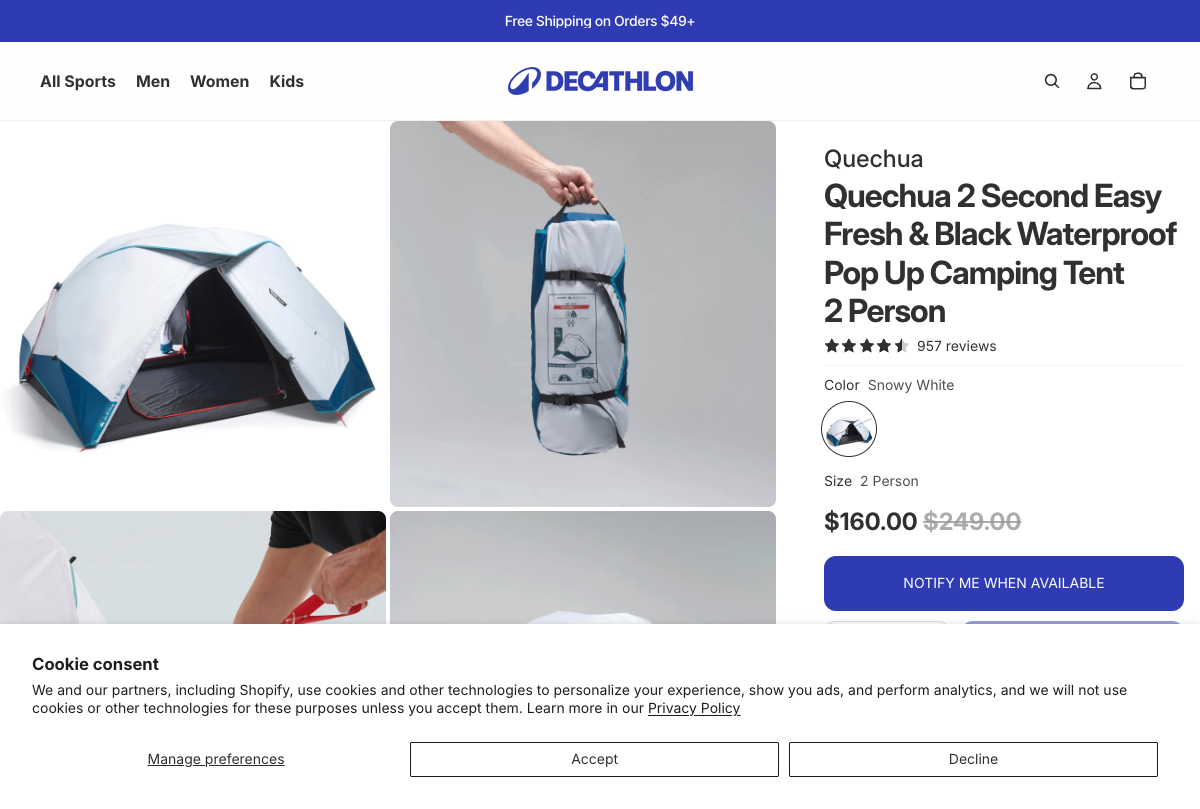
decathlon.com’s homepage: the only overlay we hit in this entire audit was a standard cookie-consent banner. No captcha, no geofence wall we couldn’t dismiss, no hard block — a first for the US flagship of any brand we’ve covered in this series.
What is Decathlon trying to do — and why audit it eighteenth?
This is part 18 of GeoParrot’s sports-brand series, running the same evidence-first method we used on Salomon, FILA and sixteen other major names. Decathlon was founded in 1976 near Lille, France, by Michel Leclercq, and it is structurally unlike every brand we’ve covered so far: it’s a single retail company that designs, manufactures and sells its own in-house sporting-goods brands exclusively through its own stores and site — no third-party labels on the shelf. It remains privately held by the Mulliez family’s holding group (the same family group behind Auchan and Leroy Merlin), not publicly traded. We picked it eighteenth specifically because it breaks the pattern of this series: every brand we’ve audited so far makes products under one name; Decathlon is a retailer selling roughly 20 of its own house brands, and — per a 2022 trade-press report that our own AI citation test below surfaced independently — it closed its two physical US stores that year to run the US market online-only, which may help explain why the exact tent variant we tracked showed as sold out rather than simply low-stock.
Brand category French multi-brand sporting-goods retailer (founded 1976), privately held by the Mulliez family group, not a single-label manufacturer like every other brand in this series.
Primary user job Find a specific piece of Decathlon house-brand gear (the Quechua 2 Second tent, in our case), check whether it’s actually available to buy in the US online-only model versus Korea’s full storefront, and compare price and reviews.
SEO + GEO challenge Two completely different e-commerce platforms by region (Shopify in the US, a Decathlon-built APAC regional app in Korea) serving two different catalogs of the same house brands — with the US product’s reviews invisible to structured data and the Korean product’s fully exposed.
The product we tracked: the Quechua 2 Second tent, two platforms, two outcomes
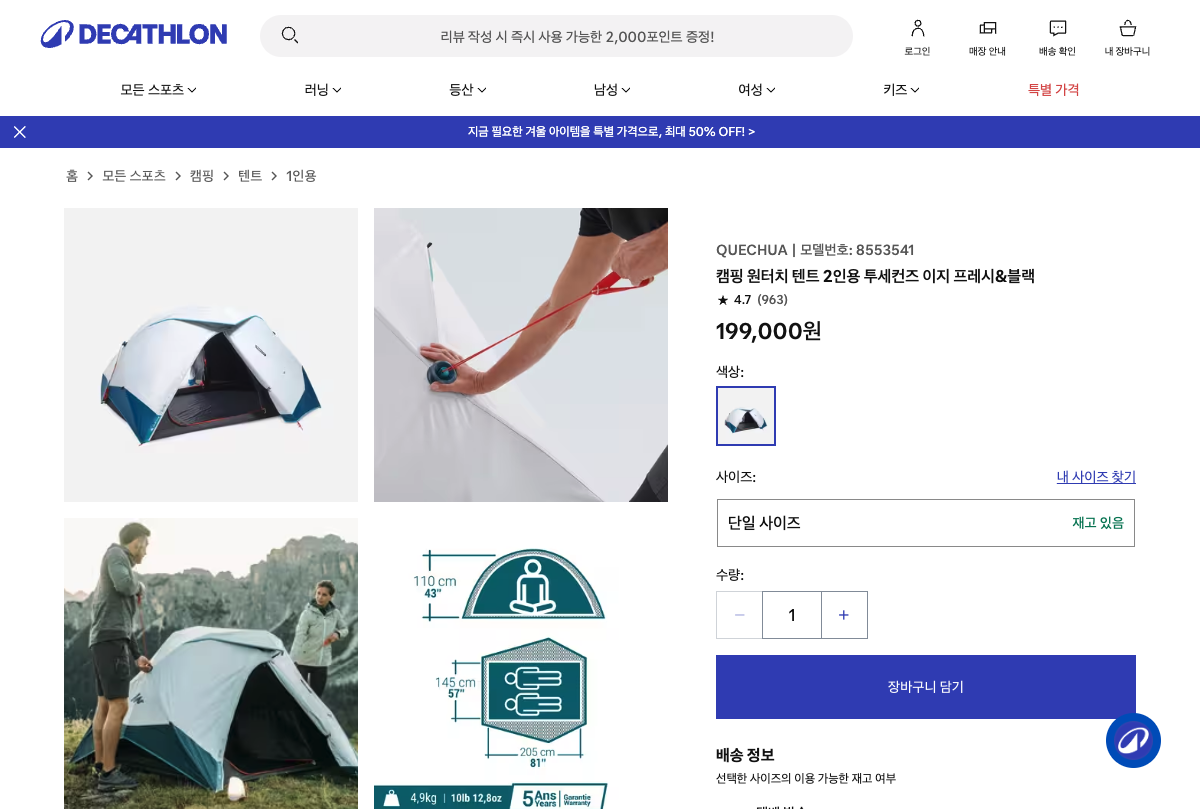
We tracked the same product line — Quechua’s “2 Second” one-touch pop-up tent in the Fresh & Black Easy 2-person configuration — on both sites, the same cross-locale method we’ve used throughout this series. The catalogs don’t share SKUs across regions (US product ID 8957947 / GTIN 3608393232502 versus Korean model number 8553541), confirming these are two independently run regional catalogs rather than one global product feed with two storefronts in front of it.
US: $160 (down from $249), “957 reviews” shown on screen, but the tracked variant was out of stock (“Notify Me When Available”) at capture time.Korea: ₩199,000 (roughly $140), 4.7/5 from 963 reviews on screen, in stock with an active cart button — and unlike the US page, this rating makes it all the way into the page’s structured data (see below).
The two review counts — 957 on the US page and 963 on the Korean page — are close enough to notice, though we can’t confirm from the outside whether that’s coincidence, a shared global review pool, or two independently popular product lines. We’re flagging the observation, not claiming the mechanism.
AI citation snapshot: 10 real queries, Google AI Mode
We sent 10 verbatim queries to Google AI Mode (udm=50) and checked direct a[href] links, counting a citation only when either decathlon.com or decathlon.co.kr appeared.
Query
Decathlon domain cited?
Who else showed up
is decathlon a good brand
❌ No
reddit.com, gearjunkie.com, quora.com, trustpilot.com, goodonyou.eco, wikipedia.org — independent review and forum sites, no Decathlon-owned domain
No other domains — only decathlon.co.kr’s own return-and-exchange page was cited, not the US equivalent, likely a reflection of our Korea-based test session
who owns decathlon
✅ Yes
wikipedia.org, baidu.com — Decathlon’s own sustainability.decathlon.com page on its founders was cited directly alongside Wikipedia
best decathlon tents
✅ Yes
reddit.com, decathlon.co.uk, livefortheoutdoors.com, bunnings.com.au — four separate decathlon.com product pages cited directly, more than any other query in this test
quechua 2 second tent review
❌ No
thegirloutdoors.co.uk, tothotornot.com, self.com, reddit.com — the one query most directly about the exact product we tracked, and every citation was a third-party review, not Decathlon’s own page
is decathlon available in the us
✅ Yes
walmart.com, bicycleretailer.com — this is where we found the 2022 trade-press report on Decathlon closing its two US stores, cited alongside decathlon.com’s own store-locator and shipping-info pages
decathlon sizing guide
✅ Yes
decathlon.co.uk, tryoutgrow.com, reddit.com, a Decathlon Ireland Zendesk help article — decathlon.com’s own size-guides page cited directly
is decathlon available in korea
✅ Yes
orderinkorea.com, instagram.com, facebook.com — decathlon.co.kr’s homepage, category pages and store-locator all cited directly
decathlon hiking gear review
❌ No
halfwayanywhere.com, reddit.com, caminodesantiago.me — independent long-trail gear blogs and forums, no Decathlon domain
Result: a Decathlon domain cited in 7/10 queries (Nike 5/10, Adidas 4/10, Puma 5/10, Under Armour 8/10, New Balance 6/10, ASICS 7/10, Skechers 4/10, Lululemon 8/10, Reebok 7/10, Converse 7/10, On Running 6/10, Hoka 5/10, Vans 8/10, The North Face 9/10, Columbia 7/10, FILA 2/10, Salomon 4/10) — tied with ASICS, Reebok, Converse and Columbia for the upper-middle of the series. The two misses that stand out: a brand-reputation query (“is decathlon a good brand”) and, notably, the one query about the exact product we spent this audit tracking (“quechua 2 second tent review”) — both went entirely to third-party sites, the same pattern of “own page wins on literal/navigational queries, loses on opinion and review queries” we’ve seen across most of this series.
G-score audit: the 8-pillar hygiene checklist
We scored seven measurable URLs with the same 8-pillar static-HTML checklist (JSON-LD present, FAQ content, visible date, author byline, concrete data points, table/list structure, 3+ subheadings, a 30-500 character early answer) used in our Week 17 quality-score experiment and on all seventeen prior brands. This is the first audit in the series where every single target page — US and Korean alike — rendered without any bot-check, so for the first time we have a full seven-page set instead of one region excluded as unmeasurable.
Page
Fetch method
G-score
Notable pillars
US homepage
Browser-rendered (200 OK)
0.75
Organization JSON-LD, visible date signal, data points, list structure, 3+ subheadings; no FAQ content, no author byline on the homepage template
US hiking/camp-accessories category
Browser-rendered (200 OK)
0.75
Same pattern as the homepage — JSON-LD, data points, list/subheadings; no FAQ, no author
US Quechua 2 Second tent PDP
Browser-rendered (200 OK)
0.875
Organization + ProductGroup/Offer JSON-LD, author signal present — but the ProductGroup schema carries no aggregateRating or review field anywhere, despite “957 reviews” shown on screen
US FAQ/help page
Browser-rendered (200 OK)
0.875
A genuine, valid FAQPage JSON-LD block with real answer text (shipping-time specifics from the Oakland, CA warehouse) — not just a visual accordion with no matching schema, a gap we’ve flagged on several other brands in this series
KR homepage
Browser-rendered (200 OK)
0.375
JSON-LD and data points present, but far less extractable plain text than any US page — the Korean storefront leans on icon-and-number UI tiles rather than prose paragraphs
KR Quechua 2 Second tent PDP (model 8553541)
Browser-rendered (200 OK)
0.375
A complete, valid Product JSON-LD block that — unlike the US PDP — includes a full aggregateRating (4.69, 963 reviews); scores lower overall only because the page is short on prose-style data points and subheading structure
KR tent search-results page
Browser-rendered (200 OK)
0.125
No JSON-LD at all on the search-results template; robots.txt also disallows /search entirely, so this page was never meant to be indexed in the first place
Seven-page average: 0.5893 (Nike: 0.4375, Puma: 0.354, Under Armour: 0.5208, New Balance: 0.5833, Adidas: 0.6458, ASICS: 0.4583, Reebok: 0.5417, Converse: 0.5208, On Running: 0.4583, Hoka: 0.6, Vans: 0.425, The North Face: 0.525, Columbia: 0.525, FILA: 0.525, Salomon: 0.5417) — third-highest in the series, behind Adidas and Hoka. That headline number hides a sharp internal split, though: averaged on their own, the four US pages come to 0.8125 and the three Korean pages come to 0.2917 — the widest regional gap we’ve measured in this series, and a reminder that these per-brand averages aren’t drawn from identically sized page sets across audits, so cross-brand ranking should be read as a rough signal, not a precise league table.
A retailer instead of a brand, a US flagship with no wall at all, and a rating that only survives one of its two product pages
decathlon.com is the first US flagship in this entire series to load with zero bot-check — No captcha overlay, no PerimeterX or Akamai challenge, no hard block on any of the four US pages we visited. The only prompt we encountered anywhere in this audit was a standard cookie-consent banner and a geolocation nudge (“Looks like you’re outside the U.S.” — a “Stay on U.S. Site” button dismissed it instantly). After sixteen straight audits that involved some form of bot wall on at least one region, this is the cleanest access we’ve had to any brand’s primary storefront.
Decathlon runs two genuinely different e-commerce platforms by region, not one global catalog behind two storefronts — decathlon.com is built on Shopify, carrying the same UCP (Universal Commerce Protocol) and MCP agent-shopping boilerplate we’ve now seen on FILA, Salomon and Reebok’s Korean sites. decathlon.co.kr runs on a Decathlon-built regional platform that shares infrastructure with decathlon.sg (the same search and category API hostnames appear in both markets’ page source), a completely different stack with its own product IDs — the US tent’s ID (8957947) and the Korean tent’s model number (8553541) share no identifier at all.
The on-screen review count survives into structured data on only one of the two product pages — The Korean PDP’s Product JSON-LD carries a complete aggregateRating block (4.69 from 963 reviews) that matches what’s shown on screen almost exactly. The US PDP, for the same product line, displays “957 reviews” on screen but its ProductGroup/Offer JSON-LD has no rating or review field anywhere — a crawler reading only the US page’s structured data would have no way to know this product has reviews at all, the same gap we found on Salomon’s Korean PDP in reverse.
decathlon.com’s FAQ page has real, working FAQPage schema — not just a visual accordion — We’ve flagged several brands in this series for shipping FAQ-styled UI with no matching structured data. Decathlon’s /pages/faq is the opposite: a genuine FAQPage JSON-LD block with real answer text (specific shipping-time details tied to its Oakland, California warehouse), one of the strongest single-page schema results in the series so far.
Neither site names a single AI crawler by name in robots.txt — Unlike brands in this series that explicitly welcome (New Balance, Vans) or explicitly block (Reebok Korea, Columbia Korea) crawlers like GPTBot or ClaudeBot by name, both decathlon.com and decathlon.co.kr are silent on AI crawlers specifically. The US robots.txt’s only agent-facing content is its own UCP/MCP shopping-protocol instructions, not a crawler allow/deny list; the Korean robots.txt instead explicitly disallows crawling its own /search results entirely, a routine anti-duplicate-content rule rather than an AI-specific one.
A trade-press report, not our own observation, explains why the US tent we tracked was sold out — Our AI citation test for “is decathlon available in the us” surfaced a 2022 BicycleRetailer.com article reporting that Decathlon closed its two physical US stores that year to run the US market online-only. We can’t independently confirm this remains the current US retail footprint, but it’s a plausible piece of context for why a specific tent variant showed “Notify Me When Available” rather than a simple low-stock count.
What works / What to verify
WHAT WORKS
decathlon.com loading with zero bot-check across every page we tried, a genuine FAQPage schema with real answer content, and decathlon.co.kr’s Product JSON-LD carrying a complete, accurate aggregateRating block that matches what’s shown on screen.
WHAT TO VERIFY
Whether the US ProductGroup schema’s missing rating/review fields are catalog-wide or isolated to this one product; whether Decathlon’s US retail footprint is still fully online-only as the 2022 report described; and whether the near-identical US/Korean review counts (957 vs. 963) reflect a shared review pool or coincidence — we flagged the observation but could not confirm the mechanism from the outside.
Target query check — reported honestly, not inflated
We have not re-measured “decathlon seo” or “decathlon geo audit” query volume this session. Per the pattern already confirmed across seventeen earlier subjects in this series on October 20, 2026 (Keyword Planner, US) — the large majority showed no measurable search volume at all for “[brand] SEO/GEO audit” phrasing — we’re not claiming this title drives ranking-based traffic. The distribution case for this series rests on internal links, our own index, and readers already following the GEO Lab arc, not on search demand for “[brand] SEO audit” as a query.
Frequently asked questions
Is Decathlon the same kind of company as the other brands in this series?
No, and that’s why we picked it eighteenth. Every other brand in this series designs and sells products under one name (Nike, Salomon, FILA, and so on). Decathlon is a retailer that designs, manufactures and sells roughly 20 of its own in-house brands — Quechua, Kipsta, Domyos, Kalenji, Van Rysel and more — exclusively through its own stores and site, with no third-party labels on the shelf.
Why did decathlon.com load without any bot-check when sixteen other US flagships in this series hit some kind of wall?
We can’t say for certain from the outside — it could be Shopify’s bot-mitigation tuning for this particular store, lower perceived scraping risk on a retailer versus a single hyped product brand, or simply a different point in whatever traffic-pattern thresholds trigger a challenge. What we can say is that every page we visited across four separate US page types loaded cleanly, the first time that’s happened in this entire series.
Does the Korean PDP’s complete rating schema mean it gets cited more by AI than the US page?
Not detectably, consistent with our findings across the rest of this series. Our 10-query test cited Decathlon domains on both the US and Korean sides roughly evenly (decathlon.com led on navigational and comparison queries, decathlon.co.kr led on the Korea-specific and, in our Korea-based test session, the return-policy query). Our Week 17 experiment already found hygiene and schema completeness were not a dependable predictor of AI citation, and this audit doesn’t change that conclusion.
Is Decathlon still closed to physical shopping in the US?
We can’t confirm this directly — we didn’t visit a store, and our audit is a public-signal snapshot of the website, not Decathlon’s retail footprint. We’re relying on a 2022 trade-press report (BicycleRetailer.com) that surfaced independently in our own AI citation test, which said Decathlon closed its two US physical stores that year to focus on online sales. If that’s materially changed since, this audit wouldn’t have caught it.
Audit evidence, scope and limits
Inspected: November 2026, public logged-out access from a Korea-based IP (real headed-browser session used for screenshots, G-score rendering and citation testing; plain HTTP fetches used curl with a standard desktop user agent, though decathlon.com rate-limited repeated plain fetches so most US pages were captured via the same headed-browser session). Screens: the US homepage, the hiking/camp-accessories category, the Quechua 2 Second tent PDP and the FAQ page — plus the Decathlon Korea homepage, its robots.txt, the matching Korean tent page (model 8553541, same product line), and a real-UI search for “텐트” (tent), a 10-query Google AI Mode citation snapshot, and an 8-pillar G-score scored across all seven pages (none excluded as bot-blocked, a first for this series).
Not measured: rankings, Search Console performance, analytics, conversion, signed-in/member flows, ChatGPT citations (not attempted, given the composer failures flagged on earlier audits in this series), whether decathlon.com’s UCP/MCP endpoint responds to a live agent request, Decathlon’s current physical-retail footprint in the US beyond the 2022 report we found via our own citation test, or the complete product/locale catalog beyond the one product line and seven URLs sampled here. This is a public-signal snapshot, not a performance claim or a full-catalogue crawl.
This is part 18 of a daily series. Every day, GeoParrot runs this same evidence-first method — real screenshots, a 10-query AI citation snapshot, an 8-pillar G-score audit, and an honest target-query check — against one more major sports and athletic-wear brand. Next: Patagonia.




Leave a Reply