
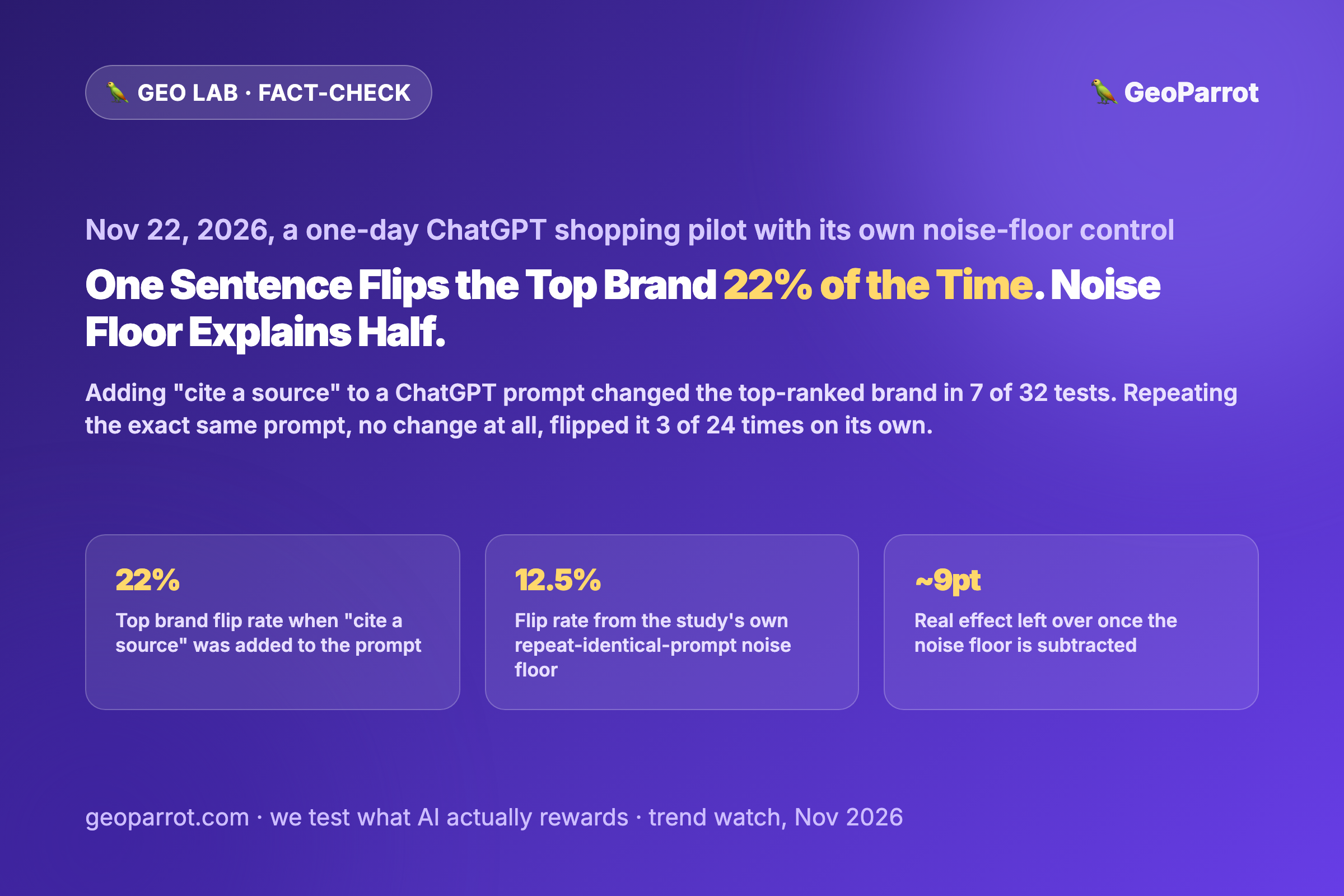
Quick answer: On November 22, 2026, a research pilot added the sentence “Cite a source for each recommendation” to 32 ChatGPT shopping prompts and found the top-ranked brand changed in 7 of them, a 22% flip rate. The same pilot also reran identical prompts with no added sentence, purely to check how much ChatGPT’s answers move on their own, and that control alone flipped the top brand in 3 of 24 reruns, 12.5%. Nobody in the write-up subtracted the second number from the first. Doing that arithmetic shrinks the “sourcing instruction changes recommendations” effect from 22 points to roughly 9, which is a real effect but less than half the headline size. We went through this exact exercise in September with our own query-phrasing experiment, and the lesson holds again: before you trust a single-day AI test’s top-line number, ask what its own noise floor already explains.
Trend watch, published November 23, 2026, in the GEO Lab. This is the same subtract-the-noise-floor check we ran on our own citation data in September, applied to someone else’s.
What did the November 22 pilot actually test?
EPR Research, the research desk at Everything-PR, ran 30 frozen U.S. shopping prompts across three categories (robot vacuums, carry-on luggage, password managers), 10 prompts per category, each asking ChatGPT to name three brands with reasoning. Every prompt was run twice in fresh, signed-out chats: once plain, once with “Cite a source for each recommendation” appended. ChatGPT’s anonymous rate limit cut the run short at 65 usable answers out of 120 planned slots, so the published numbers come from a partial, single-day sample of one model on one day. Within what they did collect, the effect was large on its face: the top-ranked brand changed in 7 of 32 paired comparisons, the three-brand shortlist changed in 17 of 32, and brand ordering shifted in 22 of 32. Direct product links also showed up far more often in the sourced answers, 22 of 32 versus 9 of 32 plain.
Why does the 22% headline number need a discount?
Because the same write-up includes the control that answers the obvious objection, and then doesn’t use it. To check whether ChatGPT’s answers simply drift chat to chat with zero wording change, the researchers reran identical prompts, no sourcing sentence added either time, 24 repeat pairs. That repeat-only control changed the top brand 3 times, 12.5%. That number is the noise floor: the rate at which the top answer moves for reasons that have nothing to do with the sentence being tested. The 22% figure measuring the sourcing sentence’s effect was never adjusted against it. A fairer estimate of what “cite a source” actually does, once you take out the noise a brand-new chat produces on its own, is closer to 22 minus 12.5, about 9 percentage points. That is still a real, directionally positive effect; it is not nothing. It is also under half of the number that will get quoted in a LinkedIn post next week.
Does this match what we found testing query wording ourselves?
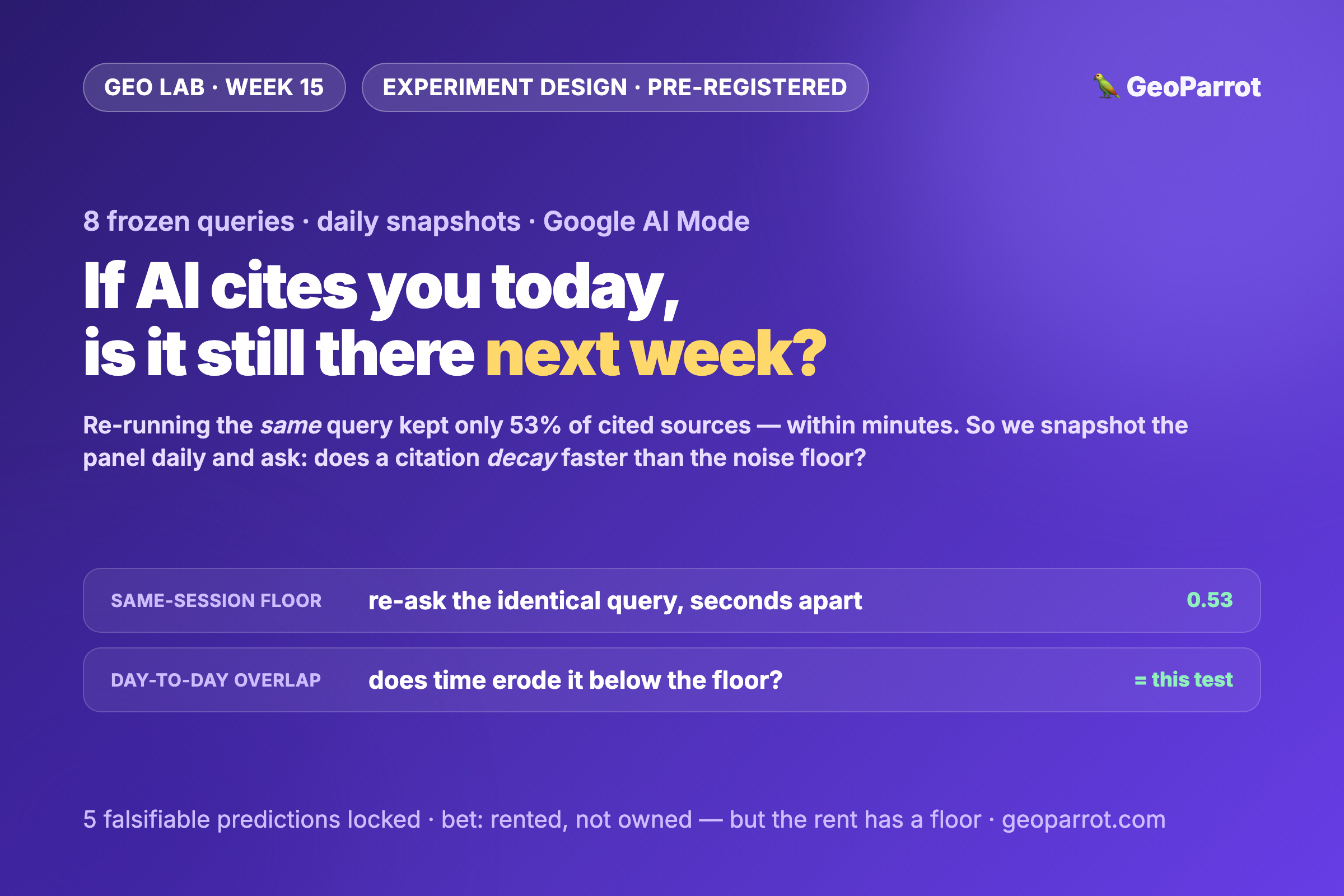
Yes, on the structure of the problem, even though the metric is different. In September we pre-registered a test of whether rephrasing a buyer-intent query, same intent, different wording, changes which sources an AI engine cites, and built in the identical safeguard: a same-phrasing repeat run as our own noise floor. The results showed the repeat-phrasing control kept a Jaccard overlap of about 0.53 between cited-source sets, meaning even zero wording change only holds citations roughly half steady from run to run. The reworded version of the same query dropped that overlap to about 0.14, an 86% swap in which sources got cited. The gap between those two numbers, 0.53 down to 0.14, is the real wording effect once our own noise floor is subtracted out, and it was large enough to survive the subtraction. EPR’s numbers point the same direction on a different measurement (which brand wins a recommendation, not which domains get cited) and a different engine lever (an added sourcing instruction, not rephrased intent). Two independent tests, months apart, on different mechanics, both say the same thing: AI answers move more than a fixed noise floor on their own, but a chunk of any “look what changed the answer” headline is that same noise floor, and you have to measure it before you believe the rest.
Should you actually add “cite a source” to AI-facing prompts or copy?
Not based on this alone, and not for the reason you might think. The pilot tested what happens when a *user* appends that sentence to their own ChatGPT prompt, not what happens when a *brand* changes its own site content to be more “citable.” Those are different levers entirely. What the pilot is actually useful for is smaller and more honest: it shows that a sourcing-focused instruction does nudge ChatGPT toward naming different top brands and surfacing more direct links, by something like 9 points above baseline noise, on a 65-answer same-day sample of one model. That is a hypothesis worth a larger, multi-day, multi-model follow-up, not an implementation-ready tactic. The instinct to treat day-one pilot numbers as a playbook is exactly what produces GEO advice that can’t be reproduced six weeks later.
| Measurement | Raw number | Noise floor | Effect after subtracting noise |
|---|---|---|---|
| EPR: “cite a source” changes top brand (ChatGPT, Nov 22 pilot) | 22% (7/32) | 12.5% (3/24 identical-prompt repeats) | ~9 points |
| GeoParrot: rewording changes cited sources (Google AI Mode, Sept experiment) | 86% swap (0.14 Jaccard) | ~47% swap (0.53 Jaccard on repeats) | ~39 points of Jaccard |
What should a GEO or content team do with this?
- Before quoting any “AI answer changed X% of the time” statistic, look for a repeat-identical-input control in the same study. If one exists, subtract it. If one doesn’t exist, the headline number is unadjusted and probably inflated.
- Treat single-day, single-model pilots as hypotheses, not findings. EPR’s own sample was cut short by ChatGPT’s rate limit (65 of 120 planned answers); that is a reasonable first pass, not a number to plan a content strategy around.
- Don’t conflate “user adds a sourcing instruction to their prompt” with “brand becomes more citable.” This pilot tested the former. Most GEO advice is about the latter. They are not interchangeable levers.
- Expect roughly half of any reported AI-answer volatility number to be noise, not signal, until proven otherwise. That ratio held in both EPR’s ChatGPT brand-flip test and our own Google AI Mode citation-overlap test, on two unrelated axes, months apart.
Frequently asked questions
Did adding “cite a source” to a ChatGPT prompt really change its brand recommendations?
Yes, but by less than the headline 22% figure suggests. A November 22, 2026 pilot by EPR Research found the top-ranked brand changed in 7 of 32 paired comparisons when “Cite a source for each recommendation” was added to a shopping prompt. The same pilot’s own control, rerunning identical prompts with no change at all, flipped the top brand in 3 of 24 reruns (12.5%). Subtracting that noise floor leaves a real effect closer to 9 percentage points.
How big was the EPR study, and what are its limits?
It covered 65 usable answers out of 120 planned slots, cut short by ChatGPT’s anonymous message rate limit, across 30 frozen prompts in three shopping categories on a single day (November 22, 2026), using one AI model. It is a single-day, single-model pilot, not a multi-day or multi-model study, and the researchers themselves note the rate-limit shortfall.
Does this mean query or prompt wording changes which sources AI engines cite?
Our own September experiment found yes, on Google AI Mode specifically: rewording a buyer-intent query while keeping the same intent dropped cited-source overlap from a 0.53 Jaccard noise floor (identical query, rerun) to 0.14 (same intent, reworded), an 86% swap in which domains got cited. That is a different engine and a different mechanic than EPR’s ChatGPT sourcing-instruction test, but both studies show wording effects that survive their own noise-floor subtraction.
Should brands add “cite your sources” language to their own content to get cited more?
This pilot doesn’t test that. It tested what happens when a user adds a sourcing instruction to their own ChatGPT prompt, not what happens when a brand changes its own site content. Those are different levers, and conflating them is the kind of leap that turns a narrow pilot into bad advice.
GeoParrot is a GEO Lab: we pre-register predictions before we test AI citation behavior, and we hold other people’s AI-search numbers to the same noise-floor standard we hold our own. See the running scoreboard at our 2026 GEO benchmark. Related: our own query-phrasing citation experiment, the OMNIFAMOUS ChatGPT citation stat fact-check, and the Podqi vs. Netcraft scam-site discrepancy.





Leave a Reply