Evidence-first case study · sports brand SEO + GEO series, part 19 of 20
Patagonia is the first brand in this series where a plain, non-browser HTTP request to the US domain — any URL on it, including robots.txt, sitemap.xml and llms.txt — returns a static fake “system maintenance” page instead of a captcha or a hard block. That outage page’s own HTTP headers show a Last-Modified date of September 2021, meaning it has been sitting behind Akamai as a standing fallback for non-browser traffic for roughly five years, not a live incident. A real, headed browser session renders the actual site — and its actual robots.txt — without issue. We tracked the Men’s Better Sweater Fleece Jacket on both patagonia.com and patagonia.co.kr: the US product page carries a complete Product+AggregateRating schema (4.4 stars, 1,168 reviews) while the Korean page carries zero structured data of any kind. Google AI Mode cited a Patagonia domain in 9 of our 10 test queries — tied with The North Face for the highest citation rate we’ve measured in this series.
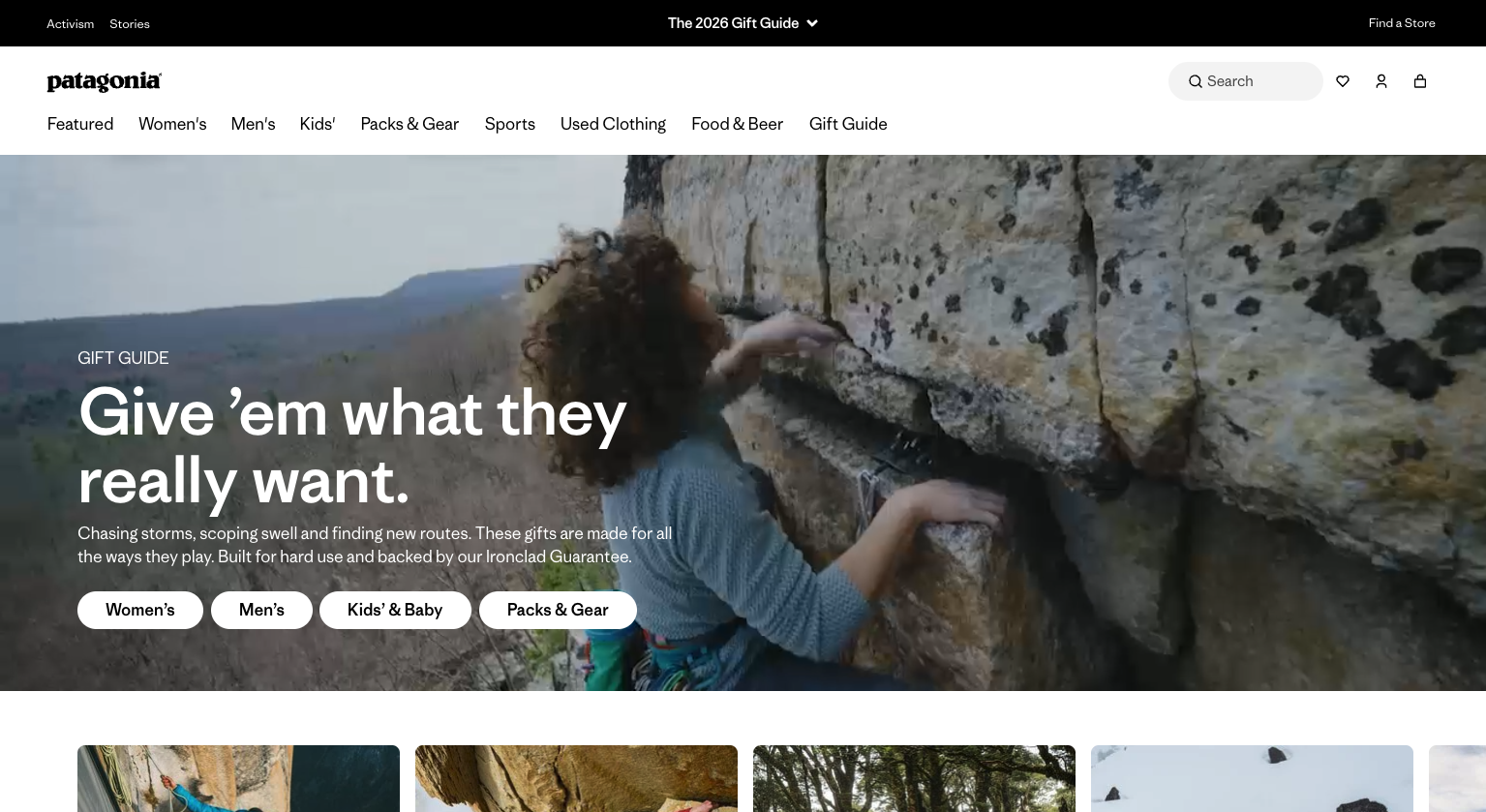
patagonia.com’s homepage, rendered in a real browser session: clean, fast, no bot-check overlay of any kind. The contrast with what plain HTTP tools see on this same domain (below) is the headline finding of this audit.
What is Patagonia trying to do — and why audit it nineteenth?
This is part 19 of GeoParrot’s sports-brand series, running the same evidence-first method we used on Decathlon, The North Face and seventeen other major names. Patagonia was founded in 1973 by Yvon Chouinard in Ventura, California, and in September 2022 Chouinard and his family irrevocably transferred ownership of the company — all of it — to a purpose-built trust and a nonprofit (the Patagonia Purpose Trust and Holdfast Collective), structuring future profits not reinvested in the business to go toward fighting the climate crisis. The company’s own homepage tagline at capture time, “Earth Is Now Our Only Shareholder,” refers to exactly this 2022 restructuring, and it’s the only brand in this series with a formal non-traditional ownership structure instead of public or private-equity ownership. We picked it nineteenth because its US technical setup — a domain-wide fake maintenance page served to non-browser traffic — is a pattern we haven’t seen anywhere else in eighteen prior audits.
Brand category American outdoor apparel and gear maker (founded 1973), owned since 2022 by the Patagonia Purpose Trust and Holdfast Collective rather than by individuals, a holding company or public shareholders.
Primary user job Find the Men’s Better Sweater Fleece Jacket, compare price, color choice and review volume between the US site and Patagonia Korea, and figure out how to get help or return it.
SEO + GEO challenge A US domain that serves a cached-since-2021 fake outage page to anything that doesn’t look like a real browser (across every path we tried, not just one wall), paired with a Korean storefront that carries no product structured data at all.
The product we tracked: the Better Sweater Fleece Jacket, two very different review pools
We tracked the same product line — the Men’s Better Sweater® Fleece Jacket in Black — on both sites, the same cross-locale method we’ve used throughout this series.
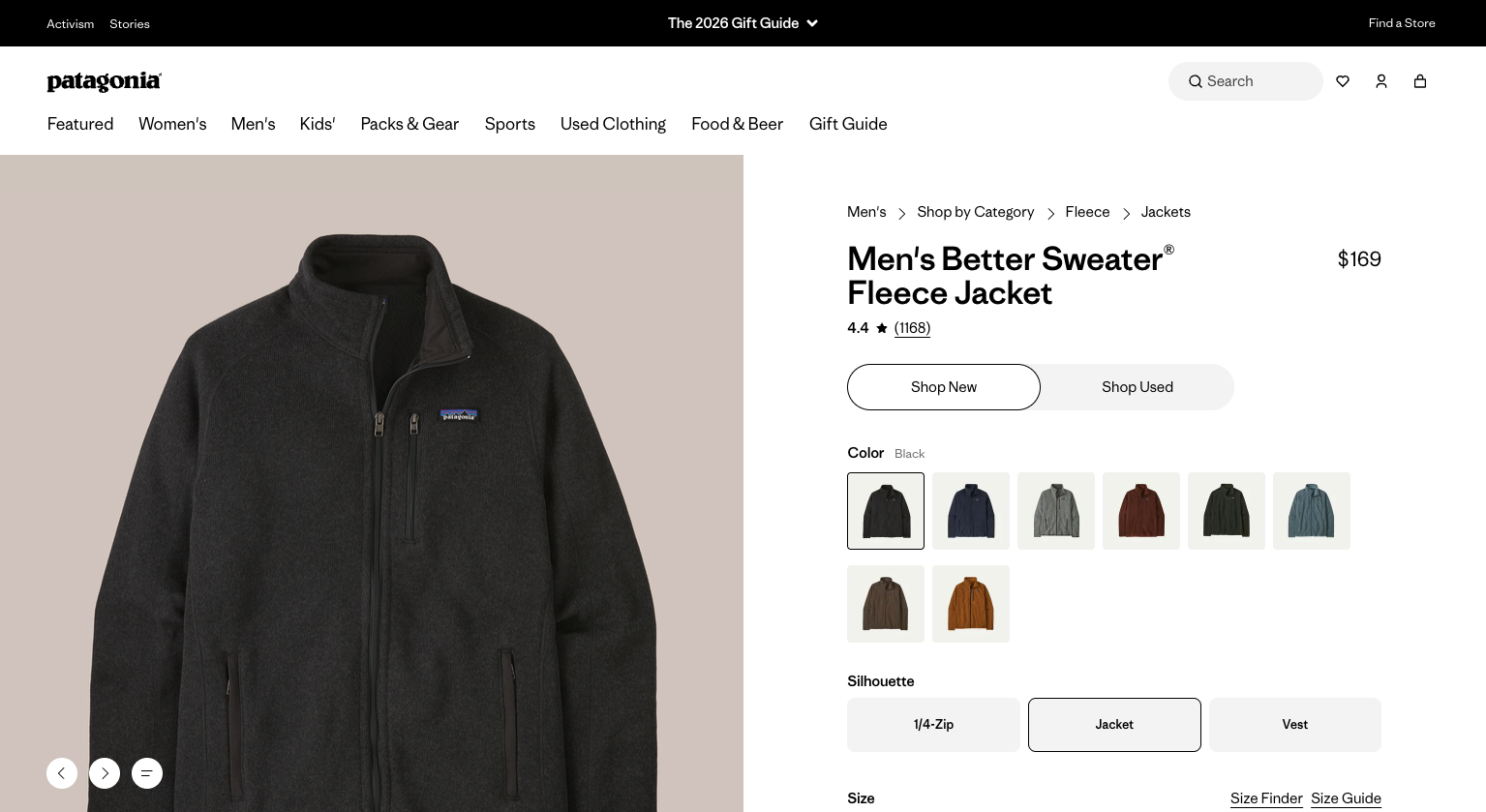
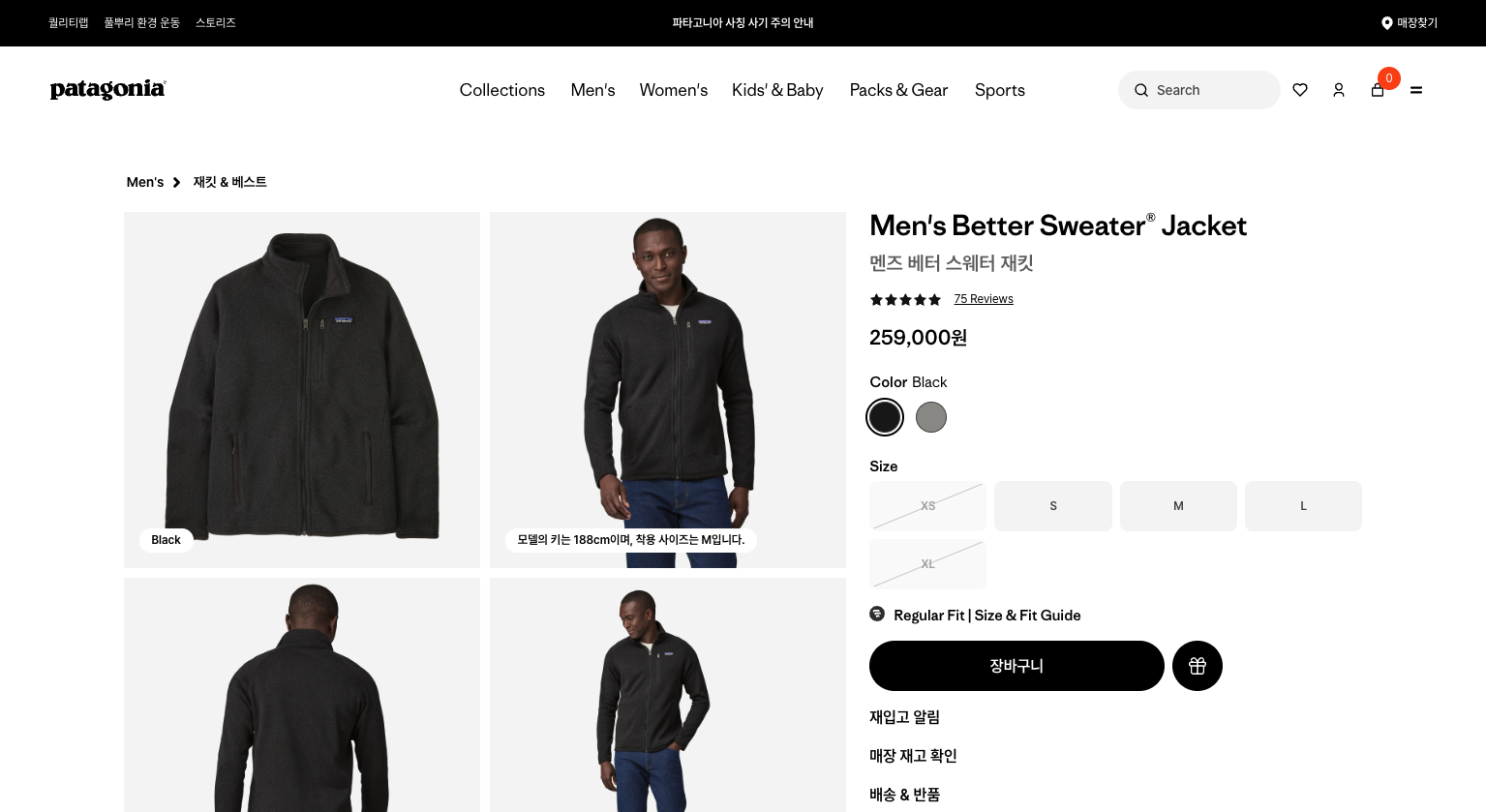
US: $169, 4.4 stars from 1,168 reviews, eight color options (Black, Navy, Gray, a dark red, two greens, a light blue and an orange), Jacket/Vest/1/4-Zip silhouette toggle.Korea: 259,000 KRW (roughly $180, not independently converted via a live FX feed), two color options (Black, Gray), a star-icon rating linked to “75 Reviews” with no printed numeric average on screen.
The review-count gap here — 1,168 on the US page versus 75 on the Korean page, roughly 15x — is far wider than the near-identical counts we found on Decathlon’s US/Korean tent listings. That’s consistent with what the underlying platforms tell us: the US PDP’s structured data points at Patagonia’s own Salesforce Commerce Cloud catalog (demandware.static image paths), while the Korean PDP’s product image is served from patagonia.edge.naverncp.com — Naver Cloud Platform’s CDN — confirming Korea runs on genuinely separate infrastructure with its own, much smaller review pool rather than a shared global one.
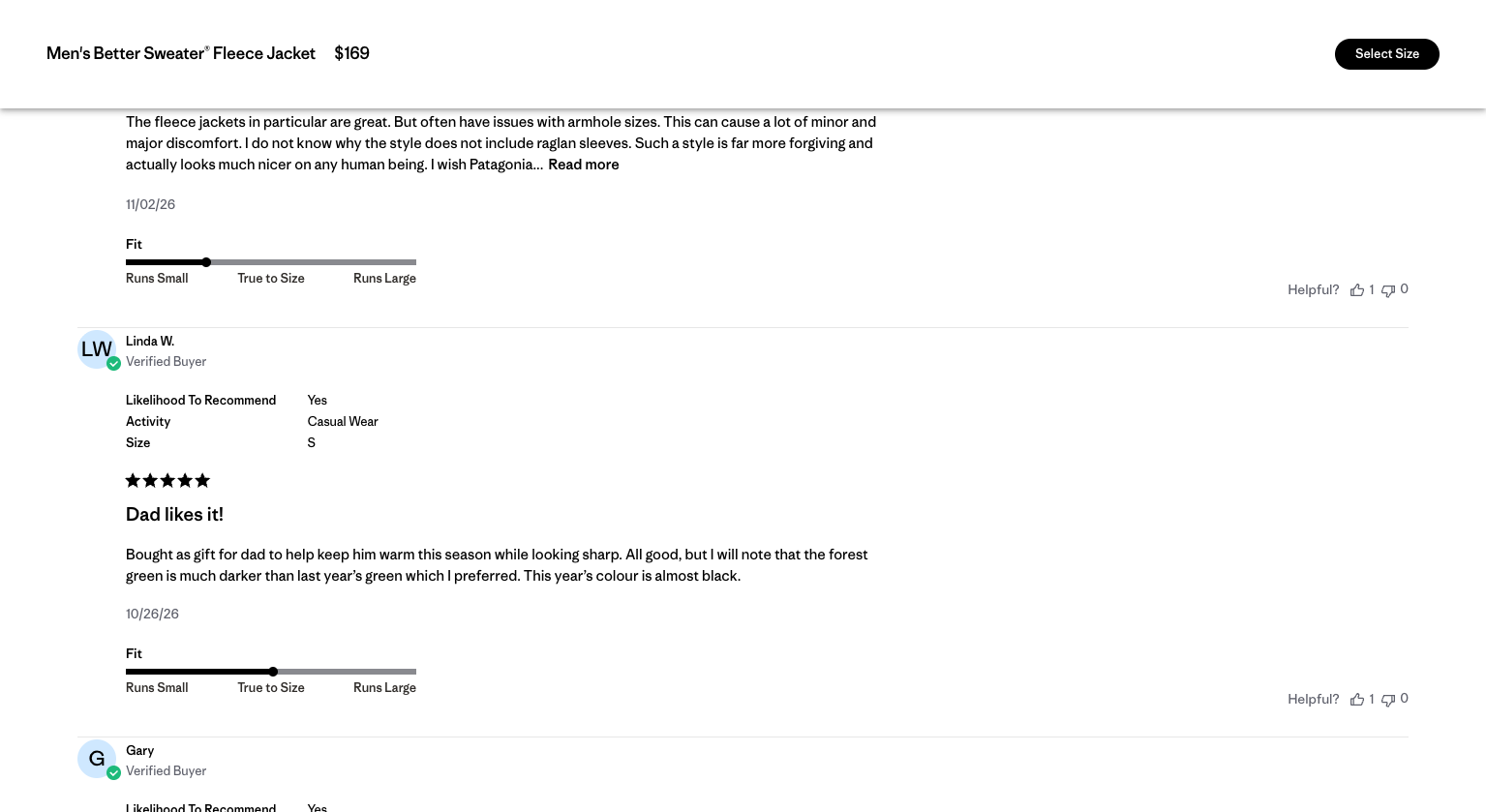
Real, dated verified-buyer reviews on the US PDP (10/26/26 and 11/02/26 at capture time) — substantive written content with per-review fit sliders, not placeholder review widgets.
AI citation snapshot: 10 real queries, Google AI Mode
We sent 10 verbatim queries to Google AI Mode (udm=50) and checked direct a[href] links, counting a citation only when either patagonia.com or patagonia.co.kr appeared.
Query
Patagonia domain cited?
Who else showed up
who owns patagonia
✅ Yes
verfassungsblog.de, wikipedia.org, patagoniaworks.com, cnbc.com, reddit.com — patagonia.com cited directly alongside its own sister domain patagoniaworks.com on the 2022 ownership-transfer story
is patagonia a good brand
✅ Yes
forbes.com, businessinsider.com, goodonyou.eco, reddit.com, thingtesting.com, fashionbeans.com, coastandfell.co.uk — patagonia.com cited alongside a wide mix of press and review sites
patagonia vs north face
✅ Yes
buckmans.com, thenorthface.com, familyhandyman.com, sectionhiker.com, reddit.com — both brands’ own domains cited side by side
bettertrail.com, backpackers.com, outdoorgearlab.com, veggievagabonds.com, reviewed.com, rei.com — the one query most directly about the exact product we tracked, and every citation was a third-party review, not Patagonia’s own page
patagonia ironclad guarantee
✅ Yes
scribd.com, brobible.com, patagoniabend.com — patagonia.com’s own guarantee page cited directly
instagram.com, or.kr — patagonia.co.kr cited directly, no patagonia.com citation on this query
Result: a Patagonia domain cited in 9/10 queries (Nike 5/10, Adidas 4/10, Puma 5/10, Under Armour 8/10, New Balance 6/10, ASICS 7/10, Skechers 4/10, Lululemon 8/10, Reebok 7/10, Converse 7/10, On Running 6/10, Hoka 5/10, Vans 8/10, The North Face 9/10, Columbia 7/10, FILA 2/10, Salomon 4/10, Decathlon 7/10) — tied with The North Face for the highest rate we’ve measured across this entire series. The single miss, again, is the query most specific to the exact product we audited (“patagonia better sweater fleece review”) — the same “own page wins on brand/navigational queries, loses on independent-review queries” pattern we’ve now seen on almost every brand in this series.
G-score audit: the 8-pillar hygiene checklist
We scored seven measurable URLs with the same 8-pillar static-HTML checklist (JSON-LD present, FAQ content, visible date, author byline, concrete data points, table/list structure, 3+ subheadings, a 30-500 character early answer) used in our Week 17 quality-score experiment and on all eighteen prior brands in this series. All seven pages were captured via a real, headed browser session rather than plain HTTP — the only way to get past patagonia.com’s domain-wide fake-outage response to non-browser requests.
Page
Fetch method
G-score
Notable pillars
US homepage
Browser-rendered (200 OK)
0.50
Organization + WebSite JSON-LD, data points, list structure, 3+ subheadings; no FAQ content, no visible date signal, no author byline on the homepage template
US Men’s fleece category
Browser-rendered (200 OK)
0.625
JSON-LD present, visible date signal, data points, list/subheadings; no FAQ, no author
US Better Sweater Fleece Jacket PDP
Browser-rendered (200 OK)
0.625
A complete ProductGroup + Product + AggregateRating + BreadcrumbList JSON-LD set (4.4 / 1,168 reviews, matching the on-screen number almost exactly); no FAQ schema, no author signal
US Help Center (help.patagonia.com)
Browser-rendered (200 OK)
0.375
FAQ-style content and list structure present, but zero JSON-LD of any kind — this help content lives on an entirely separate subdomain from the main site and carries none of patagonia.com’s structured data
KR homepage
Browser-rendered (200 OK)
0.375
Zero JSON-LD blocks found (only basic Open Graph meta tags); data points, list structure and subheadings present
KR Better Sweater Jacket PDP
Browser-rendered (200 OK)
0.375
Zero JSON-LD blocks — only Open Graph meta tags (og:title, og:image served from Naver Cloud Platform’s CDN, og:description), no Product or AggregateRating schema despite the page displaying a star rating and “75 Reviews” link on screen
KR Men’s category
Browser-rendered (200 OK)
0.50
Visible date signal, data points, list/subheadings; still zero JSON-LD, consistent with every other Korean page we sampled
Seven-page average: 0.4821 (Nike: 0.4375, Puma: 0.354, Under Armour: 0.5208, New Balance: 0.5833, Adidas: 0.6458, ASICS: 0.4583, Reebok: 0.5417, Converse: 0.5208, On Running: 0.4583, Hoka: 0.6, Vans: 0.425, The North Face: 0.525, Columbia: 0.525, FILA: 0.525, Salomon: 0.5417, Decathlon: 0.5893) — lower-middle of the series, close to Vans and On Running. The split by region is the real story here, not the headline number: the three US-only pages with any JSON-LD (home/category/PDP) average 0.583, while every single Korean page we sampled scored exactly zero on the JSON-LD pillar — a complete regional schema gap, not a partial one.
A fake outage page for bots, a trust-owned company, and a Korean storefront with zero structured data
patagonia.com serves a static fake “system maintenance” page to non-browser HTTP requests, across the entire domain — Every plain curl request we made to this domain — the homepage, /robots.txt, /sitemap.xml, /llms.txt — returned the identical HTML, titled “We’re working on it,” served by AkamaiNetStorage with an HTTP Last-Modified header of September 2021. That’s not a live incident; it’s a years-old static fallback object being served in place of real content to traffic Akamai’s edge doesn’t recognize as a real browser. A real, headed browser session reached the actual site, the actual robots.txt and the actual (404-style) llms.txt response without any issue. We’ve seen captchas, PerimeterX “press and hold” walls and Akamai challenge pages elsewhere in this series; this is the first time we’ve seen a brand mask its entire domain behind a fake outage notice instead.
robots.txt explicitly blocks Google-Extended (Google’s AI-training crawler) but not GPTBot, ClaudeBot or PerplexityBot — Once we got a real browser past the fake-outage wall, patagonia.com’s actual robots.txt names and fully disallows dotbot, Baiduspider, SpringBot, AhrefsBot, GoogleOther, AhrefsSiteAudit and, notably, Google-Extended — the crawler Google uses specifically to gather AI-training data, kept separate from Googlebot itself. OpenAI’s, Anthropic’s and Perplexity’s crawlers aren’t named at all, so they fall under the generic User-agent: * block, which disallows specific paths (cart, checkout, search, help, international, and more) rather than the whole site. The practical result: Patagonia has taken a specific stance against Google’s AI-training crawler while leaving the door open, by omission, to the others.
patagonia.co.kr runs a completely separate platform with zero structured data anywhere we sampled — Home, PDP and category pages on the Korean site returned 0 JSON-LD blocks each (only basic Open Graph tags), and its own robots.txt sets a blanket User-agent: * / Disallow: /, only carving out named exceptions for Googlebot, Naver’s Yeti, Daum’s Daumoa, Twitterbot and one additional named bot — no exception for GPTBot, ClaudeBot or PerplexityBot. Combined with product imagery served from Naver Cloud Platform’s CDN and a PHP/Apache stack (versus the US site’s Salesforce Commerce Cloud), this reads as an independently operated regional storefront, not a mirror of the US catalog.
The US PDP’s review schema is complete and accurate; the Korean PDP’s isn’t present at all — The US Better Sweater Fleece Jacket page carries a full ProductGroup + Product + AggregateRating JSON-LD set (4.401541 / 1,168 reviews) matching what’s shown on screen (4.4 stars, 1,168 reviews) almost exactly. The Korean page shows a star-icon rating linked to “75 Reviews” on screen but has no Product or AggregateRating schema anywhere in its source — a crawler reading only structured data would have no way to know this Korean product has reviews at all.
Patagonia Korea runs a persistent, sitewide scam-warning banner that the US site does not — Every Korean page we visited carried a fixed top-bar notice reading “파타고니아 사칭 사기 주의 안내” (beware of sites impersonating Patagonia / counterfeit-site scam warning). We didn’t find an equivalent banner anywhere on patagonia.com during this audit — a region-specific trust signal that speaks to counterfeit or phishing activity Patagonia Korea has evidently judged serious enough to flag on every page.
Patagonia’s ownership structure is unlike any other brand in this series — In September 2022, founder Yvon Chouinard and his family transferred all ownership of Patagonia to the Patagonia Purpose Trust and the Holdfast Collective, a nonprofit, so that profits not reinvested in the business go toward fighting the climate crisis. The company’s own homepage tagline at capture time (“Earth Is Now Our Only Shareholder”) is a direct reference to this restructuring, and our own AI citation test for “who owns patagonia” independently surfaced patagonia.com’s sister domain patagoniaworks.com alongside Wikipedia and CNBC coverage of the same 2022 story — we didn’t have to look this up separately, our own test method found it.
What works / What to verify
WHAT WORKS
The US PDP’s complete and accurate Product+AggregateRating schema, a 9/10 AI-citation rate tied for the best in this series, and real dated verified-buyer review content with per-review fit data.
WHAT TO VERIFY
Whether the fake-outage response to non-browser traffic is intentional Akamai bot-mitigation policy or a stale, forgotten fallback configuration; whether Patagonia Korea plans to add product structured data at any point; and whether the 15x review-count gap between regions reflects genuinely separate review pools or a Korea-specific collection gap we can’t see from the outside.
Target query check — reported honestly, not inflated
We have not re-measured “patagonia seo” or “patagonia geo audit” query volume this session. Per the pattern already confirmed across eighteen earlier subjects in this series on October 20, 2026 (Keyword Planner, US) — the large majority showed no measurable search volume at all for “[brand] SEO/GEO audit” phrasing — we’re not claiming this title drives ranking-based traffic. The distribution case for this series rests on internal links, our own index, and readers already following the GEO Lab arc, not on search demand for “[brand] SEO audit” as a query.
Frequently asked questions
Why does patagonia.com show a “system maintenance” message to some tools but not to a real browser?
Based on what we observed, it’s very unlikely to be a real outage: the page’s own HTTP headers carry a Last-Modified date from September 2021, and it was returned identically for every URL path we tried on the domain, including robots.txt and sitemap.xml. That pattern is consistent with an edge-level (Akamai) bot-mitigation fallback being served to traffic that doesn’t present as a standard browser, rather than a genuine site-wide incident. We can’t confirm Patagonia’s internal intent from the outside — only what a plain HTTP client sees versus what a real browser sees.
Does Patagonia’s trust ownership structure affect its SEO or GEO performance?
Not in any way we can measure directly, and that’s not really what this finding is about. We flagged it because it’s genuinely unusual among the 19 brands we’ve audited in this series (every other brand is publicly traded, privately held by individuals, or owned by a holding group), and because our own AI citation test for “who owns patagonia” independently surfaced the 2022 ownership story without us seeking it out — which is itself a small, useful signal about how well that story is indexed and citable.
Why does the Korean product page have no structured data at all when the US page’s schema is this complete?
We can’t say for certain from the outside, but the infrastructure gives a strong hint: Patagonia Korea runs on a PHP/Apache stack with imagery served via Naver Cloud Platform’s CDN, versus the US site’s Salesforce Commerce Cloud setup. That points to an independently built and maintained regional storefront rather than a shared template that simply forgot to carry schema over — the same explanation we’ve offered for similar regional gaps on several earlier brands in this series.
Does a higher G-score mean Patagonia gets cited more by AI than lower-scoring brands in this series?
Not in any way we can confirm. Patagonia’s 0.4821 average sits in the lower-middle of the eighteen brands we’ve scored so far, yet its 9/10 AI-citation rate is tied for the highest. Our Week 17 experiment already found hygiene and schema completeness were not a dependable predictor of AI citation, and this audit doesn’t change that conclusion — if anything, this is one of the starker examples of the mismatch.
Audit evidence, scope and limits
Inspected: November 2026, public logged-out access from a Korea-based IP (real headed-browser session used for all screenshots, G-score rendering and citation testing; plain HTTP fetches via curl were attempted first and found to return the domain-wide fake outage page described above). Screens: the US homepage, the Men’s fleece category, the Better Sweater Fleece Jacket PDP and the Help Center — plus the Patagonia Korea homepage, its robots.txt, the matching Korean product page, a Korean-site keyword search for “베터스웨터,” a 10-query Google AI Mode citation snapshot, and an 8-pillar G-score scored across all seven browser-rendered pages.
Not measured: rankings, Search Console performance, analytics, conversion, signed-in/member flows, ChatGPT citations (not attempted, given the composer failures flagged on earlier audits in this series), whether the fake-outage response is a deliberate, permanent bot-mitigation policy versus a forgotten configuration, or the complete product/locale catalog beyond the one product line and seven URLs sampled here. This is a public-signal snapshot, not a performance claim or a full-catalogue crawl.
This is part 19 of a daily series. Every day, GeoParrot runs this same evidence-first method — real screenshots, a 10-query AI citation snapshot, an 8-pillar G-score audit, and an honest target-query check — against one more major sports and athletic-wear brand. Next: Lacoste.




Leave a Reply