
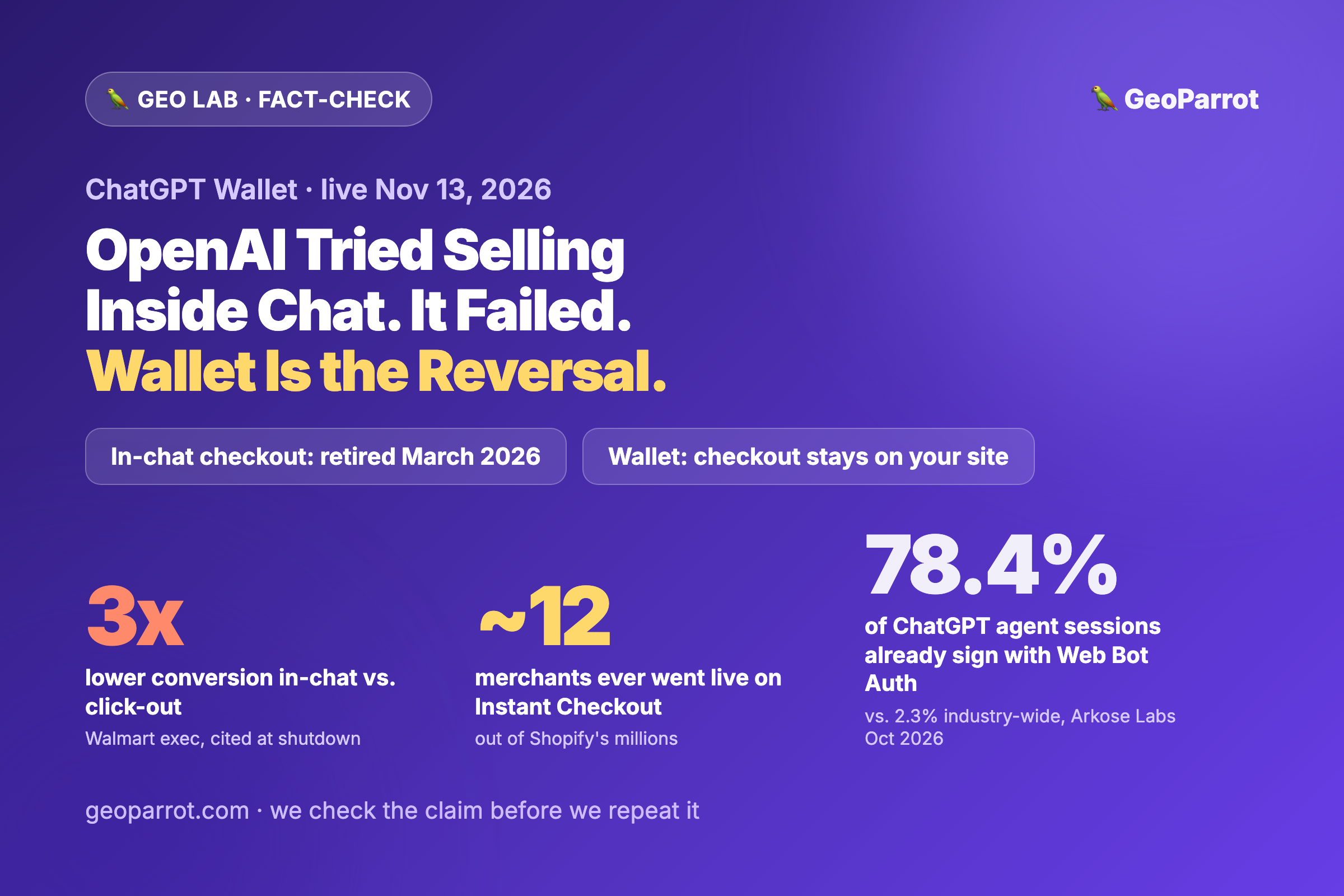
Quick answer: OpenAI launched ChatGPT Wallet on November 13, 2026. Its always-on “dots” agents can now complete a purchase on a merchant’s own website after a human approves with Face ID or a fingerprint, using a one-time tokenized card number that the agent and the merchant never see in full. It’s rolling out to U.S. ChatGPT Pro subscribers, 18 and older, with eligible U.S.-issued Amex, Mastercard, or Visa cards. The detail most coverage buried: Wallet is a reversal. OpenAI’s first attempt at AI commerce, Instant Checkout (launched September 29, 2025, built on the Agentic Commerce Protocol with Stripe), tried to complete the transaction inside the chat window itself. OpenAI retired it in March 2026 after roughly a dozen merchants had gone live and a Walmart executive said conversion for products sold inside ChatGPT ran about three times lower than for shoppers who clicked out to Walmart’s own site. Wallet’s fix is to send the agent to you instead, and leave checkout exactly where it already works.
Trend watch, published November 16, 2026. OpenAI’s own announcement is at openai.com; TechCrunch, CNBC, and PPC Land covered the launch mechanics; PPC Land’s writeup is the one that connects the Web Bot Auth adoption numbers and the Walmart conversion quote from the Instant Checkout shutdown. We’re not testing Wallet ourselves. It’s three days old and no pick-rate or adoption data exists yet. We’re flagging the pattern, because it’s the third time in three months a major AI platform has shipped commerce infrastructure and a GEO narrative has formed around it faster than any evidence that the infrastructure changes who gets recommended.
What exactly launched on November 13?
ChatGPT Wallet gives OpenAI’s “dots” (its newer, always-on agents that run on their own cloud computer and can act between conversations) the ability to finish a purchase without ever holding a user’s real card. When an agent reaches checkout, the payment network issues a one-time token: a substitute card number, security code, and expiration date that stands in for the real card for that single transaction. Before any charge goes through, the user has to approve it with a biometric check (Face ID or a fingerprint), and a review screen shows the merchant, the items, the total, and which payment method will be used. OpenAI’s own framing is that this is “the first wallet that lets agents pay without access to users’ actual card details,” with a security check required for every purchase. On the merchant side, requests from the agent are signed using Web Bot Auth, a standard that lets a retailer’s systems tell a legitimate paying agent apart from a scraper or a fraud bot. Named partners span three layers: the card networks (American Express, Mastercard, Visa), payment service providers (Adyen, Checkout.com, Stripe), and fraud-prevention vendors (Forter, Riskified, Sardine, Signifyd). For now it’s limited: United States only, ChatGPT Pro subscribers, 18 and older, eligible U.S.-issued cards only. OpenAI says it plans to eventually allow purchases inside a preset spending limit without a per-transaction approval, but that isn’t live yet.
The part most coverage skipped: OpenAI already tried the opposite model, and it failed
This isn’t OpenAI’s first swing at AI commerce. In September 2025, it launched Instant Checkout, built on the Agentic Commerce Protocol it co-developed with Stripe, which tried to move the entire transaction into the chat window: the merchant integrated with OpenAI, and ChatGPT ran the checkout itself. By March 2026, that approach was dead. Reporting on the shutdown put the total number of merchants that ever went live at around a dozen, out of Shopify’s millions, and quoted a Walmart executive saying conversion for products sold inside ChatGPT ran roughly three times lower than for shoppers who clicked out to Walmart’s own website. OpenAI’s own line at the time was that “Instant Checkout is transitioning to apps,” pointing merchants toward building retailer apps inside ChatGPT instead. Wallet, eight months later, is a different answer again: instead of OpenAI owning the transaction or merchants building an in-chat app, the agent now travels to the merchant’s own site and checks out there, using the merchant’s existing checkout flow and the user’s own payment method. The Agentic Commerce Protocol that powered Instant Checkout isn’t what Wallet runs on; Wallet runs on card-network tokenization plus Web Bot Auth for agent verification. One data point suggests OpenAI had already been building toward this before Wallet shipped: per Arkose Labs’ October 2026 bot-traffic data, ChatGPT’s agent already signed 78.4% of its sessions with Web Bot Auth, against roughly 2.3% for legitimate agent traffic industry-wide. That’s a platform that had the verification plumbing in place well ahead of the commerce feature that needed it.
| What’s confirmed | What isn’t confirmed / isn’t the claim |
|---|---|
| Instant Checkout (Sept 2025, in-chat transactions via the Agentic Commerce Protocol) was retired in March 2026 after roughly a dozen merchants went live and reported lower conversion than click-out traffic | That Wallet guarantees better conversion than Instant Checkout did; no outcome data exists yet, it’s three days old |
| Wallet (Nov 13, 2026) moves the transaction back onto the merchant’s own site, using tokenized cards, per-purchase biometric approval, and Web Bot Auth for agent verification | That implementing anything changes which merchant a dots agent chooses to visit in the first place; nothing in OpenAI’s announcement claims that |
| Eligibility is currently U.S.-only, ChatGPT Pro, 18+, U.S.-issued Amex, Mastercard, or Visa cards | Any published pick-rate, adoption percentage, or merchant conversion number for Wallet specifically |
| ChatGPT agent traffic already signs the large majority of its sessions with Web Bot Auth (78.4% vs. 2.3% industry-wide, per Arkose Labs) | That most merchant sites are currently set up to read that signal and treat it differently from anonymous bot traffic; that’s a separate, unmeasured adoption gap on the merchant side |
Where this points GEO effort next
Three findings here matter more than the feature itself, and they build directly on what we’ve already measured on two earlier commerce launches this year.
- The attribution fear is smaller than it looked a month ago, for this specific architecture. Because Wallet routes the transaction back to the merchant’s own checkout instead of completing it inside ChatGPT, the purchase still lands on your domain. If your analytics stack can recognize Web Bot Auth-signed requests, that session is visible and attributable in a way an Instant-Checkout-style in-chat purchase never would have been. The practical task this creates isn’t a GEO task in the ranking sense, it’s an instrumentation task: find out whether your site currently treats signed agent traffic as a bot to block or as a transacting visitor to count, because right now most sites do the former by default.
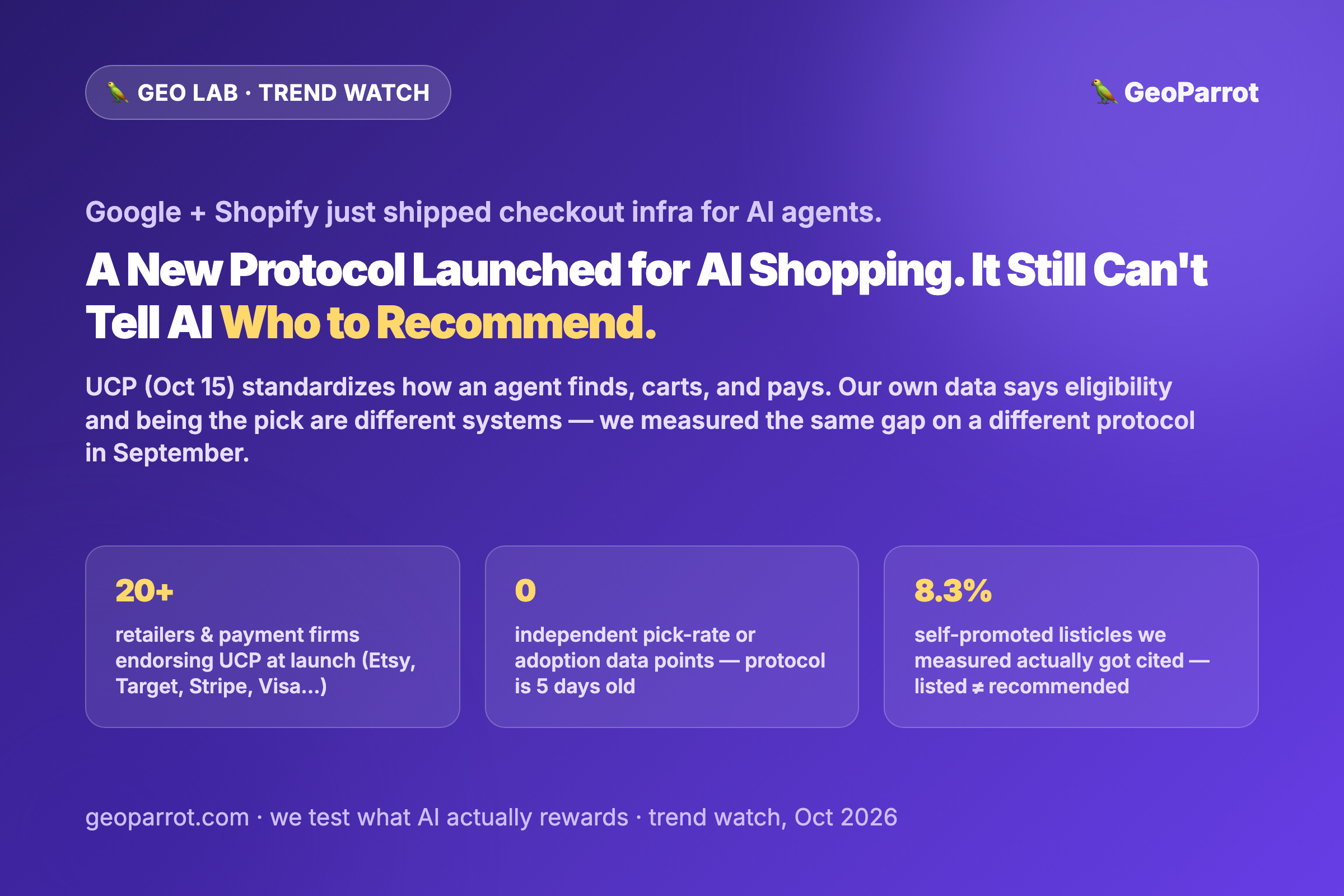
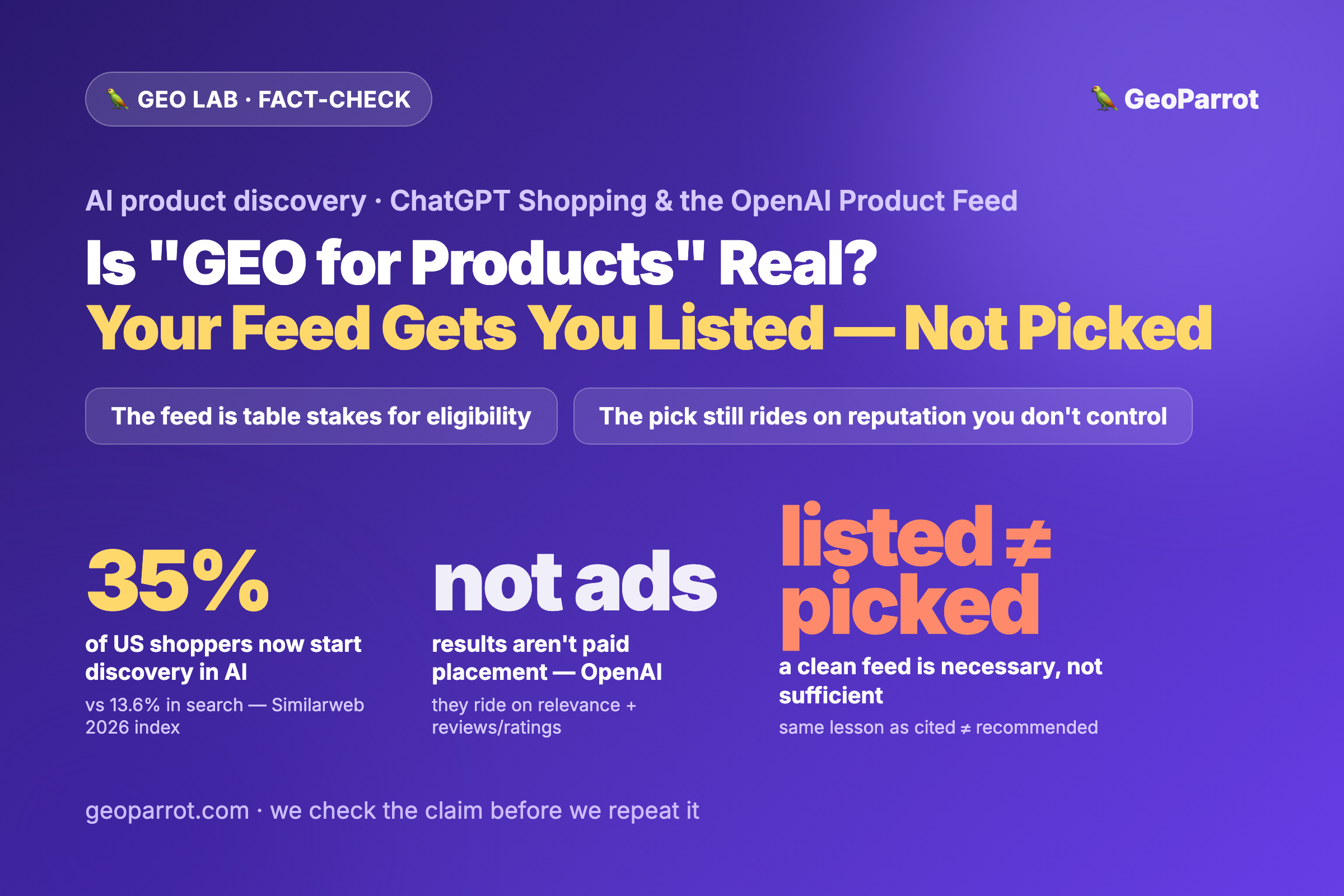
- Owning the checkout layer didn’t win OpenAI anything, and that’s evidence, not just a theory. OpenAI controlled the entire client, the payment flow, and the merchant relationship with Instant Checkout, and conversion still ran below simple click-outs. If the company with the most control over the experience couldn’t make checkout ownership translate into better outcomes, that’s a strong signal the decision of which merchant to visit is made upstream, before any wallet or checkout protocol activates. That’s the same wall we measured when OpenAI’s Product Feed launched in September and again when Google and Shopify’s Universal Commerce Protocol launched in October: eligibility infrastructure and the recommendation decision are different systems. Wallet is the third launch in three months to reinforce it, this time with a company’s own failed product as the evidence.
- Expect an “optimize for agent checkout” pitch cycle, and recognize it fast. We’ve now watched this pattern three times: a protocol or feature ships, and content claiming it affects which brand gets picked follows within days, with no primary source actually making that claim. Wallet requires no merchant integration at all, it uses the user’s own card and your existing checkout, so there is nothing to “optimize” on the merchant side beyond making sure signed agent traffic isn’t auto-blocked. If you see a pitch claiming otherwise, ask what it’s actually selling.
A checklist, without the overclaim
- Don’t rebuild an Instant-Checkout-era integration. OpenAI itself walked that model back; there’s no indication the Agentic Commerce Protocol integration path is where agent-driven purchases are headed now.
- Check how your site currently treats signed agent requests. If Web Bot Auth-signed traffic gets the same bot-mitigation treatment as unverified scrapers, a paying dots agent could be blocked before it ever reaches your checkout. This is worth a ten-minute conversation with whoever owns your WAF or bot-management vendor.
- Tag agent-originated sessions separately in analytics once you can detect them. A session that arrives already decided, approves instantly, and converts at or near 100% will look nothing like a human session, and averaging the two together will quietly distort your real conversion-rate and funnel metrics.
- Keep the actual lever where the evidence says it is. Based on what we and others have measured across three separate commerce launches now, the thing that correlates with being the chosen merchant is independent reputation, how you’re described in third-party reviews and prose, not integration with whatever payment or checkout spec shipped most recently.
- Revisit this in a quarter. Wallet is three days old and OpenAI’s own commerce track record this year is one launch, one quiet failure, and now a second attempt. If real adoption or pick-rate data shows up, that’s new information worth updating on.
The honest caveats
We have not run a Wallet-specific experiment, and nobody else has either; it’s three days old, limited to U.S. ChatGPT Pro subscribers with eligible U.S. cards, which is a narrow enough slice that early behavior may not predict how this looks once (and if) it expands to more markets, subscription tiers, and card issuers. The Web Bot Auth adoption figures (78.4% vs. 2.3%) describe ChatGPT’s agent traffic broadly as measured by one fraud-detection vendor in October, not Wallet transactions specifically, and we’re citing it as context for how prepared OpenAI’s agent infrastructure already was, not as a Wallet performance metric. The “eligibility isn’t a pick” framing in this piece extends a pattern we measured on different protocols (OpenAI’s Product Feed, our own self-ranking and consensus-pick experiments), applied here by analogy to a payment feature rather than measured directly on Wallet. It’s a reasoned extrapolation from a consistent pattern, not a direct measurement of this specific launch, and we’re naming that distinction rather than letting it read as proof.
Frequently asked questions
What is ChatGPT Wallet?
A payment feature OpenAI launched on November 13, 2026, that lets its always-on ‘dots’ agents complete a purchase on a merchant’s own website after the user approves with a biometric check. It uses a one-time tokenized card number rather than the user’s real card details, and is currently limited to U.S. ChatGPT Pro subscribers, 18 and older, with eligible U.S.-issued Amex, Mastercard, or Visa cards.
How is ChatGPT Wallet different from Instant Checkout?
Instant Checkout (launched September 2025, retired March 2026) tried to complete transactions inside the chat window itself, requiring merchants to integrate with OpenAI’s Agentic Commerce Protocol. Wallet reverses that: the agent travels to the merchant’s own site and checks out there, using the merchant’s existing checkout and the user’s own payment method, with no new merchant integration required.
Why did OpenAI retire Instant Checkout?
Reporting on the March 2026 shutdown put the number of merchants that ever went live at around a dozen, out of Shopify’s millions, and quoted a Walmart executive saying conversion for products sold inside ChatGPT ran roughly three times lower than for shoppers who clicked out to Walmart’s own site.
Does ChatGPT Wallet change which merchant an AI agent recommends?
No primary source, not OpenAI’s announcement, not the technical coverage, claims that Wallet changes which merchant a dots agent chooses to visit. It standardizes how a purchase is completed once a merchant has already been chosen, not the recommendation decision itself. That decision appears to run on a separate track, the same split we’ve measured on other AI commerce protocols.
What should merchants actually do about ChatGPT Wallet right now?
Check whether your site’s bot-management setup treats Web Bot Auth-signed requests as legitimate paying traffic or blocks them like unverified scrapers, since that determines whether a dots agent can even reach your checkout. Beyond that, there’s no merchant integration required, which means there’s little to optimize for Wallet specifically; the effort that actually affects outcomes is still independent reputation and third-party reviews, the same lever that governs whether an AI recommends you at all.
GeoParrot is a GEO Lab: we run experiments to test what AI search engines actually reward, and we grade the industry’s claims, including our own, against what was actually measured. See the running scoreboard at our 2026 GEO benchmark. Related: our September take on OpenAI’s Product Feed and the eligibility-vs-pick gap, why Google and Shopify’s Universal Commerce Protocol doesn’t decide who gets picked, and why self-ranking listicles barely get cited.




Leave a Reply