
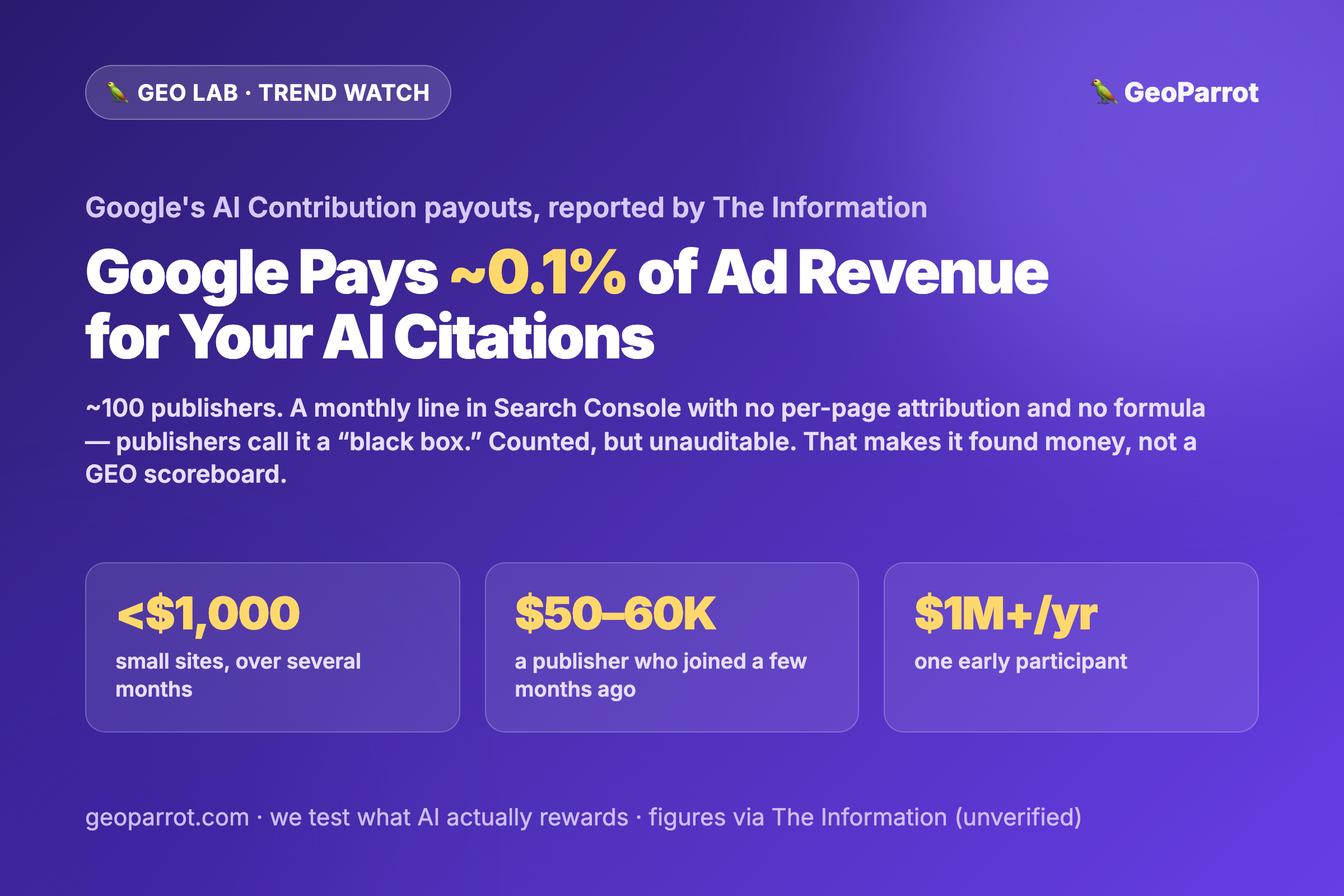
Quick answer: On September 29–30, 2026, The Information reported the first hard numbers from Google’s AI Contribution pilot — the program that pays publishers when their content “significantly contributes” to AI Overviews, AI Mode, and Gemini. The figures: about 100 publishers, earning roughly one-tenth of 1% of their advertising revenue, with individual payouts spanning under $1,000 over several months for small sites to more than $1 million a year for one early participant. The money lands as a monthly line in Google Search Console with no per-page attribution, no published formula, and amounts that change month to month without explanation — publishers quoted it as a “black box.” The GEO takeaway: this is a payment that follows citation, not one you can optimize toward — and because you can’t audit it, it’s not a measure of your AI visibility. Take the check; don’t treat it as a scoreboard.
Trend watch — published October 1, 2026. We read this the way the GEO Lab reads any citation-economy story: separate what was counted from what’s being inferred, check whether it’s one engine or all of them, then ask what it actually changes for how you operate.
What did The Information actually report?
Back on September 14 we covered the pilot’s launch and asked whether it was a GEO lever. At the time the headline was simply that the widget existed. Now there are dollars attached. According to The Information — citing people familiar with the tests — roughly 100 digital publishers are in the program, collectively earning about one-tenth of 1% of their advertising revenue. The spread is wide and lopsided: one publisher that joined early is making more than $1 million a year; another that joined a few months ago has earned roughly $50,000–$60,000 so far; smaller sites have taken in less than $1,000 over several months.
Two things to flag up front. First, these are reported figures, not a Google disclosure — outlets re-reporting them (The Next Web, among others) note they haven’t independently verified the numbers. Second, the payout surfaces as a monthly figure inside Google Search Console, which is exactly what makes it tempting to misread as a clean, first-party metric. It isn’t, and that’s the whole story.
Is 0.1% of ad revenue a lot or a little?
For context: AI surfaces are the thing eating publisher referral clicks in the first place. If your content is being pulled into AI Overviews, AI Mode, and Gemini answers often enough to register as a “significant contribution,” the compensation for that is roughly a thousandth of your ad revenue. For the one early joiner at $1M+ a year that’s material; for most sites “less than $1,000 over several months” is a rounding error. The point isn’t that the program is stingy — it’s early, and found money is found money. The point is about proportion: nobody should be re-architecting their content economics around a payout this small and this concentrated. If you were hoping AI-contribution payments would offset the click losses AI answers create, this data says: not even close, and not evenly.
Why is a number in your own Search Console still a “black box”?
This is the part that matters for anyone doing GEO. A metric being first-party — sitting in your own Search Console, reported by Google — is not the same as it being auditable. Publishers in the pilot say they have no idea how the payouts are calculated, the widget shows a monthly total but not which pages earned it, and the amount moves up or down month to month with no stated reason. That’s the exact trap we described when we wrote about counted versus inferred GEO metrics: a number can be counted (Google really did pay you $X) and still be unactionable, because you can’t attribute it, reproduce it, or tie it to anything you did.
Compare it to the generative-AI report that also lives in Search Console. That one at least ties impressions to queries and pages, so you can reason about cause and effect. The contribution payout gives you a dollar figure with the causal chain amputated. A metric you can’t attribute to a page, a change, or a cause can’t guide optimization — it can only be banked.
Does your payout tell you anything about your AI visibility?
Barely, and not reliably. The payout depends on an undisclosed weighting of “contribution” that mixes how often you’re used, how central you are to an answer, and presumably factors Google hasn’t named. A big check doesn’t cleanly mean “you’re cited a lot,” and a small one doesn’t mean “you’re invisible” — the early-joiner advantage alone (one publisher at $1M+ versus small sites under $1,000) shows the amount tracks things other than current citability. Reading your AI-visibility health off this number is inferring a cause from a figure engineered not to reveal its cause.
It’s also, by definition, a Google-only signal. ChatGPT, Perplexity, and Copilot don’t pay for contribution or report one, and the engines barely agree on who they cite in the first place: in our own cross-engine test, only 2 of 395 cited domains showed up across all four engines (full results here). A widget that scores one surface of one engine is not a dashboard for “your AI visibility,” which is why we keep arguing there’s no universal GEO strategy and that you should work from a per-engine checklist instead of one leaderboard.
So should you ignore the pilot?
No — just file it correctly. Here’s how we’d treat it:
- Take the money; don’t chase it. If you’re invited and the terms are fine, bank it. But the payout follows citation — it’s a symptom of being useful to Google’s answers, not a lever that buys or boosts a citation. You can’t optimize toward a formula no one will show you.
- Don’t use the dollar figure as a KPI. It’s counted but unauditable, with no page-level attribution. Watching it go up or down tells you nothing you can act on.
- Measure with signals you can attribute. Track real AI referrals with a GA4 AI-referral setup and watch server logs for assistant crawlers — those are events on infrastructure you control and can tie to specific pages. Pair them with the GSC generative-AI report for the Google surfaces.
- Keep optimizing for durable citability, not payout. Our experiments keep showing earned, primary-source status beats owned syndication, and that being cited isn’t the same as ranking. Those are the things that make you contribute in the first place — the check, if it comes, is downstream.
- Don’t let it distort how you value AI traffic. Whether AI visibility is worth it should rest on what that audience is actually worth to you (which varies wildly), not on a token payment with an opaque formula.
The honest caveats
These figures come from The Information‘s reporting, attributed to people familiar with the tests, and have not been independently verified or confirmed by Google — so even the dollar amounts are, strictly, reported rather than audited. The pilot is early and invite-only (~100 publishers); terms, rates, and the calculation could all change, and for the publisher clearing $1M+ a year this is clearly not trivial. None of this is an argument against participating. It’s an argument against two specific mistakes: treating the payout as a measure of your AI visibility, and treating a program that pays a thousandth of ad revenue as a reason to change your content strategy. What’s solid is the shape of the lesson — a first-party number can still be a black box, and a black box can’t be a scoreboard.
Frequently asked questions
How much does Google’s AI Contribution pilot actually pay?
Per The Information, about 100 publishers earn roughly one-tenth of 1% of their advertising revenue, with individual payouts ranging from under $1,000 over several months for small sites to more than $1 million a year for one early participant. The figures are reported by The Information, not disclosed by Google, and have not been independently verified.
Can I use my contribution payout to measure my AI visibility?
Not reliably. The payout appears as a monthly total in Search Console with no per-page attribution, no published formula, and amounts that change month to month without explanation — publishers call it a “black box.” It’s a counted number you can’t audit, so it can’t tell you which content is working or why.
Should I optimize my content to earn more from the pilot?
You can’t — the program is invite-only and the calculation is undisclosed, so there’s no formula to optimize toward. The payment follows citation; it doesn’t cause one. Optimize for durable, earned citability across engines, and treat any payout as downstream found money.
Do ChatGPT or Perplexity pay publishers for contributions too?
No. The AI Contribution pilot is Google-only, covering AI Overviews, AI Mode, and Gemini. ChatGPT, Perplexity, and Copilot don’t pay for or report contribution, and citation sources barely overlap across engines — so a Google payout says nothing about your visibility elsewhere.
GeoParrot is a GEO Lab: we run experiments to test what AI search engines actually reward, and we grade the industry’s claims against first-party data. See the running scoreboard at our 2026 GEO benchmark.
Leave a Reply