
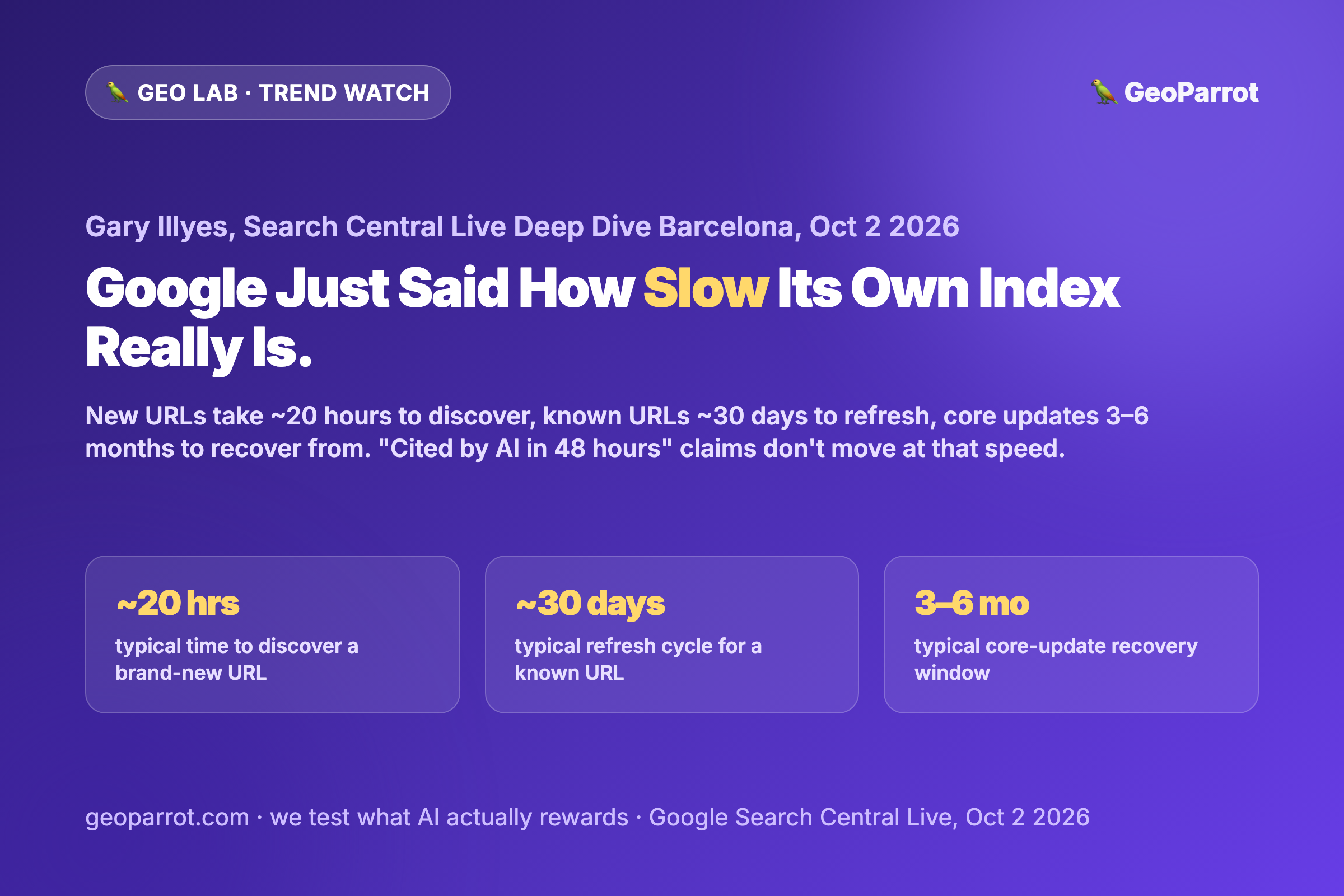
Quick answer: At Search Central Live Deep Dive in Barcelona on October 2, 2026, Google’s Gary Illyes shared internal timing data for crawling, indexing, and serving — presented as “an exercise to see if the audience can relate to the numbers,” not an official publication. Typical figures: discovering a brand-new URL takes ~20 hours; refreshing a known URL takes ~30 days; end-to-end indexing takes ~1.5 hours once crawled; a site move takes 1–3 months; core-update recovery takes 3–6 months. Slowest cases for several stretch to “weeks to never.” If you’ve seen a GEO case study claiming a new page got cited by ChatGPT or an AI Overview within 48 hours, these numbers don’t make that impossible — but they mean it almost certainly wasn’t new content moving through Google’s normal discovery-to-index pipeline. It was either already-indexed content an AI system surfaced quickly, or a path that bypasses Google’s index entirely (live web retrieval). The data is unofficial, undisclosed on methodology, and describes organic Search indexing, not AI-citation speed — a gap nobody outside Google, including us, currently has first-party data to close.
Trend watch — published October 6, 2026. We read every “Google revealed internal numbers” story the way the GEO Lab reads any claim: what was actually said, how it was sourced, and what it does and doesn’t let you conclude.
What exactly did Gary Illyes present, and how solid is the source?
On October 2, 2026, the closing day of Search Central Live Deep Dive Europe in Barcelona, Gary Illyes presented a table of internal timing data covering the stages between publishing a page and Google serving it in search results. Multiple outlets (Search Engine Roundtable, PPC Land, Search Engine Journal) converged on the same figures — reassuring cross-confirmation — but all are attendee accounts of a conference slide, not a Google blog post or help-center page. Illyes reportedly framed it as an exercise for the audience to relate to, with no disclosed methodology, sample size, or time window. Treat these as a rough internal snapshot Google was willing to say out loud, not a documented commitment.
| Process | Typical | Slowest observed |
|---|---|---|
| New URL discovery | ~20 hours | Weeks — or never |
| Known URL refresh (crawl) | ~30 days | Weeks — or never |
| End-to-end indexing | ~1.5 hours | Months — or never |
| Site move | 1–3 months | 6 months to 1 year+ |
| Core update recovery | 3–6 months | 6 months to 1 year |
| Manual action removal | 1–2 weeks | 4–6 weeks |
Why does an indexing-speed table matter for GEO at all?
Because “fast GEO win” is one of the market’s most common pitches — publish a page, add schema, get cited by ChatGPT or an AI Overview within days. Illyes’ numbers are a reality check on the organic-index side of that promise: if a brand-new URL typically takes ~20 hours just to be discovered, and a meaningful refresh of a known page typically takes ~30 days, a “we launched this page and AI cited it within 48 hours” case study isn’t describing a fresh crawl-to-index-to-citation pipeline. Either the content was already indexed and an AI system surfaced it from existing data, or the citation came through live web retrieval at query time, which doesn’t route through Google’s index at all. Both are real paths to a fast-looking citation. Neither matches the “publish it and watch AI discover it overnight” story vendors sell.
Does this mean AI citation speed equals Google’s index speed?
No — and this is the caveat that matters most. Illyes’ table describes classic organic Search crawling, indexing, and serving. It says nothing directly about how fast AI Overviews, AI Mode, ChatGPT, or Perplexity pick up and cite a specific piece of content, because those systems layer their own retrieval and summarization logic on top of (or around) the base index. We’d love to say we have first-party data closing that gap — we don’t. Our own pre-registered attempt to measure exactly this, whether an AI citation won today is still there a week later, never produced a result: Google’s bot defenses blocked every snapshot for four straight days, and we reported that failure rather than paper over it. So the honest position is: Google’s index has a documented floor on how fast new content becomes visible to it, but how AI engines’ citation timing maps onto that floor is still open, and nobody outside Google has cleanly measured it in public.
How does this connect to what we’ve already found in the GEO Lab?
On three fronts. First, our “earned beats owned” finding already pointed away from publishing content yourself as the fast lever — third-party, independently-earned mentions outperformed self-published pages in the experiments we ran and the replications we found. Illyes’ numbers add a mechanical reason why: your own new page has to clear a discovery-and-indexing floor before it can be cited from the index at all, while an already-indexed third-party page citing you has no such floor to clear. Second, this is a fresh instance of the counted vs. inferred pattern we keep running into: Illyes’ numbers are Google-counted, but “this explains why your AI citation appeared in 48 hours” is inferred — a bridge between two measurement systems we can’t verify end to end. Third, a 3–6 month core-update recovery window argues against treating AI Overview volatility as something you can out-sprint; it’s why we built the GEO benchmark as a running scoreboard instead of a one-time audit.
A timeline check for anyone evaluating a GEO speed claim
- Ask whether the cited page was actually new, or already indexed. A page published six months ago that just got a schema refresh is a far more plausible “fast AI citation” story than a brand-new URL cited within 48 hours.
- Ask which engine did the citing, and whether it does live retrieval. A citation from a live web-search call at query time doesn’t wait on Google’s crawl-to-index pipeline the way an AI Overview pulling from Google’s index does.
- Treat “cited within days” claims about brand-new domains with skepticism. Our source-check work keeps finding fast-sounding GEO statistics trace back to thin or missing methodology.
- Size expectations in months, not days, for anything depending on reindexing or recovery. 3–6 months for core-update recovery and 1–3 months for a site move are the honest planning numbers.
- Don’t assume Search Console shows you this pipeline. Search Console’s generative-AI report measures impressions, not crawl or index stage.
The honest caveats
Illyes’ numbers are unofficial: no Google blog post or help page carries them, no methodology or sample size was disclosed, and they were framed as a relatable approximation, not a measured commitment. The connection to AI citation speed is our analytical bridge, not something Illyes or Google stated — the Barcelona talk never mentioned AI Overviews, AI Mode, or chatbot citation timing. We also can’t rule out that AI answer engines have shortcuts (live retrieval, cached crawls, partnerships) that let specific citations move faster than these index-stage numbers suggest — we’re flagging the gap, not claiming to have closed it. Our own attempt to measure AI-citation timing directly failed on a technical blocker, which is evidence of how hard this is to verify independently right now, not proof of any particular timeline.
Frequently asked questions
What did Gary Illyes actually present on October 2, 2026?
Internal Google timing data for crawling, indexing, and serving, shown at Search Central Live Deep Dive Europe in Barcelona — new URL discovery (~20 hours typical), known URL refresh (~30 days typical), indexing (~1.5 hours typical), site moves (1–3 months), and core-update recovery (3–6 months).
Is this official Google documentation?
No. It was presented live at a conference as an illustrative exercise, with no disclosed methodology or sample size, and doesn’t appear in any Google blog post or help-center page.
Does this prove AI citation takes 20 hours to 30 days?
No. The data describes organic Search crawling and indexing, not AI Overview, AI Mode, or chatbot citation speed. Those systems can layer live retrieval on top of the base index, so the mapping between index speed and citation speed is unverified.
So how should I read a “cited by AI within 48 hours” case study?
With skepticism: check whether the cited page was genuinely new or already indexed, and which AI engine did the citing, since live-retrieval citations skip Google’s index pipeline entirely.
Has GeoParrot measured AI-citation speed directly?
We tried. Our pre-registered test of whether an AI citation persists over time was blocked by Google’s bot defenses on every collection attempt across four days — we reported that as a failed experiment rather than filling the gap with inference.
GeoParrot is a GEO Lab: we run experiments to test what AI search engines actually reward, and we grade the industry’s claims — including Google’s own conference disclosures — against what was actually said. See the running scoreboard at our 2026 GEO benchmark. Related: our blocked AI-citation decay experiment, why earned beats owned for AI citations, counted vs. inferred GEO metrics, and our source-check on widely-repeated GEO stats.
Leave a Reply