
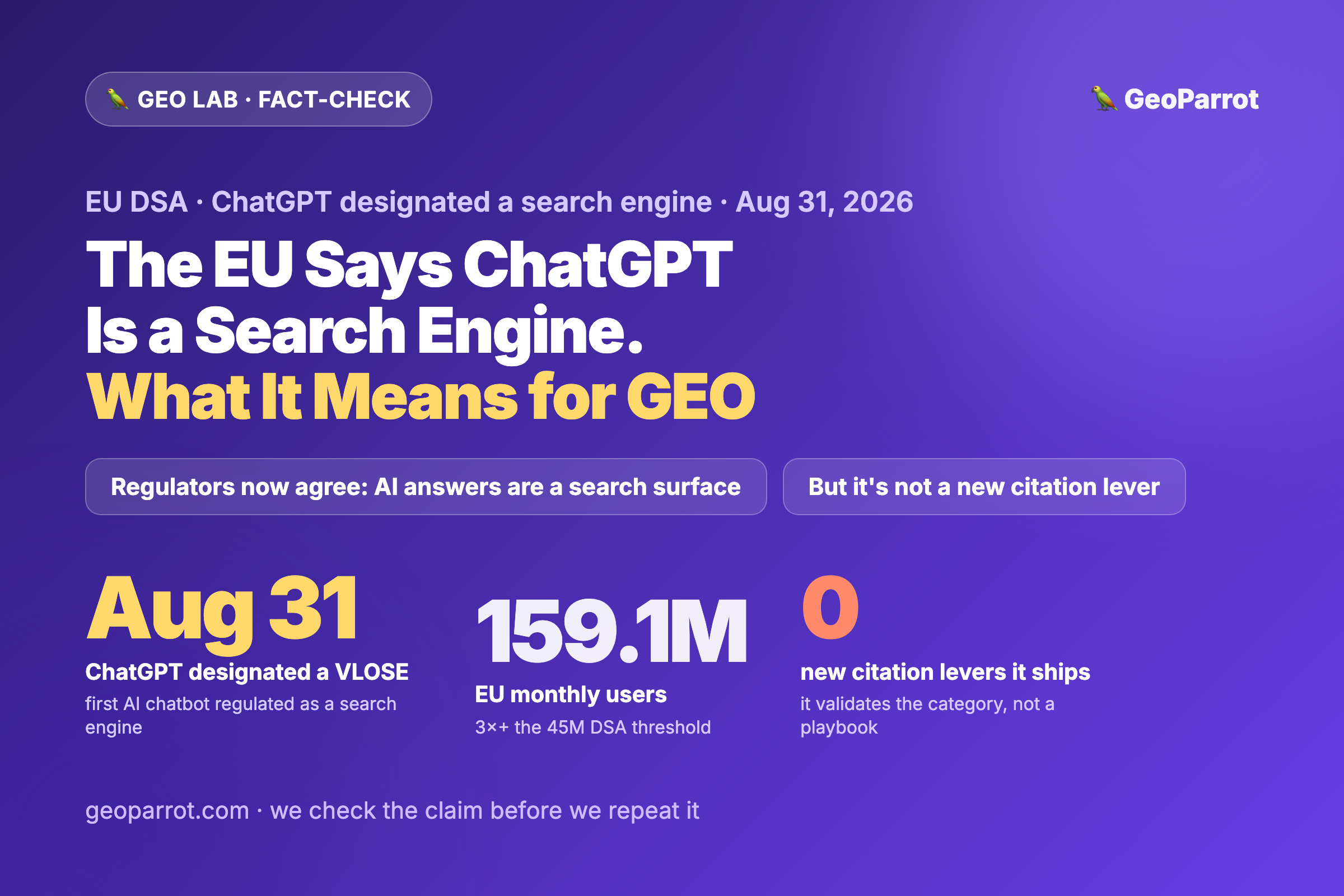
Quick answer: On August 31, 2026, the European Commission designated ChatGPT a Very Large Online Search Engine (VLOSE) under the Digital Services Act — the first AI chatbot regulated as a search engine, not a platform. The trigger was capability, not category: ChatGPT qualifies because it “responds to users’ prompts and queries, including by searching the web,” and reaches roughly 159.1 million average monthly users in the EU — more than three times the 45-million threshold. For GEO, this is real validation of the premise our whole field rests on — AI answers are a search surface you have to optimize for — now with a regulator agreeing on the record. But it is not a new citation lever. It ships no ranking signal, no analytics, no “ChatGPT Search Console.” The durable takeaway is the reframe, not a playbook change.
Trend watch — published September 6, 2026. This is a fact-check post: we report what the EU actually decided, separate the milestone from the hype, flag what’s still an untested hope, and connect it to the first-party thesis we keep testing in the GEO Lab.
What did the EU actually decide on August 31?
The European Commission formally designated three services under the Digital Services Act. ChatGPT was classified as a Very Large Online Search Engine (VLOSE); Reddit and Roblox were classified as Very Large Online Platforms (VLOPs). What makes the ChatGPT decision notable is the reasoning: it wasn’t designated because it’s an “AI chatbot.” It was designated because it searches the web to answer — the Commission’s language is that ChatGPT “responds to users’ prompts and queries, including by searching the web.” OpenAI reported roughly 159.1 million average monthly active recipients for ChatGPT search in the EU over the six months ending March 31, 2026 — well past the DSA’s 45-million bar.
The designation starts a compliance clock. Within about four months — into early 2027 — the designated services must run annual systemic-risk assessments (covering illegal content, effects on minors, mental and physical well-being, fundamental rights, electoral processes, and public security), submit to independent audits, provide data to the Commission and national regulators, grant vetted researchers legal access for systemic-risk studies, offer recommender-system transparency (including a non-profiling option where applicable), and maintain a public ad repository. Read that list carefully, because most of the GEO hype about this news is about to run past what it says.
Why should a GEO practitioner care that a regulator agrees?
Because the single biggest objection to GEO has always been definitional: is optimizing for AI answers even a real discipline, or is it SEO people rebranding a chatbot? When a regulator with the DSA’s weight puts ChatGPT in the same legal bucket as Google Search — a search engine, judged by its web-search function — it settles that argument in public. AI answer engines are a search surface. That’s not our opinion or a vendor’s pitch anymore; it’s a designation. It’s the strongest external evidence yet for the point underneath what “AI SEO” actually is and why “is SEO dead” is the wrong question: search didn’t die, it fragmented across engines that answer instead of link.
That’s genuinely useful for anyone trying to get a GEO budget approved. But be precise about what it changes: it changes the framing, not the mechanics. Nothing about how ChatGPT decides which sources to cite got easier, more transparent, or more optimizable on August 31. The category got validated; the black box stayed shut.
Will DSA transparency crack open the citation black box?
This is the tempting read — and where we pump the brakes hardest. The DSA does force real transparency: recommender-system disclosure, systemic-risk reporting, and vetted-researcher data access. It’s fair to hope that, over time, some of what GEO practitioners currently reverse-engineer by hand — which sources get cited, how retrieval favors certain domains — gets pried into the open. Our own cross-engine citation experiments exist precisely because no engine tells you this today; a mandate that anyone must document how the machine picks would be a big deal.
But three caveats keep this in the “watch, don’t reprice” column. First, the transparency is aimed at systemic risk and content safety — illegal content, minors, elections — not marketer analytics. The DSA is a safety regime, not a martech feature. It will not produce a citation dashboard for brands. Second, researcher access is gated and public-interest: vetted academics studying systemic risk, under legal access provisions — not a data feed you or your agency can query. Third, it’s EU-only, and the deadlines land in 2027. So the honest framing is: this validates the need for first-party measurement (someone has to pry the box open empirically), and it might eventually add a data source at the margins — but it does not replace instrumenting your own logs. If anything, it’s an argument for doing what we already recommend: measure AI-search referrals in your own analytics rather than waiting for a platform — or a regulator — to hand you the numbers.
What does a capability-based designation mean for every other engine?
The most durable GEO lesson here is in the logic of the decision, not the headline. The Commission designated ChatGPT on the basis of a capability — it searches the web to answer — rather than a product label. By that logic, any AI system that crosses the size threshold while answering from the live web is on the same track: Gemini, Perplexity, and Copilot’s search modes are the obvious next candidates as they scale in the EU. (To be clear, none of those has been designated yet; this is our read of the template, not a done deal.)
If that read is right, it reinforces the thesis we come back to constantly: regulators are now treating each web-searching AI as a distinct search engine — separately designated, separately audited, separately accountable. That’s the same reality our data keeps showing on the citation side, where source overlap between engines is small and each surface rewards different things. It’s why there is no universal GEO strategy and why we keep a per-engine checklist instead of one playbook. The law is starting to describe the fragmentation we’ve been measuring.
Where we pump the brakes
Two takes are already running ahead of the facts. First, “the EU designation is a new ranking factor / GEO opportunity.” It isn’t. It creates obligations for OpenAI, not signals for you. There is no action a content owner takes differently on September 6 because ChatGPT is now a VLOSE. Anyone selling “DSA-compliant GEO” as a tactic is selling the news as a lever it isn’t.
Second, “transparency rules mean we’ll finally see the citation algorithm.” Maybe, someday, partially, for researchers, in the EU. That’s a lot of qualifiers to build a strategy on. Treat it as a hypothesis about the future data environment, not a plan — the same causation discipline we apply to every trend. And resist the reflex to turn “regulated search engine” into another vanity number; the temptation to invent a “DSA visibility score” is exactly the share-of-voice trap we keep flagging. The milestone is the reframe. The work is unchanged.
What should you actually do this week?
- Use the reframe, not a new tactic. “A regulator now classifies ChatGPT as a search engine” is a clean, credible line for getting GEO onto the roadmap or into the budget. That’s the real, immediate value of this news — deploy it in the strategy deck, not in the content calendar.
- Keep earning citations the same way. Answer-first passages, first-party data, and being the source an engine trusts still decide whether you’re cited. The designation changed the label on the surface, not what wins on it (how AI search actually decides what to cite).
- Instrument your own measurement now. Don’t wait for regulator- or platform-supplied transparency. Track AI-referral traffic and citations in your own analytics so you have ground truth regardless of what the DSA eventually discloses.
- Treat each engine as its own jurisdiction — literally. The capability-based logic points at Gemini, Perplexity, and Copilot next. Keep optimizing and verifying per engine rather than assuming one approach transfers.
- Watch for real disclosures, not headlines. The things worth tracking are the systemic-risk reports and any researcher-access findings that eventually surface how retrieval and citation work — not the designation itself. File it under “future data source,” and get back to the work.
Bottom line: The EU calling ChatGPT a search engine is a milestone worth noting — the clearest official confirmation yet that AI answers are a search surface, and that the engines are separate, accountable ones. But it hands marketers no new lever and no new dashboard. It validates why GEO exists and why you have to measure it yourself; it does nothing to change how you get cited. Bank the framing, keep earning your way into the answer, and treat any future transparency as a bonus — not a plan.
Frequently asked questions
Why did the EU classify ChatGPT as a search engine and not a chatbot?
The Digital Services Act designation is capability-based. The European Commission classified ChatGPT as a Very Large Online Search Engine on August 31, 2026 because it responds to users’ prompts and queries by searching the web — the same function that defines a search engine — and because it reaches roughly 159.1 million average monthly users in the EU, more than three times the 45-million threshold. The “AI chatbot” framing wasn’t the basis for the decision; the web-search function was.
Does the DSA designation change how I get cited in ChatGPT?
No. The designation creates compliance obligations for OpenAI — systemic-risk assessments, audits, transparency reporting, researcher data access — not new ranking or citation signals for content owners. Nothing you do to earn citations should change because of it. Getting cited is still governed by retrieval and trust: answer-first content, first-party data, and being a source the engine relies on.
Will DSA transparency rules reveal ChatGPT’s citation algorithm?
Not in the way marketers hope. The transparency requirements target systemic risk and content safety, and the data-access provisions are for vetted researchers studying those risks — not a citation dashboard for brands or agencies. It’s EU-only, with deadlines in 2027. Some of how retrieval and ranking work may eventually surface through researcher studies, but treat that as a possible future data source, not a plan. Keep measuring AI-search performance in your own analytics.
Will Gemini, Perplexity, and Copilot be designated too?
None has been designated as of this writing, but the logic points that way. Because the Commission designated ChatGPT on the basis of a capability — searching the web to answer — any AI system that crosses the EU user threshold while doing the same is a plausible next candidate. That would reinforce the practical reality GEO already runs on: each web-searching AI is a distinct engine, optimized and now potentially regulated on its own terms.
What should I actually do differently because of this news?
Change your pitch, not your process. Use “a regulator now classifies ChatGPT as a search engine” to justify investing in GEO, then keep doing the work: earn citations with answer-first, first-party content, instrument your own measurement instead of waiting for disclosed data, and optimize per engine. There is no tactical action the designation itself requires from a content owner today.
Leave a Reply