
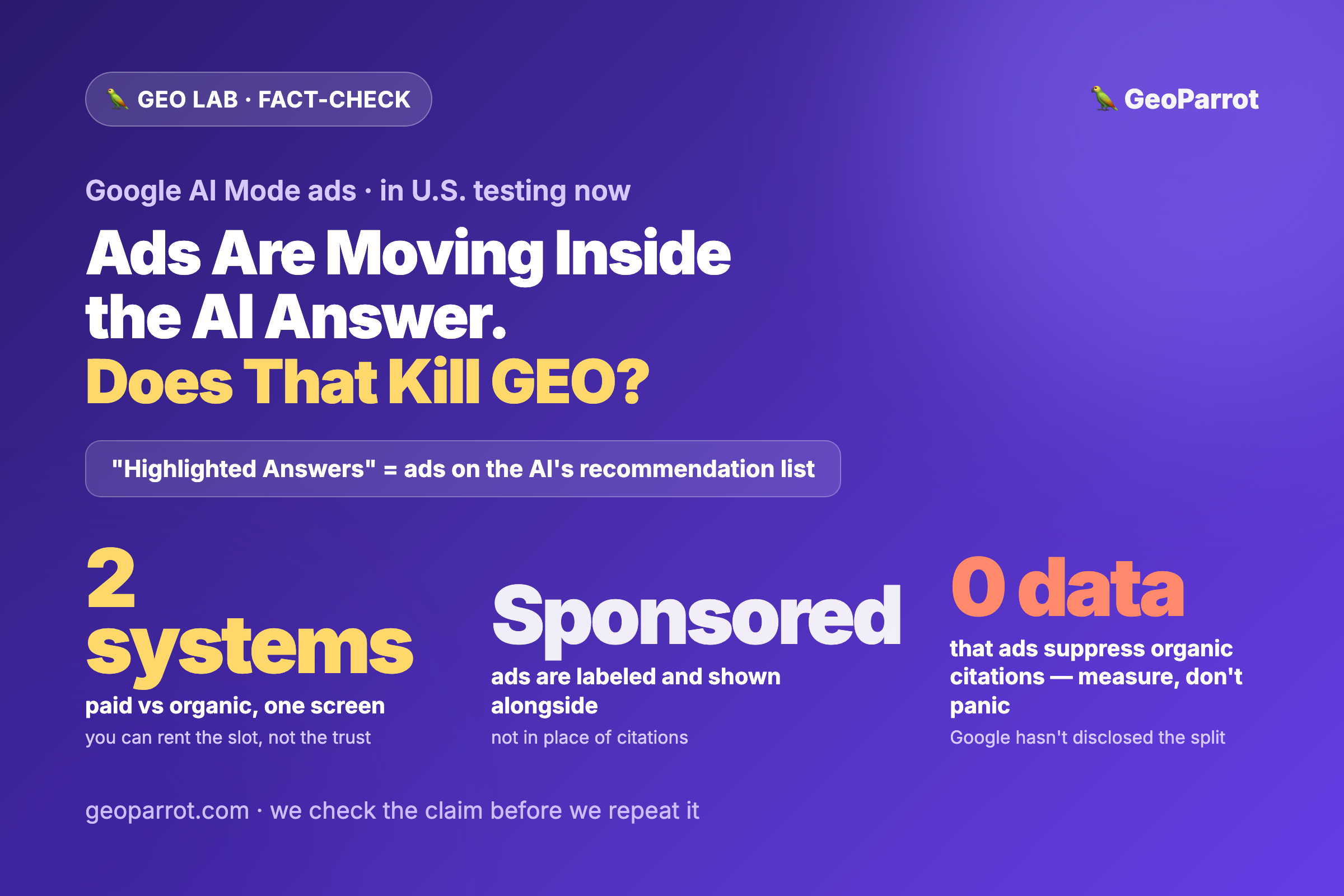
Quick answer: Google is moving ads inside the AI answer. At Google Marketing Live 2026 it introduced Gemini-powered formats that live in AI Mode responses — most notably Highlighted Answers, where “when AI Mode provides a list of recommendations… highly relevant, high-quality ads are eligible to appear on that list,” and Conversational Discovery ads that answer a query directly, with creative Gemini builds per query. Conversational Discovery ads and Highlighted Answers are in testing in the U.S. on mobile and desktop now; AI-powered Shopping ads are slated to roll out in the U.S. later this year. This matters because the recommendation list is the exact surface GEO works to earn into. But paid placement and organic citation are two separate systems: buying the ad slot doesn’t make you the source Gemini cites or recommends, and earning a citation doesn’t get you the ad. Ads are labeled “Sponsored.” Don’t panic-reallocate your citation budget off a headline — measure your own answer surface first.
Trend watch — published September 2, 2026. This is a fact-check post: we report what Google actually announced, separate it from the panic, flag what’s still an untested hypothesis, and connect it to the first-party thesis we keep testing in the GEO Lab.
What did Google actually announce?
At Google Marketing Live 2026, Google unveiled a set of Gemini-powered ad formats “designed to make ads feel more conversational, contextual and helpful” — and, critically, designed to live inside AI Mode responses rather than beside them. Three are worth naming. Conversational Discovery ads “answer a person’s specific question” directly in AI Mode, with Gemini generating creative in real time for each individual query. Highlighted Answers put ads on the AI’s recommendation list itself — Google’s own example: “when AI Mode provides a list of recommendations — like the best language apps for an upcoming trip — highly relevant, high-quality ads are eligible to appear on that list.” AI-powered Shopping ads pull a retailer’s most relevant products and “instantly write a custom explainer highlighting why your product may be the right choice.”
Two details keep the story honest. Both Conversational Discovery ads and Highlighted Answers include “an independent AI-generated explainer” — a Gemini synthesis of the product or service shown alongside the advertiser’s creative — and both “continue to be clearly labeled as ‘Sponsored.’” On timing: Conversational Discovery ads and Highlighted Answers are being tested in the U.S. on mobile and desktop; AI-powered Shopping ads are expected to roll out in the U.S. later this year. Eligibility runs through Google’s AI-driven campaign types (Performance Max, AI Max for Search, AI Max for Shopping) — an ad-account decision, not a content one. The backdrop is why this lands now: AI Mode has crossed a billion monthly users, it’s actively absorbing AI Overviews as the default answer surface, and the “Show more” gate came off this month. Ads are arriving on the surface where the answer already is.
Doesn’t this mean I can just pay to be in the AI answer?
No — and this is the distinction that survives the hype. There are two separate systems operating on the same real estate. One is the organic citation layer: Gemini retrieves, trusts, and surfaces sources in the answer, unpaid. That’s the entire subject of GEO. The other is the paid layer: an eligible advertiser wins a labeled “Sponsored” slot on the same screen. They don’t convert into each other. Buying a Highlighted Answer slot does not make you the source Gemini organically cites or the brand it names in its unpaid recommendation — and being the organically cited source does not hand you the ad. Paid ≠ earned.
This is the same wall we keep hitting from the citation side, now showing up on the ad side. Being listed is not being picked; being cited is not being recommended — the split we measured directly in our self-ranking listicle experiment and our work on how brands become the AI’s consensus pick. Add a third distinction to the stack: paid presence is not earned trust. And notice the loop — the “independent AI explainer” Google bolts onto the ad is written by Gemini from what it already knows about your product. If your organic footprint is thin, the explainer next to your own ad can undercut it. You can rent the slot; you can’t rent what the model thinks of you.
Where we pump the brakes
The take running ahead of the evidence is “ads will crowd out organic citations, so GEO is over.” It’s a plausible worry, but it’s a hypothesis, not a measured fact. Google has not disclosed how much of any given AI Mode answer becomes ad inventory, how often a Highlighted Answer actually fires, or whether a paid slot suppresses the unpaid citations below it. What Google has said is that the formats are labeled “Sponsored” and shown alongside — not in place of — its organic synthesis. Treat “ads kill GEO” the way we treat every trend claim here: as something to measure on your own surface before you re-architect around it. Sample your real queries, note when an ad appears versus when the answer is purely organic, and track whether your citation share actually moves. Don’t infer impact from a keynote slide.
The second brake: this is Google only. These formats are AI Mode / Google Search inventory. ChatGPT and Perplexity monetize on entirely different mechanics — ChatGPT’s organic product feed and shopping results are explicitly “not ads, not paid placement,” a different lever from Perplexity’s sponsored formats. There is no universal “AI ad strategy” any more than there’s a universal GEO one — the same engine-by-engine reality behind why one playbook never ports across engines. What you should do about ads on Google says nothing about what wins on the engine your customers actually use.
What should you actually do this week?
- Separate your AI tracking into paid and organic. If you lump “we showed up in AI Mode” into one number, you’ll credit a rented ad slot as if it were an earned citation. Log them apart — a Sponsored placement and an organic citation are different assets with different economics.
- Check whether you appear organically at all. Run your priority queries in AI Mode and see if Gemini cites or names you without an ad. If the only way you exist on that surface is paid, that’s a citation-layer gap ads can’t fix — it just meters your absence.
- Don’t defund citations to buy slots — if you’re a content site. Ads fit commercial-intent, high-consideration, transactional queries. If your value is being the trusted, cited source, keep earning citations; a rented slot disappears the moment the budget stops, while a citation compounds.
- Feed the explainer, not just the ad. Because Gemini writes the “independent explainer” beside your ad from your public footprint, strong answer-first, first-party content makes even your paid placement read better. The citation work is upstream of the ad’s credibility.
- Decide per engine. Whatever you conclude about Google AI Mode ads, verify separately on ChatGPT and Perplexity using the same per-engine checklist. Don’t let a Google announcement rewrite your whole-funnel plan.
Bottom line: Ads moving inside the AI answer is real, it’s live in U.S. testing, and it lands on the recommendation surface GEO cares about most. But it doesn’t collapse GEO into a media buy. Paid and organic are two systems sharing one screen — you can rent the slot, but you can’t rent the trust the model has in you, and that trust is still earned the way it always was: answer-first content and first-party authority. Measure the split on your own surface, keep earning citations, and treat ads as a separate line item — not a replacement for the work that gets you into the answer for free.
Frequently asked questions
Are there ads inside Google AI Mode now?
Yes, in testing. At Google Marketing Live 2026, Google introduced Gemini-powered ad formats that appear inside AI Mode responses. Conversational Discovery ads and Highlighted Answers are being tested in the U.S. on mobile and desktop, and AI-powered Shopping ads are expected to roll out in the U.S. later this year. All are clearly labeled “Sponsored.” Rollout status shifts fast, so verify what’s live for your own queries and account before planning around it.
Do these ads replace organic AI citations?
There’s no evidence they replace organic citations. Google presents the ad formats as labeled “Sponsored” placements shown alongside its AI-generated answer, which still includes its own synthesis and sources. Whether an ad suppresses the organic citations near it is not something Google has disclosed — treat it as a hypothesis to measure on your own queries, not a settled fact. The organic citation layer (GEO) and the paid layer are separate systems on the same screen.
Can I pay to get cited in AI answers?
No. You can pay for a labeled “Sponsored” ad slot inside AI Mode, but that is not the same as being organically cited or recommended by the model. Buying an ad doesn’t make Gemini trust or name you in its unpaid answer, and being organically cited doesn’t get you the ad slot. Paid placement is rented; organic citation is earned through content the model trusts. Being listed as an ad is not being picked as the answer.
Does this apply to ChatGPT and Perplexity too?
No — these formats are specific to Google AI Mode and Google Search. ChatGPT and Perplexity monetize differently: ChatGPT’s product and shopping results are described by OpenAI as organic, “not ads, not paid placement,” while Perplexity runs its own sponsored formats. There is no universal “AI ad strategy” across engines, just as there’s no universal GEO strategy. Verify each engine separately for the surface your customers actually use.
Should I move budget from GEO to Google AI Mode ads?
Not reflexively. Ads suit commercial-intent and transactional queries where a paid slot converts. If your goal is to be the trusted, cited source — as a publisher, content, or lead-gen site — keep investing in citations: a rented slot ends when spend ends, while a citation compounds and even improves the “independent explainer” Gemini writes beside your ad. Track paid and organic AI presence as separate assets and let the data on your own surface decide the mix.
Leave a Reply