Evidence-first case study · sports brand SEO + GEO series, part 7 of 20
Skechers’ US llms.txt is one of the most deliberately written files in this series — it even includes a “Crawling Guidance” section telling bots to ignore cart and search URLs — but the “Customer Service” link inside that same file points to a page that returns a hard error, not a help center. Meanwhile its Korea licensee site’s robots.txt is the untouched default template from the Broadleaf Commerce platform, complete with a Sitemap directive pointing at http://localhost:8080/sitemap.xml.gz — a development address that was never swapped out before the site went live.
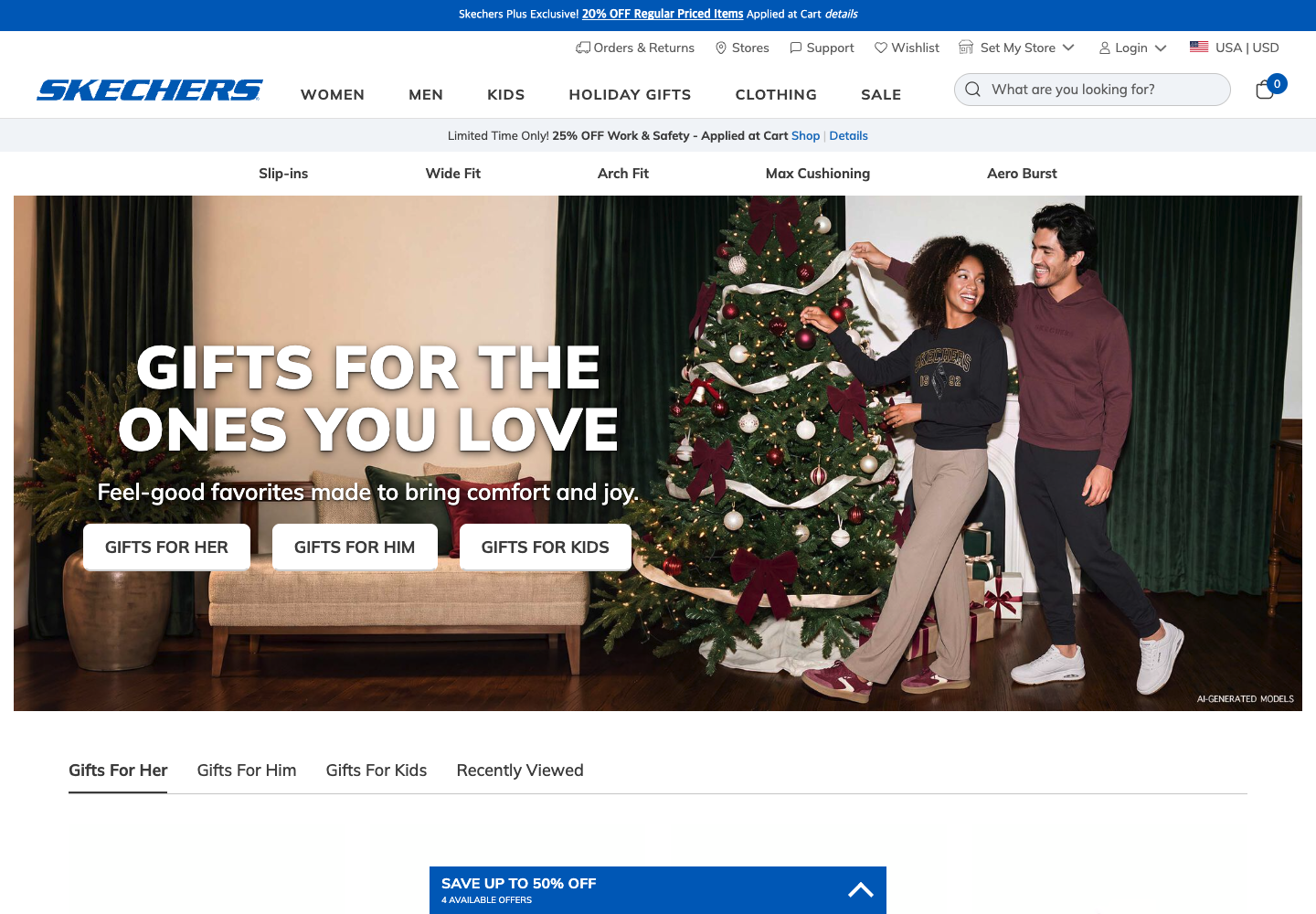
Actual public homepage captured during this audit, November 2, 2026. Note the “AI-GENERATED MODELS” label on the hero banner — a disclosure most brands in this series don’t make.
What is Skechers.com trying to do — and why audit it seventh?
This is part 7 of GeoParrot’s sports-brand series, running the same evidence-first method we used on ASICS, New Balance, Under Armour, Puma and Adidas. Skechers is a useful seventh name because, like New Balance, its Korea storefront (skecherskorea.co.kr) is run by a separate licensee company — but unlike New Balance’s licensee, whose robots.txt was at least customized, Skechers Korea’s is a verbatim ecommerce-platform default that nobody appears to have edited before launch.
Brand category California-based lifestyle and performance footwear brand, built on proprietary cushioning platforms (Arch Fit, Max Cushioning, Hands Free Slip-ins) marketed across comfort, walking, and work-safety lines.
Primary user job Find an Arch Fit style and size/width, check fit and return guidance, and get order support from a first-party help center.
SEO + GEO challenge A genuinely well-written llms.txt file whose own linked help page is broken, paired with a Korea licensee robots.txt that was never configured past its ecommerce-platform default.
The product we tracked: Arch Fit Arcade slip-in
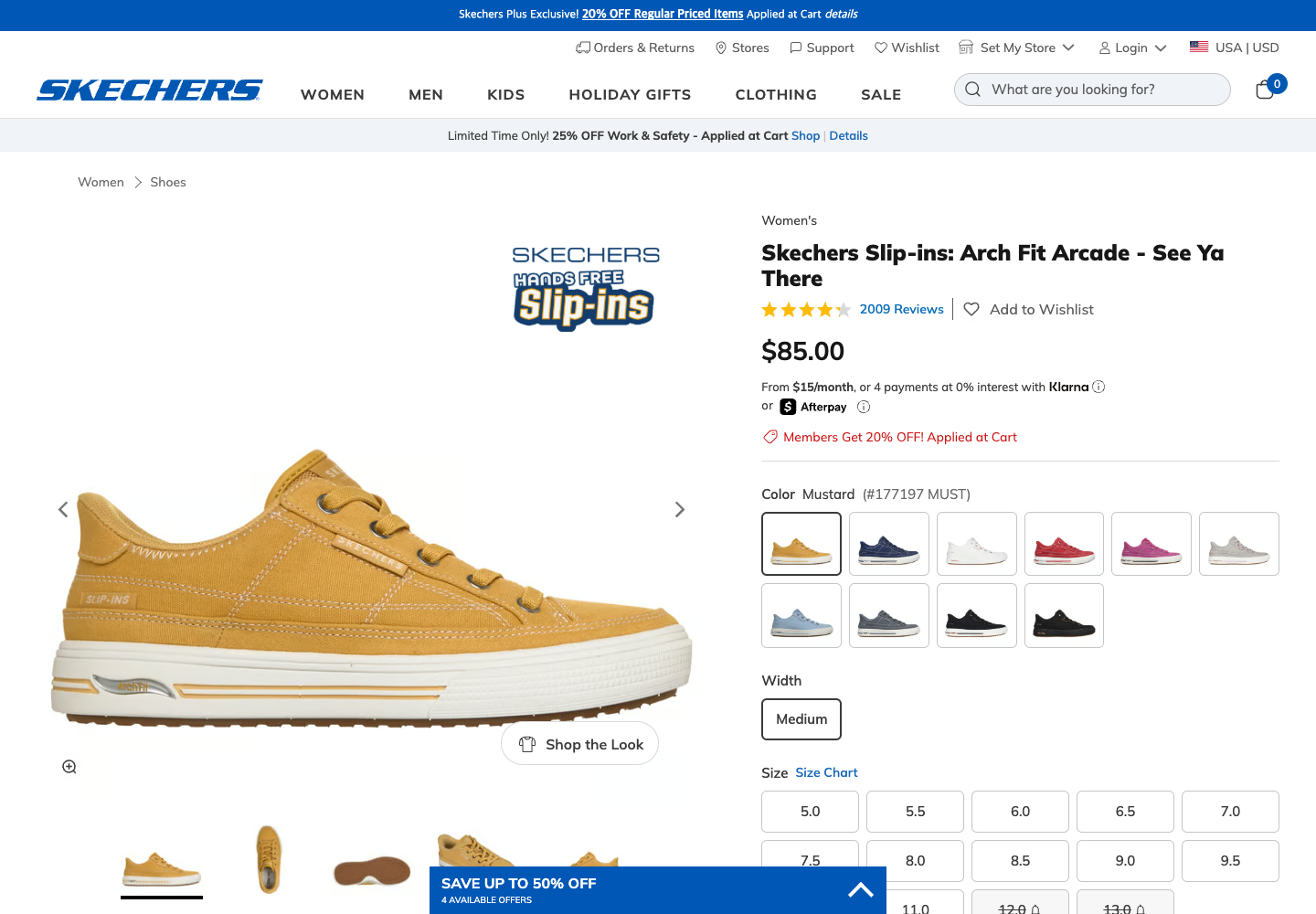
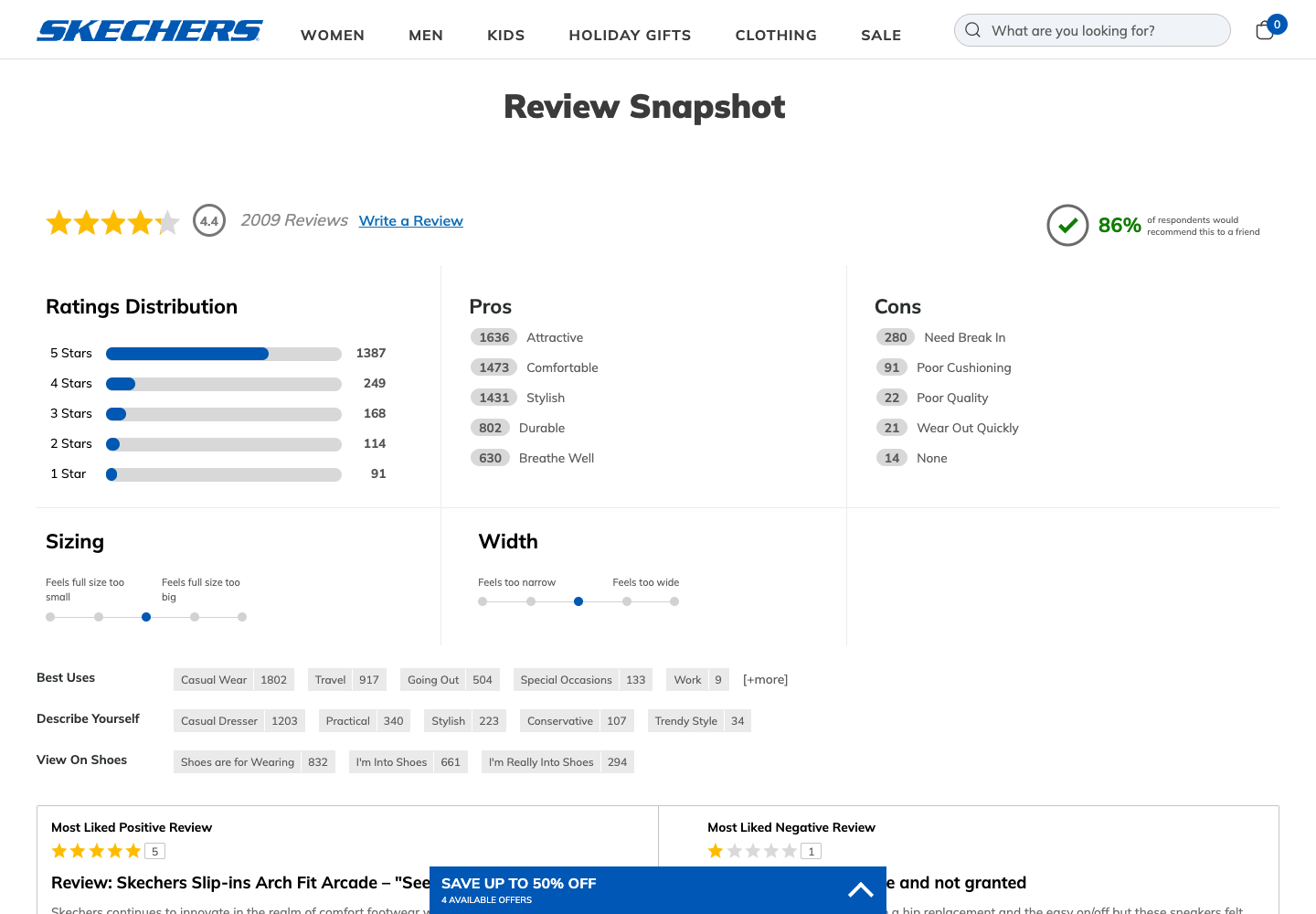
US product page: $85.00, a 4.4-star rating linking to 2,009 reviews, 10 colorways, Medium width shown.The PowerReviews-powered “Review Snapshot” panel further down the same page: a full ratings distribution, tagged pros (Attractive 1,636 / Comfortable 1,473 / Stylish 1,431) and cons (Need Break In 280 / Poor Cushioning 91), sizing and width sliders, and an 86% recommend rate — independent of whether any of it is backed by schema (checked below).
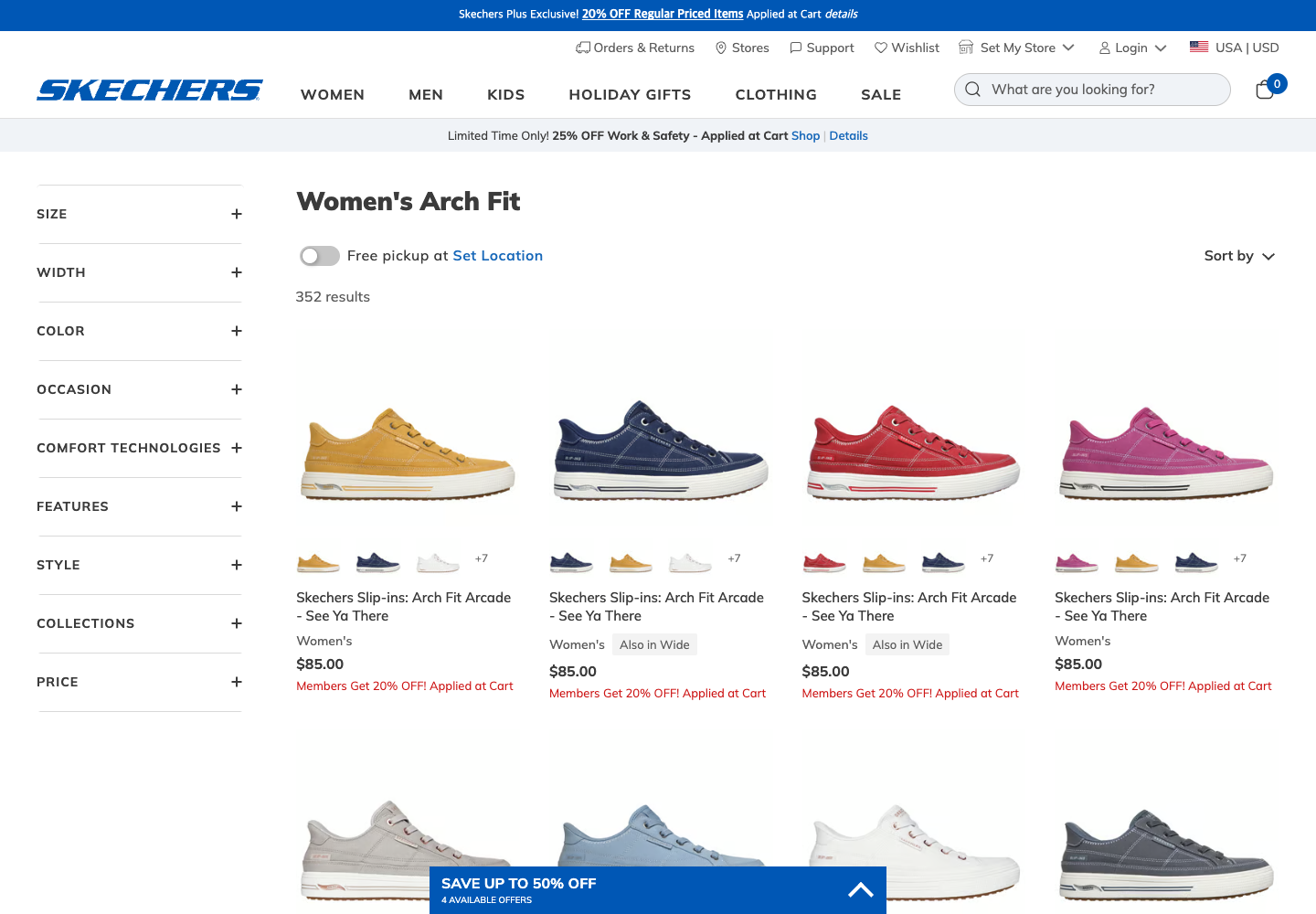
The category layer: “Women’s Arch Fit,” 352 results, filterable by size, width, color, occasion, comfort technology, features, style, collections and price.
AI citation snapshot: 10 real queries, Google AI Mode
We sent 10 verbatim queries to Google AI Mode (udm=50) and checked both direct a[href] links and citation chip aria-labels for skechers.com and skecherskorea.co.kr, including the Korean brand label “스케쳐스.” Several queries returned no usable direct hrefs at all (a recurring measurement gap in this series, not a confirmed non-citation) — those are counted as cited only when a chip label explicitly named Skechers.
Query
Skechers domain cited?
Who else showed up
best skechers arch fit shoes
❌ No
RunRepeat, YouTube (Flawless Physio | Shoe Reviews) — no Skechers-labelled chip or href captured
skechers slip-ins arch fit arcade review
✅ Yes
Instagram (direct href captured), YouTube (QVC), Zappos.com — three separate “Skechers” chips also captured
skechers vs hoka walking shoes
❌ No
Facebook (KIRO Newsradio, Chris Freytag), TikTok (ryansrunningreviews), Yahoo, GearLab, two YouTube channels — a head-to-head comparison query third-party video/social content dominated completely
skechers return policy
✅ Yes
Skechers-dominated result set — the US, India and Australia regional Skechers chips were all captured directly
is skechers true to size
❌ No
Pavers Shoes, agletless.com, RunRepeat, Super Shoes — the seventh brand in a row where third-party fit-guide content beat the brand’s own pages on a sizing query
skechers hands free slip-ins how do they work
✅ Yes
YouTube (ross ishima) — three separate Skechers-labelled chips captured on a query about Skechers’ own proprietary technology
best skechers walking shoes 2026
❌ No
RunRepeat, YouTube (NextGap), Forbes, Yahoo — the same “best [brand] shoes [year]” roundup pattern that has failed for every brand audited in this series so far
skechers plus rewards membership benefits
✅ Yes
Rivo.io (loyalty-platform vendor, x2) — plus a Korean-language “스케쳐스 코리아” chip alongside three English “Skechers” chips, the first bilingual citation pairing we’ve seen in this series
are skechers good for your feet
❌ No
michiganfootdoctors.com (x3), RunRepeat, Super Shoes, TikTok (lr_podiatry, direct href), Compleet Feet, YouTube (Paul The Podiatrist), Reddit r/PlantarFasciitis — podiatry and third-party content owns this query type
skechers vs new balance comfort shoes
❌ No
YouTube (Myself Stylish, Flawless Physio), Joybuy, Instagram, RTINGS.com — neither brand’s own domain appeared on this comparison query
Result: Skechers cited in 4/10 queries (Nike 5/10, Adidas 4/10, Puma 5/10, Under Armour 8/10 under a looser regional-counting rule, New Balance 6/10, ASICS 7/10) — tied with Adidas for the second-lowest rate measured in this series. Every brand-vs-competitor comparison query in this audit (hoka, new balance) went to third-party content, and the two misses on “is skechers true to size” / “are skechers good for your feet” continue a pattern seen in every brand audited so far: fit and foot-health questions default to podiatry and review sites over brand pages.
G-score audit: the 8-pillar hygiene checklist, six pages
We scored six representative Skechers URLs with the same 8-pillar static-HTML checklist (JSON-LD present, FAQ content, visible date, author byline, concrete data points, table/list structure, 3+ subheadings, a 30-500 character early answer) used in our Week 17 quality-score experiment and on the first six brands. All six URLs fetched successfully with a plain HTTP request — no Akamai-style block encountered this time — but one page’s fetched body was nearly content-free for reasons unrelated to bot-blocking (see below).
Page
G-score
Passes
Fails
US homepage
0.5
JSON-LD, data points, lists, subheadings
FAQ, date, author, early answer
Women’s Arch Fit category (US)
0.5
JSON-LD, data points, lists, subheadings
FAQ, date, author, early answer
Arch Fit Arcade product page (US)
0.5
JSON-LD, data points, lists, subheadings
FAQ, date, author, early answer
Help Center FAQ (US, customercare subdomain)
0.125
JSON-LD only
FAQ, date, author, data points, lists, subheadings, early answer — fetched body carried almost no extractable text
Korea homepage (skecherskorea.co.kr)
0.5
data points, lists, subheadings, early answer
JSON-LD, FAQ, date, author
Korea Arch Fit MC D’Lux product page
0.5
data points, lists, subheadings, early answer
JSON-LD, FAQ, date, author
Average G-score across six pages: 0.4375 (Nike: 0.4375, Puma: 0.354, Under Armour: 0.5208, Adidas: 0.6458, New Balance: 0.5833, ASICS: 0.4583) — tied with Nike for the second-lowest in the series. The outlier isn’t the US commerce pages (a consistent, middling 0.5 across home/category/PDP) — it’s the Help Center, which scored lower than any Korea page despite being visually the richest FAQ UI we photographed for this audit.
robots.txt (skechers.com) — A detailed, clearly hand-maintained 91-line file: disallows account/checkout/cart/search/filter-parameter paths, carves out an explicit Allow: /shipping-policy/ inside a broader shipping disallow block, and blocks the /en-gb/, /de-de/, /en-ca/ and /fr-ca/ locale paths outright (those markets apparently run on separate properties). No AI crawler (GPTBot, ClaudeBot, PerplexityBot, Google-Extended) is named anywhere, positive or negative — matching Nike’s and Puma’s silence. It does carry a working Sitemap: https://www.skechers.com/sitemap_index.xml directive.
sitemap_index.xml (skechers.com) — works, and is well-structured — Returns 200 and indexes eight sub-sitemaps: product (1.2MB), image, category, content, pipeline, a numbered fifth sitemap, a dedicated help-center sitemap, and a pages sitemap. This is the most cleanly segmented sitemap architecture we’ve found in the series so far.
llms.txt (skechers.com) — well-written, but one dead link — Returns 200 with a concise, clearly hand-authored 1,100-byte file: sections for Core Site, Product Discovery, Blog and Guides (“Skechers Stories”), Customer Information, and a “Crawling Guidance” paragraph explicitly instructing bots to use canonical sitemap URLs and ignore cart/checkout/account/search/filtered URLs — genuinely more prescriptive than most llms.txt files we’ve reviewed. See our explainer on what llms.txt actually does before treating its presence as a ranking factor — Google Search doesn’t read it regardless. But the file’s own “Customer Service” entry links to https://www.skechers.com/help/, which returned a hard error page (“Sorry! For technical reasons, your request could not be handled properly at this time”) on two independent checks minutes apart — not a 404, a functional failure on a page the brand’s own crawler-guidance file names as canonical.
The real help center lives elsewhere, unlinked from llms.txt — customercare.skechers.com/HelpCenter/s/ is a working, well-organized Salesforce Experience Cloud FAQ hub (Orders / Returns / Skechers Plus / Product Info / Payments / Store Info / Company Info tabs) — but it’s a different subdomain never mentioned in llms.txt, and its content is rendered client-side: a plain HTTP fetch of the page returns a Content-Security-Policy header listing a dozen Salesforce/Adyen/reCAPTCHA domains and almost no visible text, which is exactly why it scored the lowest G-score of any page in this audit despite being the richest FAQ UI we photographed.
robots.txt (Korea, skecherskorea.co.kr) — the headline finding — The entire file reads: "# Using default Broadleaf Commerce robots.txt file" / User-agent: * / Disallow: / Sitemap:http://localhost:8080/sitemap.xml.gz. Broadleaf Commerce is the ecommerce platform the Korea licensee’s site runs on, and this is its unmodified template output — a literal comment admitting it’s the default, a blanket non-disallow, and a sitemap pointer to a local development server address that will never resolve for any real crawler. We confirmed skechers.co.kr (the shorter domain) times out entirely and is not the live Korea site; skecherskorea.co.kr is the one that actually resolves and serves the storefront.
llms.txt and sitemap.xml (Korea) — both missing — skecherskorea.co.kr/llms.txt and skecherskorea.co.kr/sitemap.xml both return a clean 404 (not a broken redirect or empty-shell 200 like we’ve seen on other Korea sites in this series — just genuinely absent).
Product schema — present on US, but incomplete; absent on Korea — The US Arch Fit Arcade PDP carries a Product JSON-LD block (name, description, mpn, sku, brand) plus a site-level OnlineStore block, but no aggregateRating or review field anywhere in either block — despite the page displaying “2,009 Reviews” at 4.4 stars and a full PowerReviews “Review Snapshot” panel (ratings distribution, tagged pros/cons, 86% recommend). The Korea PDP returned zero JSON-LD blocks on a plain fetch at all; its content is client-rendered.
Review count and price — a stark gap, different SKUs — We could not track the identical SKU across both sites (the US style is “Arch Fit Arcade – See Ya There,” $85.00, 2,009 reviews at 4.4 stars; the nearest Korea equivalent in the same Arch Fit slip-in family is “Arch Fit MC D’Lux,” 159,000원, showing only 2 reviews at 5.0 stars). Searching “아치핏” (Arch Fit) on the Korea site returns 509 products, so the catalogue itself isn’t thin — the review volume specifically is.
AI-content disclosure on the homepage — The US homepage’s main hero banner carries a visible “AI-GENERATED MODELS” label directly on the image — a form of on-site AI-content disclosure we haven’t seen from any other brand in this series. It’s a marketing-imagery disclosure, not a GEO signal, but worth noting as the industry works out norms here.
What works / What to verify
WHAT WORKS
A genuinely prescriptive llms.txt file (the “Crawling Guidance” section is more specific than most brands bother with), a cleanly segmented 8-sitemap architecture, and an unusual on-site AI-content disclosure on the hero banner.
WHAT TO VERIFY
Whether skechers.com/help/ is a temporary outage or a long-standing dead link inside the brand’s own crawling-guidance file; whether the Korea licensee’s robots.txt has simply never been revisited since the Broadleaf Commerce platform was deployed; and whether the thin Korea review count reflects genuinely lower purchase volume or a review-collection gap specific to that market.
Target query check — reported honestly, not inflated
We have not re-measured “skechers seo” or “skechers geo audit” query volume this session. Per the pattern already confirmed across ten earlier subjects in this series on October 20, 2026 (Keyword Planner, US) — the large majority showed no measurable search volume at all for “[brand] SEO/GEO audit” phrasing — we’re not claiming this title drives ranking-based traffic. The distribution case for this series rests on internal links, our own index, and readers already following the GEO Lab arc, not on search demand for “[brand] SEO audit” as a query.
Frequently asked questions
Is Skechers’ llms.txt file actually good, given that one of its links is broken?
The file’s structure and guidance are genuinely above average for this series — it’s one of the only ones we’ve found with an explicit crawling-behavior instruction, not just a link list. But a crawler-guidance file is only as useful as the links inside it, and one of six listed URLs (Customer Service) returned a hard error on two independent checks. A well-organized file pointing to a broken page is still a broken experience for whatever reads it.
Why does Skechers Korea’s robots.txt point to a localhost address?
We can only report what we observed: the file’s content is the unmodified default output of the Broadleaf Commerce ecommerce platform, including a comment literally stating it’s the default, and a Sitemap directive pointing at http://localhost:8080/sitemap.xml.gz — a local development server address. This strongly suggests the file was never edited after the platform was set up, rather than an intentional configuration. We did not investigate who manages the licensee’s technical operations.
Does Skechers’ 4/10 AI citation rate mean its SEO/GEO setup is weaker than other brands in this series?
Not conclusively — ASICS scored both the highest citation rate (7/10) and some of the most broken infrastructure in the series, which is itself evidence against assuming citation rate tracks technical hygiene (a finding we first confirmed in our Week 17 experiment). Skechers’ 4/10 ties Adidas for second-lowest, but Adidas’s G-score (0.6458) was the highest in the series while Skechers’ (0.4375) ties Nike for second-lowest — so in this case the two metrics happen to move in the same direction, which isn’t guaranteed and shouldn’t be read as proof of a causal link.
Why only 6 pages in the G-score audit if Skechers has 352+ products in one category alone?
This audit scores a fixed, representative sample (home, category, PDP, and FAQ/help, each for US and Korea where applicable) to keep the method consistent and comparable across all 20 brands in this series — it’s a snapshot of structural hygiene on key page types, not a full-catalogue crawl. We do not claim these six pages represent every page on skechers.com.
Not measured: rankings, Search Console performance, analytics, conversion, signed-in/member flows, ChatGPT citations (not attempted, given the composer failures flagged on earlier audits in this series), or the complete product/locale catalogue beyond the one shoe family and six URLs sampled here. The US and Korea products tracked are not the identical SKU (Arch Fit Arcade vs. Arch Fit MC D’Lux) — we could not locate the exact same style on both sites, so the review-count and price comparison should be read as directional, not a precise apples-to-apples figure. This is a public-signal snapshot, not a performance claim or a full-catalogue crawl.
This is part 7 of a daily series. Every day, GeoParrot runs this same evidence-first method — real screenshots, a 10-query AI citation snapshot, an 8-pillar G-score audit, and an honest target-query check — against one more major sports and athletic-wear brand. Next: Reebok.




Leave a Reply