
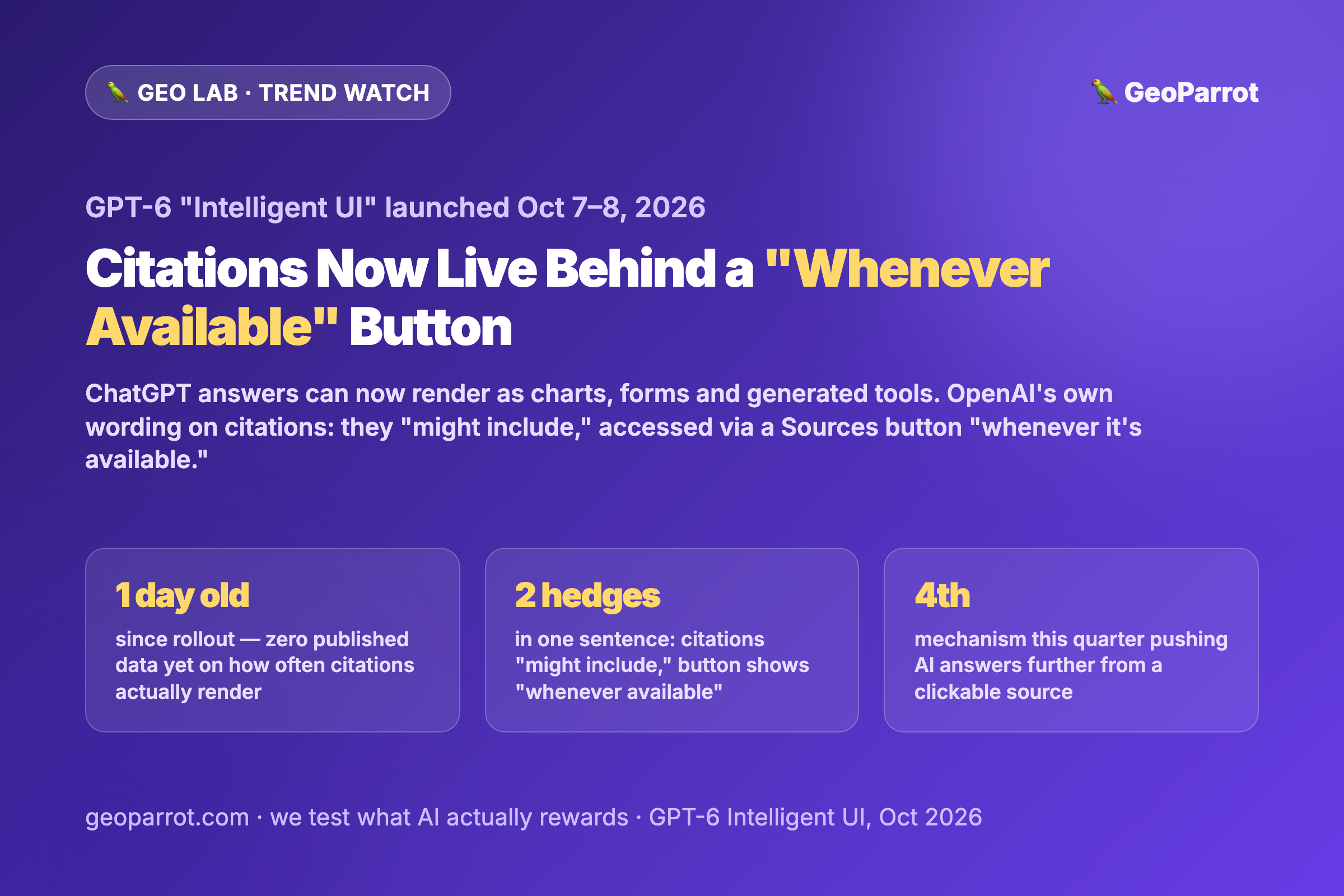
Quick answer: OpenAI shipped GPT-6 with “Intelligent UI” on October 7, 2026 — ChatGPT answers can now render as interactive widgets (calculators, bill-splitters, recipe cards that rescale by guest count, maps, checklists, multiple-choice follow-ups) instead of plain text. The rollout note’s only sentence on attribution: answers that use web search “might include citations, which can be accessed via a Sources button whenever it’s available.” That’s two hedges in one sentence — citations might appear, and the button shows up whenever it’s available. Nobody has published data yet on how often “available” turns out to be true, or whether generated tools and widgets carry any source trail at all. We checked three independent write-ups (MacRumors, Search Engine Journal, Digital Trends) and none of them had more than that one sentence either.
Trend watch — published October 8, 2026. We read every AI-search interface change the way the GEO Lab reads any claim: what’s actually confirmed, what’s inferred, and what we’d need to see measured before acting on it.
What exactly launched, and what’s confirmed vs. vague?
GPT-6 (branded Sol for paid tiers, Luna for Free/Go starting a day later) began rolling out October 7, 2026 to Plus, Pro, Business, and Enterprise users, with Free and Go following October 8. The headline feature is Intelligent UI: instead of returning only text, ChatGPT can now generate buttons, forms, charts, diagrams, interactive recipe widgets, integrated maps, and functional mini-tools (a bill splitter, a savings calculator, even small in-conversation games) as part of the answer itself. The model can also start answering before it finishes “thinking,” which OpenAI says makes GPT-6 Instant respond about 44% sooner than GPT-5.6 Instant on search-dependent questions.
What’s confirmed: the feature exists, it’s live today, and it changes the container an answer arrives in. What’s not confirmed, in any of the coverage we pulled: how source citations behave inside that container. The one sentence addressing it — citations “might include… accessed via a Sources button whenever it’s available” — tells us a button can exist, not that it reliably does, not what triggers its absence, and not whether a generated widget (the calculator, the recipe card, the checklist) carries any citation path at all when its content was partly assembled from retrieved web data.
| What we know | What’s still unknown |
|---|---|
| Feature shipped Oct 7–8, 2026, GPT-6 Sol/Luna, web + apps | What share of answers render as Intelligent UI vs. plain text |
| A “Sources button” can appear on web-search-grounded answers | How often it actually appears (“whenever it’s available” is undefined) |
| Generated tools (calculators, widgets, games) are a new answer type | Whether those tools carry any citation trail when built from retrieved data |
| GPT-6 Instant answers ~44% faster on search-dependent queries | Whether faster answering trades off retrieval depth or citation completeness |
Why should a GEO practitioner care about a UI change?
Because “getting cited in ChatGPT” has always assumed the answer is a block of text with links in it — the thing GEO advice optimizes for. Intelligent UI breaks that assumption in two ways. First, it adds friction: if citations move from inline links to a separate button that may or may not render, a cited source goes from one click away to two, or to not reachable at all. That’s the same direction as what we found when Google started testing AI Overview links that route deeper into Google’s own AI Mode instead of out to the publisher — a different company, the same structural move: the link to the source gets one step further from the user.
Second, and more structurally: some of these new answer types may not be citation-eligible in the first place. A bill-splitter or a savings calculator is a generated artifact, not a retrieved fact — there may be nothing to cite even when the underlying math logic or formatting pattern came from somewhere. If an increasing share of ChatGPT answers resolve into generated tools rather than retrieved-and-cited text, the entire category of query that “being the source ChatGPT cites” was supposed to capture may just get smaller, independent of anything a publisher does differently. That’s not a ranking problem GEO tactics can fix; it’s a shrinking addressable surface.
How does this fit the pattern we’ve already been tracking?
This is the third time this quarter we’ve flagged the same shape of change: the mechanism that delivers an AI answer keeps moving further from a clickable, attributable link, while the industry’s measurement tools lag behind. We’ve reported that earned mentions already beat owned content for AI citations in our own and replicated experiments, that a citation you win today isn’t guaranteed to still be there next week (the test we ran to check that got blocked by Google’s own bot defense, which is its own data point about how hard this is to verify independently), and that ChatGPT’s own source mix can swing by double digits month to month with no warning. Intelligent UI adds a fourth layer on top: even when a citation exists, it may now be gated behind a button whose appearance OpenAI itself only commits to as conditional. Each of these is a separate mechanism, but they all point the same way — toward less visibility into whether and how a source actually reached the end user.
That compounds a problem we’ve named before: GEO’s own measurement is already splitting into what a platform actually counts and what the industry can only infer. A citation hidden behind a conditional button that doesn’t always render is the cleanest example yet of a counted-by-OpenAI, invisible-to-everyone-else metric. If OpenAI doesn’t publish how often the Sources button appears, no third party can measure it either — the same verification gap that blocked our own decay experiment, just arriving a different way.
A checklist for what to actually do about this right now
- Don’t change anything yet based on this alone. The rollout is one day old. There’s no data on what share of queries trigger Intelligent UI, or how often the Sources button actually shows up. Reacting to an announcement, not a measured effect, is exactly the pattern we’ve warned against before.
- Watch your own referral traffic from chatgpt.com over the next 2–4 weeks, not industry commentary. If Intelligent UI is going to cost publishers clicks, your own analytics will show it before any aggregate study does.
- Keep optimizing for retrievable, quotable text — the kind of content a model pulls into a citable answer in the first place. That doesn’t change regardless of how the citation is finally rendered.
- Separate “ChatGPT answered a question in my topic” from “ChatGPT cited my page.” A growing share of answers may be generated tools with no citation slot at all — that’s a different outcome than being out-cited by a competitor, and it calls for a different response (none, in most cases).
- Treat “whenever it’s available” as a flag to monitor, not a fact to plan around, until someone — OpenAI or an independent tracker — publishes an actual rate.
The honest caveats
Everything in this piece is one day old. We have no usage data on how often Intelligent UI triggers versus a plain-text answer, no data on Sources-button appearance rates, and no independent confirmation beyond OpenAI’s own rollout note and three outlets (MacRumors, Search Engine Journal, Digital Trends) repeating it in near-identical language — which likely traces back to the same OpenAI briefing rather than three separate pieces of reporting. The “citations might disappear into generated tools” risk we’re flagging is inferred from the ambiguity of OpenAI’s own wording, not something we observed happening. It’s possible the Sources button turns out to appear reliably on every search-grounded answer and this is a non-issue; it’s also possible generated tools quietly become a large share of answers with zero citation path. We don’t know yet, and anyone claiming certainty either way one day after launch is guessing.
Frequently asked questions
What is ChatGPT’s Intelligent UI?
A GPT-6 feature, rolled out October 7–8, 2026, that lets ChatGPT answers render as interactive elements — charts, forms, checklists, maps, and generated mini-tools like calculators — instead of plain text only.
Does Intelligent UI remove citations from ChatGPT answers?
Not confirmed either way. OpenAI’s own wording says web-search-grounded answers “might include citations, which can be accessed via a Sources button whenever it’s available” — a conditional statement, not a guarantee of removal or of continuity with how citations worked before.
Should I change my GEO strategy because of this?
Not yet. There’s no usage or citation-rate data from the rollout’s first day. Watch your own ChatGPT referral traffic over the next few weeks instead of reacting to the announcement itself.
Is this the same issue as Google’s AI Overview changes?
Structurally similar, different company. We’ve separately reported Google testing AI Overview links that route into AI Mode instead of out to publishers — both cases move the link to a source one step further from the user, for different technical reasons.
Where can I verify this myself?
OpenAI’s own rollout announcement, plus independent coverage from Search Engine Journal, MacRumors, and Digital Trends (all published October 7–8, 2026) carry the same “Sources button… whenever it’s available” language.
GeoParrot is a GEO Lab: we run experiments to test what AI search engines actually reward, and we grade the industry’s claims — including our own — against what was actually measured. See the running scoreboard at our 2026 GEO benchmark. Related: Google’s AI Overview links routing into AI Mode, our blocked citation-decay experiment, why earned beats owned for AI citations, ChatGPT’s volatile source mix, and what you’ll still be able to count in 2027.
Leave a Reply