
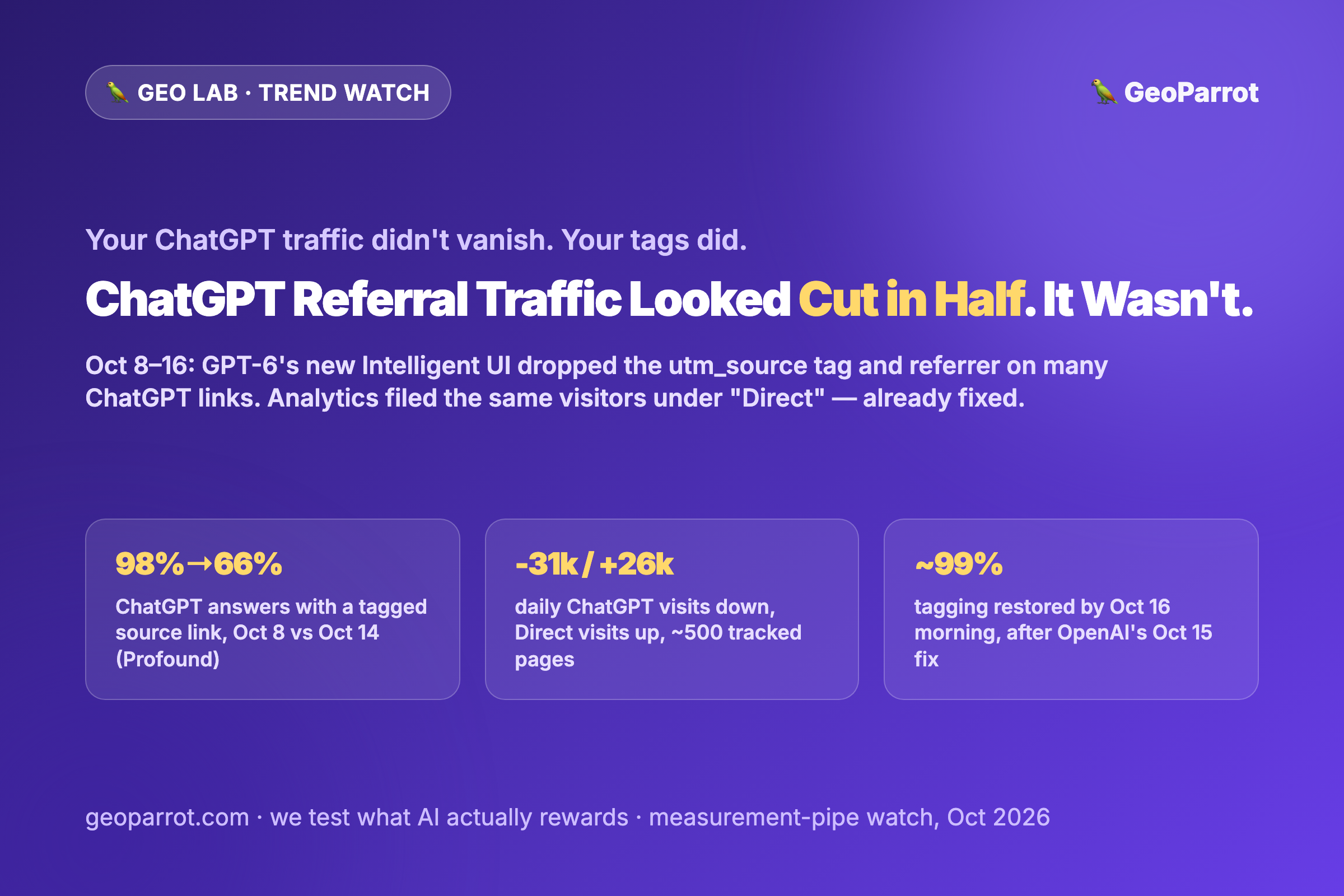
Quick answer: Between October 8 and 16, 2026, many links inside ChatGPT’s new “Intelligent UI” answers — the charts, comparisons, and mini-tools that rolled out with GPT-6 — stopped carrying the utm_source=chatgpt.com tag and opened without a referrer. Analytics tools can’t credit a visit to a source they can’t see, so GA4 and similar tools filed those visits under “Direct” instead of ChatGPT. Profound tracked the share of cited ChatGPT answers carrying a tagged link falling from about 98% on October 8 to 66% by October 14; Graphite-tracked sites saw ChatGPT-attributed sessions drop 22–57% over the same window. OpenAI confirmed it as a known bug on October 14 and shipped a fix on October 15 — by the morning of October 16, tagging was back to roughly 99%. Nothing about actual citations changed; the attribution pipe broke and got repaired.
Trend watch — published October 18, 2026. We read every AI-search measurement change the way the GEO Lab reads any claim: what’s actually confirmed, what’s inferred, and what it changes about whether your numbers mean what you think they mean.
What exactly broke, and how do we know?
GPT-6 rolled out October 7–8 with a new answer format OpenAI calls Intelligent UI — instead of a block of text with inline citations, ChatGPT increasingly renders answers as charts, comparison tables, and small interactive widgets. We flagged the open question on day one: OpenAI’s only public language on citations inside this new format was a hedged sentence — answers “might include citations,” accessible “whenever” a Sources button is available. We had no measurement of how often that “whenever” held. We have one now, and it’s a different finding than we expected: citations didn’t disappear from view — the tracking tag riding along with the link broke. Profound reports that among ChatGPT answers with citations, the share carrying at least one link tagged utm_source=chatgpt.com fell from about 98% on October 8 to 66% by October 14, while Intelligent UI’s share of answers rose from 2% to roughly 35% over the same days — a correlation Profound ties to the new format. Separately, Graphite’s cross-site tracking (via Search Engine Journal and Search Engine Land) showed ChatGPT-attributed GA4 sessions falling 22% to 57% across sites with meaningful AI-assistant traffic, starting October 9.
Why does a missing UTM tag matter more than a missing citation would?
Because the two failure modes look identical in a dashboard but mean opposite things. If ChatGPT genuinely stopped citing a site, that’s a real visibility loss worth reacting to. If ChatGPT kept citing and kept sending the visitor, but the visit arrived without a referrer or a utm_source parameter, your analytics tool has no way to credit it to ChatGPT — so it defaults to “Direct.” Profound’s own ~500-page sample shows exactly that pairing: roughly 31,000 fewer ChatGPT-attributed visits per day and roughly 26,000 more Direct visits per day over the same window — close enough to suggest the same people, relabeled. A team watching only the “AI Assistant” row during October 9–15 would have seen a scary drop and had no reason to check Direct, because Direct rising usually isn’t the alarming line. The bug doesn’t just hide itself; it points your attention at the wrong channel.
| What’s confirmed | What’s not confirmed / not the claim |
|---|---|
| Tagged-link share on cited ChatGPT answers fell from ~98% (Oct 8) to ~66% (Oct 14), per Profound | That ChatGPT reduced how often it cites sources |
| Graphite-tracked sites saw ChatGPT-attributed GA4 sessions fall 22–57% starting Oct 9 | That any individual site’s AI-referral drop this week reflects lost citability specifically |
| OpenAI confirmed a known bug Oct 14 and began a fix Oct 15 | A public root-cause writeup of why Intelligent UI links dropped the tag |
| Tagged-click rate returned to ~95–100% of the prior week’s baseline by Oct 15 morning, ~99% by Oct 16 | Whether a similar gap will reopen with the next UI format change |
How does this fit the pattern we keep documenting this quarter?
This is the fourth distinct crack we’ve tracked this quarter in the instruments people use to read AI visibility, and each fails differently. Google’s anti-scraping defenses choked third-party rank-tracker data collection by roughly 80% — a collection failure. Search Console’s own Performance report ran 44 to 64+ hours stale — a freshness failure. ChatGPT’s source mix swung YouTube citations down 91% in a month — a real but volatile selection-layer change, not a reason to pivot content monthly. This week’s failure is a fourth kind: nothing wrong with the citation or the report’s freshness — the tag the browser carries from ChatGPT to your site broke, the way a torn label doesn’t change what’s in the box. Duane Forrester’s warning that most 2027 GEO metrics won’t be independently checkable was framed as a future problem. This is the present-tense version: a number you could in principle verify (your own GA4 channel report) was silently wrong for eight days, and the only way to catch it in real time was to check a second number — Direct traffic — you probably weren’t watching.
A checklist for reading your next AI-referral number
- If an AI-referral channel drops sharply, check Direct traffic in the same window before anything else. A correlated rise in Direct is the single fastest tell for this exact failure mode — it’s what gave the bug away this time.
- Don’t rely on utm_source alone for AI-referral tracking. Pair it with referrer-domain matching (chatgpt.com, perplexity.ai) in your channel grouping, and with server-side log analysis of AI crawler and fetch user agents, which doesn’t depend on the client passing anything.
- Treat the days right after a major AI-product launch as a higher-noise window for attribution data, not a higher-signal one. New answer formats are exactly when tagging tends to break first.
- Cross-check a scary single-site number against an aggregator (Profound, Graphite, or similar) before concluding your site specifically lost AI citations. A bug this broad shows up identically across unrelated sites.
- This was a tracking fix, not a GEO signal. Nothing about retrieval or citation behavior changed, so nothing here is a reason to rewrite content strategy — the reaction this episode should produce is to your dashboard, not your content.
The honest caveats
Our figures come from Profound’s and Graphite’s tracking panels, reported through Search Engine Journal and Search Engine Land; we haven’t independently reproduced either dataset. Both vendors track a sample of sites, not the open web, so the exact percentages (66%, 22–57%) are vendor-sample statistics, not universal constants — the before/after/fixed shape is what we’d weight most, not the precise numbers. OpenAI’s October 14 confirmation was reported secondhand rather than quoted from a statement we verified directly. And the referrer loss and UTM loss sharing one root cause in the Intelligent UI rollout is Profound’s correlation, not something OpenAI has detailed publicly.
Frequently asked questions
Did ChatGPT traffic actually drop in October 2026?
The visits themselves largely didn’t disappear. Analytics tools stopped being able to attribute them to ChatGPT because the utm_source tag and referrer were missing on many links inside the new Intelligent UI answer format, so the same visitors were counted as Direct traffic instead for about a week.
Did ChatGPT stop citing sources?
Not based on the available data. This was an attribution-tagging bug, not a change in whether or how often ChatGPT cites sources. The earlier open question about whether Intelligent UI’s Sources button reliably surfaces citations at all is a separate, still-unresolved issue from this tagging bug.
Is the bug fixed now?
Yes. OpenAI confirmed it as a known issue on October 14, 2026 and began rolling out a fix on October 15. Tagged-click rates returned to roughly 95–100% of the prior week’s baseline by the morning of October 15, and to about 99% by October 16.
How do I tell a tagging bug from a real citation drop next time?
Check whether a correlated channel — usually Direct — rose by roughly the amount your AI-referral channel fell, in the same date window. If it did, suspect an attribution problem before concluding you lost visibility. Supplementing utm-based tracking with referrer-domain rules and server log analysis makes this check faster.
Is this related to the GPT-6 Intelligent UI citations question GeoParrot covered on October 8?
Yes — it’s the independent, measured follow-up to that open question. The October 8 piece flagged that OpenAI’s only language on citations inside Intelligent UI was hedged (“might,” “whenever available”) with no usage data. This week’s vendor data answers a related but different question: not whether citations exist inside the new format, but whether the tracking tag attached to them survives the trip to your site.
GeoParrot is a GEO Lab: we run experiments to test what AI search engines actually reward, and we grade the industry’s claims — including our own — against what was actually measured. See the running scoreboard at our 2026 GEO benchmark. Related: the open question on Intelligent UI citations from October 8, why chasing ChatGPT’s monthly source mix is a losing game, when Search Console’s own AI Overview data pipe ran stale, and what you’ll still be able to count in 2027.
Leave a Reply