
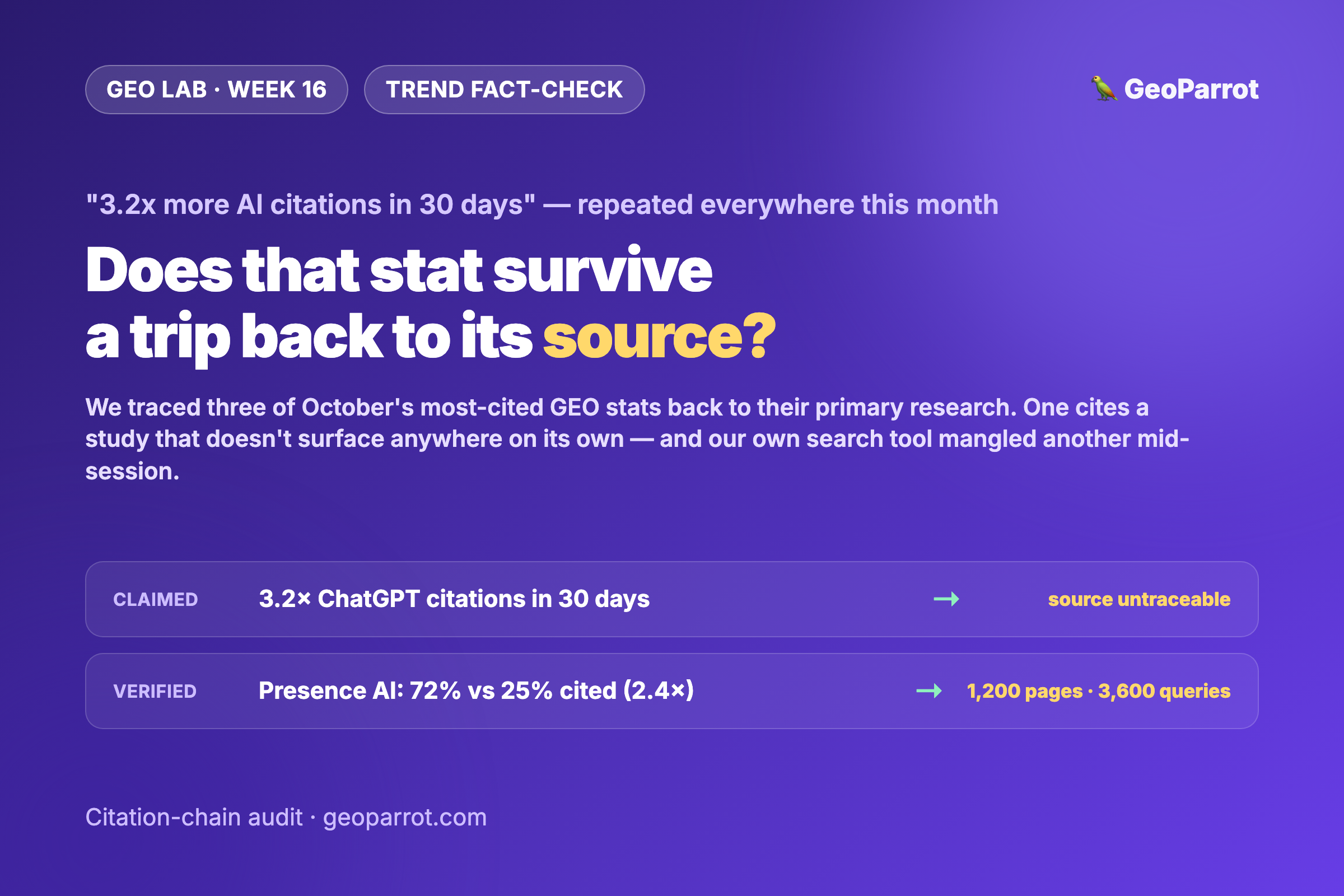
Quick answer: Partially. We traced three of October 2026’s most-repeated GEO statistics back to where they actually come from. The “pages not updated quarterly are 3× more likely to lose AI citations” claim (AirOps/Kevin Indig’s 2026 State of AI Search report) discloses no sample size or methodology. The “3.2× more ChatGPT citations within 30 days” claim traces through a blog post that cites an unnamed-platform third party — “GrowByData’s 2026 study” — which does not surface as a standalone, checkable publication anywhere we searched. The one claim with real disclosed methodology, Presence AI’s author-attribution research (1,200 pages, 3,600 queries, 500+ manually verified AI responses), is also the one whose numbers we watched get garbled in real time by our own research tooling mid-session. None of this means the underlying ideas are wrong — it means the precise multipliers being repeated as settled fact mostly aren’t verifiable at the number you’re reading.
Trend watch — published October 5, 2026. This week’s GEO Lab question: when a citation statistic gets repeated enough times, does anyone still check if it survives a trip back to its source — and what happens when the tool doing the checking has the same citation-drift problem it’s investigating?
What’s the stat everyone in GEO is repeating this week?
Two numbers are doing most of the work in early-October 2026 GEO content: a freshness multiplier and an attribution multiplier. The freshness claim says content updated recently earns dramatically more AI citations than older content on the same topic — usually stated as “3×” or “3.2×” for ChatGPT specifically, with secondary write-ups adding a full platform breakdown (Perplexity ~2.6×, Gemini ~2.1×, Google AI Overviews ~1.8×, Claude ~1.3×). The attribution claim says pages with a named author and bio get cited roughly twice as often as anonymous pages. Both numbers show up, phrased almost identically, across a cluster of SEO and GEO blogs publishing in the same two-week window — the kind of synchronized repetition that usually means one source got picked up and passed along, not that five outlets independently verified the same finding.
Does the “3x, pages not updated quarterly lose citations” claim hold up?
We went to the primary document: AirOps’ 2026 State of AI Search report, built with Kevin Indig. It contains a section titled “Pages Not Updated Quarterly Are More Than 3× as Likely to Lose AI Citations,” stating plainly that pages going more than three months without an update are over 3× more likely to lose visibility than recently refreshed pages. What the report does not disclose, in the section we could retrieve: a sample size, a definition of “lose AI citations” as an operational metric, or a methodology description beyond the headline number. That doesn’t make the finding false — Indig has a long track record in this space — but a reader can’t independently check it, replicate it, or know whether “3×” means 3× on a base rate of 2% or a base rate of 40%, which are very different real-world stakes.
What happens when you trace “3.2x more AI citations within 30 days” to its source?
This is the more interesting case. The blog post actually making the claim, apiserpent.com’s “Freshness Wins: Recent Content Earns 3× More ChatGPT Citations,” is upfront that its own first-hand evidence is a practitioner audit of 400 pages for one client — no disclosed methodology beyond that, and the author’s own number is “roughly three times,” not 3.2×. The more precise 3.2× figure, and the full five-platform breakdown that downstream blogs (authoritytech.io and others) now present as a tidy table, is attributed inside that post to “GrowByData’s 2026 study.” We searched specifically for GrowByData’s original publication — by name, by the 3.2× figure, and by the platform-breakdown numbers — across multiple queries. It never surfaces as a standalone, linkable source. It only ever appears as a name inside other blogs’ citations of it. We’re not claiming the study doesn’t exist; paywalled or unindexed research happens. We’re reporting what we could verify: as of this week, the number everyone is repeating traces to a citation of a citation, not to a document anyone reading this could open and check.
Is any of this month’s freshness or attribution research actually solid?
Yes — and it’s worth naming because it’s the exception, not the rule. Presence AI’s author-attribution research discloses real methodology: 1,200 pages tracked across 3,600+ queries in 12 industry categories, with 500+ AI responses manually verified by human review to confirm citations were real and in context. Its findings are more modest than the round numbers circulating elsewhere: a full expert bio lifts citation rate from 25% to 72% (2.4×), while just a named author with a one-sentence bio lifts it to 47% (an 89% jump with no credentials required). Presence AI also states its own limitation directly: this is practitioner research, not a peer-reviewed or controlled experiment, and it cannot fully isolate author attribution from the other quality signals — structure, editing, expertise — that tend to travel alongside a named byline. That combination — disclosed sample, disclosed method, disclosed limitation — is exactly what the freshness claims above are missing, and it’s a big part of why we’re bridging to this metric category and not dismissing GEO research wholesale.
Did our own research tool mangle this story while we were checking it?
Yes, and we’re reporting it because it’s the clearest demonstration of the whole problem. Earlier in this same research session, before we fetched Presence AI’s actual blog post, a web-search query for “Presence AI author attribution study” returned a confident summary citing “~60% more AI citations” and “1,800 brand-query pairs.” Neither number matches the real study: the actual sample is 1,200 pages across 3,600 queries, and the real lift figures are 2.4× (expert bio) and 89% (basic bio) — not a flat 60%, and not 1,800 anything. Nobody fed our tool a wrong number on purpose; a search-summarization layer blended language from adjacent sources into something that sounded precise and was wrong. That’s citation decay happening in miniature, in one session, inside the exact kind of AI tool this entire blog studies — which is the whole reason to go to the primary source instead of trusting any single AI-generated summary, including ours.
How does this connect to what GeoParrot has already found?
Directly, on three fronts. First, this is the same gap we flagged in counted vs. inferred GEO metrics — a number can be genuinely counted by whoever ran the original study and still become an unverifiable inference by the third or fourth retelling. Second, it’s the same failure mode as last week’s tracking-parameter story, where one unverified claim snowballed through SEO news sites within a day before anyone traced it back. Third, and most directly: our own citation-decay experiment set out to measure whether AI citations persist over time and came back without an answer, blocked before we could collect data. This week’s finding is almost a mirror image of that one: instead of AI-citation persistence being hard to measure, GEO-advice citation integrity turns out to be measurable right now, with search and fetch tools anyone has access to — we just rarely bother to run the check before repeating a number.
A checklist before you repeat a GEO citation statistic
- Open the primary source yourself. If the number traces to “a 2026 study” named inside someone else’s blog post with no link, treat it as unverified until you find the actual document.
- Check for a disclosed sample size and method. Presence AI’s 1,200 pages / 3,600 queries is checkable. “Pages not updated quarterly” with no N is not — even from a credible author.
- Watch for the same study wearing different numbers. “3×,” “3.2×,” and a five-platform breakdown all describe one freshness claim this month — if the precise figure shifts between re-citations, nobody re-ran the study, they re-typed it.
- Don’t trust a single AI-generated summary of a study, including this kind of search. We caught our own tool inventing a sample size mid-session. The fix was going to the actual page, not asking again.
- Correlational isn’t causal, and the honest sources say so themselves. Presence AI explicitly flags that attribution correlates with other quality signals it can’t isolate. A source that states its own limitation is more trustworthy than one that doesn’t, not less.
The honest caveats
We checked three claims, not the entire GEO content-advice ecosystem, and “we couldn’t find GrowByData’s publication” is not proof it doesn’t exist — it’s a report of what surfaced in our searches this week. It’s also fair to note the irony we’re sitting inside: we used AI-assisted web search and fetch tools to audit the reliability of AI-assisted web search and fetch tools, and we disclosed the one place that process itself produced a wrong number rather than quietly fixing it and moving on. We think that disclosure is the point, not a flaw in the piece. None of this tells you freshness or attribution don’t matter for AI citations — directionally, both plausibly do, and Presence AI’s disclosed numbers are a reasonable floor estimate. It tells you the specific multiplier you saw in a LinkedIn post or a listicle this month probably hasn’t been checked by the person repeating it, including, this time last week, by us.
Frequently asked questions
Is the “pages not updated quarterly lose 3x more AI citations” stat fake?
Not necessarily fake — it comes from a named, credible source (AirOps/Kevin Indig’s 2026 State of AI Search report) — but the report doesn’t disclose the sample size or methodology behind the number, so it can’t be independently verified at face value.
Where does the “3.2x more ChatGPT citations in 30 days” number actually come from?
It traces through a blog post (apiserpent.com) that cites a third party called “GrowByData’s 2026 study.” That study does not surface as a standalone, checkable publication in direct searches for its name or its reported figures.
Which of the claims checked out best?
Presence AI’s author-attribution research: 1,200 pages across 3,600+ queries, 500+ manually verified AI responses, disclosed limitations. Its real numbers (2.4× for a full expert bio, 89% lift for a basic named bio) are more modest than the round figures circulating secondhand.
What happened when GeoParrot’s own research tool checked this story?
A web search for the Presence AI study returned a fabricated-sounding summary (“~60% more citations,” “1,800 brand-query pairs”) that doesn’t match the real study’s numbers or sample size — caught only by going back to the primary source directly.
So should I stop updating old content or adding author bios?
No — both are reasonable, low-cost practices with at least one methodologically disclosed study pointing in their favor. The point isn’t that freshness and attribution don’t matter; it’s that the specific multiplier you’ve seen quoted probably hasn’t been checked, and shouldn’t be repeated as a verified fact until it has.
GeoParrot is a GEO Lab: we run experiments to test what AI search engines actually reward, and we grade the industry’s claims — including, this week, our own research process — against first-party checking. See the running scoreboard at our 2026 GEO benchmark. Related: does query phrasing change what gets cited, the results, why source-mix volatility is a structural feature, tracking AI-referral traffic in GA4, and the GSC generative-AI report.
Leave a Reply