
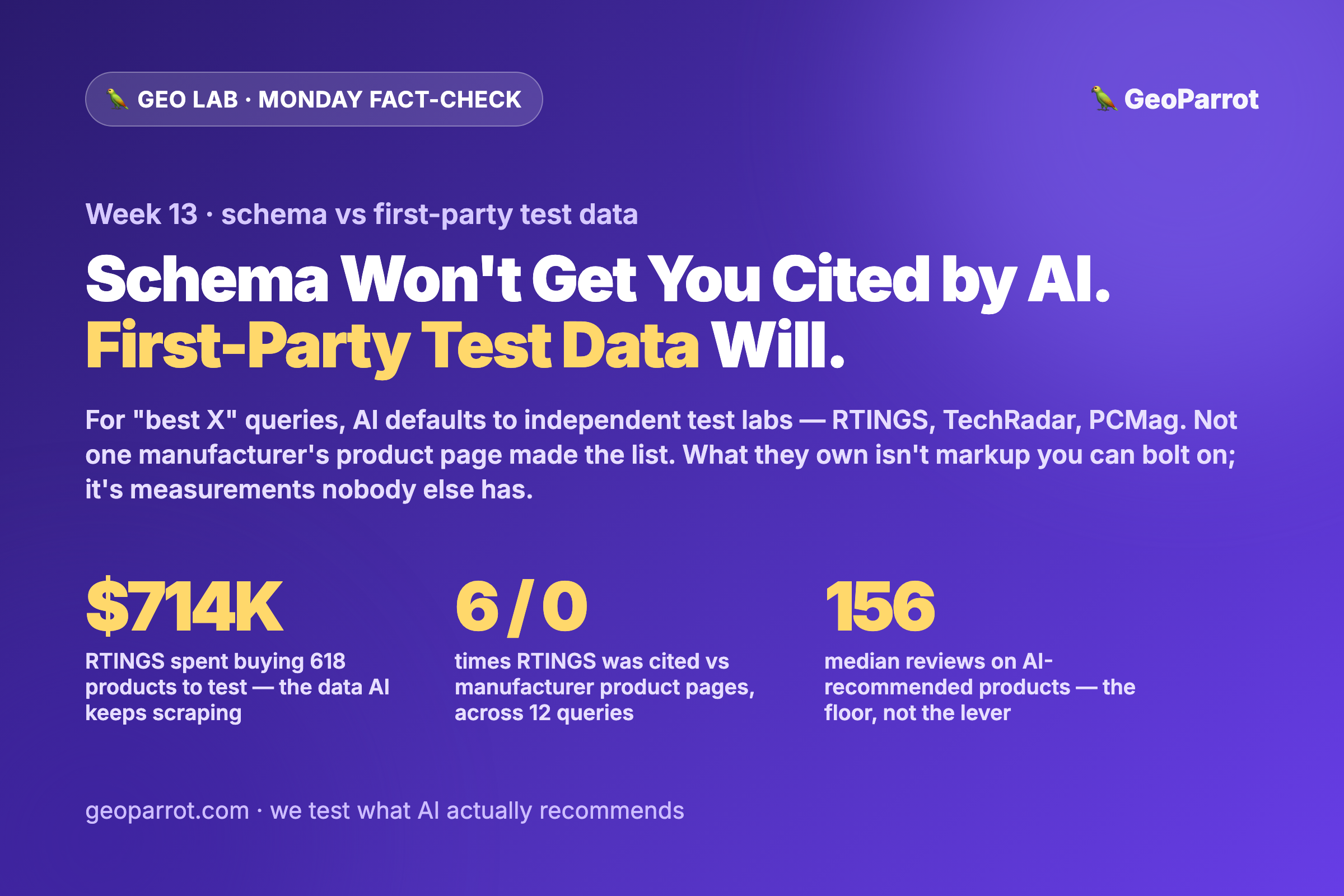
Short answer: No — you can’t schema-markup your way into an AI citation for “best X” queries. The advice circulating this month (make pages “AI-ready”: add structured data, show 150+ reviews, tick a six-point scorecard) describes the floor, not the lever. When we pulled the domains ChatGPT and Google AI Mode actually cited across 12 buyer-intent queries, the top of the list was independent test labs — RTINGS, TechRadar, PCMag — plus YouTube. What those sites own isn’t markup; it’s first-party test data that exists nowhere else. RTINGS spent $714,000 buying 618 products at retail to test last year, then locked the results behind a paywall because AI kept scraping them. Schema is table stakes everyone can reach. Original measurement is the moat you can’t fake — and that’s what this week’s arc reverse-engineers.
Monday fact-check — published September 14, 2026, opening this week’s GEO Lab arc. Last week we proved you can’t buy an AI citation with a licensing deal. The obvious follow-up: if money doesn’t decide it, why does AI reach for the same handful of independent test sites over and over — and is that something you can engineer?
What’s the claim we’re fact-checking?
The advice is everywhere this month. Search Engine Land published a six-point scorecard for “AI-ready product pages” (Jeff Oxford, March 31, 2026): product specs, unique selling points, use cases, an FAQ section, prominent review counts, and product schema markup. Follow-on case studies push it further — one September write-up claimed an electronics review site audited its top 20 pages, found none had proper schema, added it, and saw 34 pages appear in AI Overviews within eight weeks. The takeaway readers walk away with: bolt on structured data and a review widget, and the AI will cite you.
It’s not wrong, exactly. It’s incomplete in a way that sends budget to the wrong place. Every one of those six points is an eligibility signal — the hygiene that makes your page parseable and legible to a model. None of them is why a model chooses your page as the source it stands behind. We’ve drawn this line before, with backlinks and with schema: they’re floors, not levers. This week we test it where it matters most commercially — product recommendations.
Which sites does AI actually default to for “best X” queries?
We don’t have to guess. Last week, running an unrelated licensing experiment, we logged every distinct domain ChatGPT and Google AI Mode cited across 12 buyer-intent queries (four general software, four local services, four shopping products). Here are the domains cited most often — and it’s a roll call of independent testing and review, not brand-owned product pages:
| Domain | Distinct citations | What it is |
|---|---|---|
| youtube.com | 8 | Hands-on video reviews and teardowns |
| rtings.com | 6 | Independent lab that buys and tests every product |
| techradar.com | 5 | Editorial hands-on reviews with test benchmarks |
| pcmag.com | 4 | Labs-based reviews and comparative testing |
| reddit.com | 4 | First-hand user experience (Google only) |
Notice what’s not here. Not a single manufacturer’s product page. Not Yelp, whose 330M-review feed is wired directly into ChatGPT and was cited zero times. Not Wikipedia. The pattern held across engines even though ChatGPT and Google AI Mode barely overlap on the specific domains they cite: both reach for sites that tested the thing. That’s the signature we’re chasing this week.
What do RTINGS and TechRadar own that schema can’t give you?
One number tells the whole story. RTINGS disclosed that last year it spent $714,000 buying 618 different products at retail — no manufacturer samples, no loaners — specifically so it could run standardized lab measurements no one else publishes: input lag in milliseconds, measured peak brightness in nits, frequency-response curves, real battery drain. That is not content you can generate. It is first-party test data, and it’s the exact thing an AI answer needs to say “the measured peak brightness is 1,400 nits” instead of “reviewers say it’s bright.”
This lines up with the broader evidence on what AI cites. The 2026 ranking-factors survey just crowned original research and first-party data the number-one content sub-factor. Yext’s analysis found original research cited roughly 4.31× more per URL than ordinary content. And it’s why earned reputation beats mechanical signals: a model reaches for the source that did the primary work, because that source is the least reducible link in the answer chain. Schema tells the model what your page says. Test data is the reason your page is worth saying.
So why does the “add schema, show 156 reviews” advice keep working in demos?
Because it clears the floor, and a lot of pages are below the floor. The scorecard’s own data point is telling: across 1,000 e-commerce prompts, the median recommended product carried about 156 reviews. That’s real — but read it correctly. 156 reviews isn’t a lever you pull to win; it’s the ante that gets you eligible to be considered at all. If your page has no reviews, no structured data, and no parseable specs, you’re invisible, and fixing that produces a dramatic before/after screenshot. The improvement is real and the ceiling is low.
The trap is mistaking “we crossed the floor” for “we found the lever.” Once everyone in a category has schema and a review widget — and in competitive categories they do — the markup stops differentiating anyone. What breaks the tie is which source the model trusts to have actually measured the thing. Treating a review count as a target to game is the same vanity-metric mistake as chasing an “AI share of voice” score: you optimize the number and miss the substance the number was a proxy for.
Doesn’t RTINGS paywalling its data prove the opposite — that AI doesn’t need them?
It proves the opposite of the opposite. On March 2, 2026, RTINGS moved its full test results and in-depth analysis behind a paid membership, citing two forces: declining Google traffic and uncredited AI scraping of its test data. You don’t paywall the thing nobody wants. RTINGS locked its lab measurements precisely because AI systems keep repackaging them without attribution — the clearest possible signal that first-party test data is the citable asset. It also sharpens the strategic point: the moat isn’t the article or the schema wrapper around it; it’s the proprietary measurement inside, valuable enough that its owner would rather charge for it than let it leak.
Two honest caveats so we don’t over-claim. First, this is one snapshot of 12 buyer-intent queries on two engines — a strong signal, not a universal law, and engine behavior varies (Reddit only surfaced on Google). Second, “cited” isn’t the same as “picked” or “recommended” — appearing as a source is a rung below being the answer’s top choice, a ladder we’ve mapped before. This week’s experiment will pressure-test how much of the pattern is really first-party data versus structure, brand demand, or freshness.
What should you actually do this week?
- Clear the floor, then stop optimizing it. Add product schema, parseable specs, and an FAQ once. It’s eligibility hygiene, not a growth lever — do it and move on.
- Publish something you measured. A test, a teardown, a dataset, a survey — one number a model can’t get anywhere else beats ten pages of restated specs. This is the answer-first, primary-source move that compounds.
- If you can’t test it, aggregate honestly. Reddit and YouTube get cited for first-hand experience, not lab rigor — real usage, real footage. Curated primary experience is a valid moat if you can’t afford a lab.
- Measure per engine, not in aggregate. The domains ChatGPT and Google AI Mode cite barely overlap. A single “AI visibility” number hides more than it shows.
That’s Monday’s fact-check: schema gets you in the room; first-party test data gets you cited. Tuesday we’ll pre-register an experiment to isolate how much of the “cited-by-default” pattern is really original test data versus structure, brand demand, and freshness — the four suspects in this week’s reverse-engineering. Follow the GEO Lab to see whether the moat holds up when we measure it blind.
Frequently asked questions
Does adding schema markup get you cited by AI?
Schema helps a model parse your page, but it doesn’t decide whether the model cites you. In our 12-query snapshot, the most-cited domains were independent test labs (RTINGS, TechRadar, PCMag) and first-hand sources (YouTube, Reddit) — chosen for the primary data they hold, not for markup. Treat schema as eligibility hygiene you do once, not a growth lever.
Why does AI keep citing RTINGS and TechRadar?
Because they own first-party test data no one else publishes. RTINGS buys every product it tests at retail — $714,000 on 618 products last year — and runs standardized lab measurements. AI answers need those specific numbers, which is why these sites are the default source for buyer-intent queries.
If AI needs RTINGS’ data, why did RTINGS put it behind a paywall?
RTINGS paywalled its full test results on March 2, 2026, citing uncredited AI scraping and declining search traffic. That’s evidence the data is valuable, not disposable — you don’t lock up what nobody wants. It underscores that the citable asset is the proprietary measurement inside the page, not the page’s markup.
How many product reviews do you need to get recommended by AI?
One analysis of 1,000 e-commerce prompts found the median AI-recommended product carried about 156 reviews. But that’s a floor for eligibility, not a lever — once competitors also clear it, review count stops differentiating you. What breaks the tie is which source the model trusts to have actually tested the product.
What’s the difference between an eligibility floor and a citation lever?
A floor (schema, parseable specs, a review widget) makes your page legible enough to be considered. A lever (original test data, first-hand experience, primary research) is what makes a model choose your page as the source. Most “AI-ready” advice optimizes the floor; the citation goes to whoever holds the lever.
GeoParrot is a GEO Lab: we test what AI search actually cites and recommends, then publish the method and the misses. This is a Monday fact-check opening a four-part weekly arc — what AI SEO is, measured rather than asserted.
Leave a Reply