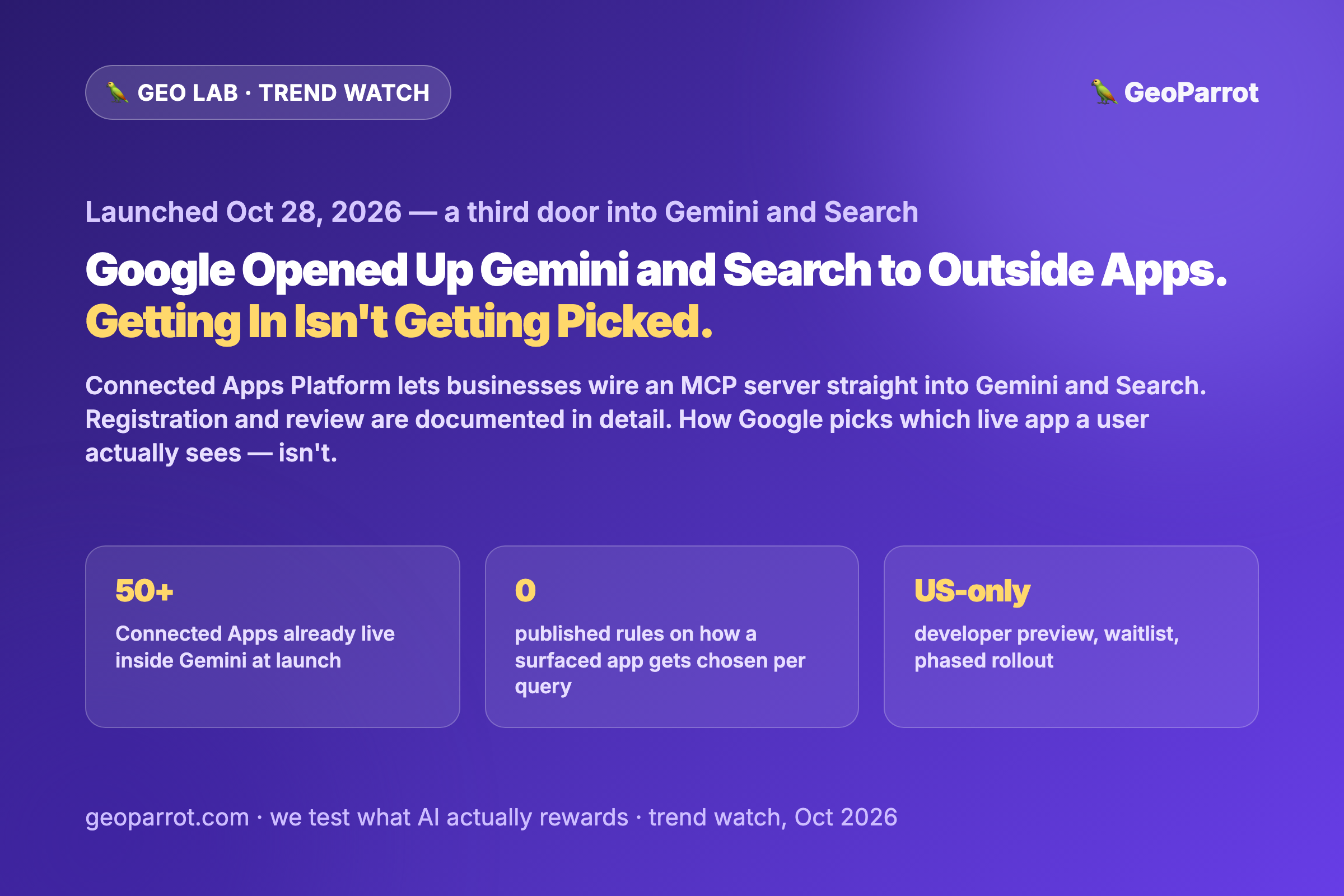
Quick answer: On October 28, 2026, Google launched a Connected Apps Platform (US developer preview) that lets businesses wire a cloud-hosted MCP server, or an Android app’s AppFunctions API, directly into the Gemini app and, within weeks, Google Search. Developers register, test and submit through a new Google Connected Console, and over 50 apps — Adobe, Instacart, Dropbox, OpenTable, Ticketmaster, Calm and others — are already live inside Gemini. It’s a real third distribution surface, separate from being cited in an AI answer and separate from letting an agent click buttons on your existing site. But nothing Google has published says how it picks which approved, live Connected App actually gets surfaced for a given user query — the same eligibility-versus-selection gap we’ve already measured twice this year in adjacent systems.
Trend watch — published October 29, 2026, in the GEO Lab. We cover GeoParrot’s own citation experiments most days; this is a case where the news isn’t about citations at all, and the distinction matters for anyone deciding where to spend engineering time next quarter.
What did Google actually launch on October 28?
A developer platform, not a content feature. To join, a business needs either a cloud-hosted MCP (Model Context Protocol) server or an Android app exposing Google’s AppFunctions APIs. From there, developers register, test and submit their “Connected App” through the new Google Connected Console, which also reports traffic, latency and error rates once an app is live, and lets a brand control how its logo and name appear. Developers choose whether their app goes live in the Gemini app, Google Search, or both. More than 50 Connected Apps are already running inside Gemini — Adobe, Experian, Localiza, Peloton, Instacart, Dropbox, OpenTable, Ticketmaster, Canva, YouTube Music and Calm among the named partners — and Google says those existing apps will start rolling into Search “over the next few weeks.” The preview itself is limited to US-based developers via waitlist, with Google saying access opens in phases after that.
Is this the same thing as GEO, or as WebMCP?
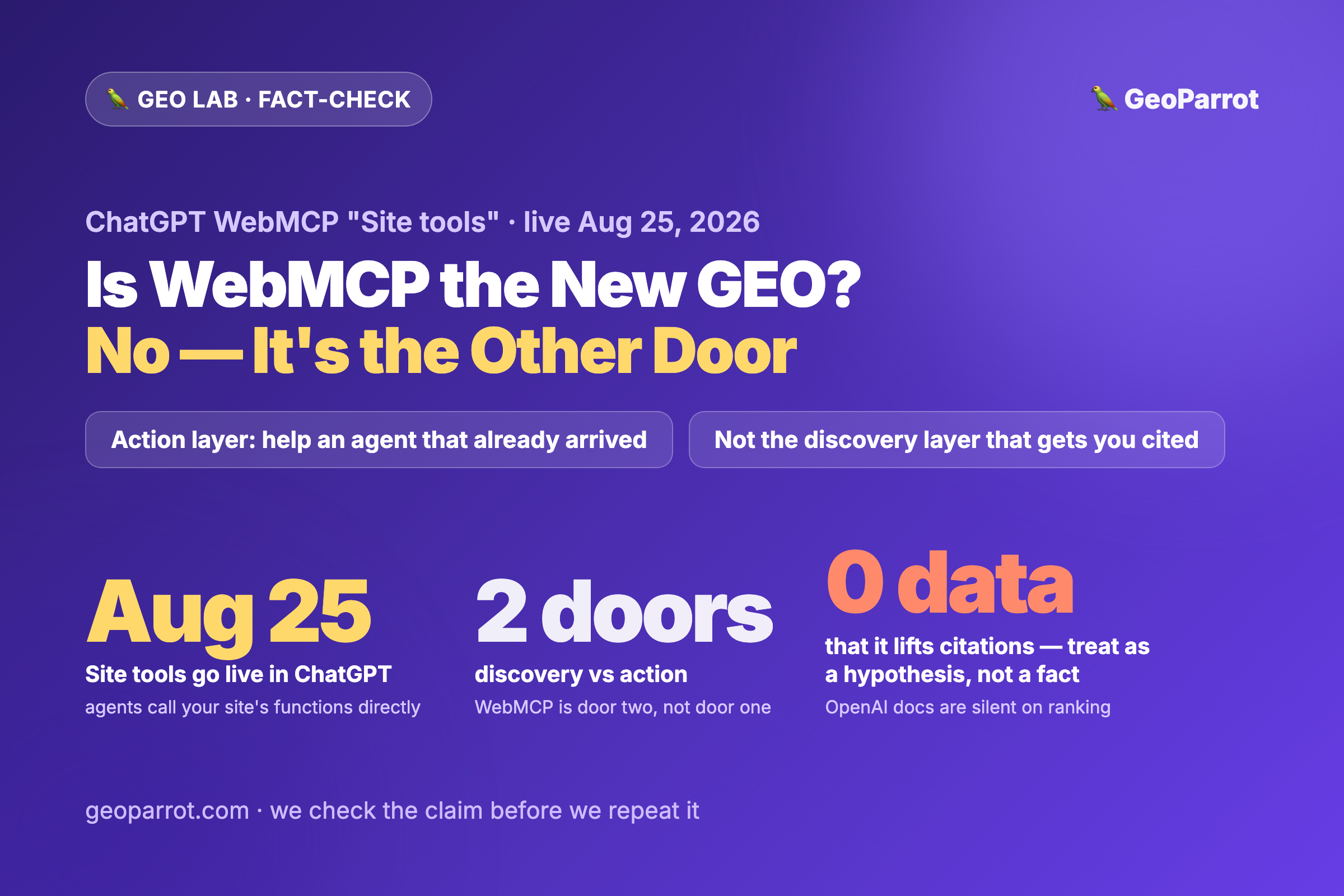
No to both, and the difference is the whole point. We’ve now covered three separate doors into AI experiences this year, and they don’t substitute for each other. Door one is citation — content-based GEO, where a page gets referenced or quoted inside an AI Overview, AI Mode answer, or chatbot response. That’s most of what we test on this site. Door two is action — OpenAI’s WebMCP “Site tools”, which we covered on August 31, lets an agent call functions your site already declares (search, add-to-cart, filter a dashboard) on your existing web pages, inside a live, logged-in session. Door three is integration — and that’s what launched this week: your app’s capabilities become a registered, reviewed, first-class citizen inside Gemini and Search themselves, independent of whether your content ever gets cited or your website ever gets agent-automated. A publisher with no app and no API has nothing to register here; this door simply isn’t open to them yet, in a way the other two doors are.
Does getting approved mean you get surfaced?
Every source we checked on this launch — TechCrunch, 9to5Google, Android Authority, ppc.land — describes the registration, testing and review pipeline in detail, and says nothing about how Google decides which of 50-plus live Connected Apps actually gets shown to a given user for a given query. That’s not a gap in the reporting; it’s a gap in what Google has disclosed. And it’s a familiar gap. We measured the identical pattern twice already: when OpenAI launched its Product Feed for ChatGPT Shopping in September, OpenAI’s own documentation described relevance and trust signals for which products get picked, but said nothing about how feed submission alone earns that pick — feed inclusion is eligibility, not selection. When Google and Shopify launched the Universal Commerce Protocol in October, the spec standardized checkout, not the decision logic for which merchant an agent recommends. Connected Apps Platform reads the same way: registration and review get you eligible to appear. Nothing published says what makes Google’s systems choose your app over another connected app, or over just answering the query in plain text, for any specific user intent.
What should a business actually do with this, this week?
Check whether you even have a door here. This platform requires a cloud-hosted MCP server or an Android app with AppFunctions support. If you’re a content publisher with no product API, this specific launch doesn’t apply to you yet — don’t reallocate GEO or content budget toward it.
If you do have a qualifying app, the waitlist itself may be worth joining now. We’ve seen early-participant advantage matter before: Google’s AI Contribution pilot payouts skewed heavily toward publishers who joined earliest, well before payout formulas were ever explained. Early access to a new surface is optionality, even when the selection logic is opaque.
Treat “live in Gemini” as a launch, not a result. Track whether your Connected App is actually being surfaced for real queries — via the Console’s own traffic data — the same way we’d insist on checking presence versus traffic for a citation. Being registered and reviewed is necessary, not sufficient.
Don’t treat this as a GEO play. It doesn’t touch how your content gets cited in AI Overviews, AI Mode or chatbot answers. If citation is your actual goal, the per-engine playbook we’ve built all year still applies unchanged.
Frequently asked questions
What is Google’s Connected Apps Platform?
A developer platform, launched in US preview on October 28, 2026, that lets businesses integrate a cloud-hosted MCP server or an Android app’s AppFunctions API directly into the Gemini app and, within weeks, Google Search. Developers register, test and submit apps through the new Google Connected Console, and more than 50 apps are already live inside Gemini.
Is Connected Apps Platform the same as WebMCP or the Universal Commerce Protocol?
No. WebMCP (OpenAI’s “Site tools”) lets an agent call functions already declared on your existing website. The Universal Commerce Protocol standardizes agent checkout across merchants. Connected Apps Platform is a third, separate thing: registering your app’s capabilities as a first-class integration inside Gemini and Search themselves, independent of your website or your checkout flow.
Does getting my app approved mean it will show up for users?
Not necessarily. Google has published detailed information on registration, review and the Connected Console, but nothing on how it decides which approved, live Connected App gets surfaced for a specific user query. Based on the identical gap we’ve already measured in OpenAI’s Product Feed and the Universal Commerce Protocol, treat approval as eligibility, not as a guarantee of selection.
Does this help my content get cited in AI Overviews or AI Mode?
No. This platform is for apps with a cloud-hosted MCP server or Android AppFunctions support, not for web content. It doesn’t change how Google’s AI surfaces select or cite pages, and a content publisher with no product API has no door to register through here.
Who can access the Connected Apps Platform right now?
As of October 28, 2026, it’s a developer preview open to US-based developers via waitlist, with Google saying it will expand access in phases. Existing Gemini-only Connected Apps are set to start appearing in Google Search over the following weeks.
Leave a Reply