
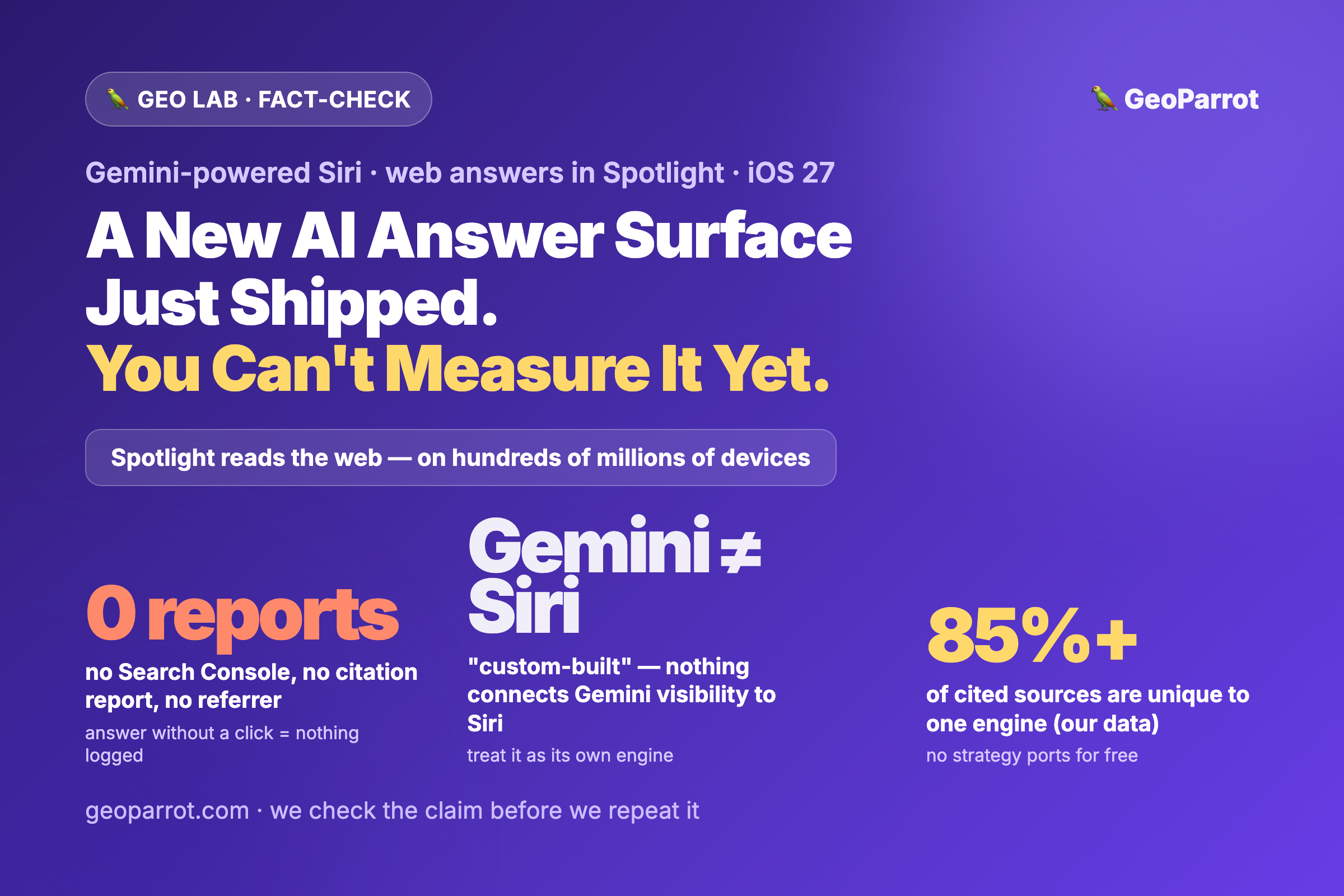
Quick answer: Apple’s rebuilt Siri — running on a Gemini model “custom-built in collaboration with Google” — ships with iOS 27 this fall and reads the live web to answer questions directly inside Spotlight on iPad and Mac (and via a swipe on iPhone). That’s a new AI answer surface arriving on hundreds of millions of devices. Two things make it different from every engine we already track. First, there is no measurement surface: Apple has described no Search Console equivalent, no citation report, and no stated referrer behavior — if Siri answers without a click, your analytics may record nothing. Second, “Gemini-powered” does not mean “optimize for Gemini.” Apple’s own language is that the model is custom-built, and nothing published connects Gemini visibility to Siri visibility. So don’t launch a “Siri optimization” sprint off a launch headline. Keep doing the thing that travels across every surface — answer-first, first-party, earned-reputation content — and treat Siri as a hypothesis to measure the moment there’s anything to measure.
Trend watch — published September 4, 2026. This is a fact-check post: we report what Apple actually announced, separate it from the “optimize for Siri now” hype, flag what’s still an untested assumption, and connect it to the per-engine thesis we keep testing in the GEO Lab.
What did Apple actually ship?
Apple’s new Siri is a ground-up rebuild whose cloud intelligence runs on a Gemini model Apple describes as “custom-built in collaboration with Google” — not licensed Gemini off the shelf. The part that matters for search is a new web-answering surface: Siri can, in Apple’s words, “get up-to-date information from the web on virtually any topic and generate a helpful answer,” and it lives inside Spotlight on iPad and Mac — the box where people already type questions — with iPhone access via a swipe from the Dynamic Island. It arrives as a developer beta first, a user beta “later this year” in English, and broadly with iOS 27 this fall, alongside the iPhone 18. The headline features require iPhone 15 Pro or newer. At launch it’s U.S. English first; it is not available in the EU, and China is pending regulatory approval.
On citations, Apple has said exactly one thing: answers “may include links to sources and websites used to help generate the answer.” That’s the entire public description — no detail on how often links appear, for which query types, or how prominent they are. For a surface that will sit on the most-used input box on the Apple ecosystem, that single sentence is the whole spec. Everything else about how it retrieves, ranks, and attributes is unstated.
Does “Gemini-powered” mean I optimize for Gemini?
This is the assumption to kill first, because it’s the one everyone reaches for. It’s tempting to conclude that if your content already gets cited by Gemini, it’ll surface in Siri answers too. Apple’s language works against that. The model is “custom-built,” and — as Search Engine Journal put it — nothing published so far connects Gemini visibility to Siri visibility. A shared model weight is not a shared engine. What decides whether you get surfaced is the whole pipeline around the model: what index it retrieves from, how it ranks candidates, what it’s tuned to trust, and how it decides to attach a link. Apple has disclosed none of that, and it’s clearly building its own layer on top.
We have a lot of first-party evidence for why the “same model = same results” shortcut fails. In our cross-engine citation study, four AI engines answering the same 15 buying-intent questions shared only two common cited domains out of 395 — over 85% of cited sources were unique to a single engine. That’s the empirical core of why there is no universal GEO strategy: citation behavior is a property of the engine’s whole retrieval-and-ranking stack, not just its underlying model. Siri is a new stack. Treat it as its own engine until data says otherwise — not as “Gemini with an Apple logo.”
Why the missing measurement surface is the real story
Here’s the part that’s genuinely new. Every answer engine you already optimize for gives you some feedback loop: Google has Search Console (and now generative-answer performance reporting), ChatGPT and Perplexity produce clickable, linked citations you can catch in referrer logs. Apple has described none of that for Siri — no Search Console equivalent, no citation report, no stated referrer behavior. As SEJ flagged, if Siri answers a question without producing a click, there may be nothing for your analytics to record at all. This is the zero-click problem in its purest form: a huge new answer surface where you may be getting used as a source and have no instrument to see it.
That inverts the usual GEO mistake. Normally we warn against chasing a vanity number — like a self-reported “share of voice” score that measures the wrong thing. With Siri the trap is the opposite but just as costly: because there’s no data, someone will sell you a “Siri visibility score” invented out of proxies and assumptions. Don’t buy a metric for a surface that ships no metric. The honest posture is to say plainly what you can and can’t see, and to not re-architect your program around a black box you can’t measure yet.
So what actually travels to a new surface?
The good news: the thing you can’t measure engine-by-engine is also the thing that generalizes best. Across the studies we’ve run and the large-n research this year, the signal that keeps predicting AI citation isn’t a schema tweak or a crawler toggle — it’s earned reputation. Ahrefs’ analysis of tens of millions of AI answers found brand web mentions correlated with AI citation far more strongly than backlinks did, which lines up with what we keep seeing: models surface the sources the wider web already treats as the authority on a topic. We unpacked that in why brand mentions beat backlinks for AI citations. That’s not a Google thing or a Gemini thing — it’s an “everywhere” thing, and it’s the safest bet for a surface whose ranking rules are invisible.
So the move is not to invent Siri-specific tactics from a launch you can’t yet see into. It’s to keep building the substrate that makes you retrievable and trusted on any surface — clear, answer-first content and genuine category authority — and to instrument the engines you can see, per engine, using the same discipline in our per-engine checklist.
What should you actually do this week?
- Don’t spin up a “Siri optimization” workstream. There are no published ranking signals and no measurement surface. Anything sold as “Siri GEO” this month is proxy and guesswork. Note it, don’t fund it.
- Don’t assume Gemini transfer. Even if you’re cited by Gemini today, treat Siri as a separate engine. Apple’s language explicitly does not connect the two, and our cross-engine data shows citation sets barely overlap even between existing engines.
- Instrument what Apple does expose. Watch your referrer logs for any Apple/Siri/Spotlight-originated traffic once iOS 27 is out, and segment it if it appears. If nothing shows, that absence is itself the finding — say so, don’t paper over it with an invented score.
- Double down on earned reputation. The signal that predicts citation across engines — brand mentions and category authority — is exactly what a black-box surface will most likely lean on. It’s the highest-confidence work you can do with zero Siri-specific data.
- EU/China teams: nothing changes yet. Siri AI isn’t available in the EU at launch and is pending approval in China. Prioritize by where your audience actually is before reacting to a U.S.-English rollout.
Bottom line: A new web-reading AI answer surface is shipping this month on a massive install base — that part is real and worth watching. But it arrives with no measurement and no published connection to the Gemini behavior you already track. The right response isn’t a sprint of Siri-specific tactics off a headline; it’s to keep earning the reputation that travels to every surface, instrument the engines you can actually see, and treat Siri as a hypothesis until Apple gives you something real to measure. We check the claim before we repeat it — and here, the honest claim is “watch, don’t panic-optimize.”
Frequently asked questions
Does the new Siri cite sources like ChatGPT or Perplexity?
Apple has said only that Siri’s web answers “may include links to sources and websites used to help generate the answer.” That’s the entire public description — there’s no stated detail on how often links appear, for which query types, or how prominent they are. Unlike ChatGPT and Perplexity, which produce consistent clickable citations, Siri’s attribution behavior is largely unspecified as of the iOS 27 rollout.
If my content is cited by Gemini, will it show up in Siri answers?
Don’t assume so. Apple describes Siri’s model as “custom-built in collaboration with Google,” and nothing published connects Gemini visibility to Siri visibility. Citation depends on the whole retrieval-and-ranking pipeline, not just the underlying model — and in our cross-engine testing, even existing AI engines shared almost no cited sources in common. Treat Siri as a separate engine until real data proves transfer.
How do I measure whether Siri is using my content?
Right now, you mostly can’t. Apple has described no Search Console equivalent, no citation report, and no referrer behavior for Siri answers, so an answer given without a click may leave nothing for your analytics to record. Watch your referrer logs for any Apple/Siri/Spotlight-originated traffic once iOS 27 ships and segment it if it appears — but be honest that a full picture isn’t available yet, and don’t buy a “Siri visibility score” invented from proxies.
When and where does the new Siri launch?
The rebuilt, Gemini-powered Siri ships broadly with iOS 27 this fall alongside the iPhone 18, following a developer beta and a user beta “later this year” in English. Headline features require iPhone 15 Pro or newer. It launches in U.S. English first; it is not available in the EU at launch, and China is pending regulatory approval.
Should I change my GEO strategy for Siri right now?
Not with a Siri-specific sprint. With no published ranking signals and no measurement surface, the highest-confidence work is the reputation that travels across every engine: answer-first, first-party content and genuine category authority — the same signals (brand mentions, trusted sourcing) that predict citation elsewhere. Instrument the engines you can actually see, per engine, and treat Siri as a hypothesis to test the moment Apple exposes anything to measure.
Leave a Reply