
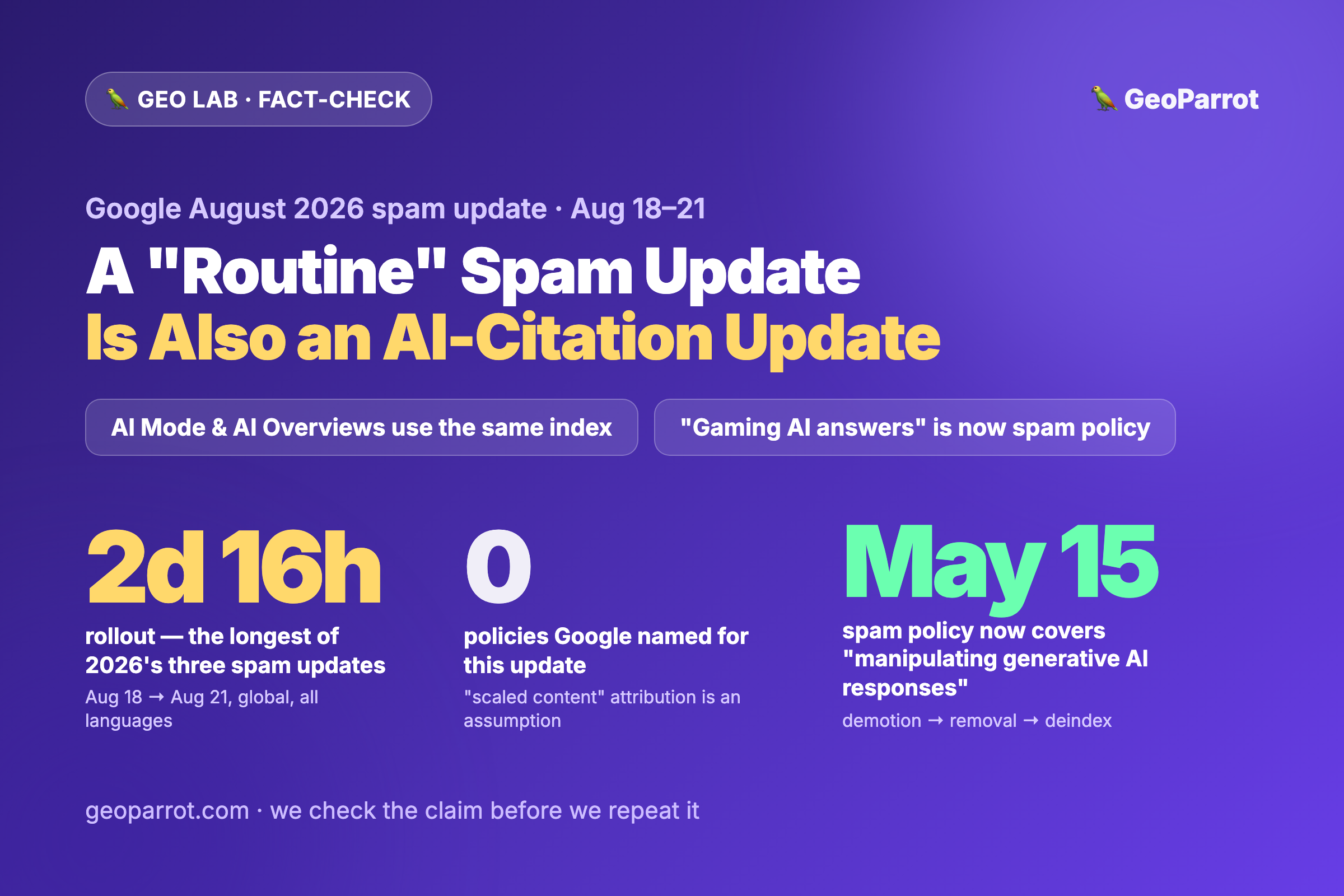
Quick answer: Google’s August 2026 spam update ran from Aug 18 to Aug 21 — about 2 days, 16 hours, the longest of the year’s three named spam updates, applied globally and to all languages. Google called it a “normal spam update” with “nothing specifically new” and named zero specific policies. The reason it matters for GEO isn’t the ranking shuffle — it’s that Google AI Overviews and AI Mode draw from the same index a spam update filters. If an update demotes or deindexes your pages, they don’t just fall in the ten blue links; they disappear from the AI answers too. And since Google’s May 15, 2026 policy rewrite, “attempting to manipulate generative AI responses in Google Search” is explicitly spam. Just don’t rebuild your strategy on the “AI-content crackdown” headline — Google didn’t say that.
Trend watch — published August 28, 2026. This is a fact-check post: we report what Google actually confirmed, flag what it didn’t, and connect it to the first-party GEO thesis we keep testing in the GEO Lab.
What actually happened?
Google announced the “August 2026 spam update, which applies globally and to all languages” on Aug 18 and confirmed the rollout complete on Aug 21. Timed precisely, it started Aug 18 at 09:27 Pacific and finished Aug 21 at 01:49 Pacific — roughly 2 days and 16 hours, making it the longest of 2026’s three named spam updates (the year’s third). Google described it as a routine “normal spam” rerun with nothing new about the mechanism.
Here is the detail almost every write-up glosses over: Google did not say which spam policies this update addresses. Any attribution to scaled content abuse, site reputation abuse, or link spam is — at this moment — an assumption, even where trade media states it confidently. That distinction is the whole post.
Why is a spam update a GEO event at all?
Because AI Overviews and AI Mode are not a separate index. They are a generative layer on top of Google Search’s existing crawl, index, and ranking systems. Google’s own guidance — the documentation titled “Optimizing your website for generative AI features on Google Search” — says the quiet part out loud: optimizing for its generative features is still SEO. We unpacked that framing in what “AI SEO” actually means.
The practical consequence: a spam action that demotes or removes a URL from Search removes it from the candidate pool that AI Overviews and AI Mode pull citations from. There is no “but we still get cited in AI” escape hatch when the underlying page is gone from the index. For anyone treating GEO as a discipline separate from technical SEO hygiene, that’s the correction — the two share a spine.
The part that IS new: gaming AI answers is now spam
This update’s mechanism may be routine, but the policy backdrop shifted earlier in 2026. On May 15, 2026, Google rewrote the introductory definition of spam in its Search spam policies. The updated text now describes spam as techniques used to deceive users or manipulate Google’s systems into featuring content prominently — “such as attempting to manipulate Search systems into ranking content highly or attempting to manipulate generative AI responses in Google Search.”
Read that clause again. Google’s spam policy now explicitly names manipulating generative AI responses — AI Overviews and AI Mode, not just the ten blue links — as a spam behavior. And the scaled content abuse policy is defined as “many pages created mainly to manipulate rankings and offering little or no value, regardless of how they were produced” — which pointedly includes using generative AI to spin up pages at scale. Enforcement isn’t cosmetic: actions range from demotion to removal, and systematic manipulation can escalate to deindexing some or all of a site.
So the tactics some “GEO” vendors sell — mass-produced answer pages, fabricated “best of” listicles that rank your own product #1, review-signal manipulation — are no longer a grey area Google tolerates because it’s “for AI.” They sit inside the same spam policy that a spam update enforces. We showed how fragile the self-ranking play already is in our experiment on whether self-ranking listicles buy AI citations (short version: engines pull the recommendation to a competitor anyway).
Where we pump the brakes
The circulating narrative — “the August spam update is Google’s AI-slop crackdown” — is a reasonable hypothesis. It is not a confirmed fact. Google named no target. Ranking volatility during any spam update is real, but attributing a specific site’s drop to “AI content” without a controlled before/after is exactly the causation error we flag over and over. It’s the same discipline we applied to the ChatGPT–Reddit citation collapse: the what can be well-measured while the why stays an open question — and acting on the wrong why is how teams waste a quarter.
If your traffic moved during this window, resist the tidy story. Check whether the affected pages were thin, templated, or scaled; check whether they lost visibility in classic Search, AI Overviews, or both; and only then form a theory. This is also why we keep arguing there’s no universal GEO strategy — the same page can behave differently across Google’s classic and generative surfaces, and a blended “we got hit” reaction hides which surface actually moved.
What should you actually do about it?
- Audit for scaled/thin content first. If you’ve published AI-generated pages at volume “for GEO,” that is now squarely in scaled-content-abuse territory — “regardless of how they were produced.” Prune or consolidate before an update prunes them for you.
- Track AI visibility and classic rankings as one system. They share an index. If a spam update hit you, check AI Overviews / AI Mode citations and blue-link positions — a drop in one without the other tells you where the problem lives.
- Stop treating “GEO” as an exemption from SEO hygiene. Google’s own doc says generative optimization is still SEO. Crawlability, dedup, genuine value, and E-E-A-T are the GEO fundamentals — not an llms.txt file (which Google still doesn’t use).
- Don’t act on the “AI crackdown” attribution until it’s tested. Treat any drop as observed and the cause as a hypothesis. Wait for a controlled read — or run your own before/after — before you rewrite your content plan.
- Lean into what survives every update: first-party, genuinely useful pages. Original data, real experiments, and answer-first passages are the content class no spam update targets — because they’re the value the policy is written to protect.
Bottom line: the August 2026 spam update looks routine, and in mechanism it is. What’s changed underneath is that Google now enforces one spam policy across both its classic and its generative results — and explicitly counts “manipulating generative AI responses” as spam. The winners aren’t the teams chasing the crackdown narrative. They’re the ones who never built on manipulation in the first place.
Frequently asked questions
When did Google’s August 2026 spam update roll out?
It started on August 18, 2026 (09:27 Pacific) and Google confirmed it complete on August 21, 2026 (01:49 Pacific) — about 2 days and 16 hours. It applied globally and to all languages, and it was the longest of 2026’s three named spam updates.
Did the August 2026 spam update target AI-generated content?
Google did not say. It described the update as a routine “normal spam” rerun and named no specific policy. Attributing it to scaled content abuse, AI-generated pages, or site reputation abuse is an assumption, not a confirmed target — even where trade media states it confidently.
Does a Google spam update affect AI Overviews and AI Mode?
Yes. AI Overviews and AI Mode are generated on top of Google’s existing index and ranking systems. If a spam update demotes or removes a page from Search, that page also drops out of the candidate pool AI answers cite from. There’s no separate “AI index” that shields a demoted URL.
Is manipulating AI answers against Google’s rules?
Yes, explicitly. Google’s May 15, 2026 spam policy rewrite added “attempting to manipulate generative AI responses in Google Search” to its definition of spam. That covers AI Overviews and AI Mode. Enforcement can range from demotion to removal, up to deindexing pages for systematic manipulation.
What should I do if my traffic dropped during the update?
Don’t assume the “AI crackdown” narrative. Check whether affected pages are thin, templated, or scaled; check whether they lost visibility in classic Search, in AI surfaces, or both; and treat the cause as a hypothesis until you have a controlled read. Prioritize pruning low-value scaled content and strengthening original, first-party pages.
Leave a Reply