
Evidence-first case study · global retail SEO + GEO
IKEA is not a furniture catalogue with a cart attached. It is a 91-market retail system that has to keep one product identity intact — and now has to decide what it lets generative AI write on its behalf.
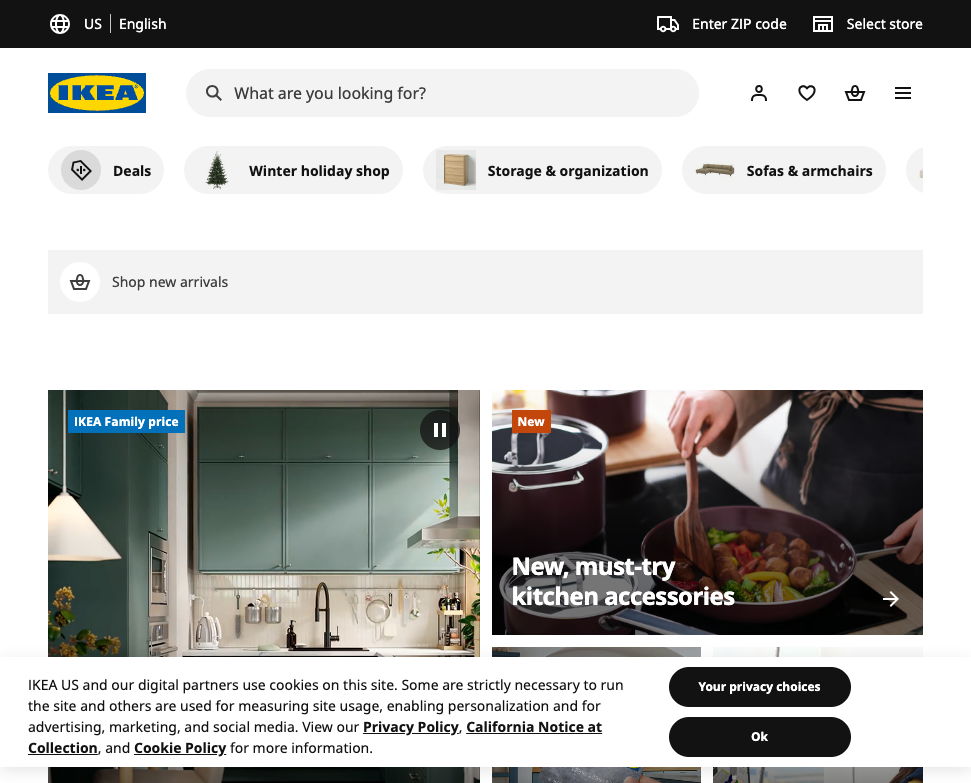
What is IKEA — and what is this site trying to do?
The public ikea.com/us/en homepage gives the clearest answer. IKEA sells furniture and home goods through a hybrid model: a browsable catalogue, in-store pickup, home delivery and a large self-assembly product range. The discovery path is pick a room or product need → compare variants on price, size, color and reviews → check stock/delivery → commit, in-store or online.
Global furniture and home-furnishings retailer; hybrid in-store and e-commerce model.
Find a product that fits a specific room, size and budget, then trust it enough to buy and assemble it.
Keep one product’s identity — reviews, specs, support answers — consistent across 91 country/language combinations, while deciding what AI-generated content is allowed to say on its behalf.
What we checked — before making a judgment
This is the checklist used across the US and Korean surfaces. Each point below is followed by the specific screen or public file examined, a diagnosis and the practical implication.
01. Commercial discovery: one product becomes a comparable grid
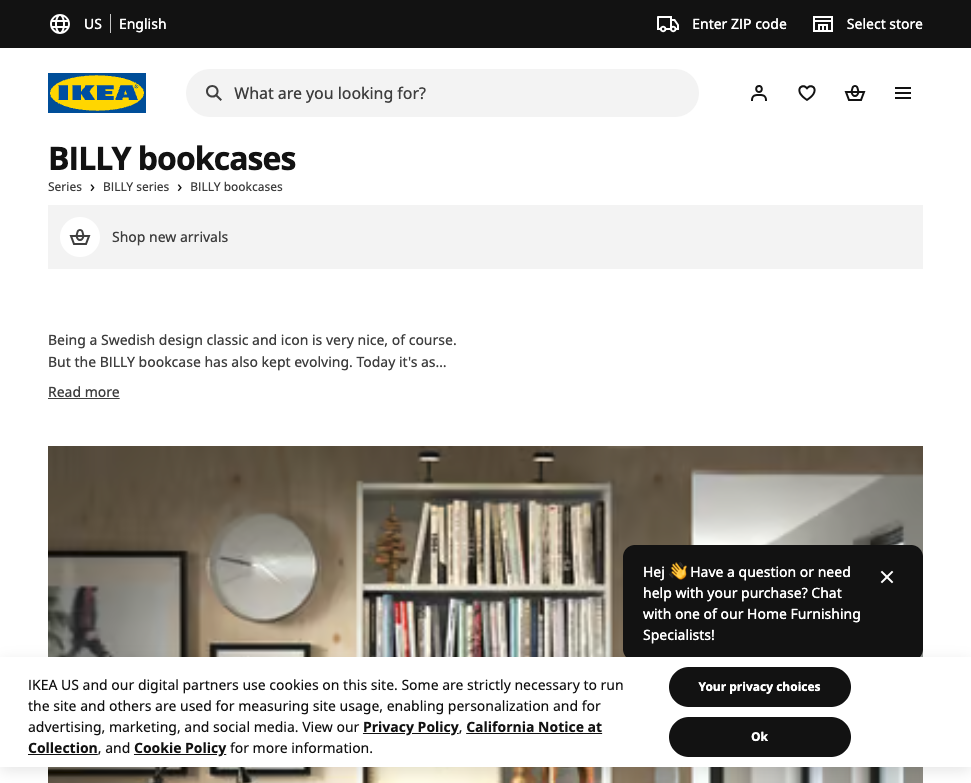
A single named product (BILLY) resolves to a filterable comparison set rather than one fixed SKU page. That matches how a shopper actually decides: not “which exact bookcase” but “which size, color and door combination fits my room.”
A screenshot cannot prove that each filter combination resolves to a correctly canonicalised URL rather than duplicate crawlable variants. Use Search Console’s Page Indexing report (free) or a Screaming Frog crawl of 10 filtered BILLY URLs to check whether filter-combination pages are indexed as separate pages or canonicalised back to the series page.
02. Decision evidence: the product page carries price, trust and financing together
AUDIT VERDICT
Strong for human choice; the review number is the one claim worth stress-testing.
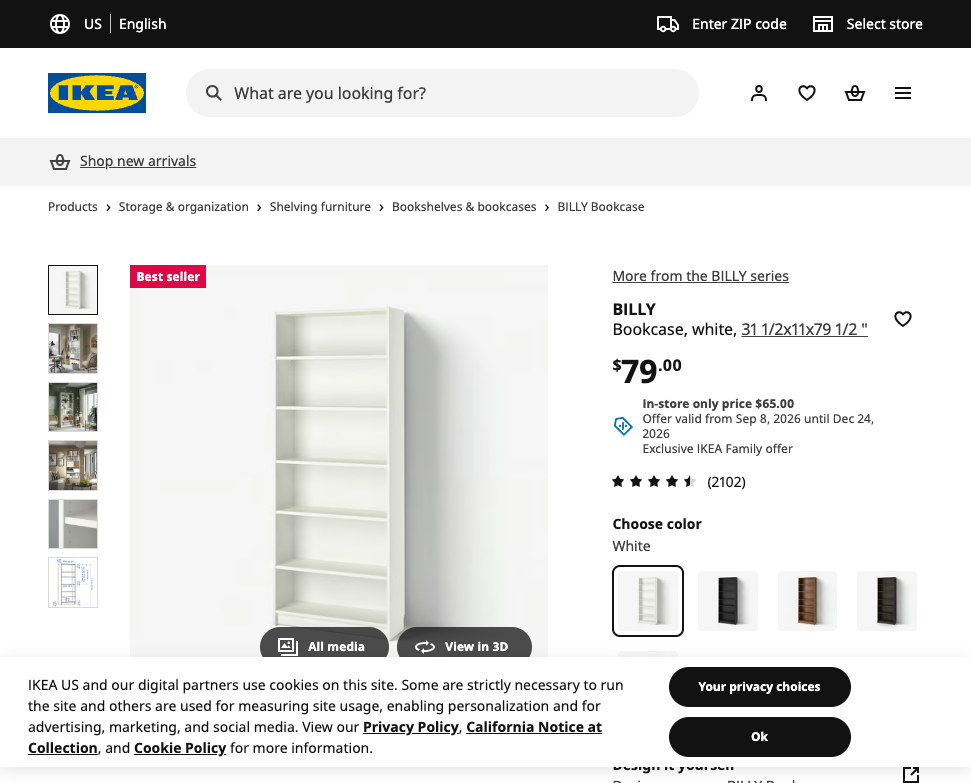
Price, rating, review volume, financing and a named return policy sit together close to the buy button — a dense decision unit. The one number that matters most for trust, the 2,102-review count, is the single figure worth checking for consistency: does it change when the same product is viewed on a different IKEA market, and is it the same population of reviewers or a per-market count? The next audit should sample this on at least three locales.
03. Post-purchase and assembly support is organised by task, not department
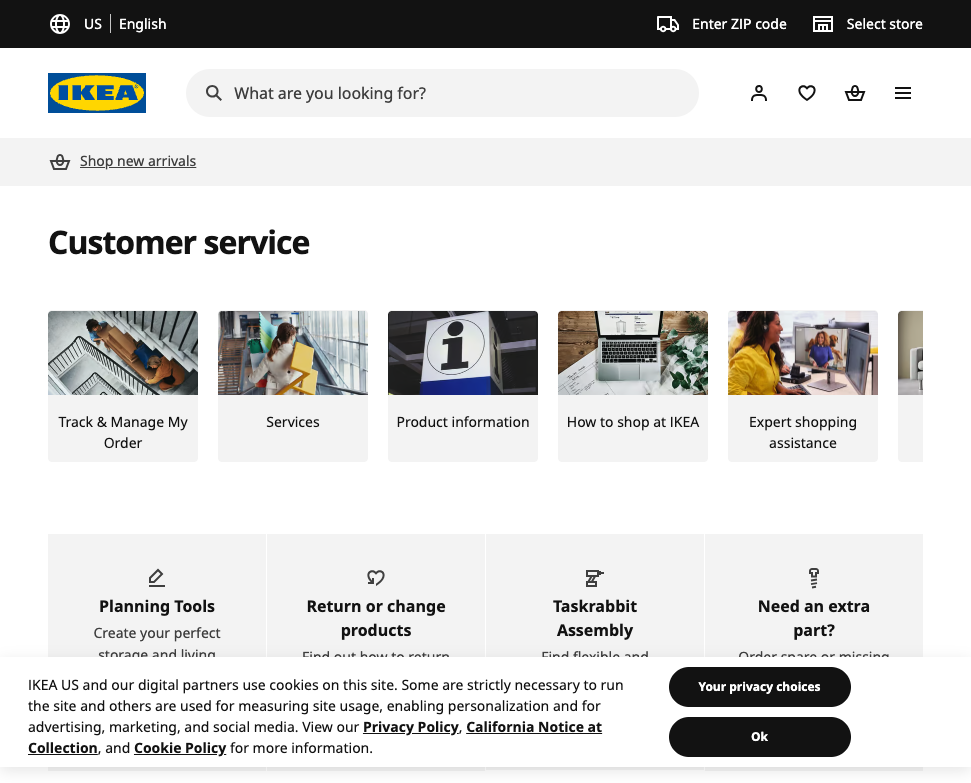
The hub leads with named tasks a shopper actually has — track an order, request a spare part, book assembly — rather than a generic “contact us” form. Further down the page, visible Q:/A: pairs are already close to a schema-ready FAQ format.
Open the 10 most-linked answers on this hub and record whether each shows a last-updated date and a direct policy statement rather than only a “contact us” prompt — repeat quarterly as policies change, the same gap this audit series keeps finding across marketplace and retail support centres.
04. The watchpoint: product-page FAQs are disclosed as Generative AI, but the disclosure does not travel with the feature
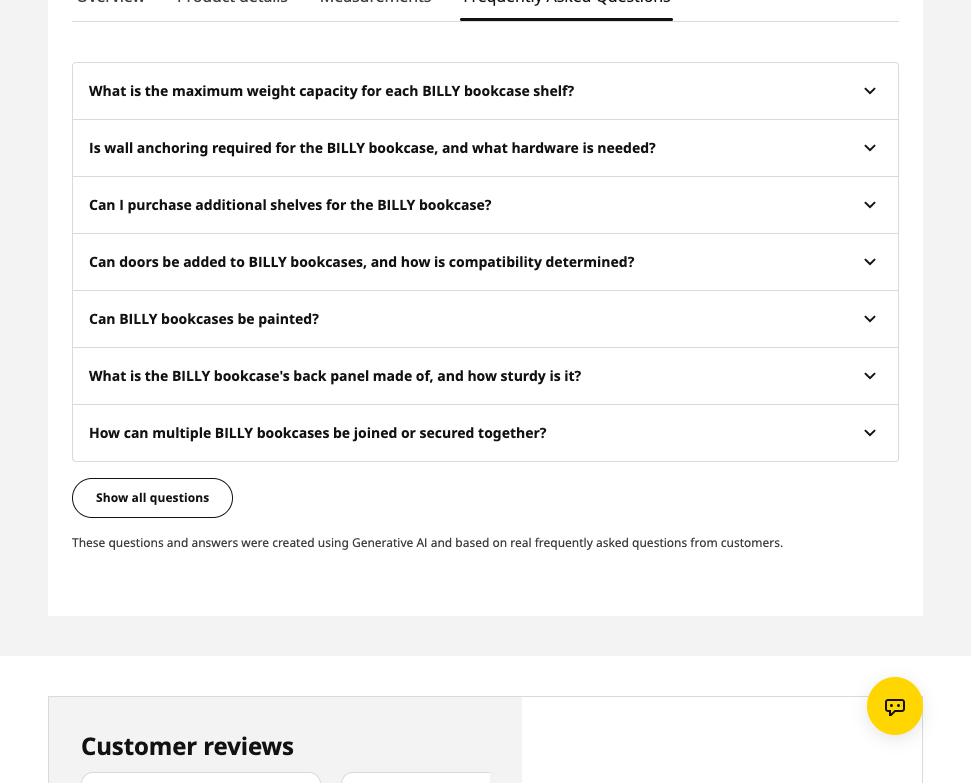
This is a genuinely rare, good practice: most sites that publish AI-written FAQ content do not label it as such. But the feature itself — and its disclosure — is not universal across IKEA’s markets. The Korean version of the same product (same article family, same review count) carries no equivalent FAQ tab at all, disclosed or otherwise. A generative-AI content policy that only ships, and is only disclosed, in some markets is a governance gap worth tracking as IKEA expands the feature. Our broader review of AI content fact-check metadata and disclosure signals covers why this kind of visible, specific labeling matters more than the content itself.
05. Korea: the product identity travels, the FAQ feature and URL do not
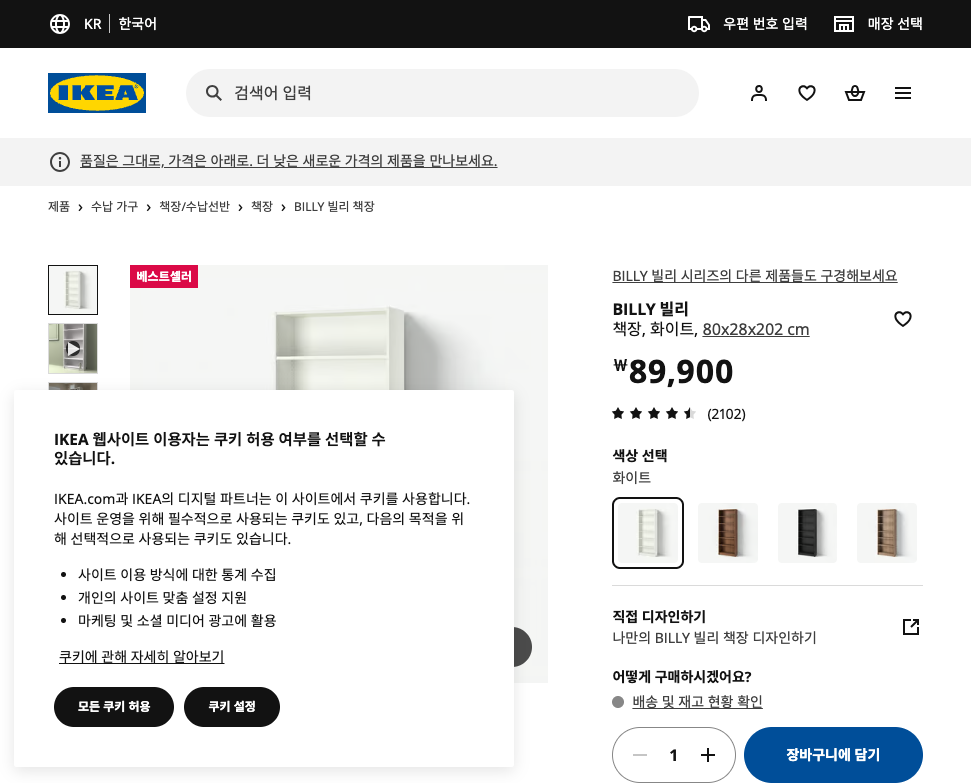
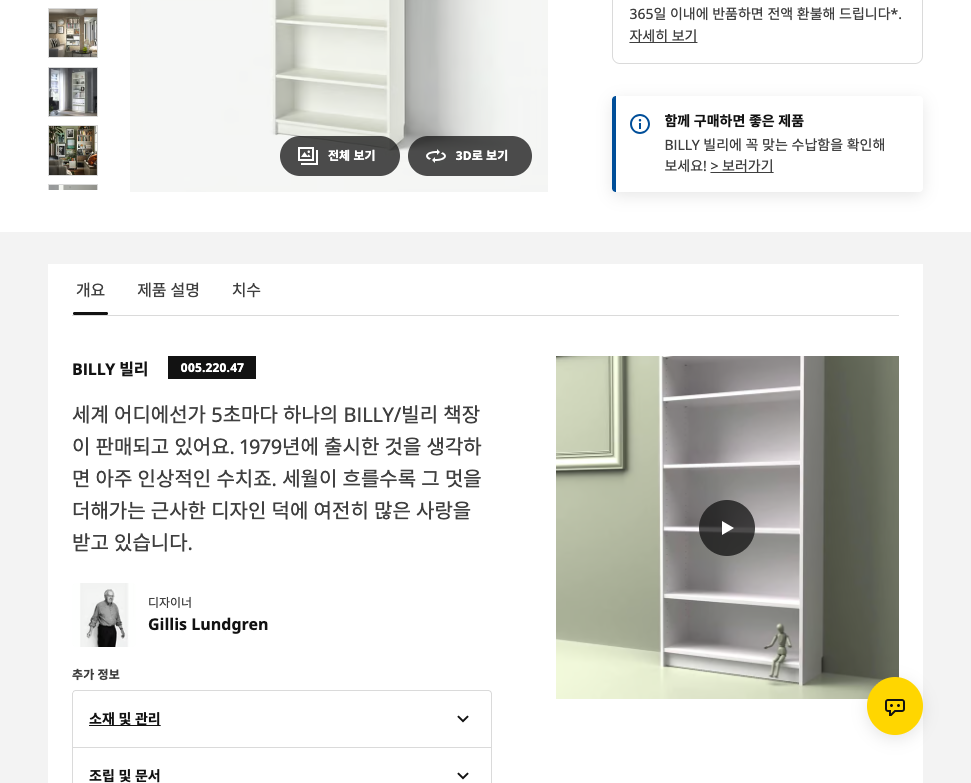
Navigating directly to the US product URL pattern on the Korean site did not resolve to the equivalent product; reaching it required using the Korean site’s own search for “빌리 책장” (Billy bookcase), which returned the correct listing with a different per-market article number (005.220.47 in Korea versus 205.220.46 in the US) but the identical 2,102-review figure — strong evidence that review data is pooled globally even where URLs and article numbers are not. The Korean customer service hub mirrors the US task-based architecture closely, including a visible 자주 묻는 질문 (FAQ) section.
Review volume and the support-hub architecture carry over faithfully. What does not carry over is the product-level Generative AI FAQ feature and the exact URL — a shopper or a crawler following a US product link into the Korean market lands on a generic category page, not the matching product. The next audit should map at least 10 matched US/Korean product URLs the same way and record the redirect pattern.
Machine retrieval: no llms.txt, no AI-crawler-specific robots.txt rules, a very large sitemap
IKEA’s public robots.txt disallows a long list of faceted and session-bound URL patterns (search query strings, price filters, order forms) under a generic User-agent: * block, and explicitly blocks only one named bot (AmazonProductDiscoverybot). It contains no directives naming GPTBot, ClaudeBot, PerplexityBot, CCBot or Google-Extended — meaning AI crawlers fall under the same general rules as any other crawler, neither specially welcomed nor specially blocked. Its sitemap index lists 2,176 sub-sitemaps spanning 91 country/language combinations, including both en-KR and ko-KR. No llms.txt file was found at the root or under /us/en/ (both returned HTTP 404) — see our breakdown of what llms.txt actually does before treating that absence as a problem on its own; Google Search does not read it, and most of IKEA’s retrieval signal already runs through the sitemap and structured product data instead.
Final diagnostic: what IKEA gets right, and what to audit next
Frequently asked questions
Does disclosing that FAQ content was Generative AI actually matter for GEO?
Yes. A labelled AI-generated answer lets both readers and AI systems distinguish an editorially reviewed claim from a pattern-matched one. Our review of AI content fact-check metadata and disclosure signals covers why this kind of explicit labeling is still rare enough to be a genuine differentiator rather than a compliance checkbox.
Why does the review count matter more than the star rating for this kind of audit?
A star rating alone is a single number anyone can state; a stable review count that matches across two completely different country sites is harder to fabricate and easier to independently verify — which is exactly the kind of evidence an AI system, or a skeptical shopper, can actually check.
Is it a problem that a US product URL does not resolve directly on the Korean site?
It is not a failure by itself — different markets commonly run separate catalogue structures and article numbering. It becomes a measurable gap only if a shopper or a crawler following a shared link between markets consistently lands on the wrong page; that is worth testing with a larger, matched URL sample rather than assuming from one product.
Does the absence of an llms.txt file mean IKEA is invisible to AI search?
No. llms.txt is not read by Google Search, and most retrieval still depends on a crawlable sitemap, structured product data and normal page content — all of which IKEA has at scale. See our full explanation of what llms.txt actually does before treating its absence as a ranking problem.
Audit evidence, scope and limits
Inspected: October 20, 2026, public logged-out access. Screens: US homepage, BILLY series (US), BILLY product page (US, including its FAQ tab), US customer service hub, Korean homepage, the matching Korean BILLY product page, and the Korean customer service hub, plus robots.txt, sitemap.xml and llms.txt checks.
Not measured: rankings, AI citations, Search Console performance, analytics, conversion, in-store behaviour, signed-in flows, or the complete product/locale population beyond the one matched product pair sampled here. This is a public-signal audit of one product across two markets, not a performance claim or a full catalogue crawl.
Target query check (Google Keyword Planner, US, checked October 20, 2026): “ikea seo” showed roughly 10 monthly searches — low, but the only measurable result among the six brand-plus-SEO phrases checked across this case-study cluster (the other five returned no data at all). Treat this as a near-zero-demand query, not a meaningful ranking target; this piece’s realistic discovery path is direct distribution, internal links and backlinks rather than organic search on that phrase.


Leave a Reply