
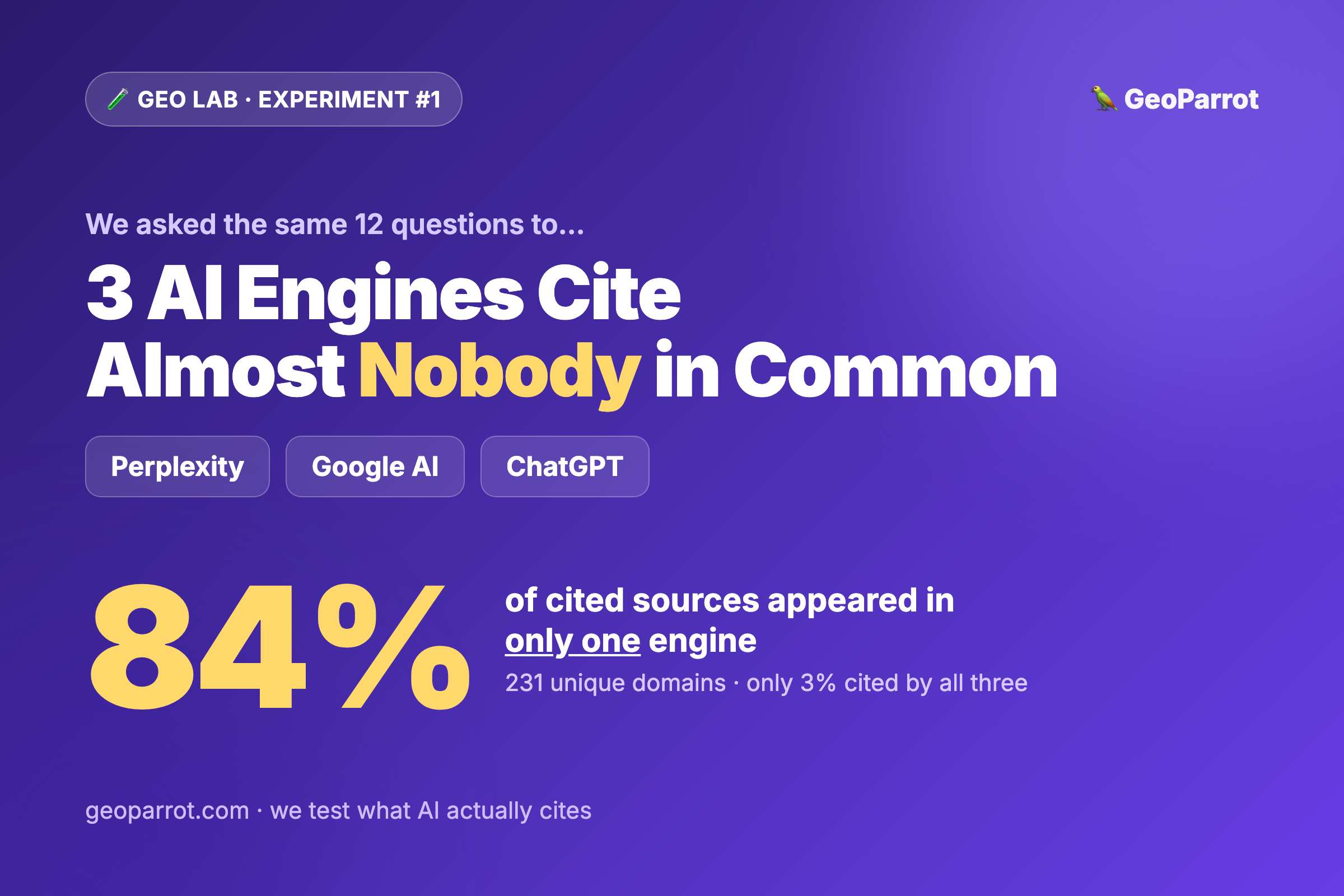
Quick answer: We asked Perplexity, Google’s AI, and ChatGPT the same 12 GEO questions and recorded every source they cited. Across 231 unique domains, only 3% were cited by all three engines — and 84% appeared in just one. Source overlap was tiny (Google ↔ ChatGPT shared only ~6.5%). The takeaway: there is no single “AI SEO.” Ranking in one engine barely predicts ranking in another. The one source they all trusted was Reddit.
Welcome to GEO Lab — where we run real experiments instead of repeating claims. The GEO space is full of confident advice with no evidence behind it. So we test it ourselves and publish exactly what we find, methods and all.
The hypothesis
H1: Different AI engines cite largely different sources — so “getting cited by AI” is not one game but several. If true, a brand could dominate Perplexity and be invisible in ChatGPT, and a single GEO checklist wouldn’t transfer between engines.
The method
- 12 questions spanning intents: definitions (“What is GEO?”), how-tos (“How do I get cited by ChatGPT?”), comparisons (“best GEO tools”), and decisions (“Is GEO worth it?”).
- 3 engines queried in a real, logged-in browser (not an API): Perplexity, Google (AI Overview + top results), and ChatGPT with web search on.
- For each answer we recorded the external domains cited, then measured overlap with Jaccard similarity (shared sources ÷ all sources).
- We also checked whether geoparrot.com (this new site) showed up anywhere — an honest baseline for future tracking.
Note on two engines we left out: we tried Gemini and Copilot too, but on consumer/free tiers they didn’t expose clickable sources the way the other three do — Gemini often answered without showing grounded links at all. That’s a finding in itself: not every engine even tells you who it cited.
Result #1: The engines barely overlap
This was the headline. Of 231 unique domains cited across the questions, only 7 (3%) were cited by all three engines. A full 84% were cited by a single engine. Pairwise, the overlap was small — and Google and ChatGPT, despite both leaning on the open web, shared the least.
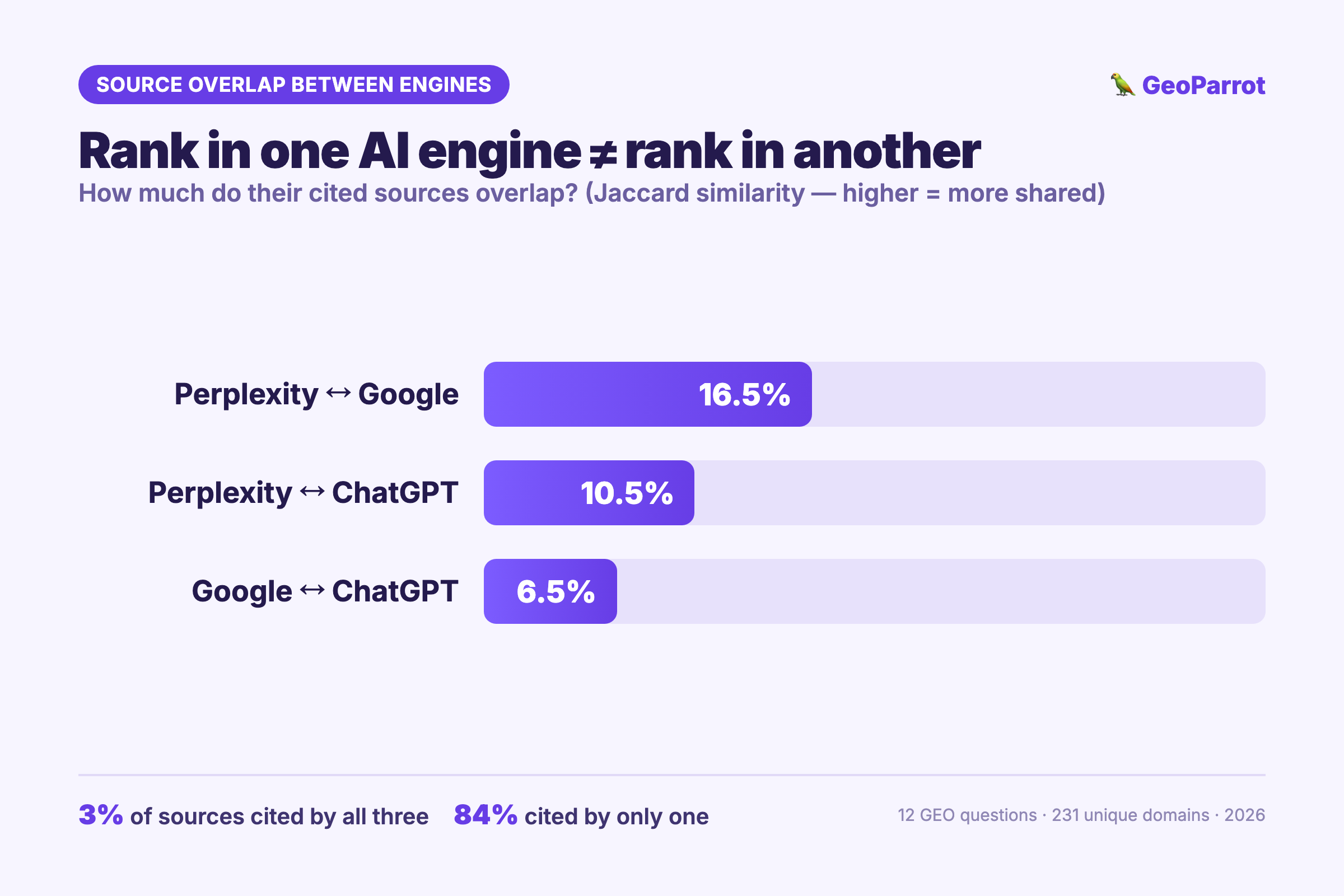
The most fragmented queries were the commercial ones. “Best GEO tools” and “best tools to track AI visibility” returned 30+ different domains with essentially zero cross-engine agreement — each engine surfaced its own roster of small tool sites. If you sell software, that’s both a warning and an opportunity: you have to earn each engine separately.
Result #2: The only universal source is Reddit
If almost nothing is cited everywhere, what is? Community and reference sources. Reddit was the only domain cited by all three engines — and it did so on 5 of 10 comparable questions. YouTube was the single most-seen domain overall, and Wikipedia reliably won definitional queries.
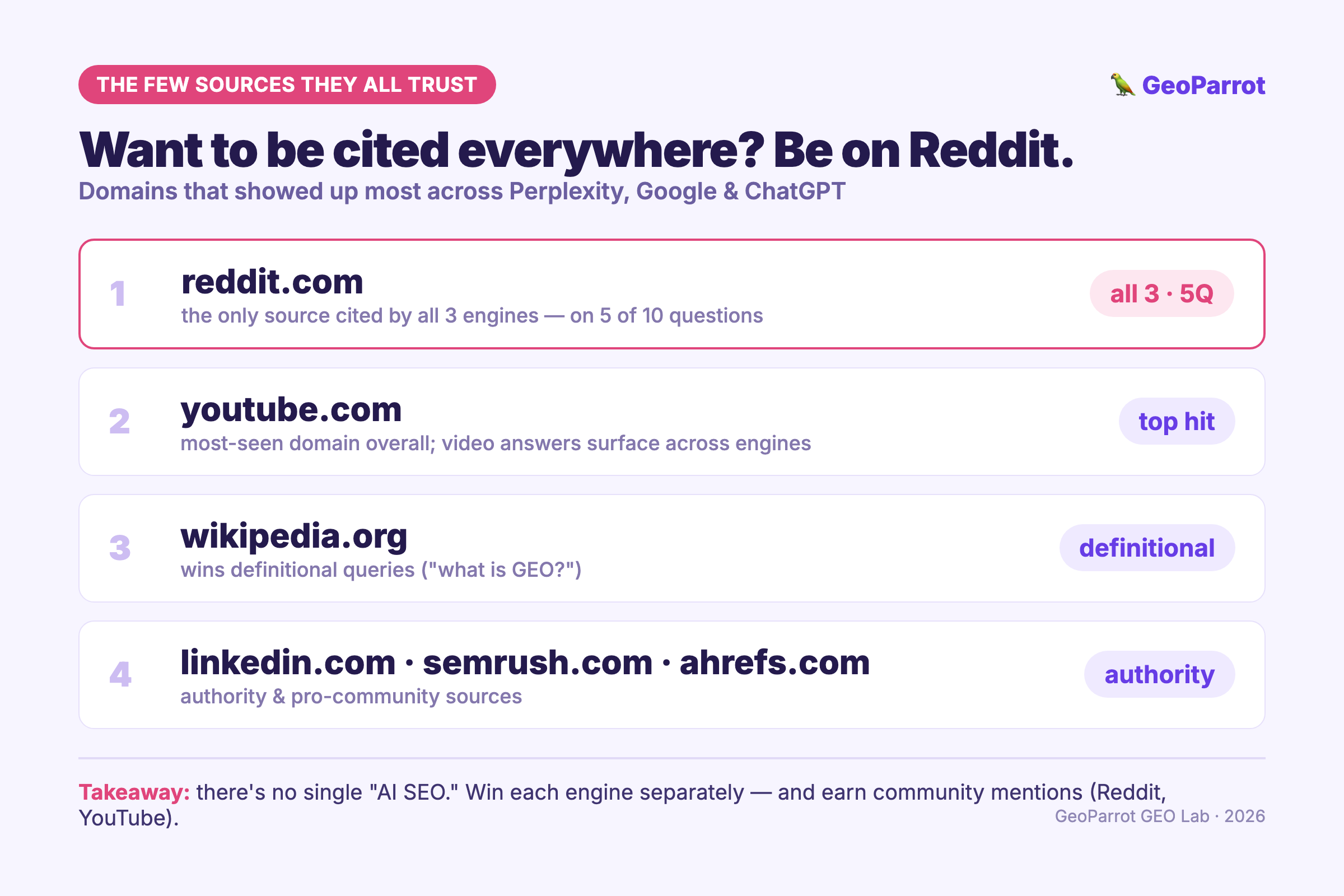
The lesson isn’t “spam Reddit.” It’s that corroboration across the open web — being discussed, reviewed, and linked in communities — is what travels between engines. A blog post alone sits in one engine’s index; a brand that people actually talk about gets pulled into many.
Result #3: ChatGPT cites no one — until it searches
A surprise from the lab: by default, ChatGPT answered our questions from its training data with zero citations. Only when we explicitly turned on web search did it produce sources. So “getting cited by ChatGPT” has a hidden prerequisite — the user (or the product) has to trigger a search in the first place. No search, no citation, no matter how good your page is.
Result #4: Our own site? Cited zero times (yet)
Honest baseline: geoparrot.com was not cited by any engine on any question. We’re a brand-new domain, and this is exactly what we’d expect — and exactly why this matters. We’ll re-run this experiment over time and report whether (and where) we start showing up. That’s the GEO Lab promise: dogfood the advice, publish the scoreboard.
Verdict: hypothesis confirmed
✅ H1 holds. AI engines cite mostly different sources, so AI visibility is not one target but several. Practically:
- Stop chasing a single “AI SEO.” Track and optimize for each engine that matters to you separately.
- Earn community corroboration (Reddit, YouTube, reviews) — that’s what crosses engines.
- Win definitional and “best” queries differently: reference authority for the former, broad third-party mentions for the latter.
- For ChatGPT, make sure a search even happens — structured, crawlable content only helps once it’s triggered.
- Measure, don’t assume. The cheapest GEO tool is asking the engines your own key questions and writing down who they cite.
Frequently asked questions
Do different AI engines cite the same sources?
Mostly no. In our 12-question test across Perplexity, Google, and ChatGPT, only 3% of cited domains appeared in all three, and 84% appeared in just one. Overlap between any two engines was under 17%.
Which source do AI engines trust most?
Reddit was the only domain cited by all three engines in our test, followed by YouTube and Wikipedia. Community and reference sites travel between engines better than individual blogs.
Does ChatGPT cite sources?
Only when it runs a web search. By default it answered from its training data with no citations; sources appeared once web search was enabled. See our guide on getting cited by ChatGPT Search.
Method & limitations
One run, 12 questions, 3 engines, in a logged-in browser in June 2026 — so personalization and region may affect results, and this is a snapshot, not a census. Google figures include AI Overview plus top organic results. We’re publishing the method so it can be reproduced and improved; future rounds will add more questions, clean sessions, and repeat measurements. This pairs with our data piece on whether llms.txt is worth it.
Related
- Is llms.txt Worth It? What 137,000 Websites Reveal
- GEO vs. SEO vs. AEO: What’s the Difference?
- How to Rank in Perplexity AI
- Best GEO Tools 2026
Leave a Reply