
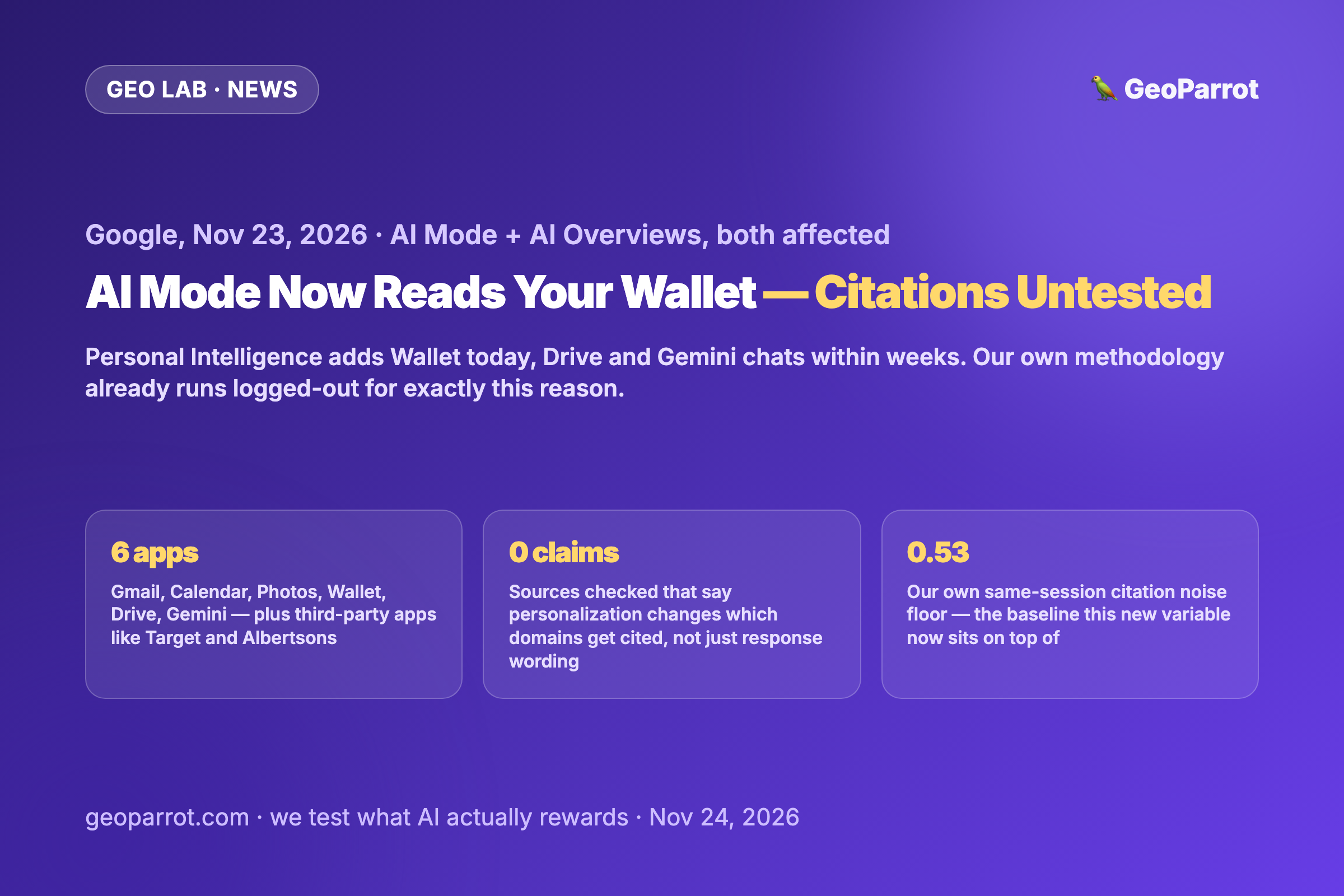
Quick answer: On November 23, 2026, Google VP Robby Stein announced that AI Mode’s “Personal Intelligence” now reads Google Wallet (live today), with Drive and the Gemini app following within weeks, joining Gmail, Calendar, and Photos. Third-party apps — Target, Albertsons, Adobe, Peloton, and home-service platforms — can connect too. Google’s own post adds one line that matters more than the Wallet feature itself: “you’ll also start seeing more personally relevant responses in AI Overviews and AI Mode, tailored to your recent search context.” That sentence applies the same personalization to both surfaces this blog tracks every week. Nobody, including Google’s own announcement, has said whether personalization changes which domains get cited, or only the prose wrapped around them. We don’t know yet either. What we do know: our own methodology has quietly run every AI Overview collection logged-out for exactly this reason, since before this feature existed.
Published November 24, 2026. Cross-posted alongside this week’s GEO Lab arc, where yesterday’s pre-registration locked a dual-engine citation definition that assumes logged-out collection on both classic AI Overview and Google AI Mode. This post is about why that assumption just became load-bearing in a new way.
What exactly did Google announce?
An expansion of a feature called Personal Intelligence, which lets AI Mode draw on a signed-in user’s connected accounts to answer questions. It already covered Gmail, Calendar, and Photos. As of November 23, Google Wallet joined the list and is live now, read-only — AI Mode can see which cards are linked and surface things like cashback categories or travel-rewards optimization, but it cannot move money. Drive and the Gemini app are “coming in the next few weeks,” which would let AI Mode pull context from a user’s documents and prior Gemini conversations. Third-party connections — Target, Albertsons, Adobe, Peloton, and unnamed home-service platforms — round out the list, per Search Engine Roundtable’s same-day coverage. Every connection is opt-in and toggled individually from Search Personalization settings; a “Personalization” icon on a given response shows which connected context it drew from.
Why does a Wallet feature belong on a GEO blog?
Because of one sentence in Google’s own post that has nothing to do with Wallet: personalized responses are rolling out to both AI Overviews and AI Mode, “tailored to your recent search context.” Every citation-tracking method in this field, including ours, has an implicit assumption baked in: that the same query, run twice, is sampling the same underlying system, modulo ordinary noise. We’ve already spent several weeks quantifying how large that ordinary noise is — same-session Jaccard overlap on an identical AI Mode query landed at 0.53 with zero delay, and a separate panel’s within-session citation set collapsed from 0.68 to 0.17 just two days later. Personal Intelligence adds a second, structurally different source of variation on top of that noise floor: not randomness, but a deliberate per-account input (what’s in your Gmail, your Wallet, your recent searches) that two different signed-in users, or one user logged-in versus logged-out, could now receive differently by design, not by accident.
Does personalization actually change which sources get cited, or just the writing?
Unresolved, and worth saying plainly instead of assuming an answer either way. We checked Google’s own announcement and the same-day trade coverage for a direct statement on this, and found none:
| Source checked | Says personalization changes which domains are cited? | Says personalization only changes response wording/framing? |
|---|---|---|
| Google’s official blog post (Robby Stein, Nov 23) | Not addressed | Implied only — describes “tailored” and “personally relevant” responses, never mentions source selection |
| Search Engine Roundtable (Nov 23, same-day) | Not addressed | Not addressed — no SEO/marketer reaction quoted at all |
| Make Tech Easier / consumer tech coverage | Not addressed | Not addressed — framed purely as a consumer convenience feature |
The honest reading: Wallet-driven personalization (cashback tips, spending summaries) is answering a different class of question than “best emergency plumber near me,” so it may not touch citation sets at all in its current, narrow rollout. But Drive and Gemini-chat context, arriving within weeks, is a different story — a user’s own documents or prior Gemini conversations could plausibly steer which sources an AI Mode answer reaches for on an informational or commercial query, not just a personal-finance one. That’s a testable claim, not a settled one, and as far as we can find, nobody has tested it yet.
How does this connect to how we already collect data?
Every classic AI Overview collection in this blog’s experiment archive has run logged-out for the AI Overview box itself — stated explicitly in exp22’s pre-registration and carried forward unchanged into this week’s dual-engine test. That choice predates Personal Intelligence by months and was made for a narrower reason — comparability across collection runs, not anticipation of this specific feature. It turns out to matter more now than it did when we wrote it: a logged-out session, by construction, has no Gmail, Wallet, Drive, or Gemini-chat context to draw on, which means our numbers describe the floor case Google is now actively building past. If our logged-out citation sets ever start drifting further from what a logged-in, connected-apps session sees, Personal Intelligence — not our collector, not ordinary noise — is the first thing to check.
What should GEO/AEO practitioners actually do with this?
- If you run any kind of AI-citation tracker: confirm whether your collection logs in with a persistent Google account or runs logged-out/incognito. If it’s logged-in, Personal Intelligence is now a confound you can’t rule out, especially once Drive and Gemini-chat context ship in the next few weeks.
- Don’t chase “Personal Intelligence optimization” yet. There is no published evidence it changes source selection, only response framing. Content and schema fixes aimed at a mechanism nobody has demonstrated exists would be guessing, not GEO.
- Watch the third-party connection list, not just the Google-app list. Target, Albertsons, Adobe, and Peloton connecting directly to Personal Intelligence suggests a possible future lever that has nothing to do with content at all: becoming one of the apps a user connects. That’s a product/partnerships question, not a content one — flagging it now so it doesn’t get missed later.
- Re-run your own same-session baseline soon. If you have a tracked query panel, a comparison of logged-out vs. a Wallet/Gmail-connected account on the same queries this month would be the first real data point anyone has published on whether this changes citations.
Frequently asked questions
What is Google’s AI Mode “Personal Intelligence” feature?
An opt-in system that lets AI Mode in Google Search draw on a signed-in user’s connected accounts — Gmail, Calendar, Photos, and as of November 23, 2026, Google Wallet — to generate more personally relevant answers. Drive and the Gemini app are rolling out within weeks. Several third-party apps, including Target and Albertsons, can also connect. Each connection is toggled individually and is read-only.
Does Personal Intelligence affect classic AI Overviews, or only AI Mode?
Both, per Google’s own announcement, which states that personally relevant responses tailored to recent search context are rolling out to AI Overviews and AI Mode alike. The connected-apps feature itself (Wallet, Drive, Gemini) is described specifically for AI Mode; the broader search-context personalization language covers both surfaces.
Does this change which websites or sources AI Mode and AI Overviews cite?
Unknown, and not addressed in Google’s announcement or the same-day trade coverage we checked. The stated benefit is more personally relevant response framing, not a claim about source selection. Until someone publishes a logged-out vs. connected-account comparison on the same query panel, treat any claim that this changes citations as untested.
Why does GeoParrot’s own data collection run logged-out?
For comparability across collection runs over time, a design choice made before this feature existed. It has the side effect of excluding exactly the Personal Intelligence inputs (Gmail, Wallet, Drive, Gemini-chat context) that Google just expanded, which makes our numbers a floor-case baseline rather than a prediction of what a signed-in, connected-apps user sees.
Should I optimize for Personal Intelligence right now?
Not yet. There’s no published evidence that it changes which sources get surfaced, so content or schema changes aimed at it would not be grounded in a demonstrated mechanism. The one concrete, non-content lever worth tracking is the growing third-party connection list — becoming a connected app is a partnerships question, not an on-page one.
Sources
- Tailored Google Search with Personal Intelligence apps — Google’s official announcement, Robby Stein, November 23, 2026.
- Google Wants You To Connect More Apps To Search In Return For Personally Relevant Responses — Search Engine Roundtable, same-day coverage, source of the third-party app list.
- The Verdict: Week 22’s Citation Set Barely Survives Two Days — source of our logged-out collection methodology and the 0.68-to-0.17 same-session baseline.
- Does Dual-Engine Citation Overlap Predict Survival? — this week’s GEO Lab arc, carrying the same logged-out assumption forward across two engines.
- AI Overview Citation Volatility: Four Studies, Four Different Numbers — source of the 0.53 same-session noise-floor figure cited above.
- GeoParrot GEO Lab index — the running weekly arc this post sits alongside.
GeoParrot is a GEO Lab: we test what AI search actually cites and recommends, then publish the method and the misses — including the parts of our own measurement pipeline that a story like this one makes newly relevant.



Leave a Reply