
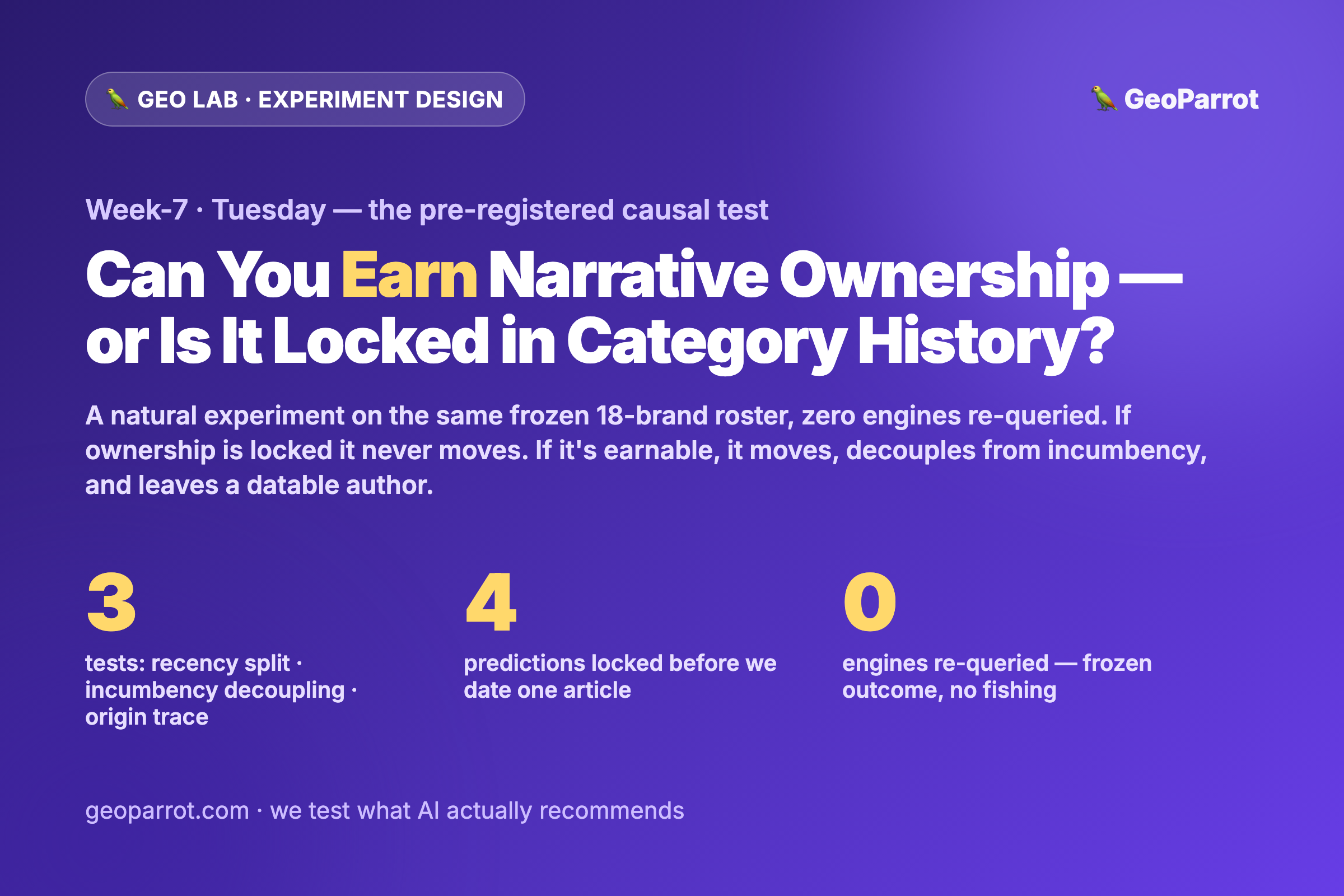
Quick answer: You can’t randomize a narrative campaign onto a real brand and wait a year — so we’re not pretending to run a true experiment. Instead we designed a natural experiment on the same frozen 18-brand roster from last month, with zero re-querying of any engine, that separates two worlds: narrative ownership as an earnable asset versus a byproduct of category history (being oldest, biggest, genuinely best). Three tests do the separating: (A) split each brand’s attribute-language into a recent and a legacy window — if ownership is locked it should be stable; if it’s earnable, some brands’ ownership will have moved. (B) decouple ownership from an incumbency proxy (age + size) — a challenger can only earn it if the narrative owner can be the smaller, younger brand (the Mullvad case). (C) trace whether each narrative move has a datable origin in earned coverage that precedes the shorthand’s spread — temporal precedence is the closest an observational study gets to a cause. Four predictions are locked below, before we date a single article — including the four ways we’ve committed to declaring a challenger can’t earn it.
This is Tuesday’s design post, and it turns this week’s GEO Lab question from a slogan into a test: can a challenger deliberately earn its way to becoming the AI consensus pick — or is that status locked in category history? On Monday we established the setup: earned media is a floor, but volume isn’t the lever — narrative ownership out-predicted mention count 4-to-1. That was a correlation. All week we push it toward causation. The honest version of that push starts by admitting what we can’t do — and building the strongest test we can around the gap.
What question are we actually answering this week?
One testable claim, stated plainly:
Hypothesis (H1): Narrative ownership is an earnable asset, not a fixed function of category history. On the frozen roster we should find (a) categories where the attribute-shorthand owner changed within our observation window — proof the position isn’t permanently locked; (b) narrative owners who are not the incumbency leader (younger and/or smaller than the runner-up they beat); and (c) for the clearest ownership shifts, a datable origin in earned coverage that precedes the shorthand spreading into independent prose, and the AI’s pick tracking the current narrative rather than the legacy one.
Null hypothesis (H0): Narrative ownership is a byproduct of category history. Ownership shares are stable across time (nobody’s narrative moves), ownership rank tracks an incumbency proxy (the oldest and biggest own the attribute), and where a shift does appear it has no identifiable origin — it emerges diffusely alongside the brand simply getting better. If H0 holds, “earn the narrative” is aspirational: a challenger can observe narrative ownership but not manufacture it, and Friday’s verdict says so.
The two worlds make opposite predictions about movement. A locked asset doesn’t move; an earnable one leaves a trail of movement, decoupling, and origins. The whole design below is built to detect that trail if it exists — and to come up empty, loudly, if it doesn’t.
Why can’t we just A/B test a challenger into the narrative?
Because the clean experiment is impossible on any useful timescale, and we’d rather say so than fake it. A true causal test would take a real challenger, deliberately run a narrative campaign (seed the category’s defining-attribute language into independent coverage), hold an equivalent brand as a control, and re-measure the AI’s pick months later. Nobody can randomize that ethically or quickly across six categories — and the moment you re-query the engines you’ve thrown away the frozen outcome that makes our roster trustworthy in the first place.
So the confound we actually have to beat is specific: narrative ownership might just be what genuinely-best, long-established brands accumulate — a symptom of winning, not a lever for winning. If the brands that own their attribute-language are always the oldest, biggest, most-reviewed incumbents, then “own the narrative” reduces to “be the incumbent,” which is useless advice for a challenger. We flagged exactly this limitation when we first scored narrative ownership: it could be a byproduct of genuinely being the best tool. This week’s entire job is to attack that byproduct explanation with observational evidence a locked-asset world could not produce.
A natural experiment does that by finding variation the confound can’t explain: narratives that changed hands, owners who aren’t incumbents, and shifts with datable authors. None of these prove causation the way a randomized trial would — but a purely category-history story predicts we’ll find none of them. If we find all three, “locked” gets very hard to defend.
How do you separate “earned” from “locked” without re-running a single engine?
We reuse the exact frozen roster and corpus — 18 brands across 6 buyer-intent categories (help desk, live chat, marketing automation, survey, accounting, VPN), each already labeled consensus pick, runner-up or challenger by two engines that independently agreed on the #1 — and the attribute-ownership scoring we froze last month. Reuse is the honest choice, not a shortcut: the outcome (which brand the engines recommend) was locked before we ever thought about earnability, so we can’t fish for it. What’s new this week is that we add a time dimension and an incumbency dimension to text we’ve already scored, and read it three ways:
| Test | The “locked” world predicts | The “earnable” world predicts |
|---|---|---|
| A · Recency split Does ownership move over time? |
Stable. Each brand’s attribute-ownership share is roughly the same in old and recent coverage — the same owner then and now. | Some categories show the owner’s share rising in the recent window, or the top owner changing — the narrative demonstrably shifted. |
| B · Incumbency decoupling Is it just being old and big? |
Ownership rank ≈ incumbency rank. The oldest, biggest, most-reviewed brand owns the attribute. | The narrative owner (and the pick) is sometimes the younger/smaller brand — ownership pulls apart from age and size. |
| C · Origin trace Does the move have an author? |
No identifiable origin. Shifts, if any, emerge diffusely with no datable starting point. | Each clear shift has a concentrated, datable origin in earned coverage that precedes the shorthand’s spread. |
The three tests escalate. A establishes that ownership can change (necessary for “earnable” to even be possible). B rules out the cheapest alternative explanation for who owns it (incumbency). C is the one that reaches for direction: an origin that precedes the spread is temporal precedence — the weakest form of causal evidence, but the only form an observational design can honestly claim.
Test A — Does ownership move over time? (The recency split)
For every datable piece of coverage in the corpus, we tag its publication date, then compute each brand’s attribute-ownership share (the same measure from last month’s method) separately in two pre-registered windows: a recent window (published in the last 12 months) and a legacy window (older than 24 months). The 12–24-month band is dropped as a buffer so the two windows don’t blur into each other. A narrative move is registered when a category’s top attribute-owner differs between windows, or the same brand’s recent-window share exceeds its legacy-window share by at least 15 percentage points. If ownership is locked in category history, both windows should agree; every move is a category where history didn’t get the last word.
Test B — Is it just being old and big? (Incumbency decoupling)
Before looking at ownership, we freeze an incumbency proxy per brand: a composite of brand age (founding year) and market size (review-count rank carried over from exp6 as the size stand-in). Then we ask whether the attribute-owner is simply the incumbency leader. The decisive rows are the ones where they come apart — where a younger or smaller brand owns the attribute and the engines pick it anyway. Mullvad is the template: the AI’s #1 VPN sits on just 1 of 8 lists with 176 reviews and 3.5★ — the least incumbent brand in its category by every count — yet it owns “privacy/no-logs.” If ownership were locked to incumbency, Mullvad couldn’t exist; that it does is the single strongest reason to run this test rather than assume the answer.
Test C — Does the move have an author? (Origin trace)
For each clear narrative move from Test A, we go back to the earliest recent-window coverage that carried the attribute-shorthand and ask: is there a concentrated, datable origin — a specific launch, third-party audit, founder essay, signature review, or campaign — whose date precedes the shorthand spreading into independent prose? Or does the framing appear diffusely, in many places at once, with no traceable starting point? An identifiable origin that comes first is what deliberate authoring would look like: someone put the language into the world, and independent writers picked it up. Diffuse, originless emergence is what “the brand just quietly got better and coverage caught up” looks like. We classify every move as origin-identified or diffuse, and we log the origin’s date and source so a reader can check the precedence themselves. This is the test that separates “a challenger did something” from “a brand deserved something.”
What did we lock before dating a single article?
Pre-registration means the predictions are on the record now, before we tag one publication date, so we can’t quietly move the goalposts on Thursday:
- The narrative moves. In at least 2 of 6 categories, ownership shifts across the windows — the top attribute-owner changes, or the owner’s recent-window share beats its legacy share by ≥15 points. Zero moves confirms “locked.”
- Ownership decouples from incumbency. In at least 3 of 6 categories the narrative owner is not the incumbency leader, and there is at least one clean Mullvad-type case where a smaller/younger brand owns the attribute and is the AI’s pick.
- Moves have authors. For every clear narrative move, a concentrated, datable origin in earned coverage precedes the shorthand’s spread (temporal precedence). If moves are real but originless, that supports “locked,” not “earned.”
- The pick tracks the current narrative. Where the legacy-window and recent-window owners disagree, the AI’s actual pick matches the recent owner — evidence engines reflect the narrative’s current state, which is the state a challenger could in principle move.
If the data contradicts these — stable shares, ownership that tracks age and size, moves without origins, a pick that clings to the legacy owner — we publish the contradiction and Friday’s verdict tells challengers to stop trying to manufacture a narrative they can only inherit. A method that can only confirm itself isn’t a method; it’s a pitch deck.
Where could this break? (The honest limitations)
- It’s a natural experiment, not a randomized one. Temporal precedence is not proof of cause. Even a clean origin-before-spread pattern is consistent with a lurking variable — the brand got genuinely better and earned coverage at the same time, with the origin just the first visible symptom. We say “consistent with earnable,” never “proves causal.” The only clean test is an actual intervention, which we flag as the future step.
- Dating coverage is noisy. Best-of lists get silently updated, articles get republished with fresh timestamps, and plenty of pages carry no reliable date at all. We only window the subset with trustworthy dates, report what share of the corpus that is, and treat undated coverage as its own bucket rather than guessing.
- The window cutoffs are our choice. 12 months recent, 24+ legacy is a judgment call. We pre-register it and publish a sensitivity check at ±6 months; if the moves only appear under one arbitrary cutoff, that weakens them and we’ll say so.
- Reverse causality inside the earned channel. Becoming the AI pick could cause more attribute-coverage rather than the other way around. That’s precisely why Test C dates the origin: an origin that predates the pick’s rise is evidence against the reverse story, but where dating is ambiguous we can’t fully separate the two.
- Small, hand-run sample. Six categories, 18 brands, coded and dated by hand. Some categories may show zero datable moves — which is itself a finding, not a failure. Strong patterns, not decimal precision, and the reused-roster caveats from exp6 ride along.
FAQ
Can you actually prove a challenger caused its AI ranking?
Not from observational data — and we won’t claim to. This week’s design establishes the preconditions for causation: that narrative ownership moves, decouples from incumbency, and has datable origins that precede the effect. That rules out the “locked in category history” world and makes deliberate earning plausible. Turning plausible into proven needs a real intervention on a live brand, which is a separate, longer experiment we name explicitly rather than smuggle in.
What’s the difference between “earned” and “locked” here?
“Locked” means narrative ownership is a byproduct of category history — the oldest, biggest, genuinely-best brand accumulates it, and a challenger can’t take it. “Earned” means it’s an asset a challenger can build by putting the category’s defining-attribute language into independent coverage. The three tests — does it move, does it decouple from incumbency, does the move have an author — are designed to tell those two worlds apart.
Why reuse last month’s roster instead of a fresh study?
Because the outcome — which brand the engines recommend — was frozen before we thought about earnability, so we can’t retrofit it, and re-querying engines now would destroy that. We’re adding a time and incumbency dimension to text we’ve already scored, which keeps every result comparable to the correlation we’re trying to explain. The cost is a small, six-category sample; we treat findings as strong signals, not laws.
Isn’t dating web coverage hopelessly unreliable?
It’s noisy, not hopeless. We window only the coverage with trustworthy publication dates, report how much of the corpus that leaves us, keep undated pages in a separate bucket, and run a ±6-month sensitivity check on the cutoff. If a “narrative move” only survives under one lucky date threshold, that’s a fragile finding and we’ll flag it as one.
When do the results come out?
We date and window the corpus midweek and publish the full data — the moves, the incumbency decoupling, the origin traces — on Thursday, then rule on Friday: can a challenger deliberately earn narrative ownership, or is it locked? The four predictions above are on the record now so you can hold us to them, including the ways we’ve committed to declaring a challenger can’t.
Sources
- GEO Lab — “85% of AI Citations Are Earned Media.” So Can a Challenger Just PR Its Way to the #1 AI Pick? (Monday’s fact-check: earned media is a floor, volume predicted the pick 1 of 6 times, narrative ownership out-predicted it 4-to-1)
- GEO Lab — Can You Score “Narrative Ownership”? Our Pre-Registered Method (the attribute-ownership scoring we reuse, and the byproduct limitation this week attacks)
- GEO Lab — Does Narrative Ownership Out-Predict Share of Voice? (the 4-to-1 correlation we’re now trying to explain causally)
- GEO Lab — Is Share of Voice the Wrong AI-Visibility Metric? The Verdict (last week’s ruling: the pick is predicted by attribute-tied prose, not mention volume)
- GEO Lab — We Scored the AI Consensus Pick Against Its Runner-Ups (the frozen 18-brand roster and the incumbency data — reviews, ratings, list breadth — we reuse)
- GEO Lab — Is “Share of Voice” the Wrong Way to Measure AI Visibility? (the Mullvad case: the least-incumbent brand owning its category’s attribute)
- GEO Lab — Can You Self-Rank Your Way Into AI Recommendations? (why owned content can’t manufacture the pick — you named yourself #1 and got recommended 4.2% of the time)
- GEO Lab — How Does a Brand Become the AI “Consensus” Pick? (consensus is real across engines and can’t be self-manufactured)
Leave a Reply