Evidence-first case study · sports brand SEO + GEO series, part 4 of 20
Under Armour’s flagship HOVR Phantom 4 Luxe product page carries the richest Review schema we’ve found in this series — full author names, dates, star ratings and actual review text for all 41 reviews, feeding a visible 4.8-star rating — yet it scored only 8/10 on our AI citation snapshot, the same range as Nike, Adidas and Puma. Under Armour also runs a structurally different locale setup than the first three brands: Korea isn’t a subpath like adidas.com/kr or puma.com/kr, it’s an entirely separate domain, underarmour.co.kr, and its version of the same shoe (UA Phantom 4 MVMNT) carries zero reviews and no aggregateRating field at all — the review-schema richness doesn’t travel with the product across locales. The page’s WebPage schema also includes a SpeakableSpecification block, a markup type aimed at voice assistants and AI readers that none of the first three brands in this series had.
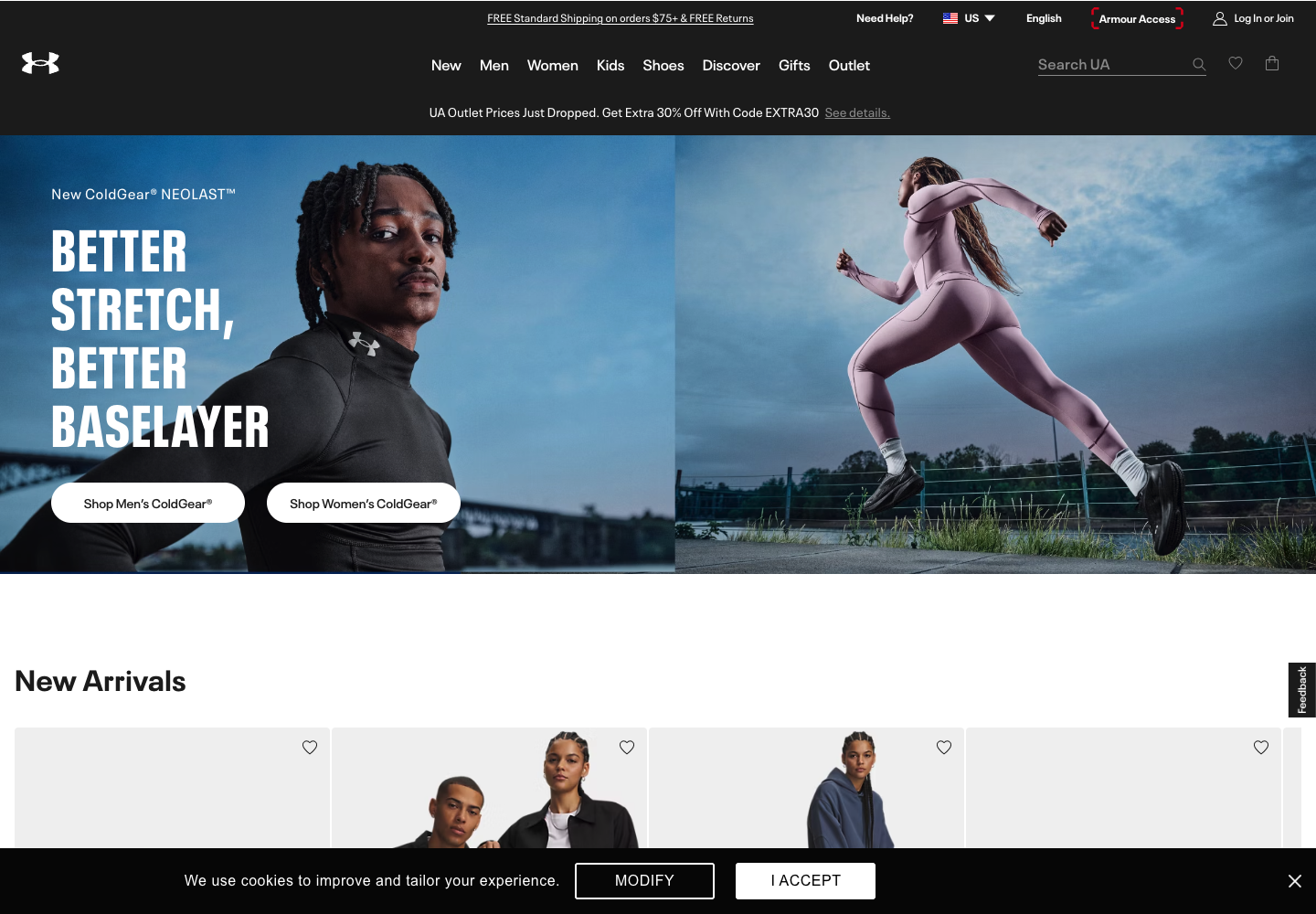
Actual public homepage captured during this audit, October 26, 2026.
What is Underarmour.com trying to do — and why audit it fourth?
This is part 4 of GeoParrot’s sports-brand series, running the same evidence-first method we used on Puma, Adidas and Nike. Under Armour is a useful fourth name precisely because it isn’t a heritage-sneaker brand the way the first three are — its identity is built on performance technology (HOVR cushioning, ColdGear/HeatGear fabrics) rather than a decades-old signature silhouette, so we picked the closest analogue: the HOVR Phantom line, UA’s flagship cushioned running-to-lifestyle shoe and the product most comparable in marketing weight to Nike’s Air Force 1, Adidas’s Samba or Puma’s Suede Classic.
Brand category Global performance apparel, footwear and equipment brand; strongest historically in compression base layers and team sports, expanding into lifestyle sneakers via the HOVR and Curry Brand lines.
Primary user job Find a performance or lifestyle shoe backed by a visible, structured review trail, then get order/returns help via a first-party Help Center rather than an outsourced vendor.
SEO + GEO challenge A US product page with unusually rich, fully structured review data that simply doesn’t exist on the identical product’s Korea listing, plus a locale architecture (separate ccTLDs, not subpaths) that none of the first three brands in this series used.
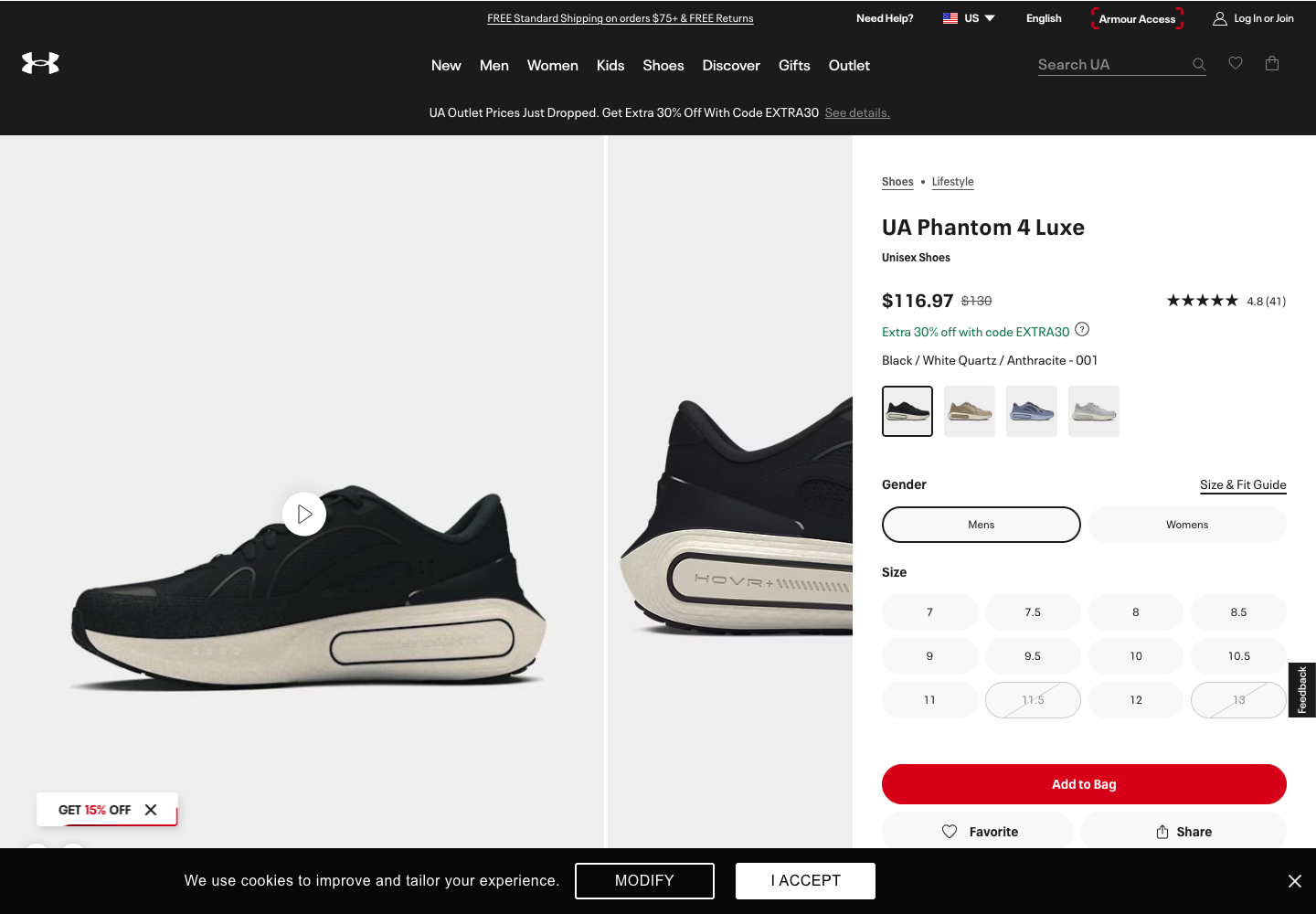
The product we tracked: UA Phantom 4 Luxe (HOVR)
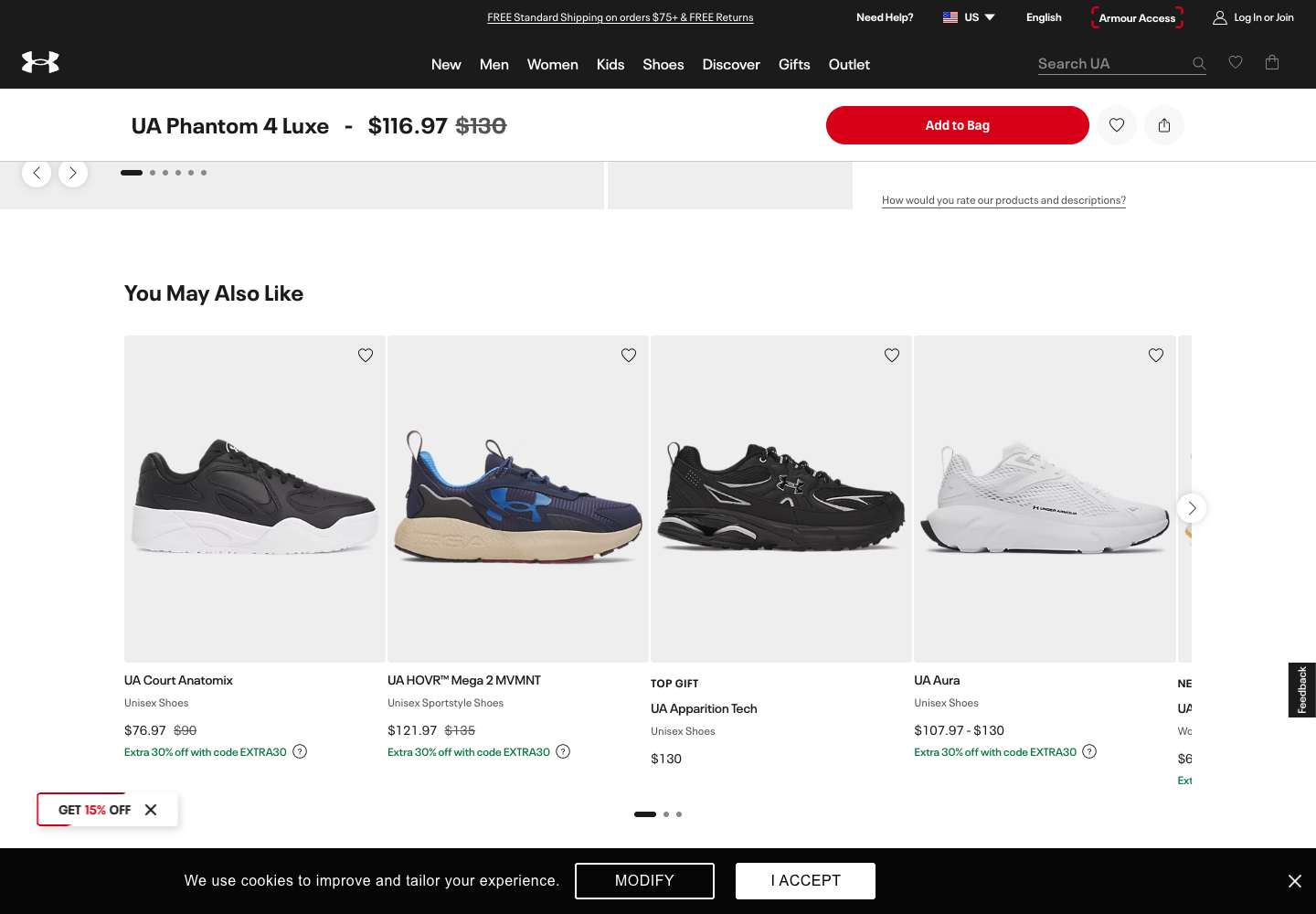
US product page: $116.97 (list $130), a 4.8-star rating linking to 41 reviews, and 4 colourways.Scrolling past the fold surfaces a “You May Also Like” cross-sell carousel (UA Court Anatomix, UA HOVR Mega 2 MVMNT, UA Aura) rather than visible on-page review text — the review content lives in structured data, not rendered copy, on this pass.
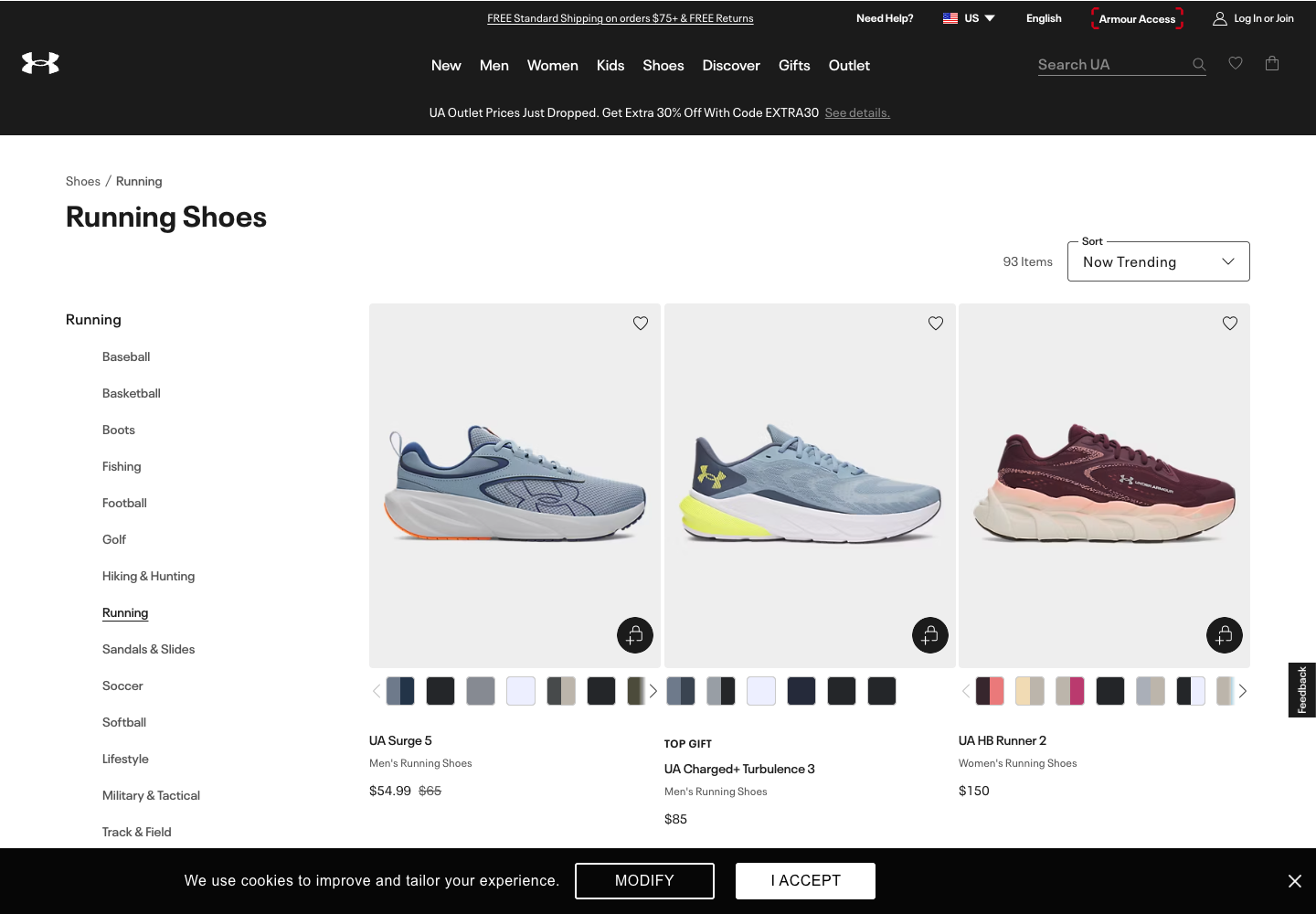
The category layer: “Running Shoes” at 93 items, with a left-rail Sports filter and a “Now Trending” sort — a narrower catalogue than Puma’s 747-item Men’s Shoes grid, reflecting UA’s smaller footwear-only slice of a broader apparel business.
AI citation snapshot: 10 real queries, Google AI Mode
We sent the same style of 10 verbatim queries used on Nike, Adidas and Puma to Google AI Mode (udm=50) and checked citation chip labels for the Under Armour brand family. Method note, reported honestly: direct a[href] capture again returned almost no raw links this run (consistent with all three prior brands), so our signal is the citation chip’s visible publisher label. Under Armour’s label set included not just “Under Armour” but regional variants — “Under Armour UK,” “Under Armour DE,” “Under Armour India,” and the Korean “언더아머” — which we confirmed (via direct redirect checks on underarmour.co.uk, underarmour.de and underarmour.in) are Under Armour’s own country-specific storefronts, not third-party retailers, so we counted them as brand citations. We did not attempt a chip-click-through to resolve exact URLs; Google’s citation links route through an encoded /goto?url= redirect that blocks plain-text extraction, the same practical limit we hit on the first three audits.
Query
UA domain family cited?
Who else showed up
best under armour running shoes 2026
✅ Yes
RunRepeat, SportsShoes.com, ACTIVE.com, Instagram, YouTube (Jacob Thomson) — UA cited via “Under Armour India”
under armour vs nike compression shirts
✅ Yes
Foot Locker, Amazon.com, BSN Sports, Nike
under armour return policy
✅ Yes
UA-dominated result set
is under armour true to size
✅ Yes
Sizely, SquadLocker, RunRepeat
under armour hovr vs charged shoes
✅ Yes
rawandrendered.com, DICK’S Sporting Goods, RunRepeat — UA cited via “Under Armour” and Korean label “언더아머”
best under armour compression shirts
✅ Yes
Hnak — UA cited via “Under Armour” and “Under Armour DE”
under armour rewards membership benefits
✅ Yes
Rivo, SGB Media
under armour hovr technology explained
✅ Yes
Canadian Running Magazine, rawandrendered.com, YouTube (WearTesters, The Run Testers), joybuy.co.uk — UA cited via “Under Armour UK” and “Under Armour”
under armour hovr phantom review
❌ No
weartesters.com (direct href captured), Believe in the Run, RunRepeat, Running Northwest, iRUN Singapore, coachweb.com
under armour vs adidas running shoes
❌ No
Unlabelled chips / third-party comparison sites only
Result: Under Armour’s domain family cited in 8/10 queries — the highest raw count in the series so far (Nike 5/10, Adidas 4/10, Puma 5/10), though the comparison isn’t perfectly apples-to-apples since this is the first brand where we counted country-specific storefronts (UK/DE/India/KR) alongside the primary .com domain. The one named-product review query failed exactly like it did for Nike, Adidas and Puma: a dedicated third-party review site (WearTesters) outranked the brand’s own page. The direct brand-vs-competitor query (“vs adidas”) also failed to cite UA, continuing a pattern across all four audits where head-to-head comparison queries are the hardest for a brand’s own domain to win.
G-score audit: the 8-pillar hygiene checklist, six pages
We scored six representative Under Armour URLs with the same 8-pillar static-HTML checklist (JSON-LD present, FAQ content, visible date, author byline, concrete data points, table/list structure, 3+ subheadings, a 30–500 character early answer) used in our Week 17 quality-score experiment and on the first three brands. Both the Running Shoes category page and the Help Center render almost nothing to a plain HTTP fetch (303 and 71 characters of text respectively) — fully client-side JavaScript shells, the same limitation we hit on Puma’s Zendesk help center, just without a Cloudflare challenge this time.
Page
G-score
Passes
Fails
HOVR Phantom 4 Luxe product page (US)
0.875
JSON-LD, date, author, data points, lists, subheadings, early answer
FAQ
Korea homepage
0.75
JSON-LD, date, data points, lists, subheadings, early answer
FAQ, author
Korea Phantom 4 MVMNT product page
0.75
JSON-LD, date, data points, lists, subheadings, early answer
FAQ, author
US homepage
0.625
JSON-LD, data points, lists, subheadings, early answer
FAQ, date, author
Men’s Running Shoes category
0.125
Early answer (short placeholder text only)
JSON-LD, FAQ, date, author, data points, lists, subheadings
Help Center
0.0
—
All 8 pillars (71-character JS shell)
Average G-score across six pages: 0.5208 (Nike: 0.4375, Puma: 0.354, Adidas: 0.6458) — second-highest average in the series, but the single highest individual page score of any brand so far: the Phantom 4 Luxe PDP’s 0.875 beats every page we’ve scored across all four audits, missing only the FAQ pillar.
The product page’s near-perfect score traces directly to its Review schema: each of the 41 reviews carries a structured author.name, dateCreated/datePublished, headline, full reviewBody text and a reviewRating, which alone satisfies our “date,” “author” and “data points” pillars simultaneously. That’s a structurally different source of points than Adidas’s 0.6458 average, which came more from consistent baseline markup across pages rather than one standout page.
robots.txt — US runs a single generic User-agent: * block disallowing account/checkout/cart/search-parameter paths and Demandware-platform query strings (cgid, srule, demandware.store) — no AI crawler (GPTBot, ClaudeBot, PerplexityBot, Google-Extended) is named, positive or negative, matching Puma’s and Nike’s silence but differing from Adidas’s explicit ClaudeBot crawl-delay rule. Korea’s robots.txt follows the same template but lists two separate sitemap indexes (ko-kr and en-kr), hinting at a bilingual setup within the single Korea domain.
llms.txt — underarmour.com/llms.txt returns a clean HTTP 200: 264 lines, roughly 20KB, 257 markdown links organized under two headers (“Shop” and “Featured”) with a nested category tree (New & Featured → Men/Women/Kids/Shoes → sport and collection sub-pages). It reads as a genuine, if mechanical, export of the site’s own navigation menu — more curated than Puma’s 2,672-link near-total dump, but still structurally a sitemap-in-markdown rather than a prioritized summary of what the brand wants an AI assistant to know. underarmour.co.kr/llms.txt returns a 302 redirect straight to the Korea homepage — a clean 200-disguised-as-real-file never materializes, the same redirect-masquerading-as-content pattern we flagged on Adidas’s .co.kr domain. See our explainer on what llms.txt actually does before treating either behavior as a ranking factor — Google Search doesn’t read it.
Sitemap — US robots.txt lists one sitemap_index.xml pointing to 8 sub-sitemaps split by purpose (product, category, two “global” variants for categories and products, a generic numbered sitemap, and three custom sitemaps for “other,” a “global index” and “playbooks” content). Korea’s sitemap index is far smaller: just 3 entries. The underlying “demandware.store” references in robots.txt suggest the same Salesforce Commerce Cloud platform family we saw disallowed on Puma’s US site, despite the differently named sitemap files.
Product schema — The Phantom 4 Luxe US page carries three JSON-LD blocks: a ProductGroup (name, SKU, brand, description, image set, aggregateRating of 4.8/41, and a full review array with per-review author/dates/headline/body/rating), a WebPage block that includes a SpeakableSpecification naming specific CSS selectors (product name, price, accordions, return policy) intended for voice assistants and AI readers to extract, and a BreadcrumbList. The SpeakableSpecification is new to this series — none of Nike, Adidas or Puma’s pages carried one. Gap: the Korea PDP for the same shoe line (Phantom 4 MVMNT) carries a ProductGroup block too, but with no aggregateRating and no review array at all — matching the “(0)” review count visibly shown on the page. The richest review infrastructure in the series doesn’t travel to the Korea listing.
FAQ / Help center — No FAQPage schema anywhere we checked. The Help Center (underarmour.com/en-us/help/) is first-party (unlike Puma’s externally-hosted Zendesk center) and organizes into Track Order / Returns & Exchanges / Find a Store self-service cards plus category tiles (My Account, My Order, Returns & Exchanges), with Text/Chat/Call contact options listed alongside — structurally closer to a support hub than an FAQ, and like the category page, it’s a near-empty shell to a plain HTTP fetch.
Locale architecture — the headline technical finding — Under Armour is the first brand in this series to run country sites on fully separate ccTLD domains rather than subpaths. underarmour.com/en-gb/ and /en-de/ both 301-redirect out to underarmour.co.uk and underarmour.de; Korea lives at underarmour.co.kr, not underarmour.com/kr. Catalogue breadth differs sharply by locale too: searching “hovr phantom” on the US site returns 104 items across the HOVR Phantom family (Phantom X, Phantom 4 Luxe, HOVR Mega 2 MVMNT and more); searching “phantom” on the Korea site returns exactly one product, UA Phantom 4 MVMNT, a different model in the same family. Unlike Puma’s silent homepage-redirect-on-no-results, the Korea search behaves correctly here — it’s a genuine but narrow 1-item catalogue, not a broken search.
What works / What to verify
WHAT WORKS
The richest, most fully structured Review schema in the series (author, dates, headline, full body text and rating for all 41 reviews), a novel SpeakableSpecification block aimed at voice/AI readers, and a Korea search experience that returns an honest single-item result instead of a silent redirect.
WHAT TO VERIFY
Whether the rich Review schema is specific to high-traffic flagship products or applied catalogue-wide, whether Korea’s zero-review PDPs are a review-collection gap (no customers have reviewed yet) versus a schema-generation gap (reviews exist but aren’t marked up), and whether the separate-ccTLD locale structure changes international SEO signal consolidation compared to the subpath approach Nike, Adidas and Puma use.
Target query check — reported honestly, not inflated
We have not re-measured “under armour seo” or “under armour geo audit” query volume this session. Per the pattern already confirmed across eight earlier subjects in this series on October 20, 2026 (Keyword Planner, US) — the large majority showed no measurable search volume at all for “[brand] SEO/GEO audit” phrasing — we’re not claiming this title drives ranking-based traffic. The distribution case for this series rests on internal links, our own index, and readers already following the GEO Lab arc, not on search demand for “[brand] SEO audit” as a query.
Frequently asked questions
Does Under Armour’s rich Review schema give it an AI citation edge over Nike, Adidas and Puma?
Not clearly in this snapshot — Under Armour’s domain family was cited in 8/10 queries, the highest raw count in the series, but that count includes regional storefronts (UK/DE/India/KR) that the comparison with Nike (5/10), Adidas (4/10) and Puma (5/10) didn’t count the same way for those brands. On the one query where product-level review depth should matter most, “under armour hovr phantom review,” UA still lost to a third-party review site — the same failure mode as all three prior brands on their equivalent named-product query.
Why does the Korea product page have zero reviews when the US page has 41?
We can’t determine intent from the outside. It could mean the Korea catalogue listing is newer and simply hasn’t collected reviews yet, or that Under Armour’s review-syndication pipeline (likely a third-party platform like Bazaarvoice or Yotpo, given the structure) isn’t connected on the Korea storefront. Either way, an AI engine or shopper reading the Korea page sees a materially different trust signal for the same shoe family.
What does the SpeakableSpecification schema actually do?
It’s a Schema.org property that flags specific sections of a page (via CSS selectors) as suitable for text-to-speech or voice-assistant readout — originally aimed at Google Assistant news use cases, now relevant more broadly to any AI system that parses structured hints about which page content is a good “spoken answer.” Under Armour naming the product name, price, return policy and accordion content as speakable sections is a deliberate signal, though we have no way to confirm from the outside whether any AI engine currently acts on it.
Does a G-score of 0.875 on one page mean that page is more likely to be cited by AI engines?
Not reliably — this audit is itself a data point against that idea, consistent with Nike, Adidas and Puma. Our Week 17 experiment found hygiene/structure score was not a dependable predictor of AI citation. Here, the Phantom 4 Luxe PDP scored highest of any page in the series (0.875) but we have no isolated per-page citation data to confirm it outperforms lower-scoring UA pages on citation specifically — our 10-query snapshot measures the domain family, not individual URLs.
Audit evidence, scope and limits
Inspected: October 26, 2026, public logged-out access from a Korea-based IP (real browser session used throughout). Screens: US homepage, Running Shoes category, HOVR Phantom 4 Luxe product page (top and cross-sell), US Help Center, Korea homepage, a Korea “phantom” search (1 result), and the resulting Phantom 4 MVMNT PDP — plus robots.txt, sitemap-index and llms.txt checks on both locales, a 10-query Google AI Mode citation snapshot, and an 8-pillar G-score scored on six fetched pages.
Not measured: rankings, Search Console performance, analytics, conversion, signed-in/member flows, ChatGPT citations (not attempted, given the composer failure flagged on the first three audits), or the complete product/locale catalogue beyond the one shoe family and six URLs sampled here. This is a public-signal snapshot, not a performance claim or a full-catalogue crawl.
This is part 4 of a daily series. Every day, GeoParrot runs this same evidence-first method — real screenshots, a 10-query AI citation snapshot, an 8-pillar G-score audit, and an honest target-query check — against one more major sports and athletic-wear brand. Tomorrow: New Balance.

Leave a Reply