
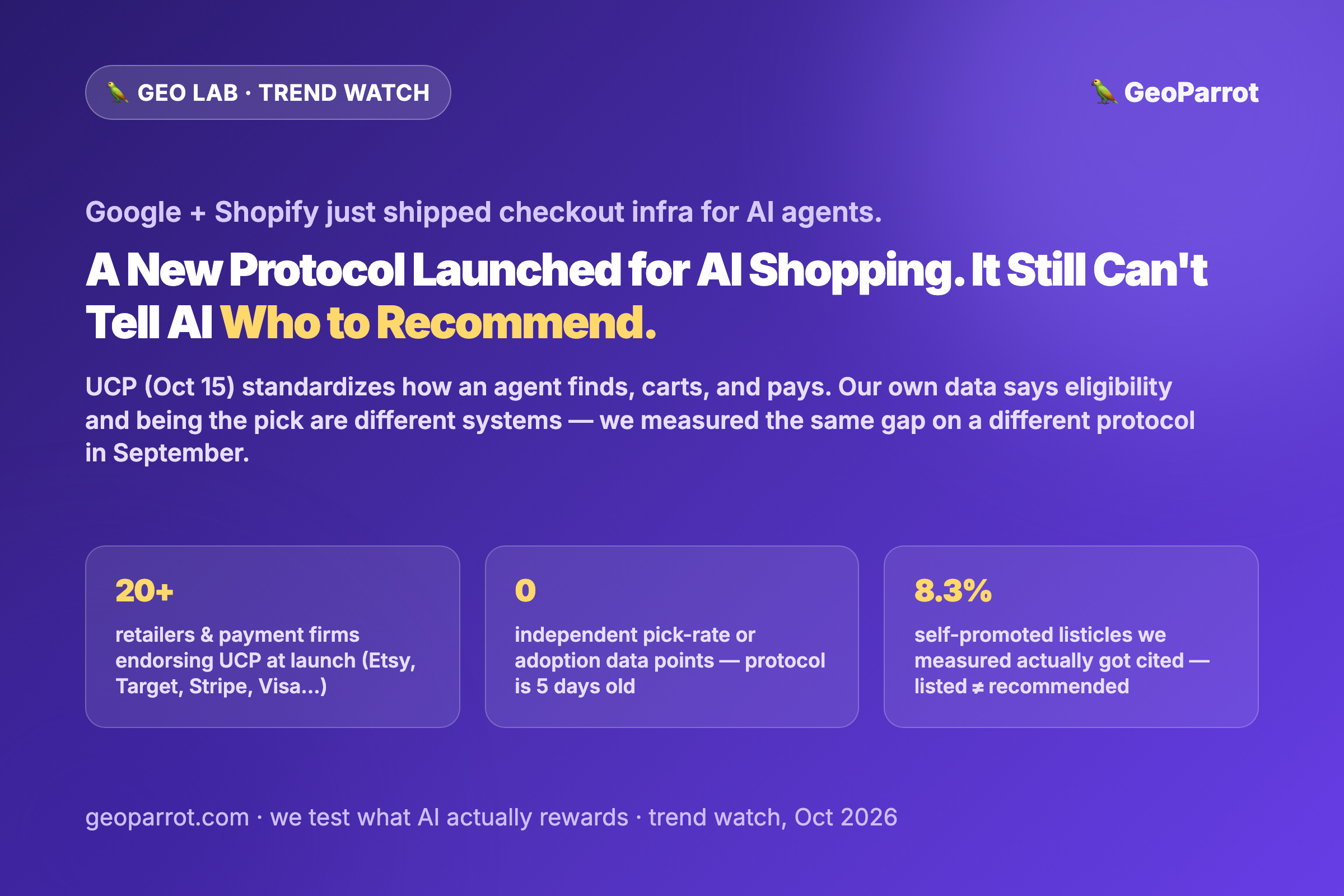
Quick answer: On October 15, 2026, Google rolled out Universal Cart in the U.S. — a shared shopping cart inside Google Search (including AI Mode) and the Gemini app — powered by a new open standard called the Universal Commerce Protocol (UCP), co-developed with Shopify and endorsed by 20+ retailers and payment companies including Etsy, Target, Walmart, Wayfair, Amazon, Mastercard, Stripe, and Visa. UCP standardizes how an AI agent finds a product, puts it in a cart, and pays for it — a merchant publishes a “capability profile” and implements at least one “capability handler” (Shopify merchants get this by default; everyone else builds or waits for it). What UCP’s own spec and Google’s launch material do not claim is that implementing it changes which merchant an AI agent recommends over a competitor. That’s a separate layer — and it’s the layer we already have measured data on from a different platform’s version of this exact rollout.
Trend watch — published October 20, 2026. UCP’s spec is public at ucp.dev under Apache 2.0, with a reference implementation on GitHub; Shopify’s own engineering writeup is at shopify.engineering/UCP, and Search Engine Land and 9to5Google covered the consumer-facing Universal Cart launch on October 15–16. We’re not testing UCP directly — it’s five days old and no adoption data exists yet. We’re flagging the pattern, because we called this exact gap on OpenAI’s Product Feed seven weeks ago, and the same structure just reappeared at a much bigger scale.
What exactly launched, and what does UCP actually require?
Two different things launched together, and it matters that you keep them separate. Universal Cart is the consumer product: a shared cart that follows you across Google Search, AI Mode, and the Gemini app, tracks price drops and promo codes, and lets you check out across retailers without re-entering payment details each time. UCP is the plumbing underneath it — an open, Google-and-Shopify-co-developed protocol that lets an AI agent talk to a merchant’s systems in a standard way: discover a product, confirm availability and price, add it to a cart, and complete payment. The spec is public, not a Google-only black box, and more than 20 retailers and payment processors (Etsy, Target, Walmart, Wayfair, Amazon, Microsoft, Meta, Salesforce, Adyen, American Express, Mastercard, Stripe, Visa, and others) are named as co-developers or launch endorsers. Technically, a merchant has to publish a capability profile and implement at least one capability handler. Shopify’s roughly five million merchants get this automatically — the protocol work is done, and the remaining job is making sure product data (brand, category, images, price, availability, SKU) and real-time inventory sync are accurate, since an agentic transaction happens live and unsynced inventory means overselling. Non-Shopify merchants on WooCommerce, Magento, or custom stacks have to build the integration themselves or wait for a platform vendor to ship one.
Does implementing UCP get you recommended by Gemini or AI Mode — or just eligible?
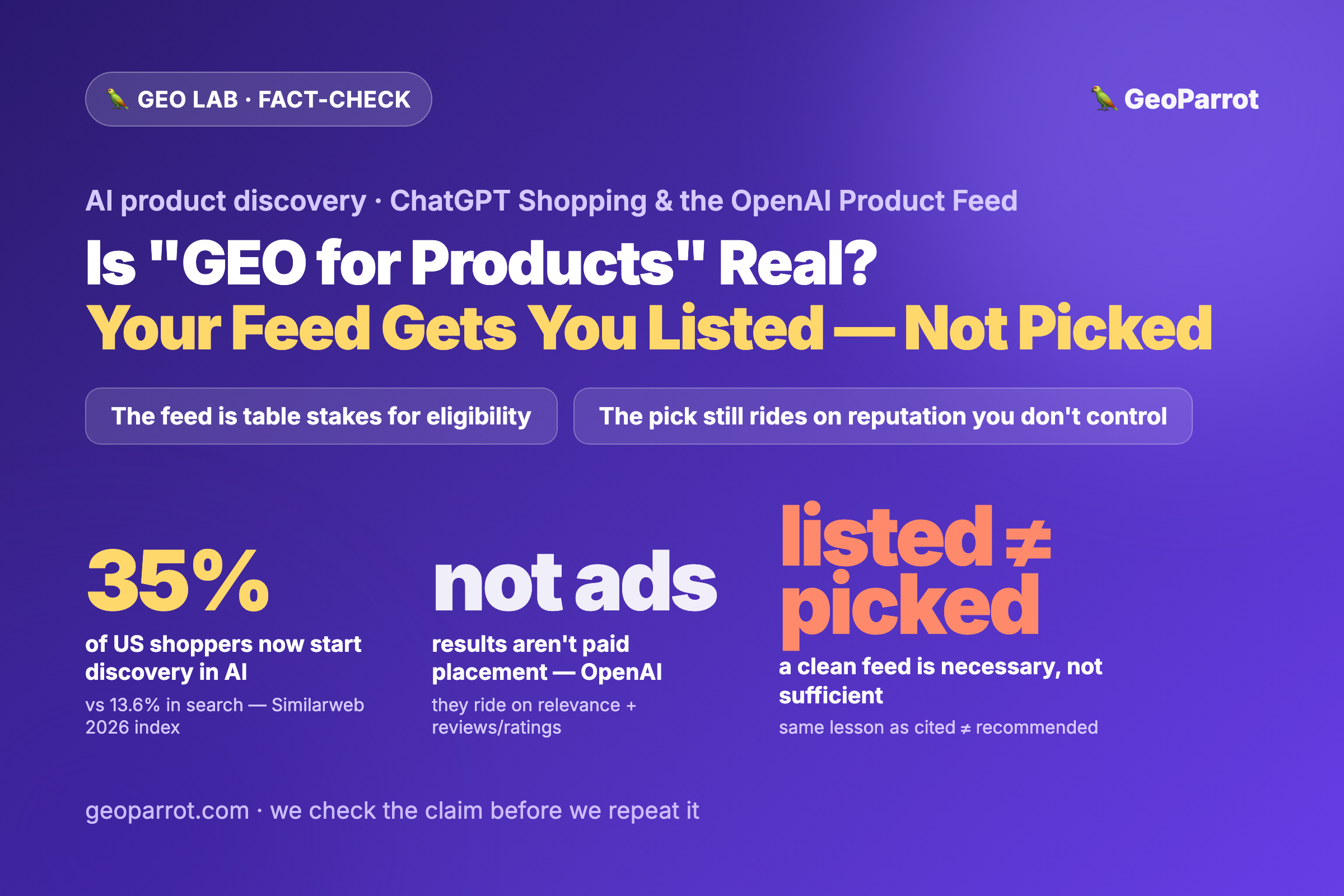
Every primary source we checked — Google’s own launch posts, the UCP spec, Shopify’s engineering writeup — describes what the protocol does to transactions: find the product, hold the cart, move the money, confirm the fulfillment. None of them claim it changes selection — which of several competing merchants an AI agent surfaces or recommends when a shopper asks a vague, comparative, or “best X” question. Google’s marketing language leans the other way (“critical for brands to get discovered in the AI era”), but that’s a claim about eligibility, not about winning the pick against a rival with an equally clean feed. This is the same split we measured directly, just on a different protocol: in September, when OpenAI’s Product Feed and Agentic Commerce launched for ChatGPT Shopping, we wrote that a clean feed makes you eligible, but it doesn’t buy you the pick — and that the real lesson came from our own self-ranking experiment, where being listed in an AI answer (8.3% citation rate for brands pushing their own “best of” listicles) was a weak, almost irrelevant predictor of being the thing actually recommended. A second experiment made the same point from a different angle: breadth of being listed across review sites didn’t predict which brand got the AI’s consensus pick (82.6% average list-presence for picks vs. 93.2% for runners-up, in 6 of 8 categories) — what did correlate was how a brand was described in independent prose, something no feed format controls.
| What’s confirmed about UCP | What’s not confirmed / not the claim |
|---|---|
| Open spec co-developed by Google + Shopify, public at ucp.dev, Apache 2.0 licensed (launched ~mid-Sept–Oct 2026) | That implementing it increases the odds an AI agent picks you over a competitor with an equally compliant feed |
| 20+ retailers/payment companies named as co-developers or endorsers at launch (Etsy, Target, Walmart, Wayfair, Amazon, Stripe, Visa, Mastercard, others) | That non-adoption gets you excluded from AI Mode or Gemini shopping results entirely — it governs checkout mechanics, not visibility gating (unconfirmed either way from primary sources) |
| Universal Cart (the consumer feature) rolled out in the U.S. on October 15, 2026, inside Search, AI Mode, and Gemini | Any first-party adoption, conversion, or “AI pick rate” data — the protocol is five days old as of this writing |
| Shopify merchants are UCP-enabled by default; others must build or wait for an integration | That clean product data alone solves selection the way it solves eligibility — our own cross-platform data says it doesn’t |
Why we’re confident enough to say this about a five-day-old protocol
We haven’t run an experiment on UCP itself — there’s no adoption data to test yet, and we’re naming that limit up front. What we’re confident about is the shape of the gap, because we’ve now watched it appear twice on two different companies’ infrastructure in under two months. OpenAI’s Product Feed and Agentic Commerce launched in September promising easier product discovery inside ChatGPT; we flagged then that eligibility infrastructure and recommendation logic are different systems, built and governed separately, and that assuming a feed buys a pick repeats a mistake GEO vendors already made with llms.txt and schema markup. UCP is a bigger, more credibly cross-industry version of the same idea — built jointly by a search giant and the dominant commerce platform, with two dozen co-signers — which makes it more likely to get adopted at scale, and exactly as likely to get over-sold by a wave of “implement UCP to get recommended by Gemini” content that’s probably being written somewhere right now. The protocol layer and the ranking layer not being the same system isn’t a one-off finding from one experiment; it’s turned out to be the default relationship between any AI-facing data format and what the AI actually decides to say.
A merchant checklist for UCP, without the overclaim
- Treat UCP as a transaction-infrastructure project, not a marketing project. The actual engineering work — capability profile, capability handler, real-time inventory sync — sits with whoever owns checkout and fulfillment systems, not the content or SEO team.
- If you’re on Shopify, your remaining job is data hygiene, not protocol work. Complete, accurate product data (brand, category, images, price, live availability, SKU) is what the merchant-prep guidance actually asks for — because an agentic transaction happening in real time will oversell on stale inventory and that gets you removed from eligibility, which is a real, confirmed consequence.
- Don’t defer “getting recommended” work until UCP is done. Based on what we measured on the OpenAI version of this pattern, the things that correlate with being the actual pick — independent review coverage, how your brand is described in third-party prose, category-specific reputation — run on a completely separate track from feed compliance, and nothing about them waits on a checkout protocol.
- Watch for vendors selling “UCP optimization” as a visibility play. If a pitch promises implementing UCP will get you picked more often by Gemini or AI Mode, ask what independent, outcome-based evidence backs that — as of this week, we could not find any from Google, Shopify, or the UCP spec itself.
- Revisit this in a quarter. UCP is five days old. If adoption data or a documented pick-rate effect shows up, that would be new information worth updating on — we’re describing the current evidence, not predicting it stays this way forever.
The honest caveats
We have not run a UCP-specific experiment, and as far as we can tell, nobody else has either — the protocol launched five days before this was published, which is too soon for real adoption or outcome data to exist anywhere. Our confidence in the “eligibility ≠ pick” framing comes from analogy to a related but different protocol (OpenAI’s Product Feed) and from our own self-ranking and consensus-pick experiments, which measured recommendation behavior in general, not product-shopping scenarios specifically. It’s a reasoned extrapolation, not a direct measurement of UCP, and we’re naming that distinction rather than letting the pattern-match read as proof. It’s also possible Google builds a more direct feed-to-recommendation link into AI Mode shopping results later than this launch; nothing here forecloses that, we’re describing what’s confirmed as of today.
Frequently asked questions
What is the Universal Commerce Protocol (UCP)?
UCP is an open standard, co-developed by Google and Shopify and endorsed by 20+ retailers and payment companies, that lets AI agents discover products, manage a cart, and complete checkout across merchants in a standardized way. The spec is public at ucp.dev under an Apache 2.0 license, with a reference implementation on GitHub.
Does implementing UCP help my products get recommended by Gemini or AI Mode?
No primary source — not Google’s launch material, not the UCP spec, not Shopify’s engineering writeup — claims that implementing UCP changes which merchant an AI agent recommends over a competitor. It standardizes the transaction (discovery, cart, checkout), not the recommendation decision. Our own data on a comparable protocol (OpenAI’s Product Feed) and on general AI recommendation behavior suggests those are separate systems.
Do I have to implement UCP if I’m on Shopify?
Shopify merchants are UCP-enabled by default — there’s no separate integration to build. The remaining work is data hygiene: complete, accurate product data and real-time inventory sync, since poor fulfillment performance (caused by unsynced inventory in a real-time agentic transaction) can remove you from eligibility.
What if I’m not on Shopify?
Merchants on WooCommerce, Magento, or custom platforms need to build their own UCP integration or wait for their platform vendor to ship one. As of this launch, the broader ecosystem support (beyond the ~20 named co-developers and endorsers) is still filling in.
Has this “feed eligibility isn’t a pick” pattern happened before?
Yes. We documented the same structure in September 2026 when OpenAI launched its Product Feed and Agentic Commerce tools for ChatGPT Shopping: a clean feed made a product eligible to appear, but our own self-ranking and consensus-pick experiments showed being listed was a weak predictor of being recommended. UCP is a larger, cross-industry version of the same split.
GeoParrot is a GEO Lab: we run experiments to test what AI search engines actually reward, and we grade the industry’s claims — including our own — against what was actually measured. See the running scoreboard at our 2026 GEO benchmark. Related: our September take on OpenAI’s Product Feed and the same eligibility-vs-pick gap, why self-ranking listicles barely get cited, and why listing breadth doesn’t predict the AI’s consensus pick.


Leave a Reply