
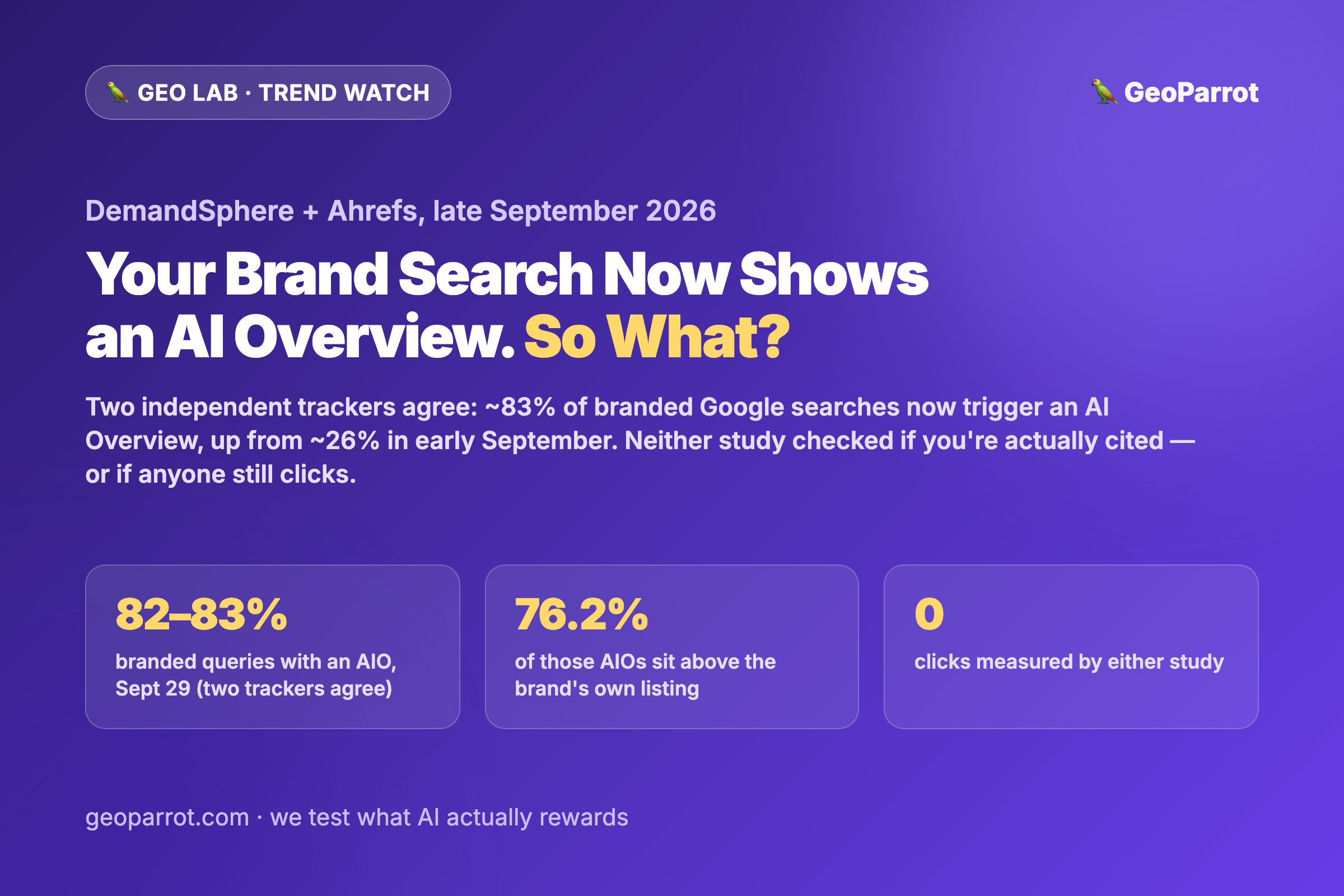
Quick answer: Two separate trackers published numbers in the first days of October 2026 showing Google AI Overviews now appear on the large majority of branded search queries. DemandSphere’s daily panel went from roughly 26–27% of tracked branded keywords showing an AIO in early September to 82.06% by September 29, peaking at 90.48% on September 27. Ahrefs, crawling 232.8 million US desktop results, found a steadier climb — 61.3% in July, 65.1% in August, 73.3% in September — and 82.91% specifically on September 29. Both numbers describe the same real shift: your brand name now almost certainly triggers an AI Overview. But both studies explicitly measure presence, not whether your brand is the one being cited inside that AI Overview, and neither measured clicks. That distinction is the entire GEO story here.
Trend watch — published October 4, 2026. We read fast-moving GEO data the way the GEO Lab reads any citation-economy claim: find what was actually measured, then ask what it doesn’t tell you.
What did the two studies actually find?
DemandSphere published first, on October 1, tracking branded keywords once per day across all markets and devices through DemandMetrics. Its headline numbers: ~26–27% of tracked branded queries showed an AI Overview in the first days of September, climbing to a peak of 90.48% on September 27 before settling at 82.06% on September 29. Ahrefs followed a day later with a much larger dataset — 232.8 million US desktop search-result crawls from July through September, split into 92.5 million branded-keyword crawls and 140.2 million non-branded. Ahrefs’ monthly averages show a steadier build (61.3% in July, 65.1% in August, 73.3% in September) that lands at 82.91% specifically on September 29 — within a percentage point of DemandSphere’s same-day figure, despite completely different methodologies. Separately, Nectiv co-founder Chris Long tested 100 enterprise brands through SerpApi and found an AI Overview on 93 of them, including Reddit, Salesforce, Mailchimp, and Facebook; Ahrefs’ own 100-brand sample found 63 AI Overviews, 48 of them (76.2%) sitting in position one above the brand’s own listing, at an average position of 1.49.
Why isn’t “an AI Overview appeared” the same as “I was cited”?
Because both trackers say so themselves. DemandSphere’s methodology note states an AI Overview is “counted as present when the SERP returns an AIO for the query, regardless of whether the brand itself is cited in the AIO.” In plain terms: if you search your own company name and Google shows an AI Overview that cites three competitors, a review site, and Wikipedia — and never mentions you — that query still counts toward the 83%. The metric answers “does Google generate an AI answer for this query,” not “does that answer represent me.” This is the same gap we flagged in counted vs. inferred GEO metrics: the 83% figure is genuinely counted (it’s a crawl observation, reproducible, cross-verified by two independent methodologies), but treating AIO-presence-on-your-brand-query as evidence of your AI visibility is an inference these studies never made and explicitly warned against.
Does it matter that AI Overviews usually sit in position one?
It matters for attention, not necessarily for outcome. Ahrefs found 76.2% of the AI Overviews in its brand sample rendered above the brand’s own organic listing, at an average position of 1.49 — meaning for most brands tested, the AI-generated box is now the first thing a searcher sees on their own name, ahead of their homepage. That’s a real UI change worth knowing about. But position-one presence still isn’t click data. Our own experiment on forced AI Mode exposure found a preregistered, randomized −18.8-point swing in external clicks when AI Mode replaced regular results — that’s the kind of causal evidence that actually tells you what an AI answer sitting above your listing costs. Observational CTR data from AI Overviews in France points the same direction. Neither the DemandSphere nor the Ahrefs branded-query study measured anything like it — Chris Long says so directly, warning the expansion could reduce branded CTR while confirming his test never measured a single click.
So what should you actually check on your own brand searches?
Run the search yourself, logged out, and ask three separate questions — not one. First: is there an AI Overview at all (that’s the 83% question, now close to a given for most tracked brands). Second: does it cite you, a competitor, or a third-party review site — that’s the question the presence metric skips entirely, and it’s the one with GEO consequences; it maps onto the same presence-versus-ranking distinction we’ve documented in cross-engine citation data. Third: is your actual branded-search traffic moving, which only your own first-party data can answer — GA4 AI-referral tracking and the GSC generative-AI report are the two tools that measure what happened to you specifically, as opposed to what happened to a tracked keyword panel.
A checklist before you react to “83% of brand searches now show an AI Overview”
- Separate “AIO appeared” from “I was cited.” The 83% figure is a presence rate, not a citation rate — DemandSphere says so in its own methodology.
- Check your own brand query by hand, logged out. See whether the AI Overview actually names you, names a competitor, or pulls from a third-party review site instead.
- Don’t infer a CTR hit from a presence stat. Neither study measured clicks. If you want causal click evidence, that’s what randomized AI Mode experiments are for, not crawl panels.
- Watch your own branded-search traffic, not an industry average. GA4 AI-referral tracking and the GSC generative-AI report tell you what’s actually happening to your brand, which a 92.5-million-crawl average cannot.
- Treat the 90.48% single-day peak (Sept 27) as noise, not a ceiling. DemandSphere’s own trend shows real day-to-day volatility inside the same two-week window — one high reading three days before the “stable” 82% figure isn’t a new normal, it’s a data point.
The honest caveats
Two independently-methodologied trackers landing within a point of each other (82.06% vs. 82.91%, both dated September 29) is unusually strong corroboration for this space, and we treat the underlying presence trend as solid. What’s genuinely uncertain: neither tracker defines “branded query” the same way, so the keyword panels aren’t identical; DemandSphere tracks daily and itself flags that it’s still “working on” historical and device/market breakdowns; and Google has made no official announcement confirming or explaining the expansion, so the cause (a deliberate rollout vs. a side effect of another change) is inferred by every outlet covering it, including us. Chris Long’s CTR warning is a reasonable hypothesis given what forced-AI-Mode experiments have shown elsewhere — it is not itself a measurement of your situation.
Frequently asked questions
What percentage of branded Google searches now show an AI Overview?
Two independent trackers put the figure at 82–83% as of September 29, 2026: DemandSphere’s daily panel measured 82.06%, and Ahrefs’ 232.8-million-crawl index measured 82.91% on the same day, both up sharply from roughly a quarter of branded queries in early September.
Does an AI Overview appearing on my brand name mean I’m being cited?
Not necessarily. DemandSphere’s own methodology counts an AI Overview as “present” whenever Google returns one for the query, regardless of whether the brand being searched is actually mentioned inside it. You have to check the AIO’s contents yourself to know if you’re cited.
Does this mean branded search click-through rates are dropping?
It’s plausible but unmeasured by either study. Chris Long warned the expansion could cut branded CTR, but neither his test nor DemandSphere’s tracked clicks. The closest causal evidence we have comes from separate, randomized experiments on forced AI Mode exposure, which found real click losses — but that’s a different dataset answering a related, not identical, question.
Where do AI Overviews typically appear relative to a brand’s own listing?
Ahrefs’ 100-brand sample found AI Overviews in 63 cases, with 48 of those (76.2%) rendering in position one — above the brand’s own organic listing — at an average position of 1.49.
What should I actually do about this?
Search your own brand name logged out and read what the AI Overview actually says and cites, then check your own first-party data — GA4 AI-referral traffic and the GSC generative-AI report — rather than assuming an industry-wide presence stat describes your specific outcome.
GeoParrot is a GEO Lab: we run experiments to test what AI search engines actually reward, and we grade the industry’s claims against first-party data. See the running scoreboard at our 2026 GEO benchmark.
Leave a Reply