
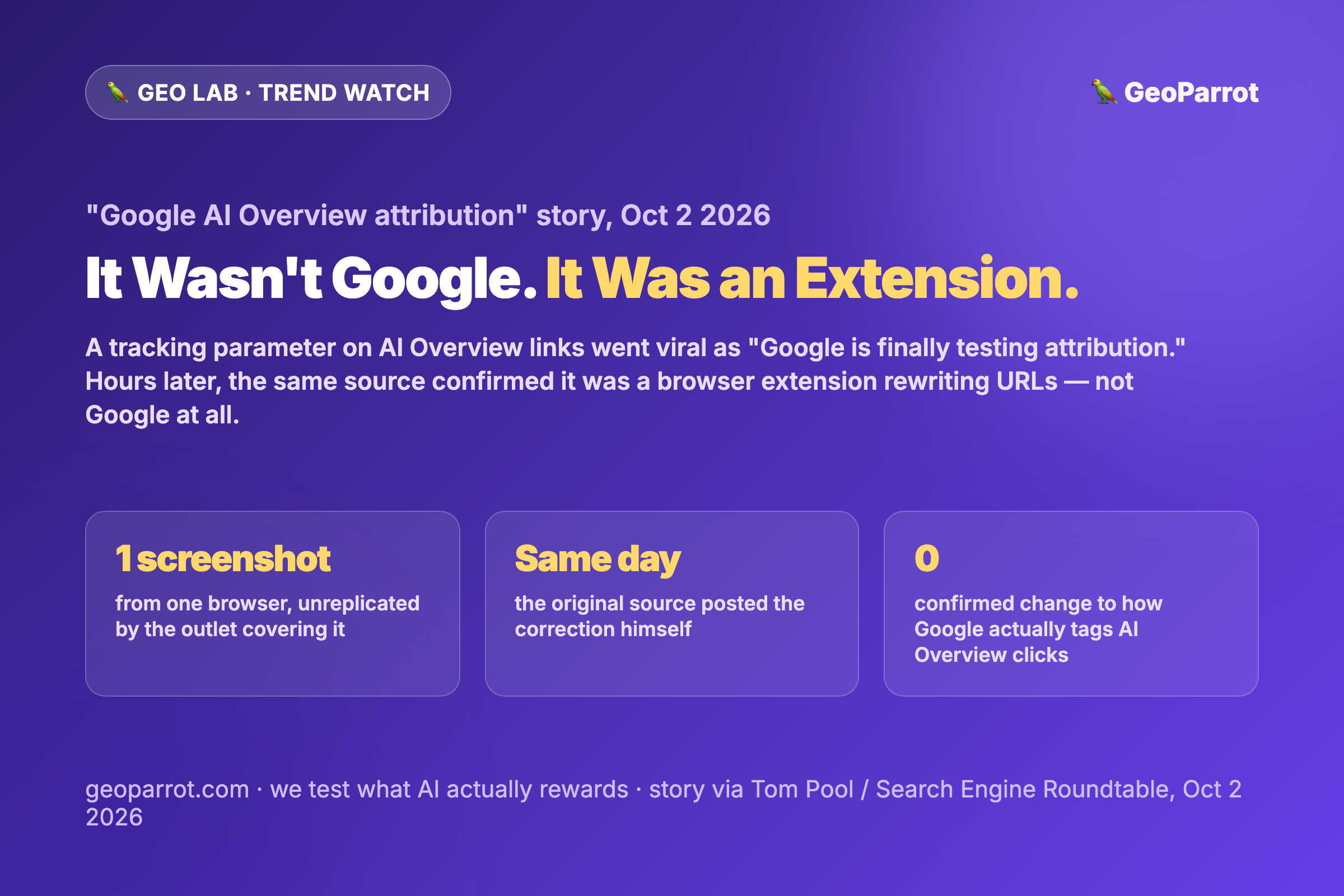
Quick answer: On the morning of October 2, 2026, a LinkedIn post from Tom Pool reported seeing a ?st_source=ai_overview parameter appended to links inside Google AI Overviews and AI Mode — framed as the first real sign of AI Overview click attribution. Search Engine Roundtable covered it the same morning. By that afternoon, Pool himself posted the correction: it wasn’t Google at all. A Chrome browser extension was rewriting the URLs client-side, “presumably to sell the data to brokers.” Barry Schwartz, trying to replicate the finding independently across multiple browsers, couldn’t reproduce it. For GEO practitioners starved for any way to isolate AI Overview clicks inside Google Search Console’s pooled totals, the story is a clean case study in why “Google is testing X” claims need a source check before they become your measurement plan.
Trend watch — published October 3, 2026. We read fast-moving SEO/GEO claims the way the GEO Lab reads any citation-economy story: separate what was actually verified from what people wanted to be true, then ask what that gap costs you.
What did the original post actually claim?
Tom Pool posted on LinkedIn that he was “just started seeing the ?st_source=ai_overview parameter on links mentioned within AI Overviews — is this the start of actual proper attribution reporting?” He documented it with screenshots, and said the parameter showed up not just on the main AI Overview answer links but on the source-list links underneath. Search Engine Roundtable picked it up at 7:46am on October 2 under the headline “Google Testing Appending URL Tracking Parameters to Links in AI Overviews,” with the caveat that it “seems to be testing” this — not confirmed by Google. The framing made sense to anyone who’s tried to measure AI Overview traffic: Google Search Console pools AI Overview clicks inside your overall Web search totals with no first-party way to split them out, so a native tracking parameter would be a genuinely useful feature.
What did it turn out to be?
A browser extension. Pool followed up the same day: “Turns out it was a Chrome Browser Extension modifying the URLs to include these parameters. Presumably to sell the data on to brokers…” Nothing about it came from Google’s search results, and nothing about it was a server-side change to how AI Overviews render links. It was client-side URL rewriting happening in one person’s browser, driven by whatever extension he had installed — likely one built to harvest and resell click-source data, not a Google attribution feature at all. Schwartz noted he tried to reproduce the parameter across multiple browsers himself and couldn’t, which should have been the first flag before the story spread.
Why did a browser extension get reported as a Google test?
Because the claim filled a real gap with a plausible-sounding fix. AI Overview attribution is one of the most-requested, least-available signals in GEO measurement right now — Google’s own Search Console generative-AI report gives you impressions and queries, but not a clean click split between AI Overviews and classic organic results. A story that says “Google is finally fixing this” is exactly the story this community wants to be true, which is precisely when verification discipline matters most. One person’s LinkedIn screenshot, unreplicated by the outlet covering it, traveled through the SEO press as “Google is testing” before anyone else had confirmed it independently. The correction came from the same original source a few hours later — but corrections rarely travel as far as the original claim, and the recap digests covering that day’s news still carried the uncorrected framing.
What does this say about AI Overview attribution right now?
That it still doesn’t exist as a native, Google-provided signal — which is exactly why a fake version of it was so easy to believe. Nothing changed on October 2 about what you can actually measure. The real options are the same ones we’ve covered before: GSC’s generative-AI report gives you impressions tied to AI surfaces but no click-level attribution, and first-party GA4 tracking of AI-referred sessions is still the most reliable way to see whether AI Overviews are sending you traffic at all. A real st_source-style parameter from Google would be genuinely useful — it would finally let you separate AI Overview clicks from the rest of Web search the way referral-based tracking can’t always do cleanly. But “would be useful if true” is not evidence it’s true, and that distinction is the whole discipline behind counted vs. inferred metrics: a number (or a URL parameter) you can see in your own account is countable; a claim about what Google is doing upstream, sourced from one unverified screenshot, is inferred until someone else reproduces it.
A checklist before you act on the next “Google is testing X” claim
- Ask who saw it, and with what. One screenshot from one account, in one browser, is not a confirmed rollout — especially for anything involving URL parameters, which browser extensions, affiliate plugins, and ad blockers rewrite constantly.
- Try to reproduce it yourself, in a clean browser profile. Schwartz tried and failed across multiple browsers before the correction landed — that failed replication was the signal, not the original screenshot.
- Check what extensions are installed on the device that “found” it. Client-side URL rewriting from an extension is indistinguishable from a server-side change unless you test in an incognito window with extensions disabled.
- Wait for a second, independent source before you change a dashboard or a report. If you’d already told a client “Google now tags AI Overview clicks,” you’d be issuing a retraction a few hours later.
- Keep measuring with what’s actually yours. First-party GA4 AI-referral tracking and the GSC generative-AI report don’t depend on a rumor turning out to be real.
The honest caveats
This isn’t a story about Tom Pool getting something wrong — he posted the correction himself, the same day, which is exactly the right behavior and more transparent than a lot of claims in this space ever get. We also can’t fully verify which extension was responsible or confirm his “selling data to brokers” explanation beyond his own account; that part remains his characterization, not something we independently audited. And this doesn’t mean Google will never ship real AI Overview click attribution — it means this specific October 2 sighting wasn’t it. If Google does roll out something like this for real, it’ll be worth covering on its own merits, with Google’s own documentation as the source rather than a single screenshot.
Frequently asked questions
What was the “?st_source=ai_overview” parameter story?
On October 2, 2026, a LinkedIn post reported seeing a tracking parameter on AI Overview and AI Mode links that appeared to mark clicks as coming from AI Overviews. It was covered by Search Engine Roundtable as a possible Google test the same morning.
Was this actually a Google feature?
No. The person who first reported it confirmed later the same day that a Chrome browser extension was rewriting the URLs client-side, not Google. The outlet covering the story also couldn’t reproduce the parameter independently across multiple browsers.
Can you currently track clicks from AI Overviews separately from regular Google results?
Not cleanly, as a native Google feature. The GSC generative-AI report gives impression-level data tied to AI surfaces, and first-party GA4 tracking can catch AI-referral traffic, but Google doesn’t currently tag individual AI Overview clicks with a public parameter inside your normal Web search totals.
Why did this unverified claim spread so quickly?
Because it answered a real, frequently-asked question — how to isolate AI Overview clicks — with a plausible-sounding fix. That gap between “this would be useful” and “this is confirmed true” is exactly where unverified claims travel fastest.
What should you do differently next time a “Google is testing” story breaks?
Check how many independent sources confirmed it, try to reproduce it yourself in a clean browser, and don’t change your reporting or client communications until a second source verifies it. Keep relying on your own first-party measurement in the meantime.
GeoParrot is a GEO Lab: we run experiments to test what AI search engines actually reward, and we grade the industry’s claims against first-party data. See the running scoreboard at our 2026 GEO benchmark.
Leave a Reply