Evidence-first case study · sports brand SEO + GEO series, part 20 of 20
Lacoste is the only brand in this series that runs all 20 of its national storefronts on one shared domain (lacoste.com) and one shared Salesforce Commerce Cloud deployment, and its robots.txt is the most explicitly AI-crawler-friendly one we’ve measured — naming and allowing OpenAI’s, Anthropic’s, Perplexity’s, Mistral’s and Cohere’s crawlers individually, each with its own dedicated Allow: / rule. We tracked the same Classic Fit Original L.12.12 Polo (style L1212) on the US and Korean storefronts: the US page carries a complete Product+AggregateRating schema (4.7058 stars, 1,407 reviews) and 49+ color options, while the Korean page — full price, no Black Friday discount, only 4 colors — shows no review count anywhere on screen and carries no aggregateRating field at all. Lacoste also runs the richest actual FAQ hub we’ve found in this series, with zero structured-data markup on it. Google AI Mode cited a Lacoste domain in 9 of our 10 test queries, tying The North Face and Patagonia for the highest rate in the series — which closes out this 20-brand batch.
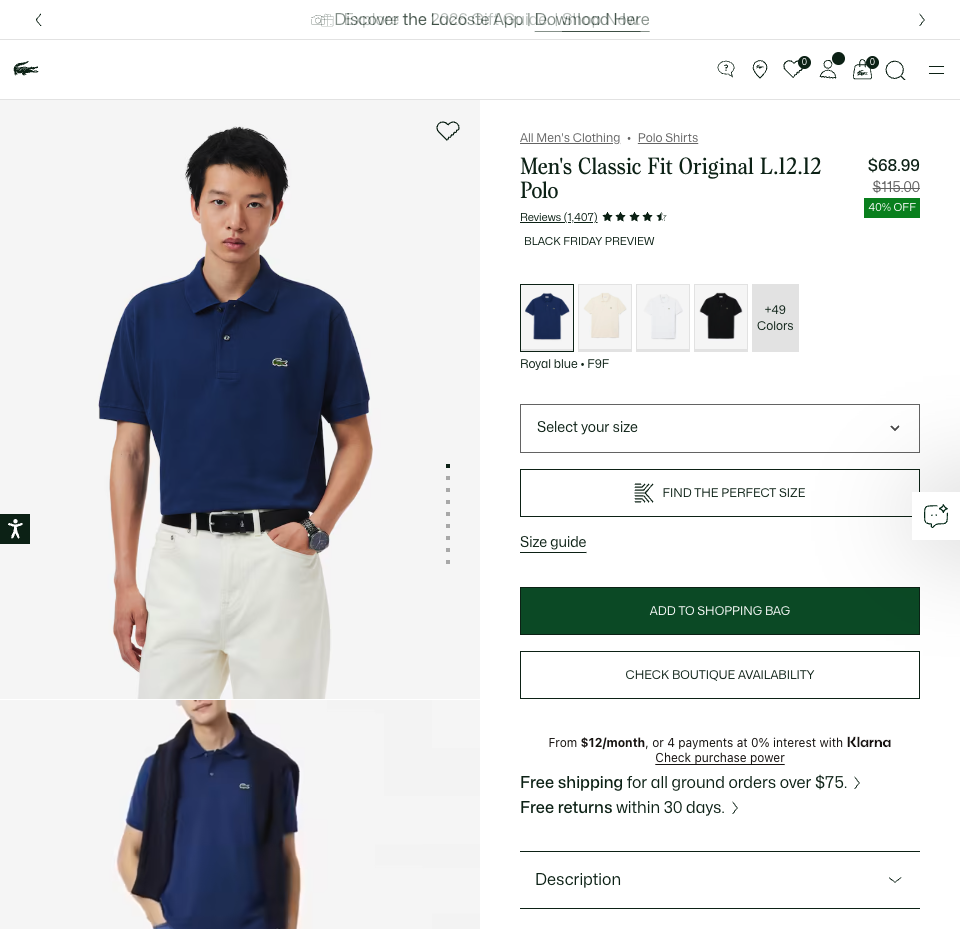
lacoste.com/us/: clean render, Black Friday Preview hero. Requesting this exact /us/ path serves the US storefront regardless of where the request comes from — a geo-redirect only kicks in on the undifferentiated root domain (see below).
What is Lacoste trying to do — and why audit it twentieth?
This closes out GeoParrot’s sports-brand series, running the same evidence-first method we used on Patagonia, Decathlon and eighteen other major names. Lacoste was founded in Paris in 1933 by French tennis champion René Lacoste, who put his own nickname and crocodile emblem on a piqué cotton shirt he designed for his own on-court comfort — a garment now generally credited as the first branded-logo sportswear item to cross over into everyday fashion. We picked it twentieth, as the final entry in this batch, because its single-domain, single-platform architecture across 20 country storefronts stood out as structurally different from everything else we’d seen in this series, where most brands run genuinely separate regional platforms.
Brand category French apparel and footwear maker founded 1933, privately held (majority-owned by the Maus Frères group since 2012), known globally for the Original L.12.12 piqué polo and its crocodile logo.
Primary user job Find the Classic Fit Original L.12.12 Polo, compare price, color choice and review volume between the US and Korean storefronts, and check return policy or sizing before buying.
SEO + GEO challenge One domain and one commerce platform serving 20 markets, a Korean storefront whose matching product carries no reviews on screen at all, and a genuinely rich FAQ hub that carries no FAQPage schema whatsoever.
The product we tracked: the L.12.12 polo, two very different shopping experiences
We tracked the same style family — the Classic Fit Original L.12.12 piqué polo — on both sites, the same cross-locale method we’ve used throughout this series.
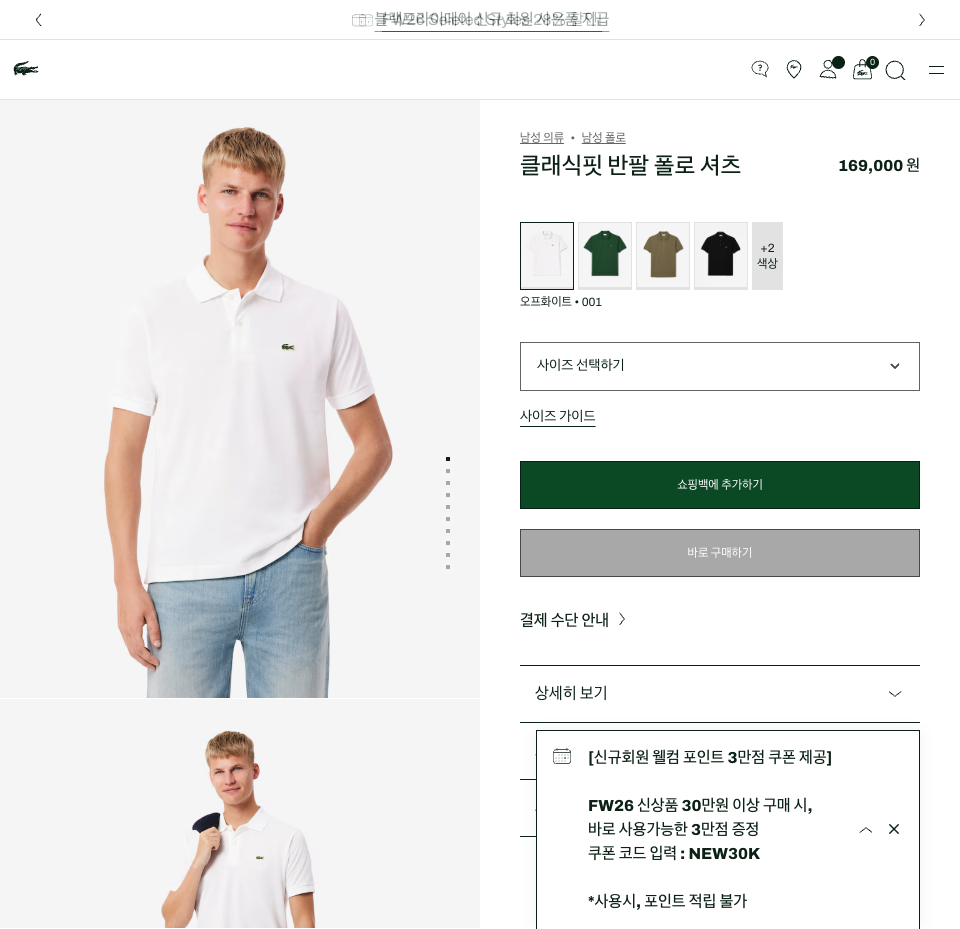
US (style L1212-51): $68.99, reduced 40% from $115 for Black Friday Preview, Reviews (1,407) with a visible star rating directly under the product title, 49+ color options.Korea (style L1212-56G, 클래식핏 반팔 폴로 셔츠): 169,000 KRW at full price — no Black Friday reduction applied despite a sitewide 60%-off banner elsewhere on the Korean site — and only 4 color options (2 shown plus “+2 색상”). No review count or star rating appears anywhere on this page.
The US page’s URL slug (L1212-51.html) returns a hard 404 under the Korean path — confirmed by the internal site ID exposed in the error response, Sites-KR-Site, versus the US site’s Sites-FlagShip-Site. Those are two separate Salesforce Commerce Cloud “Sites” instances, not a shared catalog with locale-filtered pricing. Product imagery, though, still comes from Lacoste’s own infrastructure on both sides — imagena1.lacoste.com for the US page, imageapac1.lacoste.com for the Korean one — both resolving to the same underlying demandware.static/Sites-master asset path. That’s a more unified setup than almost anything else we’ve audited in this series: separate storefront “Sites,” but one shared commerce platform and one shared domain, rather than two completely independent systems.
AI citation snapshot: 10 real queries, Google AI Mode
We sent 10 verbatim queries to Google AI Mode (udm=50) and checked direct a[href] links, counting a citation only when a lacoste.com domain appeared.
Query
Lacoste domain cited?
Who else showed up
who owns lacoste
✅ Yes
en.wikipedia.org, www.jonesday.com, www.scribd.com, www.instagram.com — corporate.lacoste.com (the group’s own corporate site) cited directly
is lacoste a good brand
✅ Yes
www.ralphlauren.com, www.fredperry.com, www.gentlemansgazette.com, reddit.com, supreme.com, www.facebook.com, www.weavabel.com — lacoste.com cited alongside a wide mix of competitor and review sites
lacoste vs ralph lauren polo
✅ Yes
insidehook.com, stylino.cy, readysleek.com, ralphlauren.co.kr, reddit.com, youtube.com — both brands’ own domains cited side by side
lacoste return policy
✅ Yes
no other domains surfaced — lacoste.com’s own policy page was the sole citation
lacoste original polo shirt review
❌ No
gentlemansgazette.com, amazon.in, spiralseven.com, reddit.com, zappos.com, youtube.com, lxrynow.com, macys.com — the one query most directly about the exact product we tracked, and every citation was a third party, not Lacoste’s own page
lacoste sizing guide
✅ Yes
lacoste.com.ph, denimexchangeusa.com, opumo.com, gentlemansgazette.com, reddit.com, lacoste.in — three separate Lacoste country domains cited on the same query
where are lacoste polos made
✅ Yes
newasiagarment.com, asmapp.mssm.edu, knitwear.io, apparel.alibaba.com, quora.com, en.wikipedia.org — both lacoste.com and corporate.lacoste.com cited
m.eng.lottedfs.com — lacoste.com (the Korean path) was the only other citation
is lacoste outlet real
✅ Yes
reddit.com, styleforum.net, askandyaboutclothes.com — lacoste.com’s own outlet-store locator cited directly
Result: a Lacoste domain cited in 9/10 queries (Nike 5/10, Adidas 4/10, Puma 5/10, Under Armour 8/10, New Balance 6/10, ASICS 7/10, Skechers 4/10, Lululemon 8/10, Reebok 7/10, Converse 7/10, On Running 6/10, Hoka 5/10, Vans 8/10, The North Face 9/10, Columbia 7/10, FILA 2/10, Salomon 4/10, Decathlon 7/10, Patagonia 9/10) — tying The North Face and Patagonia for the highest rate we’ve measured across this entire 20-brand series. The single miss, again, is the query most specific to the exact product we audited (“lacoste original polo shirt review”) — the same “own page wins on brand/navigational queries, loses on independent-review queries” pattern we’ve now seen on almost every brand in this series.
G-score audit: the 8-pillar hygiene checklist
We scored seven measurable URLs with the same 8-pillar static-HTML checklist (JSON-LD present, FAQ content, visible date, author byline, concrete data points, table/list structure, 3+ subheadings, a 30-500 character early answer) used in our Week 17 quality-score experiment and on all nineteen prior brands in this series.
Page
G-score
Notable pillars
US homepage
0.625
Organization JSON-LD (founding date, founder, legal name), data points, list structure, 3+ subheadings, early answer; no FAQ content, no date, no author byline
US Original L.12.12 Polo category
0.625
JSON-LD present, data points, list/subheadings, early answer; no FAQ, no date, no author
US L.12.12 Polo PDP
0.625
A complete Product + AggregateRating + BreadcrumbList JSON-LD set (4.7058 / 1,407 reviews, matching the on-screen 4.706/5 almost exactly); no FAQ schema, no author signal
US FAQ hub (/us/FAQ.html)
0.5
Zero JSON-LD of any kind despite genuinely substantial FAQ content (six categories, dozens of real questions) — and because the on-page questions aren’t marked up as <h2>/<h3> headings, our own scorer’s “faq” pillar doesn’t even detect this page as FAQ content, a blind spot in our heuristic worth flagging honestly
KR homepage
0.625
JSON-LD present, visible date-pattern match, data points, list/subheadings; no FAQ, no author, no early-answer paragraph
KR polo category
0.5
JSON-LD present, data points, list/subheadings; no FAQ, no date, no author, no early answer
KR L.12.12 Polo PDP
0.5
Product JSON-LD present but with no aggregateRating field at all — consistent with the on-screen absence of any review count or star rating; no FAQ, no date, no author
Seven-page average: 0.5714 (Nike: 0.4375, Puma: 0.354, Under Armour: 0.5208, New Balance: 0.5833, Adidas: 0.6458, ASICS: 0.4583, Reebok: 0.5417, Converse: 0.5208, On Running: 0.4583, Hoka: 0.6, Vans: 0.425, The North Face: 0.525, Columbia: 0.525, FILA: 0.525, Salomon: 0.5417, Decathlon: 0.5893, Patagonia: 0.4821) — upper-middle of the series, just above Salomon and Reebok. Unlike several earlier brands, the US/KR split here is narrow (three US pages average 0.625, three KR pages average 0.5417) — the real gap in this audit isn’t regional, it’s between e-commerce pages (routinely 0.5-0.625) and the dedicated FAQ page (0.5, dragged down by a heuristic that can’t see its own FAQ content as FAQ content).
One shared platform, an AI-crawler-friendly robots.txt, and a review feature that only exists on one side of the world
robots.txt explicitly names and allows nearly every major AI crawler — the most permissive one we’ve measured in this series — Lacoste’s single, shared robots.txt (covering all 20 markets) gives named, dedicated Allow: / blocks to OAI-SearchBot, ChatGPT-User, ChatGPT-User/2.0, GPTBot, Perplexity-User, PerplexityBot, MistralAI-User, ClaudeBot, Claude-User, Claude-SearchBot and Cohere AI. Most brands in this series either say nothing about these crawlers (leaving them to a generic wildcard rule) or specifically carve out a block against one of them, the way Patagonia’s robots.txt singled out Google-Extended. Lacoste is the first brand here to do the opposite — naming AI crawlers one by one specifically to clear them.
One domain, one commerce platform, 20 markets — the most architecturally unified setup in this series — Every market we checked lives under path-based locales on the single lacoste.com domain (/us/, /kr/, and 18 more named directly in robots.txt’s 20 separate sitemap-index entries), all running on the same Salesforce Commerce Cloud deployment. Requesting the bare root from our Korea-based IP auto-redirected us to /kr/men.html; explicitly requesting /us/ served the US storefront regardless. That’s a sharp contrast with brands like Decathlon (two fully independent platforms) or Patagonia (a separate regional system with its own bot-mitigation behavior) — Lacoste’s regional split happens entirely inside one shared infrastructure.
The Korean L1212 polo page shows no review feature at all, not just an empty one — The US PDP displays “Reviews (1,407)” with a 4.5-star icon directly under the product title, and its JSON-LD carries a complete AggregateRating (4.7058 average, matching the on-screen 4.706/5 almost exactly). The matching Korean PDP (style L1212-56G) has a complete Product JSON-LD block but no aggregateRating field whatsoever — and, unlike several earlier brands in this series where the on-screen star icon was present even when the schema wasn’t, the Korean page doesn’t show a review count or star rating anywhere on the page either. It isn’t a markup gap layered on top of a working feature; the review feature doesn’t appear to be user-facing on this storefront at all for this product.
The Korean L1212 PDP wasn’t included in the sitewide Black Friday discount — The Korean homepage and category pages both advertise “UP TO 60% OFF” Black Friday banners, and the US version of this exact polo is marked down 40% (to $68.99 from $115). The Korean PDP for the same L1212 style showed the full 169,000 KRW price with no visible discount at the time we captured it — we can’t confirm from the outside whether that’s a timing gap, a market-specific promotion calendar, or a product this particular Black Friday push didn’t cover, but the contrast with the US pricing on the identical style was clear in our evidence.
A genuinely rich FAQ hub exists — and carries zero structured data — /us/FAQ.html organizes real customer-support content into six categories (General info, Product info, My account, Returns & refunds, Shipping, Orders & payments) with dozens of individually expandable questions — more actual FAQ content than any other brand we’ve audited in this series. We found no FAQPage JSON-LD anywhere on it, and because the question text isn’t marked up with heading tags either, our own 8-pillar scorer doesn’t register this page as containing FAQ content at all — a limitation of our own method as much as a finding about Lacoste.
What works / What to verify
WHAT WORKS
The US PDP’s complete and accurate Product+AggregateRating schema, a 9/10 AI-citation rate tied for the best in this series, and a robots.txt that goes out of its way to name and clear nearly every major AI crawler.
WHAT TO VERIFY
Whether the Korean storefront plans to add a customer-review feature for this product at any point, whether the Black Friday pricing gap on the Korean L1212 PDP is temporary or permanent, and whether Lacoste’s FAQ hub is a near-term candidate for FAQPage markup given how much usable content already sits on that page.
Target query check — reported honestly, not inflated
We have not re-measured “lacoste seo” or “lacoste geo audit” query volume this session. Per the pattern already confirmed across nineteen earlier subjects in this series on October 20, 2026 (Keyword Planner, US) — the large majority showed no measurable search volume at all for “[brand] SEO/GEO audit” phrasing — we’re not claiming this title drives ranking-based traffic. The distribution case for this series rests on internal links, our own index, and readers already following the GEO Lab arc, not on search demand for “[brand] SEO audit” as a query.
Frequently asked questions
Why does Lacoste run all of its country sites on one domain instead of separate country domains?
We can’t confirm Lacoste’s internal reasoning from the outside, but the technical signal is consistent: every market we checked uses a path prefix (/us/, /kr/, and 18 others named in robots.txt) under lacoste.com, all served by the same Salesforce Commerce Cloud deployment. That’s a simpler infrastructure footprint than maintaining 20 separate country domains and platforms, which is the pattern several other brands in this series use instead.
Does the Korean L1212 polo page really have no reviews, or are they just hidden from the page source?
Based on what we observed, there’s no review count or star rating displayed anywhere on the rendered Korean page, and the page’s own Product JSON-LD has no aggregateRating field. We can’t rule out that Korean customer reviews exist somewhere else on Lacoste’s systems that simply isn’t surfaced on this product page, but as far as a visitor or a crawler reading this exact URL is concerned, there’s no review signal to find.
Should Lacoste add FAQPage schema to its FAQ hub?
Based on what we measured, it looks like a reasonable opportunity: the content is already there in volume (six categories, dozens of real questions) and FAQPage markup is a well-established, low-risk schema type. We’d note the caveat that our own G-score heuristic failed to detect this page as FAQ content at all, which is a flag about the limits of lightweight heuristic scoring generally, not a claim that schema would or wouldn’t change Lacoste’s search or AI-citation outcomes specifically.
Does a higher G-score mean Lacoste gets cited more by AI than lower-scoring brands in this series?
Not in any way we can confirm. Lacoste’s 0.5714 average sits in the upper-middle of the twenty brands we’ve scored in this series, and its 9/10 AI-citation rate ties for the highest — which is broadly consistent with a positive relationship on the surface, but our Week 17 experiment already found hygiene and schema completeness were not a dependable predictor of AI citation at a larger sample size, and this single audit isn’t enough evidence to revisit that conclusion either way.
Audit evidence, scope and limits
Inspected: November 2026, public logged-out access from a Korea-based IP (real headed-browser session used for all screenshots, G-score rendering and citation testing). Screens: the US homepage, the Original L.12.12 Polo category, the Classic Fit Original L.12.12 Polo PDP and the FAQ hub — plus the Korean homepage, the matching Korean product page, its category page, robots.txt (fetched via a real browser, since plain curl requests to lacoste.com returned an Akamai 403), an attempted llms.txt fetch (404), a 10-query Google AI Mode citation snapshot, and an 8-pillar G-score scored across seven browser-rendered pages.
Not measured: rankings, Search Console performance, analytics, conversion, signed-in/member flows, ChatGPT citations (not attempted, given the composer failures flagged on earlier audits in this series), ChatGPT citations, ChatGPT-adjacent reasons the Korean PDP showed no Black Friday discount, or the complete product/locale catalog beyond the one style and seven URLs sampled here. We also checked whether lacoste.co.kr is a separate live storefront: it resolves in DNS but the connection timed out during this audit, and robots.txt and the sitemap index only reference the unified lacoste.com/kr/ path, so we treated that as the live Korean storefront. This is a public-signal snapshot, not a performance claim or a full-catalogue crawl.
This is part 20 of this daily series — and it closes out the original 20-brand batch. Over twenty days we ran the same evidence-first method — real screenshots, a 10-query AI citation snapshot, an 8-pillar G-score audit, and an honest target-query check — against Nike, Adidas, Puma, Under Armour, New Balance, ASICS, Skechers, Lululemon, Reebok, Converse, On Running, Hoka, Vans, The North Face, Columbia, FILA, Salomon, Decathlon, Patagonia and now Lacoste. We’ll follow up separately with what the full batch adds up to.



Leave a Reply