
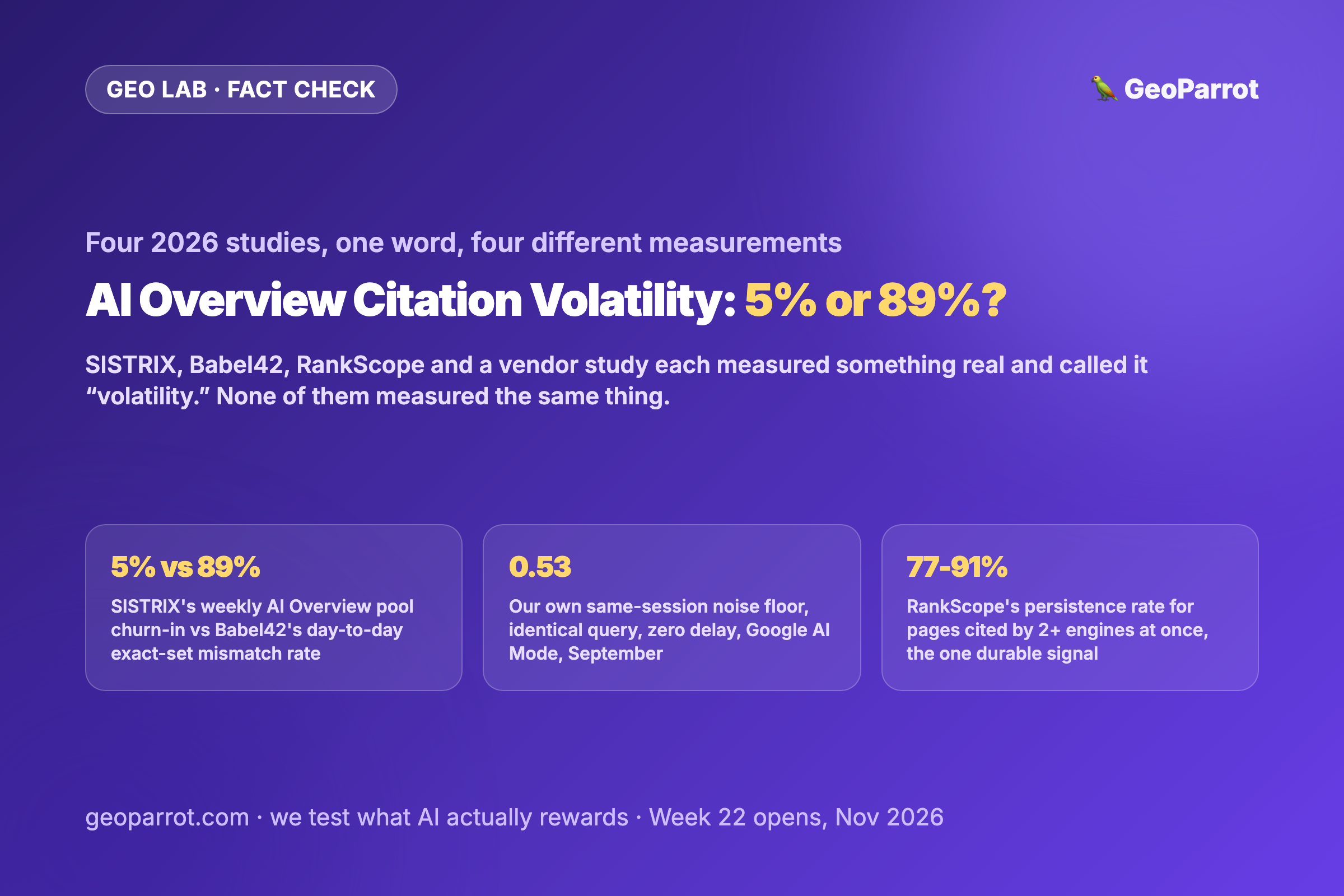
Quick answer: Four separate 2026 studies set out to answer “how volatile are AI Overview citations” and came back with numbers that look like they contradict each other. SISTRIX’s 82,619-prompt, 17-week tracker puts classic Google AI Overview’s weekly “churn-in” at just 5% (versus 56% for AI Mode and 74% for ChatGPT Search). Babel42’s 15-day daily audit of 418 AI Overviews found only 11% repeated the exact same citation set as the day before. RankScope’s three-run re-ask test measured 14 to 16% of AI-Overview-cited pages still cited about 2.7 days later. A vendor study from GetMentions, built on 530,875 citations, put pooled day-over-day source turnover across four engines at 69%. None of these four numbers is wrong. Each one is computing a different thing under the same one-word label: a pool’s weekly growth rate, a full-set exact match, one page’s survival odds, and a multi-engine average. Our own same-session control, from a Google AI Mode experiment in September, landed at a Jaccard of 0.53: rerunning the identical query seconds apart already loses close to half the citation set, before a single day passes. This week we’re running a clean, single-definition test of our own: does a citation you get today survive to Thursday, measured one way, on queries we already have a baseline for.
Week 22 opens, published November 16, 2026, in the GEO Lab. Last week’s arc ended on an open question: before blaming Google Business Profile signals for a loose match between what AI Overview cites and what the Local Pack shows, is the citation list itself even stable enough to compare against anything? This week we test that directly.
What do the four 2026 studies actually say?
Here is each study side by side, including the detail that usually gets stripped out when a number gets quoted on its own: what exactly counted as “volatility.”
| Study | Published / sample | What “volatility” measures | Headline number |
|---|---|---|---|
| SISTRIX (Johannes Beus) | May 1, 2026. 82,619 prompts, 1.55M snapshots, 17 weeks, 6 countries, 3 platforms | Weekly “churn-in”: the share of domains newly entering a topic’s cited-source pool | AI Overviews 5%, AI Mode 56%, ChatGPT Search 74% |
| Babel42 | Sep 26 to Oct 12, 2026. 418 AI Overviews, 601 queries re-run daily for 15 days at 13:00 UTC | Share of AI Overviews citing the exact same full set of sites as the day before | 11% matched the prior day; 0% matched every day |
| RankScope | Nov 6, 2026. 50 questions across 10 brands, 4 engines, 3 runs (0h / +3h / +~2.7 days) | Share of individual cited pages still cited on a later run | AI Overview 14-16%, AI Mode 15-18%, ChatGPT 40-44%, Perplexity 66% |
| GetMentions (vendor) | Jul 9, 2026. 530,875 citations, 4 engines pooled, 7 consecutive days | Average day-over-day source replacement rate, engines pooled together | 69% of sources change daily; 0.4-11.1% persist all 7 days |
Why does SISTRIX say 5% and Babel42 say 89% different?
These two numbers sound like they can’t both be true for the same product. They can, because “churn-in” and “exact-set match” measure different layers of the same mechanism. Churn-in asks: how many brand-new domains enter a topic’s pool of ever-cited sources this week, compared to last week? A 5% churn-in means the universe of candidates barely grows, Google is drawing from roughly the same roster of sites it already knows about for that topic. It says nothing about which subset of that stable roster gets displayed on any one render.
Babel42’s own numbers show exactly why a stable roster still produces a volatile daily lineup: the average tracked AI Overview cited about 7 sites per day but drew from 18 different sites across the 15-day window. If a render pulls 7 names from a fixed pool of 18 each day, two random days will share only a few names by chance alone, even though the pool of 18 hasn’t changed at all. A low pool-growth rate and a low day-to-day exact-match rate are not contradictory findings. They are compatible descriptions of a rotation mechanism: the candidates barely change, but which candidates get shown keeps reshuffling.
Is a single page more durable than the whole citation set?
RankScope’s metric is a third axis entirely: not “does the full panel match” but “does this one specific page survive.” Its numbers (14-16% for classic AI Overview, 15-18% for AI Mode, 40-44% for ChatGPT, 66% for Perplexity, all measured about 2.7 days after the first run) sit closer to Babel42’s volatility picture than to SISTRIX’s stability picture, because page-level survival and full-set match are both downstream of the same reshuffling, while pool-level churn-in is upstream of it.
The one RankScope number that breaks cleanly in a useful direction: pages cited by two or more engines at once persisted at 77-91%, versus 14-44% for pages cited by only a single engine. That is the one finding across all four studies that points at something actionable rather than just describing the noise floor. Cross-engine citation looks like the closest thing to a durability signal in this entire dataset.
Where does our own data sit in this range?
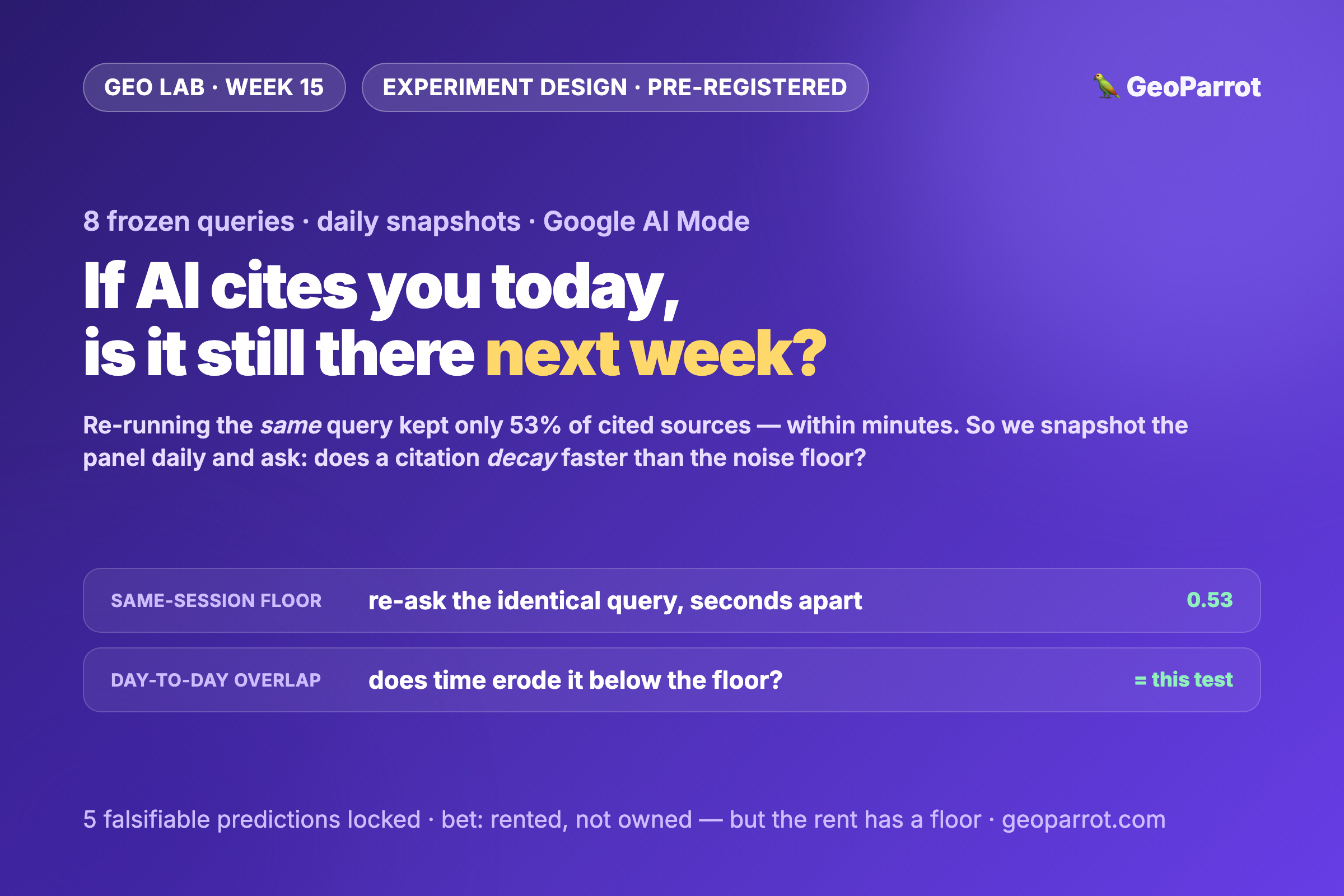
We have a same-session noise floor from our own September query-phrasing experiment: running the identical query twice in a row on Google AI Mode, no delay, no rewording, kept a Jaccard overlap of only 0.53. Half the citation set was already gone before any clock time passed at all, which is the baseline every one of the four studies above is implicitly measuring against without saying so. A week later we tried to extend that into a real day-over-day decay test and never got a single data point: Google’s bot defense returned an empty, forever-loading page to our automated browser profile on every attempt, and we published the blocked attempt itself as the finding rather than quietly dropping the week.
That question, does a citation decay over days rather than seconds, is still open on our own data. It is also the same question Babel42, RankScope, and SISTRIX each tried to answer with a different yardstick. We are reopening it this week with the collection method that already worked cleanly without triggering a block: the same real-browser approach that pulled Google AI Overview and Google Maps data for eight queries last week with zero throttling, documented in last week’s GBP signals arc. Separately, our own ChatGPT source-mix tracking showed an 91% single-month drop in YouTube citations on that one engine, a different kind of volatility again: not within-query rotation, but a platform-wide re-weighting that moves an entire content category at once.
What are we testing this week?
One clean definition, applied consistently: for a fixed query, what share of the domains cited on day 0 are still cited on day 1 and day 3, measured as a straight overlap percentage, not a pool-growth rate and not a cross-engine average. Tuesday’s post locks the query set, the exact overlap formula, and falsifiable predictions before we collect a single snapshot. The theme question for the week: when Google’s AI Overview cites your business today, is that citation rented by the second, or does it usually survive to the next time someone asks?
What should you actually do with four different volatility numbers?
- Don’t average 5%, 11%, 69%, and 86% together. They are not four samples of one distribution. Ask which axis a number sits on, pool growth, exact-set match, single-page survival, or pooled multi-engine turnover, before comparing it to any other number.
- Treat “X% volatility” claims as incomplete until the metric is named. The next vendor deck or blog post that cites a bare percentage without saying which of these four things it measured is not giving you enough information to act on.
- Chase cross-engine citation, not single-engine citation count. RankScope’s 77-91% persistence for multi-engine pages is the one number in this set that looks like a lever rather than a measurement of noise.
- Track classic AI Overview separately from AI Mode and ChatGPT Search. SISTRIX’s split (5% vs 56% vs 74% weekly churn-in) suggests lumping “AI search” into one bucket hides a real difference in how often the underlying surface itself changes shape.
Frequently asked questions
Why do different 2026 studies report such different AI Overview citation volatility numbers?
Because volatility is not one measurement. SISTRIX’s 5% figure is a weekly entrant rate into a topic’s citation pool. Babel42’s 11% is whether the exact full set of cited sites repeats from one day to the next. RankScope’s 14 to 16% is whether one individual page survives about three days. GetMentions’s 69% pools four different engines’ daily source replacement into a single average. All four can be accurate descriptions of the same underlying system without agreeing with each other.
What is churn-in and how is it different from citation overlap?
Churn-in, as SISTRIX defines it, measures how many brand-new domains enter a topic’s pool of ever-cited sources each week. A low churn-in means the universe of candidates barely grows over time. It says nothing about which subset of that already-stable pool gets shown on any single render, which is what citation overlap measures instead. A pool can stay 95% unchanged week to week while the specific 7 sites shown today still look nothing like the 7 shown yesterday.
Is Google’s classic AI Overview more stable than AI Mode or ChatGPT Search?
By SISTRIX’s pool-level churn-in metric, yes, by a wide margin: 5% weekly for AI Overviews versus 56% for AI Mode and 74% for ChatGPT Search. But by RankScope’s page-persistence metric, classic AI Overview (14-16% after about 2.7 days) scored close to AI Mode (15-18%) and well below Perplexity (66%). Which surface looks more stable depends entirely on which axis is being measured.
Does being cited by multiple AI engines make a citation more durable?
In RankScope’s data, yes, clearly. Pages cited by two or more engines persisted at 77 to 91%, versus 14 to 44% for pages cited by only one engine. That gap is a more actionable signal than chasing any single engine’s citation count in isolation.
What is GeoParrot testing this week to measure citation stability directly?
A focused, pre-registered test using one consistent definition: the overlap of cited domains for an identical query across a time gap, extending our own 0.53 same-session noise floor from September into multi-day territory, the same question that got blocked by Google’s bot defense in October. Tuesday’s post locks the query set and the exact overlap formula before we collect anything.
GeoParrot is a GEO Lab: we run experiments to test what AI search engines actually reward, and we grade the industry’s claims, including our own prior calls, against what was actually confirmed. See the running scoreboard at our 2026 GEO benchmark. Related: last week’s GBP signals verdict, the arc this week’s question grew out of, and the September experiment where the 0.53 noise floor first came from.


Leave a Reply