Quick answer: On November 3, 2026, Adam Fry, who leads consumer product for ChatGPT, told a fireside chat at an OpenAI-hosted dinner in New York that “ChatGPT’s volume of search-like queries is now roughly one-fifth the volume of queries of Google.” OpenAI didn’t publish the methodology, didn’t name Google’s baseline, and when pressed on what counts as a “search,” Fry didn’t give a precise definition. Independent trackers that do publish their math land much lower: Ahrefs put ChatGPT at 12% of Google’s volume after filtering for search-comparable prompts, Semrush’s activation data implies closer to 6.3%, and seoClarity estimates 7.5%. The one number that actually produces “one-fifth” is the unfiltered ratio — all 2.5 billion daily ChatGPT prompts (coding, writing, everything) against Google’s 13.7 billion daily searches, which comes out to roughly 18%. OpenAI’s framing describes a narrow, search-specific comparison. The arithmetic that supports “20%” is the broad one.
Trend watch — published November 7, 2026, in the GEO Lab. A self-reported market-share stat went from a dinner conversation to a dozen syndicated headlines in under 48 hours. We checked whether the number survives contact with the math everyone else publishes.
What did OpenAI actually say, and where’s the data behind it?
Fry’s exact line, delivered in a fireside conversation with Big Technology’s Alex Kantrowitz on November 3, was that ChatGPT’s search-like query volume is “roughly one-fifth the volume of queries of Google” — a milestone he framed as reached in about 18 months since ChatGPT added search. That’s it: no absolute query count, no named Google baseline (Search alone, or Search plus AI Overviews and AI Mode), and no precise answer when asked what counts as a “search” versus a chat. OpenAI’s own loose definition, reported elsewhere, is “every time you ask a question and go search the web” — room enough to include a lot of borderline cases, and OpenAI is private, with no obligation to publish the data behind it.
Why do Ahrefs, Semrush, and seoClarity land on such different numbers?
Because they show their work, and the work has a filter OpenAI’s one-liner skips. Ahrefs’ February 2026 analysis starts from the same two public data points everyone uses — OpenAI’s own July 2025 disclosure of roughly 2.5 billion ChatGPT prompts a day, and Google’s January 2025 disclosure of more than 5 trillion searches a year (about 13.7 billion a day). Divide those two raw numbers and you get roughly 18% — “nearly a fifth,” in Ahrefs’ own words, and close enough to OpenAI’s 20% that it’s almost certainly the same comparison. But Ahrefs didn’t stop there: it then estimated that only about 65% of ChatGPT’s daily prompts are actually search-comparable (the rest is coding, writing, brainstorming — things Google Search was never going to count as queries either). Apply that filter and the number drops to 12%, which is the figure Ahrefs actually published as its headline. Semrush’s February 2026 activation data goes a step further and finds that only 34.5% of ChatGPT usage has web search actively turned on; apply that narrower cut and the comparable figure falls to roughly 6.3%. seoClarity’s independent estimate, 7.5%, sits in the same neighborhood. Three different vendors, three different filtering choices, and all three land in a 6-12% band — nowhere near 20%, because all three are measuring “search,” not “everything.”
Is OpenAI’s number wrong, or just a different measurement?
Closer to the latter, which is the more useful story than “OpenAI lied.” Fry’s framing promised a search-specific comparison, but the only arithmetic that reproduces his number counts every ChatGPT prompt against every Google search, with no filter applied. That’s not necessarily dishonest — OpenAI may genuinely use a broader internal definition of “search-like” than Ahrefs’ 65% cut or Semrush’s 34.5% activation rate, and without published methodology there’s no way to check which one it actually used. What’s checkable is that every independent tracker that does publish its filter lands two to three times lower than the headline — the same shape of gap we found when we compared a vendor’s cross-engine disagreement number against data we collected ourselves. The gap usually isn’t fraud, it’s an undisclosed filter doing the work.
Does this change anything about how we measure AI search behavior?
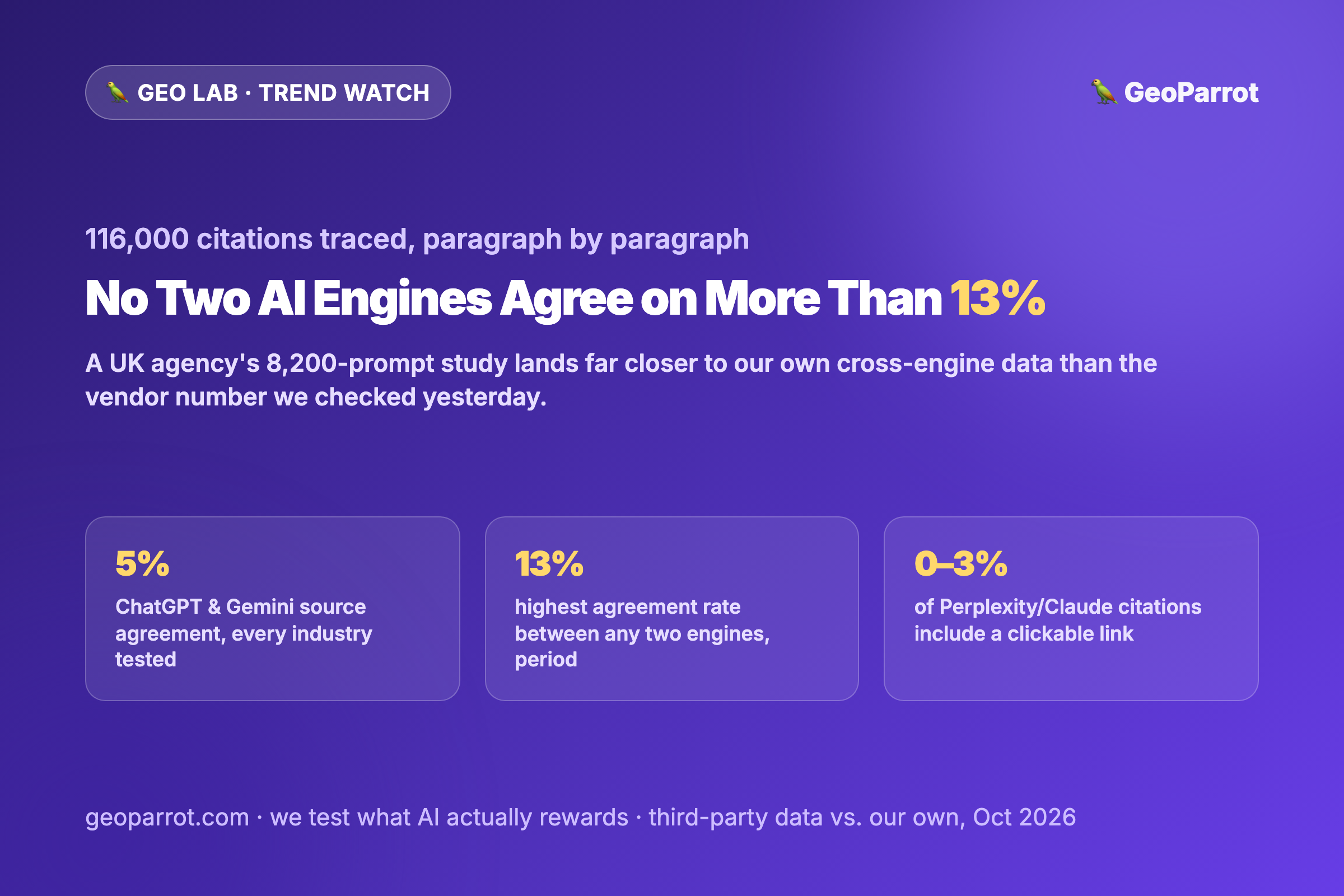
It reinforces a pattern we keep running into. We’ve already shown that a widely-adopted AI-visibility metric can measure the wrong thing entirely — mention share didn’t predict which brand got recommended. Volume share has the same failure one level up: a single aggregate hides a methodology choice that changes the answer 2-3x, and most coverage this week repeated “one-fifth” without the filter attached. It’s a clean case of the counted-vs-inferred distinction we use across this blog — Google’s 13.7 billion and OpenAI’s 2.5 billion are both counted, but “20% of Google’s volume” is inferred from them divided one specific way; a different, equally defensible division gives 12%, 7.5%, or 6.3%. None of the four is “the” answer; they’re four questions wearing one headline. Our own cross-engine work carries the same lesson — when we asked four AI engines the same 15 questions, only 0.5% of cited sources overlapped, a reminder that engine-level aggregates rarely describe what’s happening underneath them.
What to actually do with this number
Don’t cite “ChatGPT has 20% of Google’s search volume” in a client deck without the filter attached. Say which comparison you mean: the unfiltered prompt ratio (~18-20%) or the search-comparable estimate (6-12%, per Ahrefs/Semrush/seoClarity).
Treat any self-reported platform usage stat as a starting point, not a citation-ready number. OpenAI is private and under no obligation to publish methodology; until it does, independent trackers that show their filters are the more defensible source.
Don’t resize your GEO budget off this headline alone. Even the high-end 20% estimate still leaves Google sending roughly 190x more referral traffic to websites than ChatGPT does, per Ahrefs’ same analysis — volume share and traffic value aren’t the same allocation question.
Watch for the next vendor to publish their own number this quarter. When three independent trackers already cluster at 6-12% and a fourth self-reported figure sits at 20%, the next data point that matters is whether anyone replicates OpenAI’s filter, not whether more outlets repeat it.
Frequently asked questions
Did OpenAI actually say ChatGPT has 20% of Google’s search volume?
Close to it. Adam Fry, who leads ChatGPT’s consumer product, said on November 3, 2026 that ChatGPT’s ‘volume of search-like queries is now roughly one-fifth the volume of queries of Google’ — one-fifth being 20%. The claim came from a dinner-event fireside chat, not a published report, and OpenAI hasn’t released the underlying data.
What do independent trackers estimate instead?
Ahrefs estimates 12%, after filtering ChatGPT’s daily prompts down to the ~65% it considers search-comparable. Semrush’s activation data (only 34.5% of ChatGPT usage has web search turned on) implies a narrower ~6.3%. seoClarity independently estimates 7.5%. All three cluster well below 20%.
So where does the 20% number actually come from?
The unfiltered ratio of OpenAI’s disclosed 2.5 billion daily ChatGPT prompts (all of them, including coding and writing) against Google’s disclosed 13.7 billion daily searches works out to roughly 18% — nearly identical to OpenAI’s ‘one-fifth.’ That counts every ChatGPT interaction, not just search-like ones, which is a broader comparison than the ‘search-like queries’ language OpenAI used.
Does this mean OpenAI’s claim is false?
Not provably false — OpenAI hasn’t published the methodology needed to check it either way. What’s checkable is that every independent tracker that discloses its filtering method lands two to three times lower than OpenAI’s figure, and the only published math that reproduces OpenAI’s number is the broadest possible comparison, not a narrow search-specific one.
What should marketers and SEOs do with this stat?
Use the range, not the headline: 6-12% for search-comparable volume per independent trackers, up to ~20% only if you mean all ChatGPT usage versus all Google searches. And remember that volume share isn’t traffic share — Ahrefs’ own data shows Google still sends roughly 190x more referral traffic to websites than ChatGPT does, regardless of which volume number you pick.





Leave a Reply