
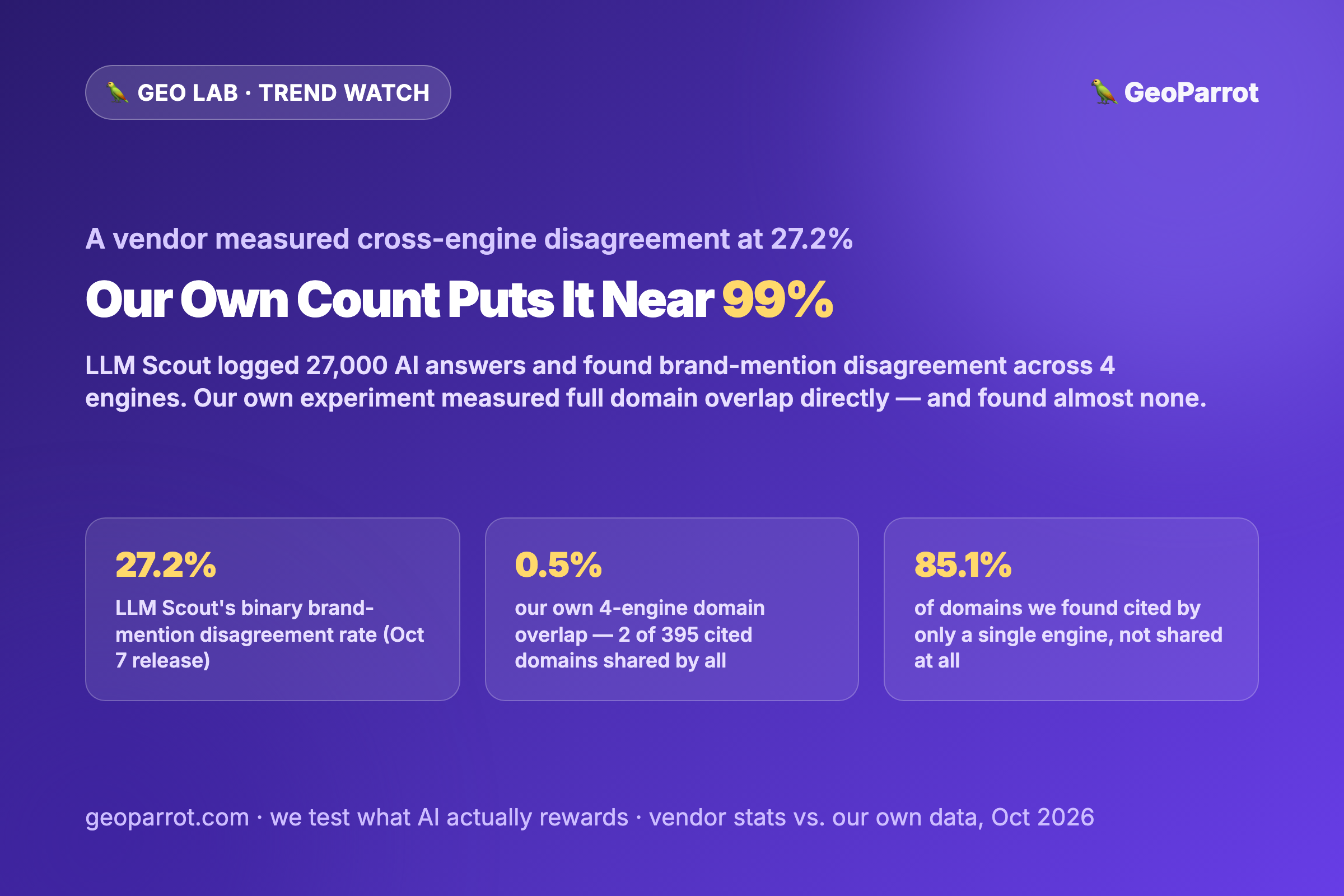
Quick answer: On October 7, 2026, AI-visibility platform LLM Scout published a press release claiming ChatGPT, Claude, Gemini and Perplexity disagreed on whether to mention a tracked brand in 27.2% of 749 product-selection queries, drawn from roughly 27,000 logged AI answers over nine months. That’s a real, specific number — but it measures something narrow: whether a known brand got named at all, yes or no. Our own cross-engine experiment measured a different thing directly: which domains four engines actually cited across the same question set. We found 395 unique domains total, with just 2 appearing in all four engines — overlap near zero, not 27%. Neither number is wrong. They’re answering different questions, and the size of the gap between them is the actual lesson here.
Trend watch — published October 9, 2026. We read every AI-visibility vendor claim the way the GEO Lab reads any stat: what was actually measured, what methodology was disclosed, and how it compares to data we can verify ourselves.
What did LLM Scout actually measure?
LLM Scout, a London-based AI-visibility analytics platform founded by Frank Vitetta, published a press release on October 7, 2026 built around one headline number: across 749 identical product-selection queries run through ChatGPT, Claude, Gemini and Perplexity, the four engines disagreed on whether to name a tracked brand in 27.2% of cases. The underlying dataset is described as nearly 27,000 AI answers logged by the platform over a nine-month window.
Two things are worth flagging before using that number for anything. First, this is a vendor measuring its own tracked-brand dataset with its own platform and publishing the result as a press release — there’s no independent replication, and the release doesn’t disclose which brands, which product categories, or what counts as a “mention” in edge cases (a brand named in a comparison table versus named as the top pick, for instance). Second, “disagreement on whether to name a brand” is a binary yes/no metric. It tells you nothing about which other brands or sources each engine cited instead when they didn’t mention the tracked one.
How does 27.2% compare to data we measured ourselves?
We ran a comparable test in June 2026 — 15 purchase-intent questions across ChatGPT, Perplexity, Google AI Mode and Gemini, logging every domain each engine actually cited, not just whether one tracked brand showed up. The result: 395 unique domains across all four engines combined, and only 2 of them — Reddit and Semrush — appeared in every engine’s answers. That’s roughly 0.5% full overlap. 85.1% of cited domains were exclusive to a single engine. We didn’t track brand mentions in a binary sense; we tracked the actual source pool each engine pulled from, and the pools barely intersect.
| Measurement | What it counted | Result |
|---|---|---|
| LLM Scout (Oct 2026 press release) | Binary: did engine X mention tracked brand Y, yes/no, per query | 27.2% disagreement rate |
| GeoParrot exp2 (Jun 2026, our data) | Full domain-level citation set per engine, compared pairwise | ~0.5% full 4-way overlap, 85.1% single-engine-exclusive |
Both numbers point the same direction — the engines are drawing from meaningfully different source pools for the same questions. But they’re not the same claim, and treating 27.2% as “mild disagreement” versus our 85%+ exclusivity as “near-total fragmentation” would lead a practitioner to very different conclusions about how much per-engine GEO work is actually necessary. The gap exists because a binary brand-mention check only registers disagreement when a specific, pre-selected brand is involved; it says nothing about the dozens of other domains each engine is citing that a tracked-brand dashboard was never built to see.
Can we score this stat the way we scored the others this week?
This week we built and ran a three-part scoring method — reachability, methodology disclosure, and re-citation stability (R/M/S) — to audit eight GEO citation stats circulating in the industry. Running the same lens here: Reachability is high (the press release itself states the figure plainly, no dead link or paywall). Methodology disclosure is low — sample brands, categories, and the exact mention-matching rule aren’t published, and nine months of proprietary logs can’t be independently re-run. Stability is untested; this is a brand-new release with no re-citation history yet to check. On our own three-part scale, that’s a stat that’s reachable but thin on the two criteria that actually determine whether a number survives scrutiny — the same pattern we found in most of the GEO stats we traced to source this week.
That’s not a knock on LLM Scout specifically — it’s the default condition of almost every AI-visibility vendor number right now, including, to be clear, our own. Our 0.5%/85.1% figures come from a 15-question sample we ran once in June with a tool we built ourselves; we’ve been upfront in our own writeups about that sample size being too small to generalize from alone. The difference is we’ve published the method, the raw domain lists, and the collection script, so anyone can check our arithmetic. That’s the bar we think any cross-engine divergence number should clear before a GEO strategy gets built on top of it.
A checklist for reading vendor AI-visibility stats
- Check what the metric actually counts before comparing it to anything. “Disagreement rate” on a binary brand-mention check and “domain overlap” on a full citation set are not interchangeable, even when both describe “cross-engine divergence.”
- Ask whether the number could be replicated by someone outside the company that published it. If the dataset, query list, and matching rules aren’t public, the stat is a claim, not a result — ours included, until someone else reruns it.
- Don’t let one metric’s scale tell you how big the real problem is. A 27% figure and an 85% figure can both be true descriptions of the same underlying fragmentation, depending on what’s being counted. Neither alone tells you how much per-engine optimization you need.
- Treat “engines cite different things for the same query” as the working assumption now, regardless of whose number you use — our data, LLM Scout’s, or the broader citation-overlap research this space keeps producing. The direction is consistent even when the magnitude isn’t.
- Re-run small samples before trusting them, including our own. Our exp2 sample was 15 questions. That’s enough to show a pattern, not enough to put a firm percentage on it — which is exactly the caveat we’d want applied to anyone else’s number too.
Frequently asked questions
Is LLM Scout’s 27.2% disagreement figure wrong?
Not necessarily wrong, but narrow. It measures whether a specific tracked brand got named, which is a much smaller question than measuring the full set of domains each engine cites. A low binary disagreement rate can coexist with near-total divergence in the broader source pool — our own data suggests exactly that.
Why did your experiment find near-zero overlap when LLM Scout found 73% agreement?
Because “agreement” in LLM Scout’s framing means both engines either mentioned or didn’t mention one pre-selected brand — a coin that only has two sides. Our measurement compared the full list of domains cited, which has hundreds of possible outcomes per query. Fewer categories almost always produces a higher apparent agreement rate than more categories, independent of how similar the underlying behavior actually is.
Does this mean cross-engine GEO tracking tools are unreliable?
It means their headline percentages depend heavily on what they define as a match, and that definition is rarely published in full. Use vendor dashboards for directional trend-watching on your own brand, not as a universal fragmentation benchmark, unless the methodology is public enough to audit.
Should GeoParrot’s own 0.5%/85.1% numbers be trusted more than LLM Scout’s?
Trust the method, not the magnitude. We’ve published our question list, collection script, and raw domain data, which makes our number checkable. We’ve also been explicit that 15 questions is a small sample. Checkability and small-sample honesty are what we’d ask of any stat, including our own and including LLM Scout’s.
Data and method: our cross-engine citation experiment (exp2, June 2026) and its per-engine verdict and checklist. Framing: there is no universal GEO strategy, counted vs. inferred GEO metrics, and this week’s R/M/S stat-scoring method.
Leave a Reply