Evidence-first case study · sports brand SEO + GEO series, part 9 of 20
Reebok.com runs on Shopify, and its llms.txt — a genuine HTTP 200, unlike most brands in this series — turns out to be a generic Shopify-generated “Agent Instructions” document about checkout automation (the Universal Commerce Protocol and a Shop-skill integration), not a GEO or AI-citation policy at all. More strikingly, the Product and Organization JSON-LD that an AI shopping agent would actually need is injected client-side by JavaScript: a plain HTTP fetch of the homepage and Contact Us page — what a non-JS-rendering crawler like GPTBot or ClaudeBot sees by default — returns zero structured-data blocks, while the same pages after full browser rendering carry a complete Organization + Product schema. Meanwhile Reebok’s Korea storefront, reebok.co.kr, is run by an entirely different company — Korean fashion conglomerate LF Corporation — whose robots.txt explicitly blocks ClaudeBot and GPTBot by name.
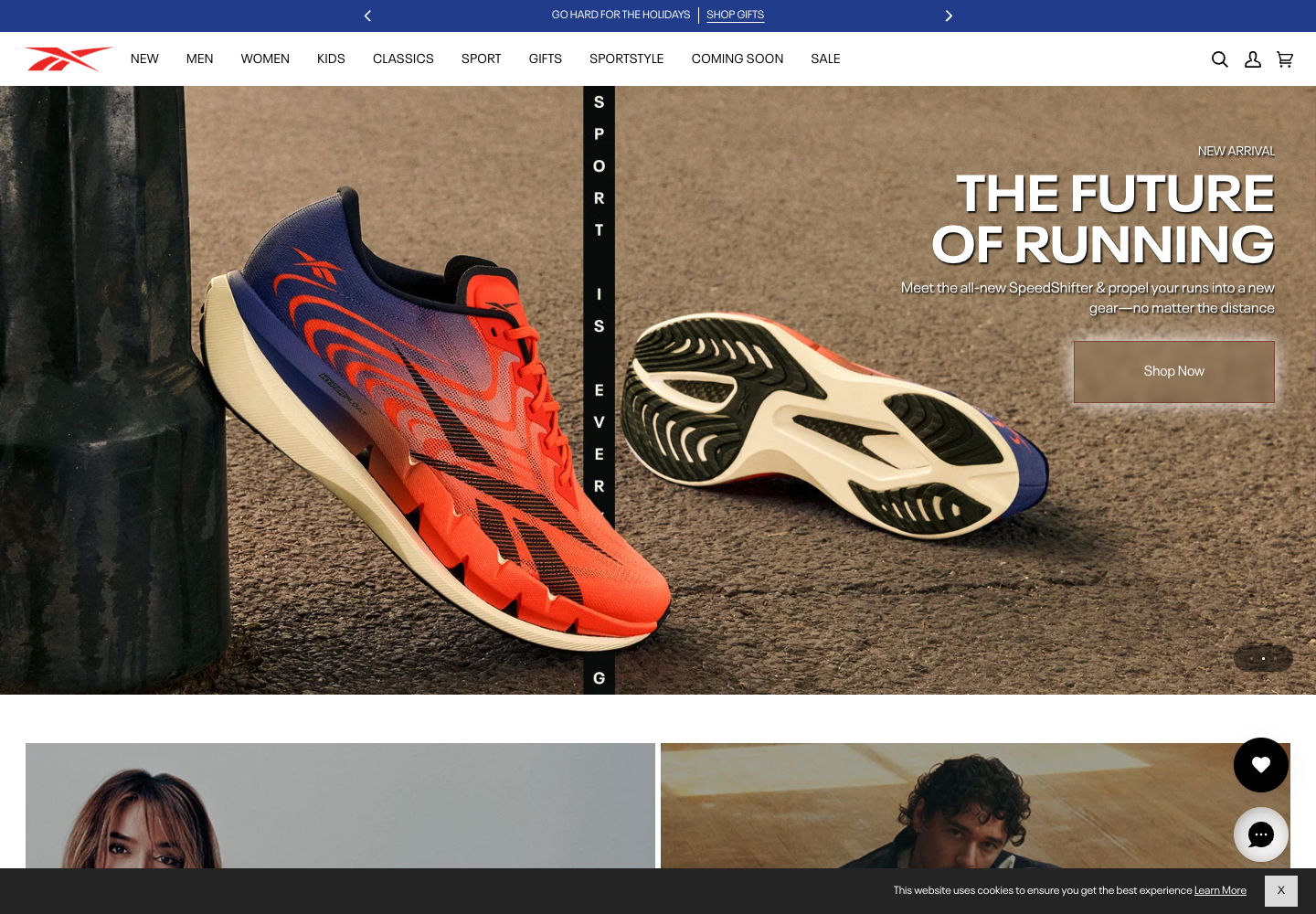
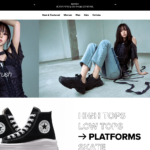
Actual public homepage captured during this audit, November 5, 2026.
What is Reebok.com trying to do — and why audit it ninth?
This is part 9 of GeoParrot’s sports-brand series, running the same evidence-first method we used on Lululemon, Skechers and New Balance. Reebok is a useful ninth name because it has changed hands twice in recent years — sold by Adidas to Authentic Brands Group (ABG) in 2021 — and its storefront infrastructure shows it: reebok.com now runs on Shopify (confirmed via its public /.well-known/ucp endpoint, which names the backing shop as abg-reebok-store.myshopify.com), a platform none of the previous eight brands in this series used. That migration brought Shopify’s own emerging “agentic commerce” infrastructure along with it — which turns out to be a genuinely different category of llms.txt than anything we’ve seen so far.
Brand category Heritage sport-lifestyle footwear brand, now owned by Authentic Brands Group, with the Classic Leather as its best-known heritage silhouette and the Club C as a close second.
Primary user job Find the Classic Leather (or a comparable heritage sneaker) in the right colorway and size, backed by visible reviews, and get order/returns help from a first-party support hub.
SEO + GEO challenge A Shopify-generated llms.txt built for agentic checkout rather than AI-citation guidance, paired with Product schema that a non-JS crawler can’t actually see — and a Korea licensee site whose robots.txt names ClaudeBot and GPTBot specifically to block them.
The product we tracked: Classic Leather Shoes
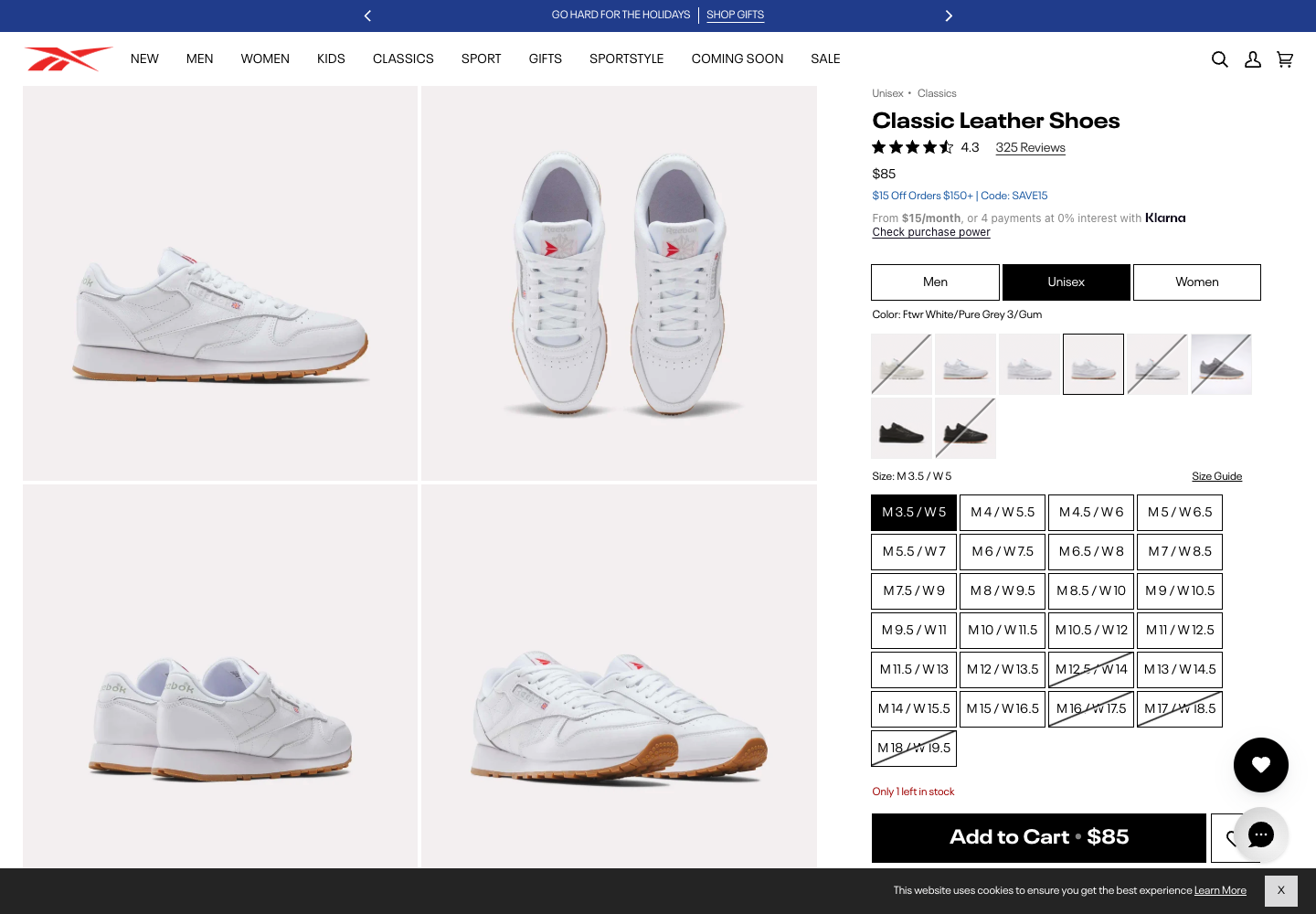
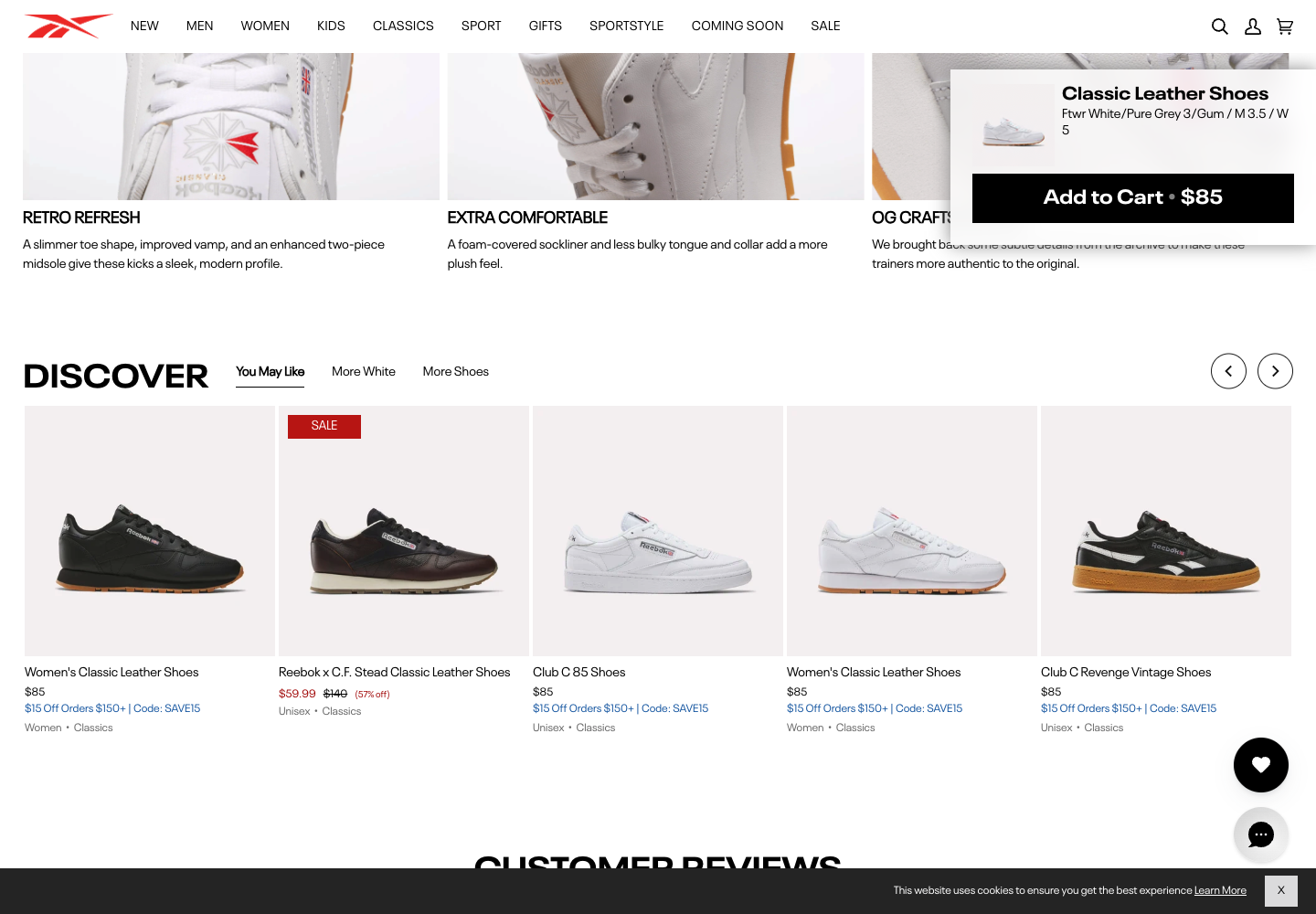
US product page: $85, a 4.3-star rating linking to 325 reviews, and 7 colorways.Scrolling past the fold surfaces a “Discover” cross-sell carousel (Women’s Classic Leather, Club C 85, Club C Revenge Vintage) immediately above the Customer Reviews section.
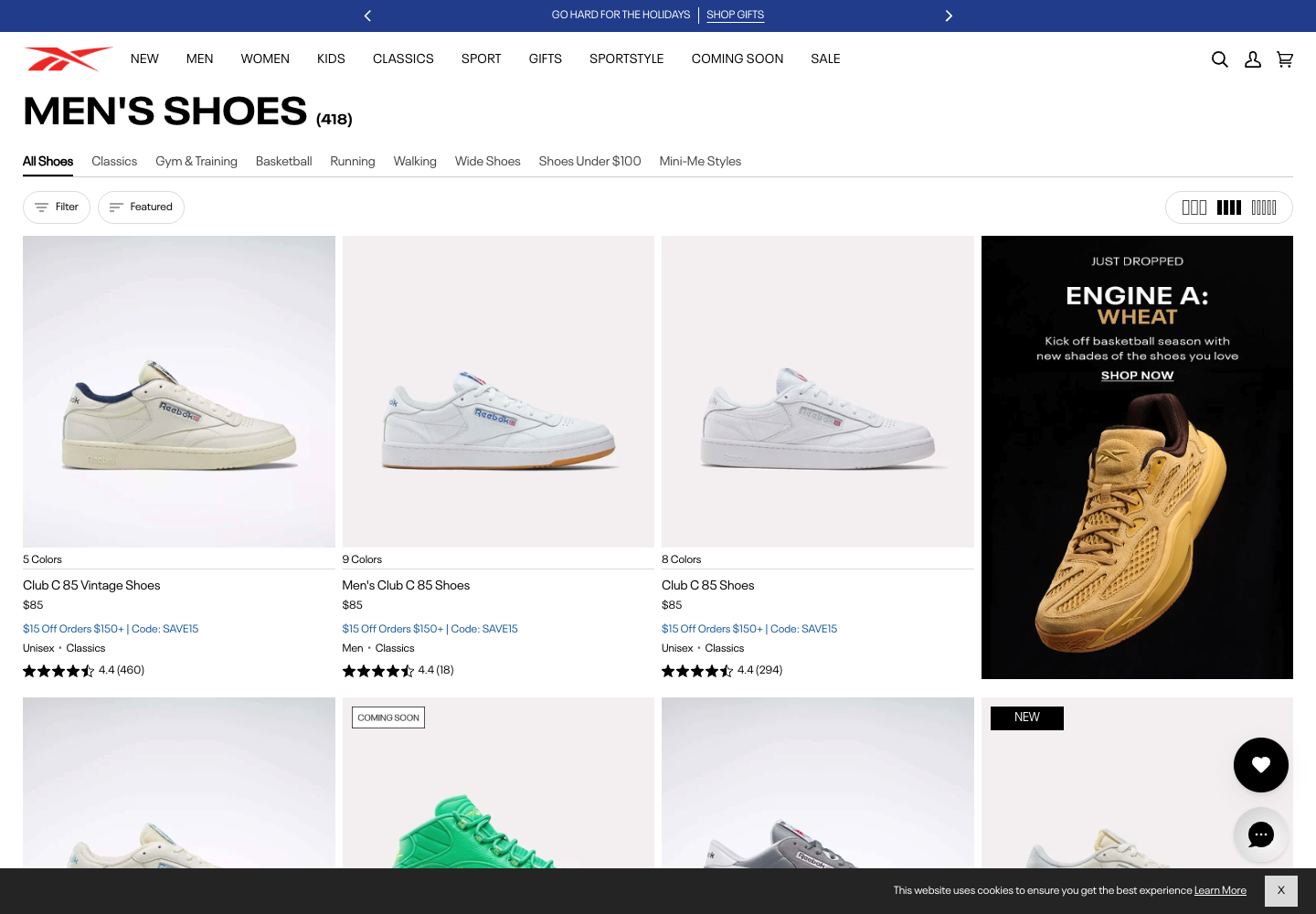
The category layer: “Men’s Shoes” at 418 items, with Club C 85 variants as the top three featured tiles ahead of the Classic Leather — the widest catalogue count in this series so far.
AI citation snapshot: 10 real queries, Google AI Mode
We sent 10 verbatim queries to Google AI Mode (udm=50) and checked both direct a[href] links and citation chip aria-labels for the Reebok brand family (reebok.com, reebok.co.kr, reebok.eu, reebok.com.au). Method note, reported honestly: direct link capture worked well this run (most queries returned 2-20 raw URLs), so counts lean on actual hrefs rather than chip labels alone — the same convention used for New Balance and Lululemon.
Query
Reebok domain family cited?
Who else showed up
best reebok classic leather colorways
✅ Yes
footlocker.com — reebok.com’s own Classic Leather collection page captured directly
reebok classic leather review
✅ Yes
runrepeat.com, zappos.com, soleracks.com — reebok.com’s own PDP cited alongside three third-party review sites
reebok vs adidas originals sneakers
✅ Yes
adidas.co.kr, adidas.com, zhihu.com — both brands’ own domains cited side by side
reebok return policy
✅ Yes
reebok.eu, donotpay.com — reebok.com’s own returns page cited directly
is reebok true to size
✅ Yes
sneakerjagers.com, runrepeat.com, reddit.com, stylight.com, thesolesupplier.co.uk — the regional reebok.com.au domain cited, not reebok.com itself
reebok club c vs classic leather
✅ Yes
runrepeat.com, reddit.com, footlocker.com, tradeinn.com — reebok.eu cited, not the .com domain
best reebok running shoes 2026
❌ No
runrepeat.com, sapphirerunningzone.com — third-party running-shoe review sites only
reebok loyalty program benefits
✅ Yes
happyrewards.io, loyaltyrewardco.com — reebok.com’s own loyalty page cited directly
who owns reebok now
❌ No
wikipedia.org, authentic.com (ABG’s own site), sportsbusinessjournal.com, instagram.com — third-party and ABG-side sources answered, not Reebok’s own domain
reebok vs new balance sneakers
❌ No
newbalance.com, nbkorea.com, naver.com, reddit.com and 15 other retail/review domains — New Balance’s domain family appeared, Reebok’s did not
Result: Reebok’s domain family cited in 7/10 queries (Nike 5/10, Adidas 4/10, Puma 5/10, Under Armour 8/10, New Balance 6/10, ASICS 7/10, Skechers 4/10, Lululemon 8/10) — tied for second-highest in the series. The two head-to-head brand-comparison queries split: Reebok won when compared against Adidas (both domains cited), but lost when compared against New Balance (only New Balance’s domain family appeared) — continuing the series-wide pattern that comparison queries are the least predictable for any single brand’s own domain to win. The named-product review query succeeded this time, breaking the five-brand losing streak we’d tracked on “[brand] [product] review” queries through New Balance.
G-score audit: the 8-pillar hygiene checklist, and a client-side schema gap
We scored six representative Reebok URLs with the same 8-pillar static-HTML checklist (JSON-LD present, FAQ content, visible date, author byline, concrete data points, table/list structure, 3+ subheadings, a 30–500 character early answer) used in our Week 17 quality-score experiment and on all eight prior brands. What we found this time is new to the series: on reebok.com, a plain HTTP fetch of the homepage and Contact Us page returns zero application/ld+json blocks, but the identical URL re-fetched through a full browser session (JavaScript executed, 5-second settle) carries a complete Organization + Product schema. We confirmed this isn’t a fluke by running both fetch methods side by side on the same four US pages in the same pass.
Page (US, reebok.com)
Plain-fetch G (JSON-LD blocks)
JS-rendered G (JSON-LD blocks)
US homepage
0.5 (0)
0.75 (2)
Men’s Shoes category
unmeasurable (HTTP 429)
0.75 (1)
Classic Leather product page
unmeasurable (HTTP 429)
0.75 (2)
Contact Us / help
0.5 (0)
0.75 (1)
Method note, reported honestly: repeated plain-HTTP requests to reebok.com’s category and product pages returned HTTP 429 (Too Many Requests) partway through this audit — Shopify-side rate limiting, not a hard block, and notably the exact behavior Reebok’s own agents.md tells AI agents to expect (“Back off on 429 responses and respect Retry-After when provided”). We didn’t attempt to defeat it; those two rows use the browser-rendered score only, consistent with how we handled Akamai blocks on Adidas, New Balance and Lululemon earlier in this series.
Page (KR, reebok.co.kr)
G-score (plain fetch)
Passes
Fails
Korea homepage
0.375
data points, lists, subheadings
JSON-LD, FAQ, date, author, early answer
Korea Classic Leather product page
0.375
data points, lists, subheadings
JSON-LD, FAQ, date, author, early answer
Blending the primary fetch method used per page (plain where it succeeded, browser-rendered where 429 forced a fallback), the six-page average is 0.5417 (Nike: 0.4375, Puma: 0.354, Under Armour: 0.5208, New Balance: 0.5833, Adidas: 0.6458, ASICS: 0.4583) — middle of the series range. But the headline isn’t the average, it’s the gap: reebok.com’s own Product schema exists and is reasonably complete, yet it’s invisible to anything that fetches the page without running JavaScript — which describes most AI crawlers (GPTBot, ClaudeBot, PerplexityBot and CCBot do not execute JavaScript by default).
US support, and the Korea storefront: a different company, a different platform
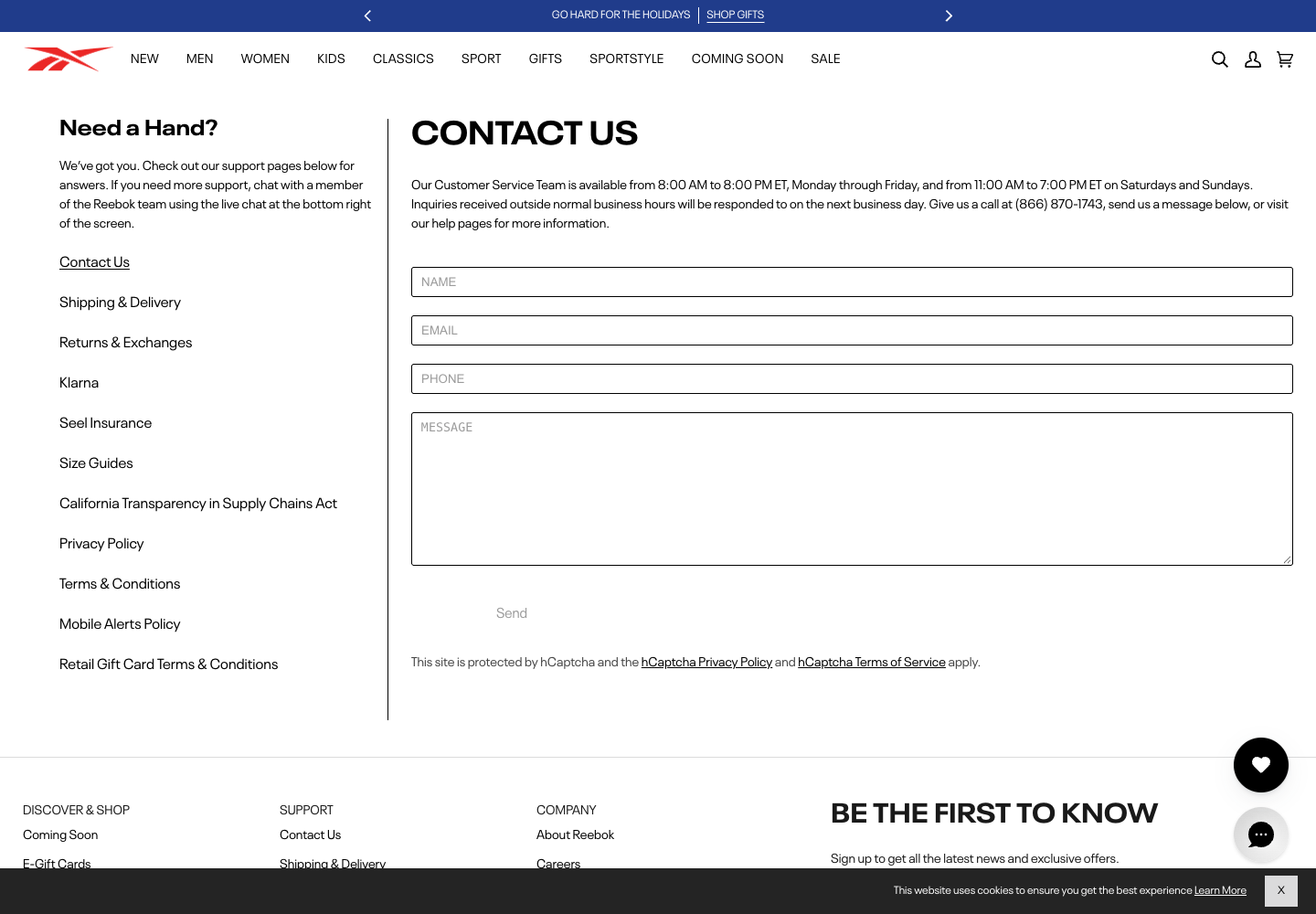
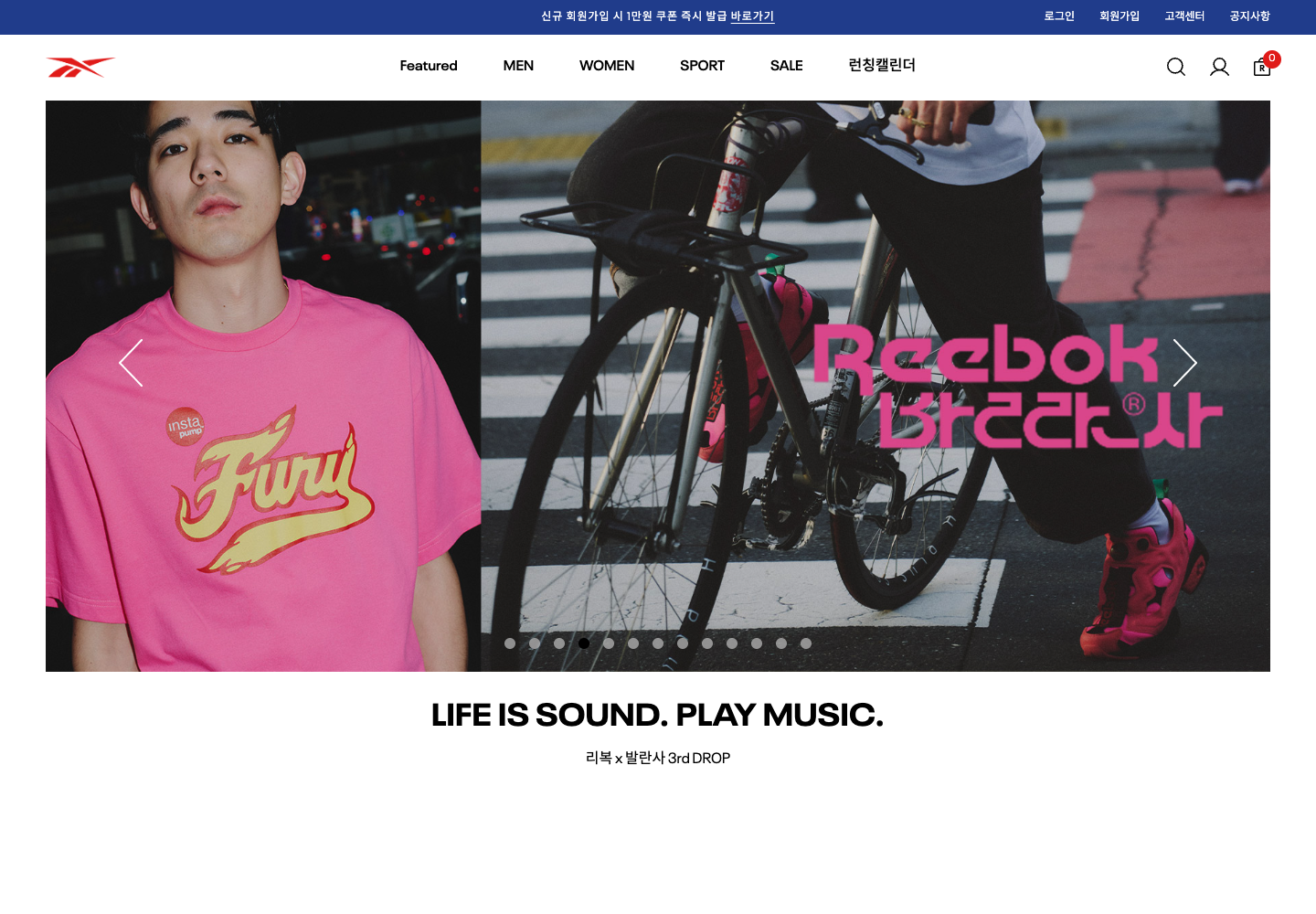
Reebok’s US Contact Us page runs standard hCaptcha-protected support form. The Korea storefront, reebok.co.kr, is a visibly different site end to end — different design system, different e-commerce platform (GODOMALL, not Shopify), and as the product page itself discloses, a different operating company.
US Contact Us page: hCaptcha-protected support form, live chat widget bottom-right.Korea homepage on reebok.co.kr — a visually distinct storefront built on GODOMALL, a Korean e-commerce SaaS platform, not Shopify.
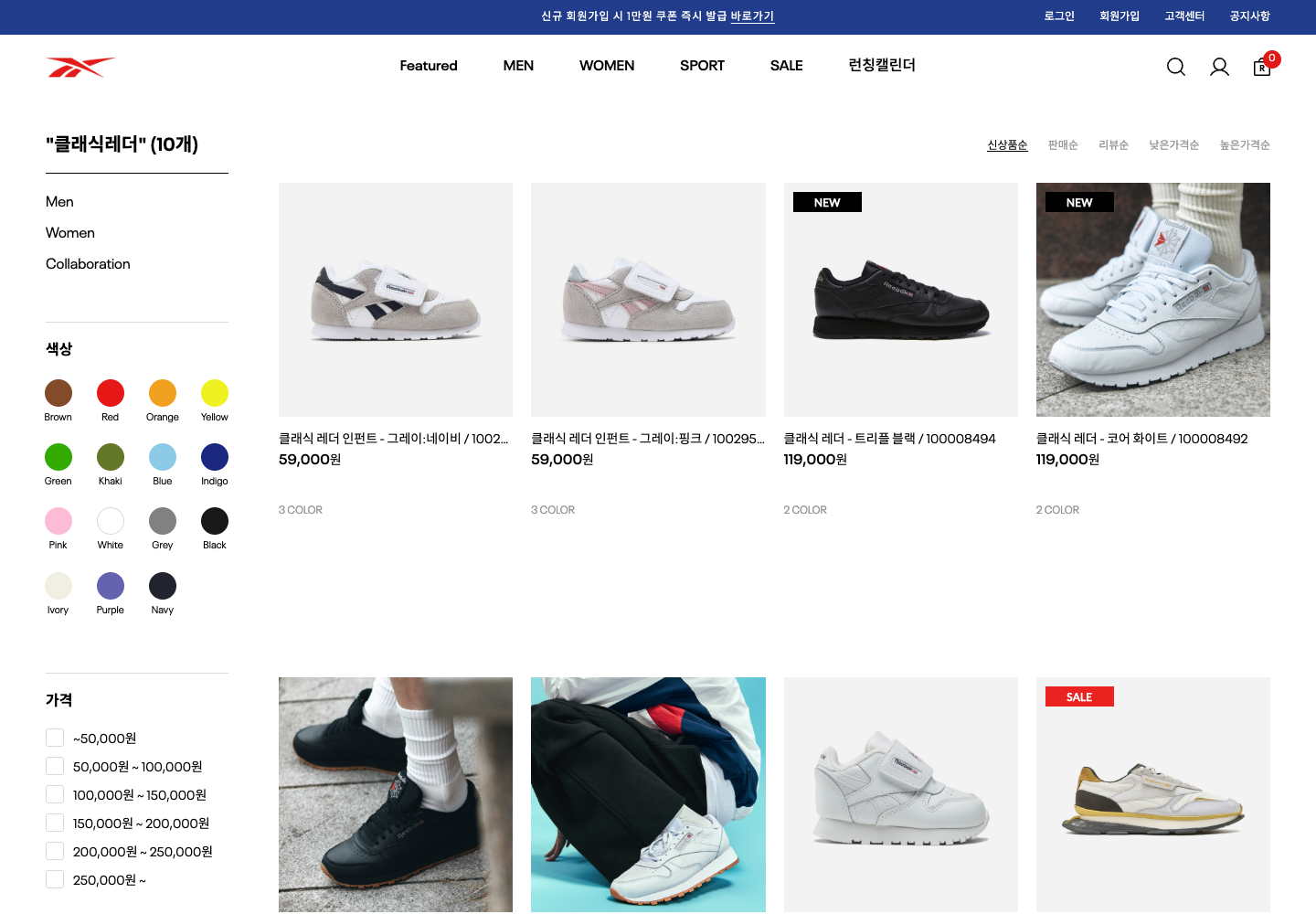
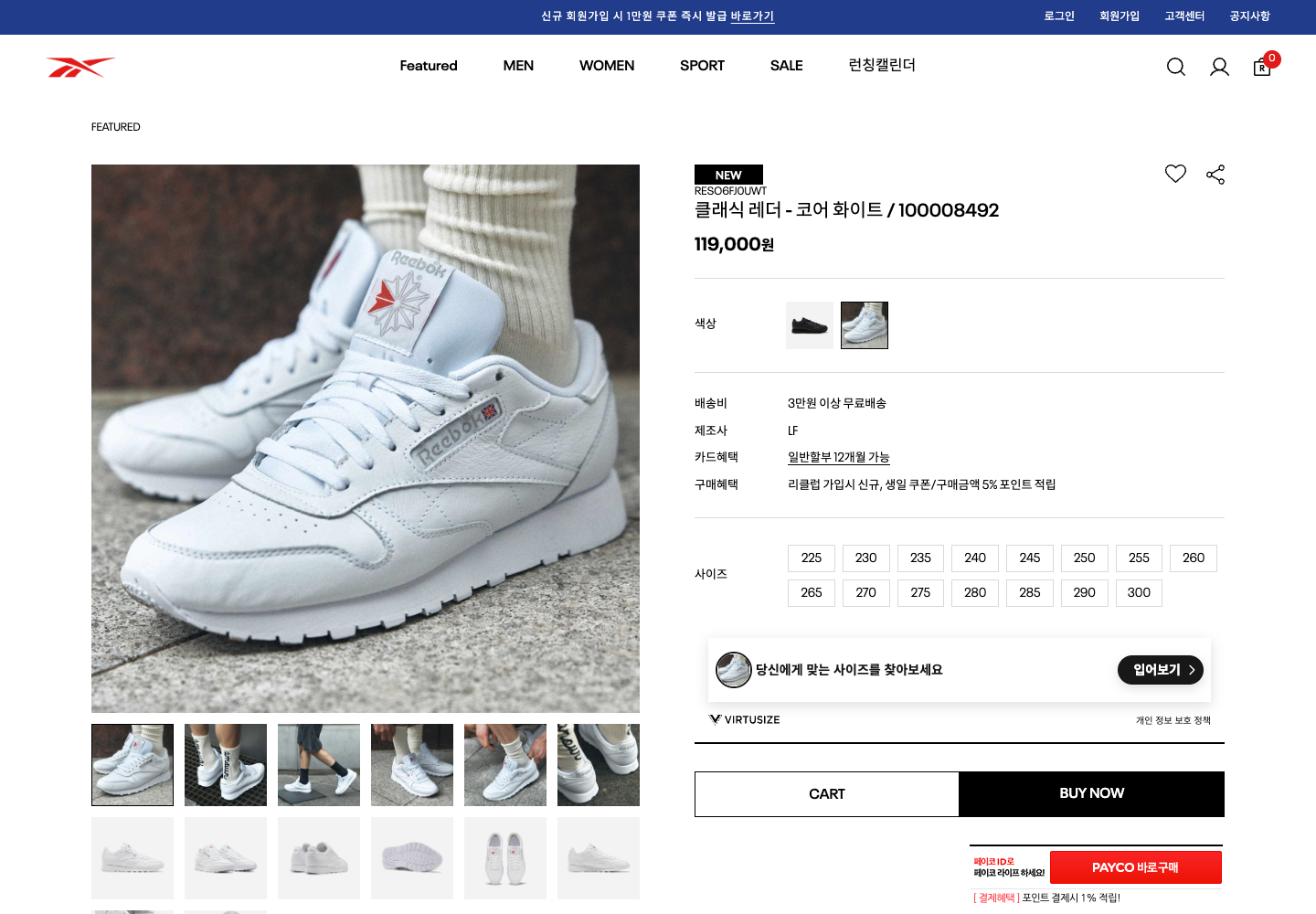
Korea search results for “클래식레더” (Classic Leather) — 10 matching products, including the Core White colorway tracked below.Korea Classic Leather – Core White product page: 119,000원, with “제조사” (manufacturer) listed as “LF” directly on the page.
robots.txt (US) — A standard Shopify disallow list (cart, checkout, orders, account, sort/filter parameters), plus a dedicated adsbot-google block that explicitly allows product, collection and page paths. No AI crawler (GPTBot, ClaudeBot, PerplexityBot, Google-Extended) is named anywhere, positive or negative — matching Nike’s and Puma’s silence rather than New Balance’s explicit welcome or Korea’s explicit block (below).
llms.txt (US) — the headline finding — Returns a clean HTTP 200, unlike most brands in this series. But reading it shows it’s not a GEO or AI-citation policy at all: it’s a Shopify-generated “Agent Instructions” document covering the Shop skill and the Universal Commerce Protocol — instructions for AI shopping agents on how to browse the catalogue, build a cart and complete a buyer-authorized checkout via MCP tools, not guidance on how an AI engine should summarize or cite the brand. A dedicated sitemap entry, sitemap_agentic_discovery.xml, points to a second file, /agents.md, which turns out to be nearly identical content — the one line that differs confirms it: llms.txt says “You’re reading /llms.txt, which mirrors [/agents.md‘s] content.” This is the first commerce-protocol-flavored llms.txt in this series, distinct from New Balance’s hand-written GEO policy and Puma’s raw link dump — see our explainer on what llms.txt actually does before treating any of these as a ranking factor; Google Search doesn’t read it.
robots.txt (Korea, reebok.co.kr) — an explicit AI-crawler block — A completely different, GODOMALL-platform document (the file’s own comment reads ‘Default Bot Policy List provided by GODOMALL,’ a Korean e-commerce SaaS vendor, so this may be platform boilerplate rather than a Reebok- or LF-specific decision). It names ClaudeBot and GPTBot explicitly, grouped with mj12bot and SemrushBot, under a flat Disallow: / — while separately allowing Googlebot, Naver’s Yeti and Daum’s Daumoa to crawl everything except admin/config paths. This is the first robots.txt in the series to name specific AI crawlers for an outright block rather than a crawl-delay (Adidas) or a welcome (New Balance’s Korea site).
llms.txt (Korea) — Returns a clean HTTP 404. No file exists on reebok.co.kr, consistent with a GODOMALL-template storefront that hasn’t had AI-agent-facing documentation added.
Sitemap — US sitemap.xml is a standard Shopify sitemap index (products, collections, pages split into numbered sub-sitemaps) plus the agentic-discovery entry above. Korea’s sitemap.xml returns HTTP 500 — not a redirect loop like ASICS, not a soft-404 shell like ASICS’s Korea llms.txt, but a genuine server error page (“요청하신 작업을 처리할 수 없습니다” — “the requested task could not be processed”).
Product schema — where the gap actually lives — The US Classic Leather page’s JS-rendered DOM carries two JSON-LD blocks: an Organization block with logo and social profiles, and a Product block with name, URL and images. Neither of those two blocks is present in the raw HTTP response — Shopify (or this store’s theme) builds them client-side. The Korea product page, fetched as plain HTML with no JS execution needed on that platform, carries zero JSON-LD of any kind despite visibly displaying price and a “제조사: LF” manufacturer field on the page itself.
Locale architecture — a fourth pattern in the series — reebok.com detects a Korea-based IP and offers a modal choice (“Yes, please” / “No — keep me here”) rather than auto-redirecting; declining keeps the shopper on the US Shopify store. The actual Korea storefront, reebok.co.kr, runs on GODOMALL (a Korean SaaS e-commerce platform, not Shopify) and is operated by a separate company: the product page itself lists “제조사” (manufacturer) as “LF,” and the site footer discloses 주식회사 LF (LF Corporation) with business registration 211-87-87724 — a well-known Korean fashion conglomerate (Hazzys, Daks) acting as regional licensee, structurally the same licensee pattern New Balance has with E-Land, but a different specific company and platform.
What works / What to verify
WHAT WORKS
A 7/10 AI citation rate, a genuinely present (if JS-gated) Product + Organization schema on the US PDP, and an unusually candid agent-facing document (agents.md/llms.txt) that tells automated clients exactly how to back off on rate limits — advice its own infrastructure gave us mid-audit.
WHAT TO VERIFY
Whether Reebok’s US product schema would benefit from being present in the initial server response rather than client-injected, whether LF Corporation’s Korea robots.txt is a deliberate brand decision or unexamined GODOMALL platform default, and whether the broken Korea sitemap.xml (HTTP 500) is a known, open issue.
Target query check — reported honestly, not inflated
We have not re-measured “reebok seo” or “reebok geo audit” query volume this session. Per the pattern already confirmed across nine earlier subjects in this series on October 20, 2026 (Keyword Planner, US) — the large majority showed no measurable search volume at all for “[brand] SEO/GEO audit” phrasing — we’re not claiming this title drives ranking-based traffic. The distribution case for this series rests on internal links, our own index, and readers already following the GEO Lab arc, not on search demand for “[brand] SEO audit” as a query.
Frequently asked questions
Does Reebok’s llms.txt actually help AI engines cite Reebok more?
We have no evidence either way from this snapshot. Reebok’s domain family was cited in 7/10 queries — near the top of the series range — but the llms.txt we read is a Shopify commerce-agent integration guide, not AI-citation guidance, so there’s no mechanism by which its content would influence what Google AI Mode chooses to cite. Google Search doesn’t read llms.txt at all; see our explainer.
Why is Product schema missing from a plain fetch of reebok.com but present after a browser renders the page?
We can only report what we observed, not the underlying engineering decision: the Organization and Product JSON-LD blocks appear in the DOM only after JavaScript executes, meaning Shopify (or this specific store’s theme) builds and injects them client-side rather than including them in the initial server-rendered HTML. A crawler that doesn’t execute JavaScript — which describes most AI crawlers by default — would see a page with no structured data at all on this URL.
Why does reebok.co.kr’s robots.txt block ClaudeBot and GPTBot specifically?
We can’t confirm intent, only what’s disclosed: the file itself is commented ‘Default Bot Policy List provided by GODOMALL,’ the Korean e-commerce platform reebok.co.kr runs on, which suggests this may be a platform-wide template rather than a decision LF Corporation made specifically about Reebok’s Korea storefront. It’s still the first robots.txt in this series to name AI crawlers for an outright block rather than a crawl-delay or a welcome.
Does a G-score around 0.54 mean Reebok is more likely to be cited by AI engines?
Not reliably — this audit is itself a data point against that idea, consistent with all eight prior brands. Our Week 17 experiment found hygiene/structure score was not a dependable predictor of AI citation, and here ASICS scored a lower 0.4583 average yet matched Reebok’s 7/10 citation rate, while Skechers scored a comparable hygiene profile yet landed at just 4/10. Our 10-query snapshot measures the domain family, not individual URL citation, so we can’t confirm which specific page — if any — drove Reebok’s 7 successful citations.
Audit evidence, scope and limits
Inspected: November 5, 2026, public logged-out access from a Korea-based IP (real browser session used throughout for screenshots and citation testing; plain HTTP fetches used urllib with a standard desktop user agent, falling back to browser-rendered HTML when fetches returned HTTP 429). Screens: US homepage, Men’s Shoes category, the Classic Leather Shoes product page (top and cross-sell), US Contact Us page, Korea homepage, a Korea “클래식레더” search (10 results), and the resulting Classic Leather – Core White PDP — plus robots.txt, sitemap and llms.txt/agents.md checks on both domains, a 10-query Google AI Mode citation snapshot, and a dual-method (plain-fetch and JS-rendered) 8-pillar G-score scored on six pages.
Not measured: rankings, Search Console performance, analytics, conversion, signed-in/member flows, ChatGPT citations (not attempted, given the composer failures flagged on earlier audits in this series), or the complete product/locale catalogue beyond the one shoe and six-to-eight URLs sampled here. This is a public-signal snapshot, not a performance claim or a full-catalogue crawl.
This is part 9 of a daily series. Every day, GeoParrot runs this same evidence-first method — real screenshots, a 10-query AI citation snapshot, an 8-pillar G-score audit, and an honest target-query check — against one more major sports and athletic-wear brand. Next: Converse.




Leave a Reply