
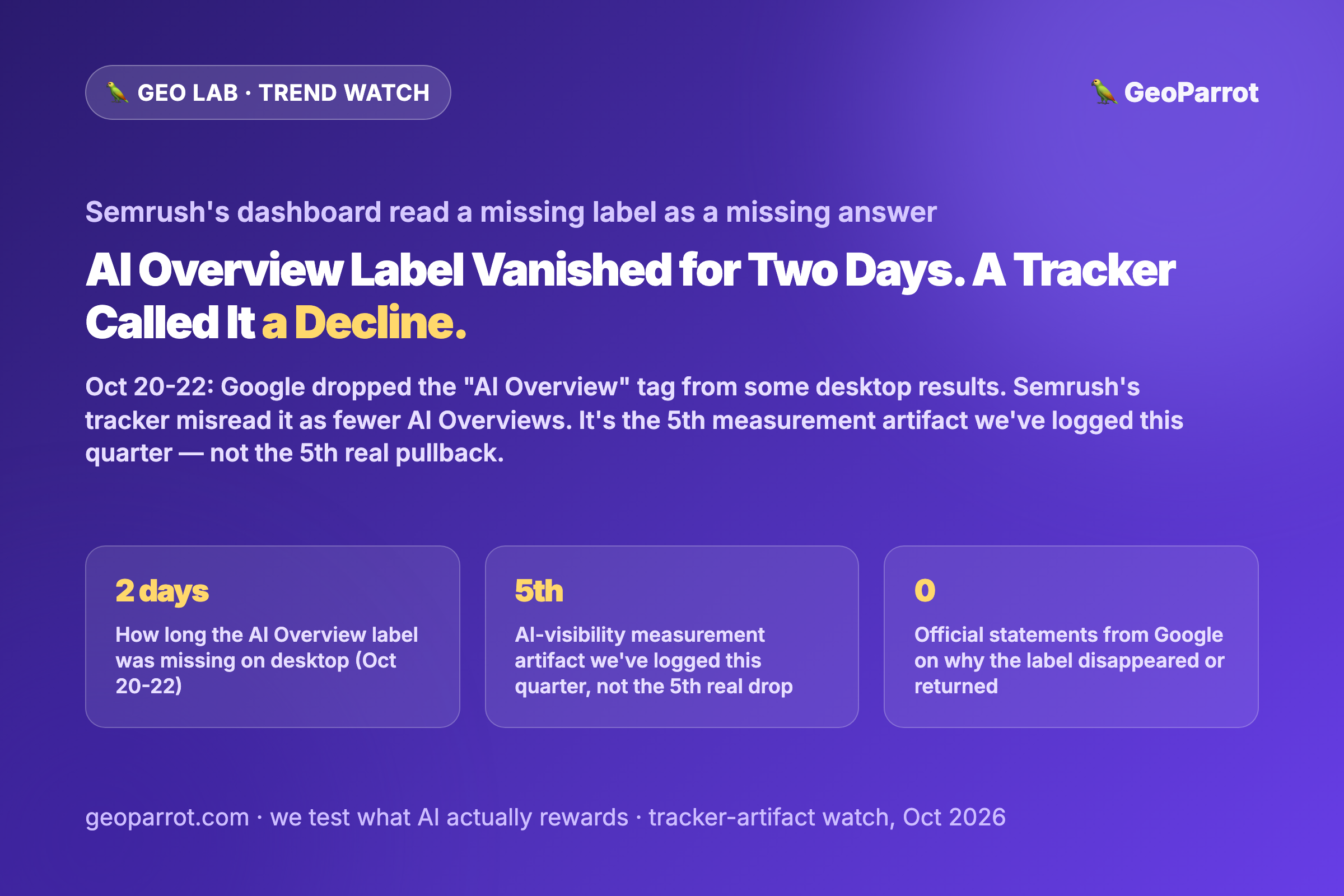
Quick answer: SEO consultant Glenn Gabe spotted on October 20, 2026 that some desktop AI Overviews — mostly for shows and movies — were missing the “AI Overview” label entirely, even though the AI-generated box itself was still there. The same results on mobile kept the label. Semrush’s tracking dashboard, which counts AI Overviews partly by detecting that label, read the missing tag as AI Overviews getting rarer and reported a drop. Barry Schwartz at Search Engine Roundtable called it immediately: “this has to be a bug in Semrush tracking – I see AIOs everywhere.” Google fixed the label on October 22, with no statement either way. Nothing about how often Google actually shows AI Overviews changed in those two days — only whether a third-party counter could see them.
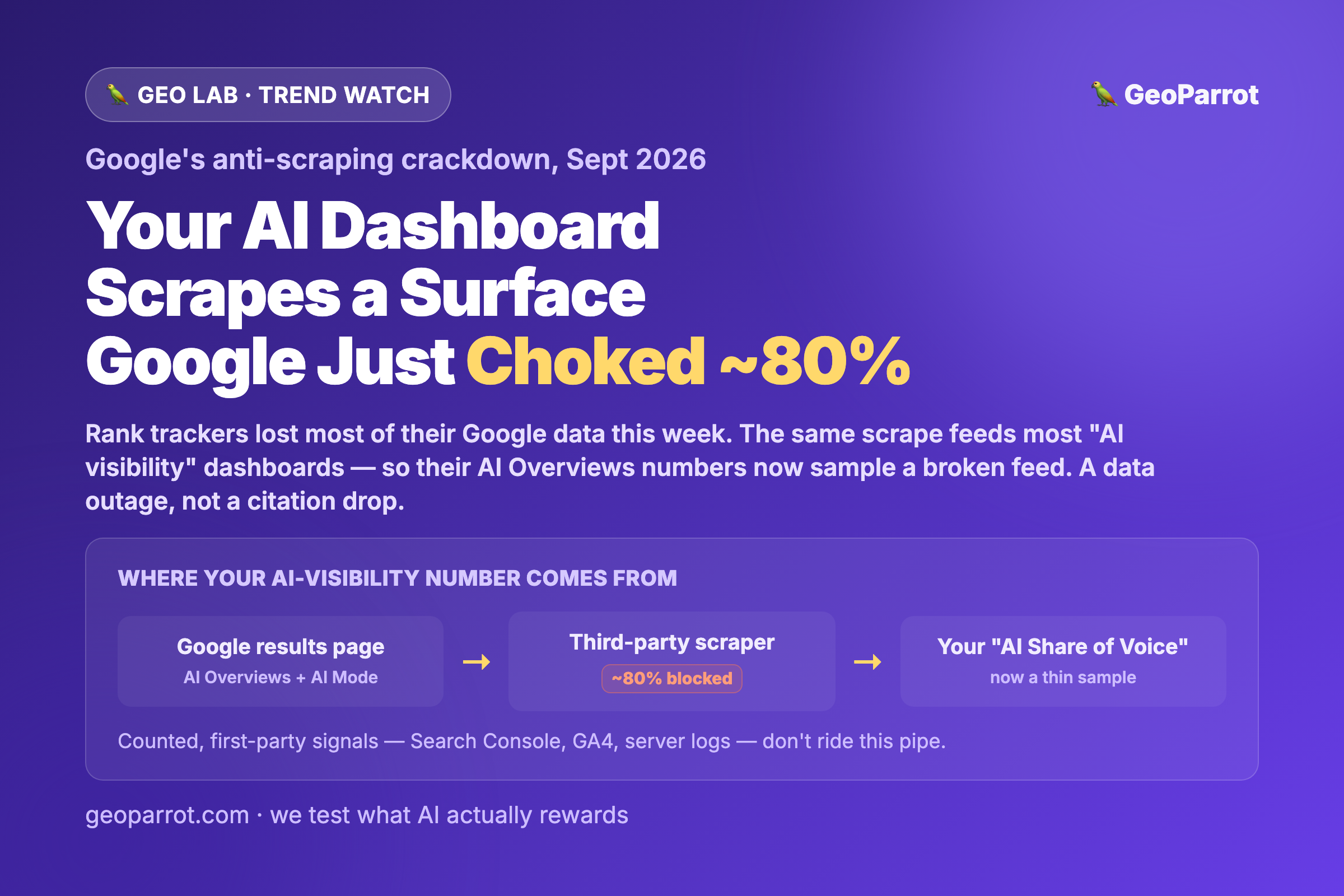
Trend watch — published October 25, 2026, in the GEO Lab. This is the fifth time this quarter we’ve had to write some version of the sentence “a visibility metric moved, and the AI didn’t do anything — the measurement did.” The other four: a 44-hour Search Console reporting lag, a broken UTM tag that looked like a ChatGPT referral collapse, a rank-tracker-targeted SERP block that nearly derailed one of our own experiments, and a viral “Google attribution” story that turned out to be a browser extension. Five incidents, same shape, worth naming the pattern instead of writing the sixth post from scratch.
What exactly broke, and who found it?
Glenn Gabe posted on X on October 20: “Very interesting to see AIOs for shows or movies and Google not provide the AIO label.” His screenshots showed the AI-generated answer box rendering normally on desktop, but without the small “AI Overview” tag that usually sits above it — while the mobile version of the identical query kept the label in place. It wasn’t every AI Overview, and it wasn’t every device; it was a subset, on desktop, concentrated in entertainment-style queries, for roughly two days. Barry Schwartz confirmed the sighting and reached out to Google for comment; no statement came back. On October 22, the labels were back, with no explanation from Google about what caused the gap or why it resolved.
Why did a missing label turn into a reported traffic-style drop?
Because third-party AI Overview trackers, including Semrush’s, don’t get a feed from Google saying “this query triggered an AI Overview.” They scrape a set of tracked keywords and classify what they see — and one of the signals they use to classify a result as an AI Overview is almost certainly the presence of that exact label or its surrounding markup. Pull the label, and a tracker built to detect it can misclassify the same AI-generated box as a normal result. Semrush’s dashboard reported a drop in AI Overview frequency during the window Gabe documented. Schwartz’s read, stated plainly: “this has to be a bug in Semrush tracking – I see AIOs everywhere.” The AI Overview was never gone. The thing that announces an AI Overview to an automated scraper was.
This is the fifth one. What’s the actual pattern across all five?
Line them up and the mechanism is different each time, but the failure mode is identical: a number that looks like it’s measuring AI behavior is actually measuring a pipe between Google (or OpenAI) and the tool reading it, and the pipe is what moved.
| Incident | What looked like it happened | What actually broke |
|---|---|---|
| This week (Oct 20-22) | AI Overviews getting rarer, per Semrush | The “AI Overview” label disappeared from some desktop results, so the tracker miscounted |
| Two weeks ago | ChatGPT referral traffic collapsing in GA4 | UTM parameters were missing from ChatGPT’s new interactive-answer links, not the traffic itself |
| Earlier this quarter | “Live” Search Console AI Overview numbers | A 44+ hour reporting lag meant the dashboard was never showing the current state |
| Late September | Rank trackers losing visibility into real SERPs | Google appeared to serve altered results specifically to automated collectors, not to users |
| Earlier | A viral “Google now shows AI Overview attribution” story | It was a third-party browser extension injecting its own UI, unrelated to Google |
We’ve made the “counted vs. inferred” distinction before in a dedicated piece on GEO metrics — the short version is that almost nothing in AI visibility reporting is a direct count from the source system; it’s an inference built on scraping, sampling, or label-matching, and every one of those layers can break independently of the thing it’s trying to measure. This week’s incident is the cleanest version yet, because the break was a single HTML label, and the fix was Google quietly putting it back with zero acknowledgment that anything had happened.
Does this mean AI Overview trackers are unreliable in general?
No, and that’s worth saying directly — Semrush, Nozzle, and the others catch real, large-scale trends most of the time, and we cite their aggregate numbers regularly in this newsletter. What this incident (and the four before it) argues for isn’t distrust of trackers, it’s a default skepticism toward any sudden, short-window move in a single tool’s dashboard, especially one that isn’t corroborated by a second source or by your own eyes. Schwartz’s fix for this one wasn’t a methodology paper; it was literally searching Google himself and noting “I see AIOs everywhere.” That’s the cheapest and fastest check available, and it’s the one most people skip.
What to actually do before you trust a tracker’s “AI Overviews are dropping” claim
- Run the query yourself before reacting to a dashboard number. If a tracker shows a sudden multi-point swing in AI Overview frequency over a day or two, check a handful of the underlying queries by hand — on both desktop and mobile — before treating it as a real shift in Google’s behavior.
- Treat a one-tool, short-window drop as a measurement question first, a trend question second. A real pullback in AI Overviews would show up in official channels or get corroborated across multiple trackers within days; a single dashboard’s isolated dip is the more common failure mode, per the five incidents above.
- Check the Google Search Status Dashboard before assuming any single-tool anomaly is confirmed. Google gave no statement on this label gap, same as it has for most of the incidents on this list — the absence of an official denial isn’t confirmation of a real change, either.
- Keep a running list of your own measurement layer’s failure points — GA4 tagging, GSC lag, rank-tracker blocks, label-dependent scraping — the same way we have. Once you’ve seen the pattern once, the next “the numbers moved” alert gets a five-minute sanity check instead of a panic.
Frequently asked questions
Did Google actually reduce how often it shows AI Overviews this week?
No evidence of that. What changed, for about two days (October 20-22, 2026), was that some desktop AI Overviews lost their visible “AI Overview” label while the underlying AI-generated content stayed on the page. Google restored the label on October 22 with no public explanation.
Why did Semrush report a drop if nothing actually changed?
Third-party AI Overview trackers classify results by scraping and pattern-matching, often including the visible label as one signal. When Google removed the label from a subset of results, a label-dependent detector could misclassify those results as not being AI Overviews, producing an apparent drop that reflected a tracking gap rather than Google’s real behavior.
Is this the same kind of issue as the Search Console reporting lag or the ChatGPT UTM problem?
The specific mechanism is different in each case, but the shape is the same: a tool meant to measure AI visibility depends on a layer (a label, a tag, a report refresh cycle, a scraper’s access) that can fail on its own, independent of what the AI system is actually doing. We’ve now logged five separate incidents with that same shape this quarter.
How should I react the next time a tracker shows a sudden AI-visibility swing?
Check a sample of the underlying queries yourself, on both desktop and mobile, before treating the dashboard number as a confirmed trend. Look for corroboration from a second tracker or an official Google statement. A short-window, single-tool anomaly is more often a measurement artifact than a real shift, based on the pattern so far.
Does this affect my own AI Overview citation tracking?
Only if your tracking method depends on detecting the visible “AI Overview” label specifically. If you or your tool scrape for that label, build in a sanity check against manual spot-searches, since this incident shows the label itself is not a permanently stable signal.

Leave a Reply