
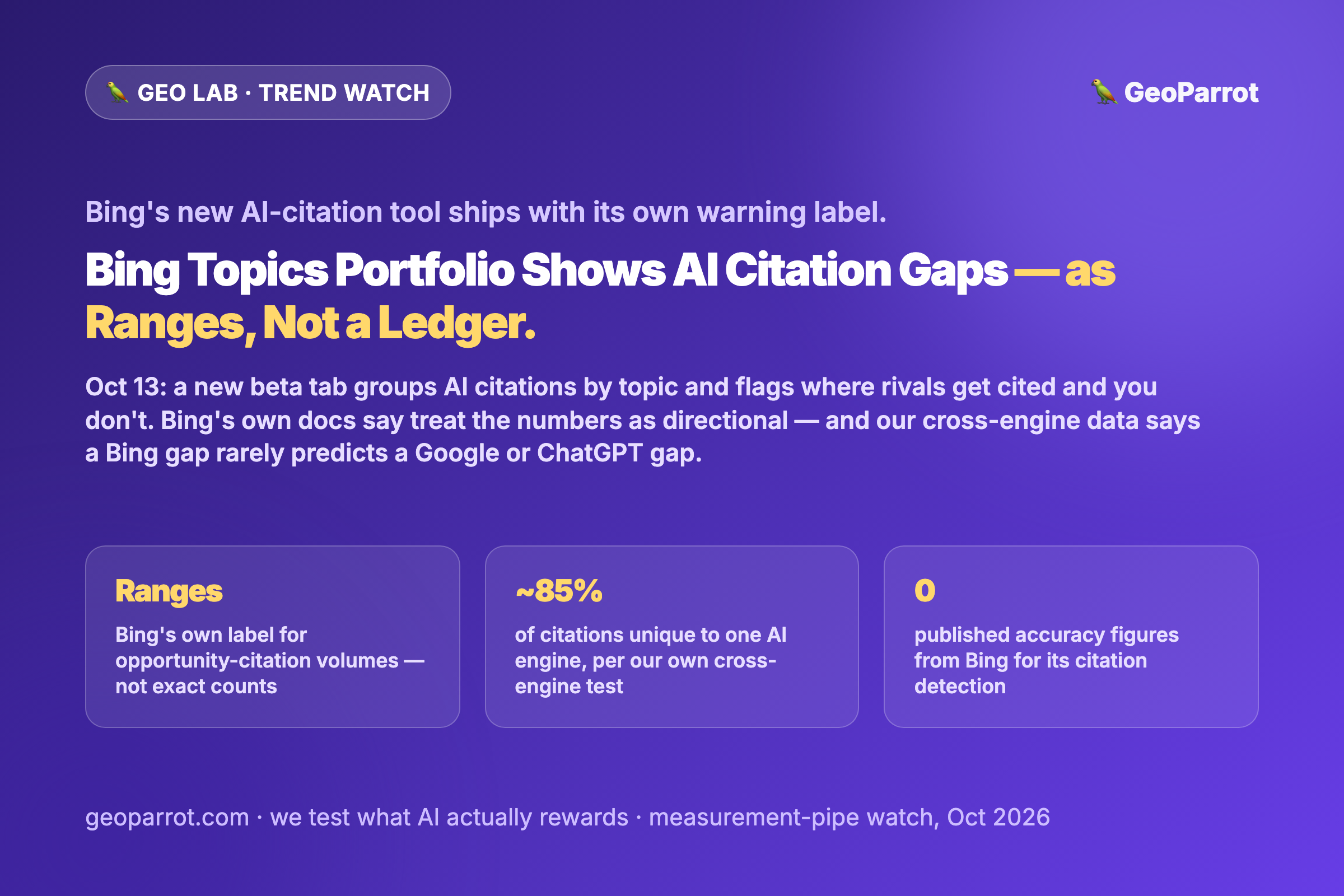
Quick answer: On October 13, 2026, Microsoft shipped Topics Portfolio, a beta addition to Bing Webmaster Tools’ AI Performance report. It groups the “grounding queries” where a site is cited by Bing’s AI into broader topic clusters and shows Topic Size, Sites Cited, Queries, and a “Top Opportunity Queries” list — places competitors get cited and you don’t. The useful part is buried in Bing’s own documentation: Topic Size, Sites Cited, and opportunity citation volumes are explicitly approximate, shown as ranges rather than exact counts, and Bing tells users to treat the numbers as “a directional planning signal,” not a precise ledger. That’s an honest caveat, and it’s also exactly the counted-vs-inferred gap we’ve flagged in every AI-visibility vendor tool we’ve tested this year.
Trend watch — published October 17, 2026. We read every new AI-visibility dashboard the way the GEO Lab reads any vendor claim: what’s counted, what’s inferred, and whether the tool says so out loud.
What exactly did Bing ship on October 13?
Topics Portfolio is a new tab inside the AI Performance report in Bing Webmaster Tools, announced in a post co-authored by Microsoft’s Krishna Madhavan, Saral Nigam, and Vivek Jain. Instead of listing individual grounding queries one at a time — the queries where Bing’s AI answer cites a given site — it rolls them up into named thematic clusters (Bing’s own examples: football, taxes, AI chatbots). Each topic row shows four things: Topic Size (total citations across all sites for that topic, an approximate read on AI-search demand), Sites Cited (how many sites appear anywhere in that topic, a crowding signal), Queries (the number of distinct grounding queries folded into the topic), and a separate Top Opportunity Queries section showing the strongest queries portfolio-wide where other sites are cited and yours isn’t. It’s the first vendor-native tool we’ve seen that tries to answer “where should I even look for AI-citation gaps” at the topic level rather than the single-query level.
What does “directional, not a ledger” actually mean in the numbers?
This is the part most coverage skipped past. Bing’s own post labels Topic Size, Sites Cited, and Queries as approximations, and goes further on the headline feature: opportunity citation volumes are “shown as ranges rather than exact numbers,” and the explicit guidance is to “treat the numbers as a directional planning signal, not a precise ledger.” Topic classification is AI-generated and, per Bing, “can occasionally be imperfect” — a query might land in a cluster you’d have labeled differently, and brand-name queries can surface as false “opportunities.” The beta also only surfaces topics with enough site presence and ecosystem activity, so smaller sites may see a short list or nothing at all. None of that makes the tool useless — it’s an unusually candid disclosure for a visibility product — but it means every number in Topics Portfolio is an inferred estimate, not a counted event, in the framework Bing/Yext veteran Duane Forrester laid out for 2027 measurement: a counted number comes from an observed event on infrastructure you control; an inferred number comes from a sample extrapolated to a population nobody can fully enumerate, and only one of the two can actually be checked.
Why does Bing-only data undersell the real gap?
Even a perfectly precise version of Topics Portfolio would only describe one engine’s citation pool. Our own cross-engine testing found that ChatGPT, Perplexity, and Google AI Mode share almost no cited URLs for the same questions — roughly 85% of citations were unique to a single engine. That’s the same finding behind our repeated conclusion that there is no universal GEO strategy, and the reason we maintain a per-engine checklist instead of a single playbook. A “Bing opportunity query” where a competitor is cited and you aren’t tells you something true about Bing’s AI answers specifically — it tells you nothing directly about whether the same gap exists in ChatGPT, Perplexity, or Google AI Mode, which run on different retrieval stacks and, per our data, cite largely different sources. Topics Portfolio is a Bing-shaped window; treating it as a GEO dashboard requires remembering the window’s edges.
How does this compare to Google’s equivalent tooling?
Google Search Console’s generative-AI report has the opposite problem from Bing’s new tool: it’s precise-sounding but reports impressions and an “AI position” metric that isn’t a rank, and we’ve separately documented that GSC’s AI-surface data lags real citation events by 44 to 64 hours, which breaks same-day tracking workflows. Bing’s disclosure that its numbers are ranges is arguably more honest than GSC’s unlabeled point estimates — at least you know not to trust the decimal place. Neither vendor publishes a precision or recall figure for its AI-citation detection, so “honest about being approximate” and “actually accurate” remain two different claims, and only the first one is verifiable from the public documentation of either tool.
Bing’s own disclosure vs. the GEO vendor-tool pattern
| Source | What it shows | What it says about its own precision |
|---|---|---|
| Bing Topics Portfolio (beta, Oct 13) | Topic-level AI citation size, competition, opportunity gaps | Explicitly approximate; opportunity volumes shown as ranges, “directional,” not a ledger |
| Google Search Console AI report | Impressions, clicks, “AI position” for AI Overviews/Mode | No stated precision/accuracy figure; reporting lag of 44–64 hours separately documented |
| Typical third-party “AI visibility” SOV tools | Share-of-voice, brand mention rate across engines | Rarely disclose sampling method or margin of error |
| GeoParrot cross-engine test (our own data) | Actual citation overlap across 3 engines on identical questions | Fully counted: we logged every cited URL, not sampled or inferred |
A checklist for using Topics Portfolio without overreading it
- Use it to find candidate topics, not to size a market. Topic Size is an approximation of citation volume across every site, not a traffic or revenue forecast — treat it as a shortlist generator, not a TAM calculation.
- Verify every “opportunity query” by hand before acting on it. AI-generated topic classification is admittedly imperfect, and brand queries can show up as false opportunities — spot-check a sample in Bing Chat directly before building content around a gap the tool flagged.
- Don’t extrapolate a Bing gap to other engines. Our cross-engine data puts unique-to-one-engine citations at roughly 85% — a Bing opportunity query is Bing-specific information until you check ChatGPT and Google AI Mode separately.
- If your site is small, expect an empty or short report. The beta only surfaces topics with sufficient site presence and ecosystem activity — a blank Topics Portfolio means insufficient data, not zero AI citations.
- Credit Bing for the disclosure, and hold other vendors to the same bar. Ask any AI-visibility tool you pay for whether its numbers are counted or inferred, and whether it will say so in writing the way Bing just did.
The honest caveats
Bing’s announcement is a first-party source describing its own product, so the feature’s existence and the quoted caveat language are well-sourced; what we’re doing is applying our counted-vs-inferred and cross-engine frameworks to it, not independently verifying Bing’s underlying citation-detection accuracy, which Bing hasn’t published and we have no way to audit from outside. We haven’t tested Topics Portfolio ourselves against GeoParrot’s own Bing citation activity, because the beta requires “sufficient ecosystem activity” and our current traffic may not qualify — this analysis is based on Bing’s documentation and corroborating coverage, not a hands-on audit. The 85% unique-citation figure comes from our own three-engine experiment and may not hold at Bing’s specific topic granularity, which we haven’t separately tested.
Frequently asked questions
What is Bing Topics Portfolio?
A beta feature in Bing Webmaster Tools’ AI Performance report, launched October 13, 2026, that groups AI grounding-query citations into topic clusters and flags queries where competitors are cited and your site isn’t.
Are the numbers in Topics Portfolio exact?
No. Bing’s own documentation describes Topic Size, Sites Cited, and Queries as approximate, and shows opportunity citation volumes as ranges rather than exact counts, explicitly telling users to treat them as directional rather than a precise ledger.
Does a Bing citation gap mean I’m also missing citations on ChatGPT or Google?
Not necessarily. Our cross-engine testing found roughly 85% of citations are unique to a single AI engine for the same questions, so a Bing-specific opportunity query doesn’t reliably predict a gap on other platforms without checking separately.
Why would my site not show any data in Topics Portfolio?
The beta only displays topics with sufficient site presence and ecosystem activity. Smaller or newer sites may see a short list or no data at all, which reflects a data threshold, not necessarily zero AI citations.
Is Bing’s approach better than Google Search Console’s AI reporting?
They fail differently. Bing discloses that its numbers are approximate ranges; Google Search Console’s AI report presents impressions and an “AI position” metric without a stated precision figure and with a documented 44–64 hour reporting lag. Honest about being approximate isn’t the same as being accurate — neither vendor has published an accuracy figure for its AI-citation detection.
Leave a Reply