
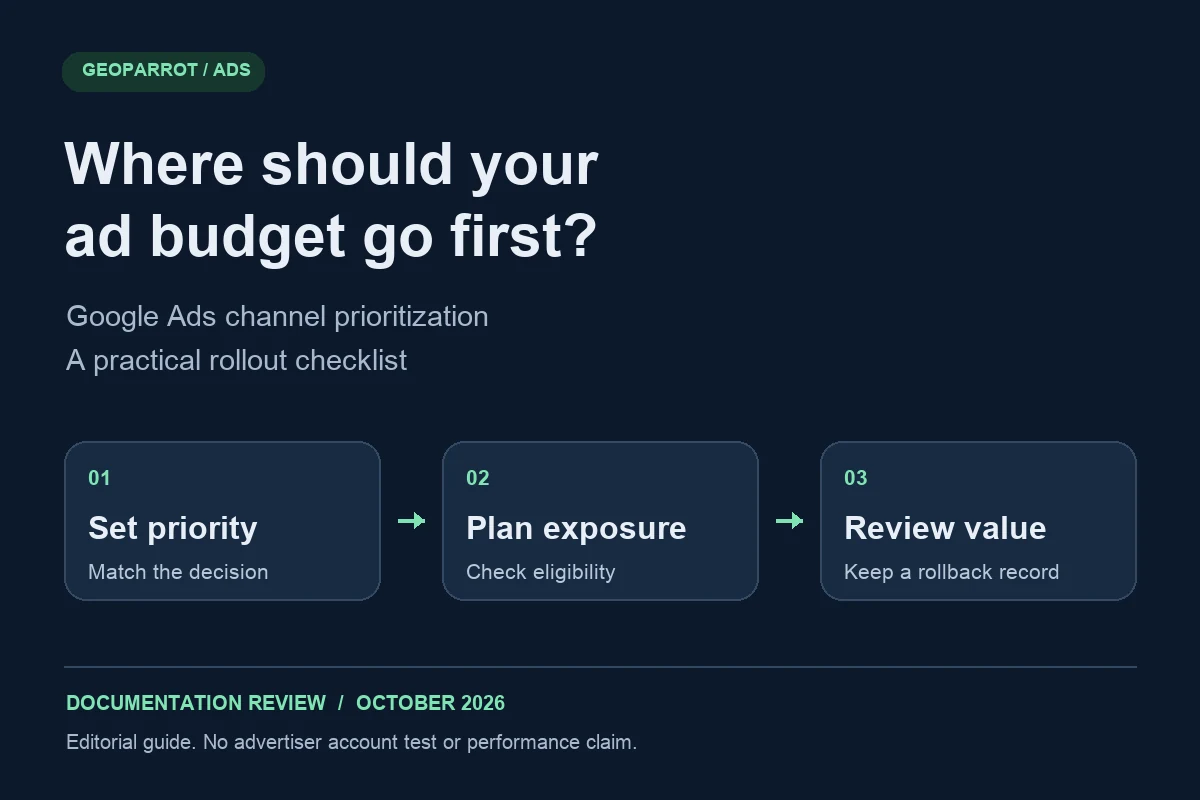
Google Ads channel prioritization changes how advertisers express where they want budget to go. Google announced the controls on October 14, 2026, with a progressive rollout beginning October 15. The useful operational question is which spending decision you need to control, who owns it, and how you will recognize an unwanted change.
This guide combines Google’s announcement and current documentation with an editorial rollout framework. We have not tested these controls in an advertiser account. Examples below are planning exercises, not reported campaign results. Documentation reviewed October 19, 2026.
What Google announced
According to Google’s announcement, advertisers can assign inventory higher or lower spending priority. Higher-priority inventory gets funded first, subject to bidding targets where relevant; remaining budget can flow to lower-priority inventory. This creates another choice alongside excluding a network entirely.
Google also announced optional allocation percentages for lower-priority channels. These are best-effort spending limits. Priority alone generally has little effect on a Target CPA or Target ROAS campaign that is not budget constrained. Availability is rolling out across Search, Shopping, Performance Max, and Demand Gen, so an announcement does not establish that a particular account has access.
The implementation documentation adds material qualifications: allocation percentages use the average daily budget, rather than actual spend; shared budgets are treated as a pool; Demand Gen supports prioritization but not budget allocation. Account defaults can be overridden. For Performance Max and Demand Gen, Google’s own surfaces are grouped together, rather than individually prioritized through this control.
Choose the decision before choosing a setting
Start with a sentence that an account owner could approve: we want to explore a secondary source of demand while keeping the acquisition program financially acceptable. That is more useful than a blanket instruction to reduce a channel. It forces the team to identify the objective, the economic constraint, and the evidence needed for a decision.
| Decision you need | First question | Evidence to save |
|---|---|---|
| Favor established demand | Is the campaign actually constrained by its budget? | Budget status, bid strategy, target, recent spending pattern |
| Explore secondary inventory | What business loss can the team tolerate during the review? | Owner-approved exposure plan and review trigger |
| Apply a consistent account policy | Which campaigns require exceptions? | Default policy, exception list, affected budget pools |
| Judge whether the change helped | Which outcome reflects customer value? | Conversion definition, attribution window, qualified outcomes |
The table deliberately starts with a business decision. A setting can redistribute exposure without improving customer acquisition. Decide whether success means qualified inquiries, completed purchases, retained customers, or another verified outcome before interpreting a channel report.
A rollout checklist your team can actually review
1. Write down the economic boundary
Use your contribution margin, refund exposure, fulfillment costs, and customer quality to define an acceptable acquisition outcome. Our ROAS, CPA, CTR, and conversion-rate guide explains why a cheaper conversion or stronger click rate can still accompany weaker economics. For a lead-generation program, explicitly distinguish a submitted form from a qualified lead and a closed customer.
Put the boundary in the change record before editing settings. If finance and media teams disagree about which revenue or conversion definition to use, resolve that first. A priority setting cannot repair an ambiguous success criterion.
2. Map who shares the decision
List the campaigns, the people responsible for them, and any shared budget relationships. Ask the owner of each affected campaign to confirm whether the proposed change fits its objective. This review is especially useful when different teams manage acquisition and remarketing, or when one budget funds several commercial offers.
Save the current configuration and an explicit restoration plan. A screenshot or exported setting record is useful operational evidence; a vague note that the previous arrangement was the default is difficult to act on later.
3. Separate the hypothesis from the observation
A workable hypothesis is that a different inventory mix may preserve qualified customer acquisition while allowing measured exploration. The observation is the actual spending and outcome pattern after a documented change. Keep them in separate fields. Otherwise, a team can unconsciously rewrite its original objective around whichever metric improves.
Change one material policy at a time where practical. Record concurrent promotions, creative changes, conversion-tracking edits, and landing-page releases. If those move together, describe the outcome as a combined operational change rather than attributing it exclusively to prioritization.
4. Compare outcomes using consistent definitions
Use the Marketing Metrics Calculator to recompute CPA and revenue ROAS from matching spend and outcome windows. Keep the same currency, conversion definition, and treatment of refunds. A platform total and a finance total can both be internally correct while answering different questions.
Allow for the conversion delay your business actually observes. A spending change is visible before every sale or qualified lead can be credited. Choose the review cadence using your own lag and volume, and label incomplete cohorts. There is no universal number of days that makes every campaign comparison reliable.
5. Decide whether customer quality changed
For a subscription or repeat-purchase business, use the LTV:CAC and payback calculator to explore how acquisition cost interacts with margin and retention. Feed it observed cohort inputs where available. A model can expose an assumption; it cannot establish that a new channel produces customers with the same lifetime value.
If customer quality is not yet observable, write that limitation into the decision. A lower platform CPA can justify further investigation without establishing stronger business performance. Save the next evidence needed, its owner, and when that evidence should become available.
Copy this change register
The following is an editorial template for your internal worksheet. It is not an instruction to change an account before checking feature eligibility and the current Help Center guidance.
- Decision: Which spending problem are we trying to solve?
- Scope: Which campaigns and budget relationships are affected?
- Before: What settings, bidding targets, and conversion definitions are in force?
- Proposed change: What exactly will be edited, and by whom?
- Economic boundary: Which acquisition or contribution outcome would require intervention?
- Review: What reporting window and conversion delay will we use?
- Confounders: What else changed during the same period?
- Restoration: What configuration should the owner restore if the change is unacceptable?
- Decision record: Continue, revise, restore, or wait for more evidence, with a reason.
A worked planning scenario
Imagine a subscription business whose media team wants more inquiries while its sales team cares about qualified opportunities. This is a hypothetical scenario. Before changing a network policy, the team records the existing inquiry definition, sales qualification criteria, and normal delay between inquiry and qualification.
The team then chooses a limited operational scope, records its settings, and agrees on a review trigger based on acceptable acquisition economics. During the review, inquiry CPA improves, but the qualified-opportunity cohort is incomplete. The appropriate decision is to keep that uncertainty visible and gather the missing qualification data. It would be premature to describe the setting as a customer-acquisition win.
If qualification later deteriorates, the record helps the team distinguish an inventory-quality concern from a sales-processing delay or tracking change. That distinction determines whether to restore the configuration, correct measurement, or continue collecting evidence. No outcome in this scenario is a forecast for your account.
Add the Display Expansion migration to your calendar
Google says the existing Search campaign Display Expansion allocation arrangement changes in February 2027. Its stated configuration for retaining the current arrangement is to mark the Google Display Network as lower priority with a 50% allocation. Check the current documentation and your account’s eligibility before applying that instruction; the same documentation notes bid-strategy and campaign-budget exceptions.
Make this an ownership task: identify affected campaigns, name the person reviewing them, save the current configuration, and record the intended migration decision. Treat the deadline as a reason to prepare an inventory now. Review the live documentation again when scheduling an actual change, because rollout details can evolve.
Frequently asked questions
What should we do if the setting is missing?
Check rollout availability for the account and campaign type in Google’s current documentation. Save the review task rather than assuming that a different account’s interface proves your account has access.
How should we judge whether a change helped?
Write the economic objective first, compare consistently defined outcomes, and allow for your observed conversion delay. Record concurrent changes so the conclusion reflects what the evidence can support.
Is a before-and-after comparison proof of incremental growth?
No. Seasonality, demand, promotions, tracking changes, and other interventions can affect the same comparison. Use it as operational evidence and choose a suitable causal evaluation design when the decision requires an incrementality claim.
Did GeoParrot test these controls in an advertising account?
No. This article explains official documentation and supplies an editorial decision framework, a hypothetical scenario, and a review template. It reports no account test or performance improvement.
Leave a Reply