
Travel experience platforms · Case study 03
Viator makes booking confidence a discoverable product attribute—not a checkout footnote.

What is Viator—and what job does this site perform?
Viator is a travel-experience marketplace for tours, attractions and activities. The public surface is designed to move a visitor from a place or activity question into a purchasable option. Its notable framing is not simply inventory volume: the site visibly leads with reassurance—customer support, reviews, flexible cancellation and reserve-now-pay-later.
Global tours and activities marketplace; presented as a Tripadvisor company.
Choose a specific activity while reducing price, availability and cancellation anxiety.
Can the platform answer destination intent and expose enough evidence for a recommendation to be traceable?
Audit checklist
01. The brand promise is visible before the search journey begins
These are decision criteria, not generic brand adjectives. A traveller who is uncertain about commitment, support or social proof can see a stated answer before entering a product page.
The screenshot proves the promises are presented; it does not prove their eligibility or consistency. The next audit should trace each statement to a booking-level policy, exception and update date.
02. Rome is treated as a named discovery entity
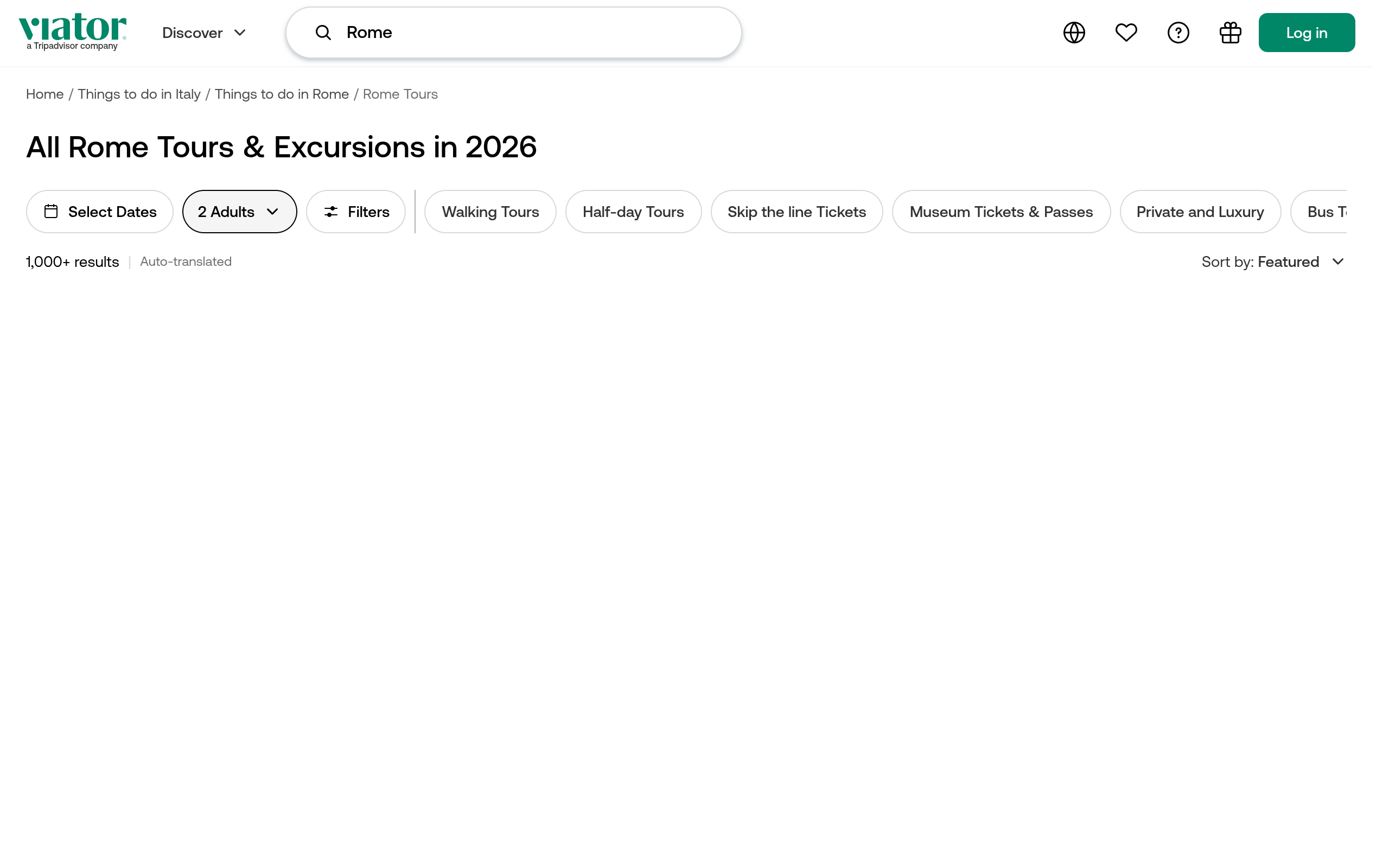
The page is doing more than listing products. Breadcrumbs establish the geographic hierarchy, the title makes the visitor’s city-level query explicit, and the result set becomes a set of narrower activity decisions. That creates a useful public route from a broad location question to inventory.
CONSULTING READ
A destination page earns its role when it narrows intent, not when it merely aggregates URLs.
The visible hierarchy offers a concrete answer path: country, city, tour type, then a selected experience. That is a clearer retrieval model than routing everyone through one universal catalogue.
03. The comparison vocabulary mirrors trip constraints
The filter set turns natural planning constraints—time, party, access and format—into consistent retrieval terms. It helps a visitor turn “Rome tour” into a more answerable request.
We could not use the public capture to verify product-card fields or pagination canonicalisation. A technical follow-up should inspect rendered product data, filter URL rules and indexation treatment for combinatorial pages.
GEO reading: expose the reason behind the recommendation
For generative retrieval, “best Rome tour” is not useful on its own. A usable answer needs a named place, a tour format, a time constraint, an access condition, a price/policy context and a source route. Viator’s public destination and filter vocabulary makes several of those attributes visible. The next level is ensuring each product page makes them specific, current and policy-backed.
Final diagnostic
Audit evidence and limits
Inspected: October 16, 2026, logged-out public pages: Viator homepage and Rome tours.
Not measured: rankings, citations, analytics, conversion, booked flows, full-template crawl, policy eligibility, structured data or supplier criteria. This is a public-signal consulting audit, not a performance claim.
Leave a Reply