
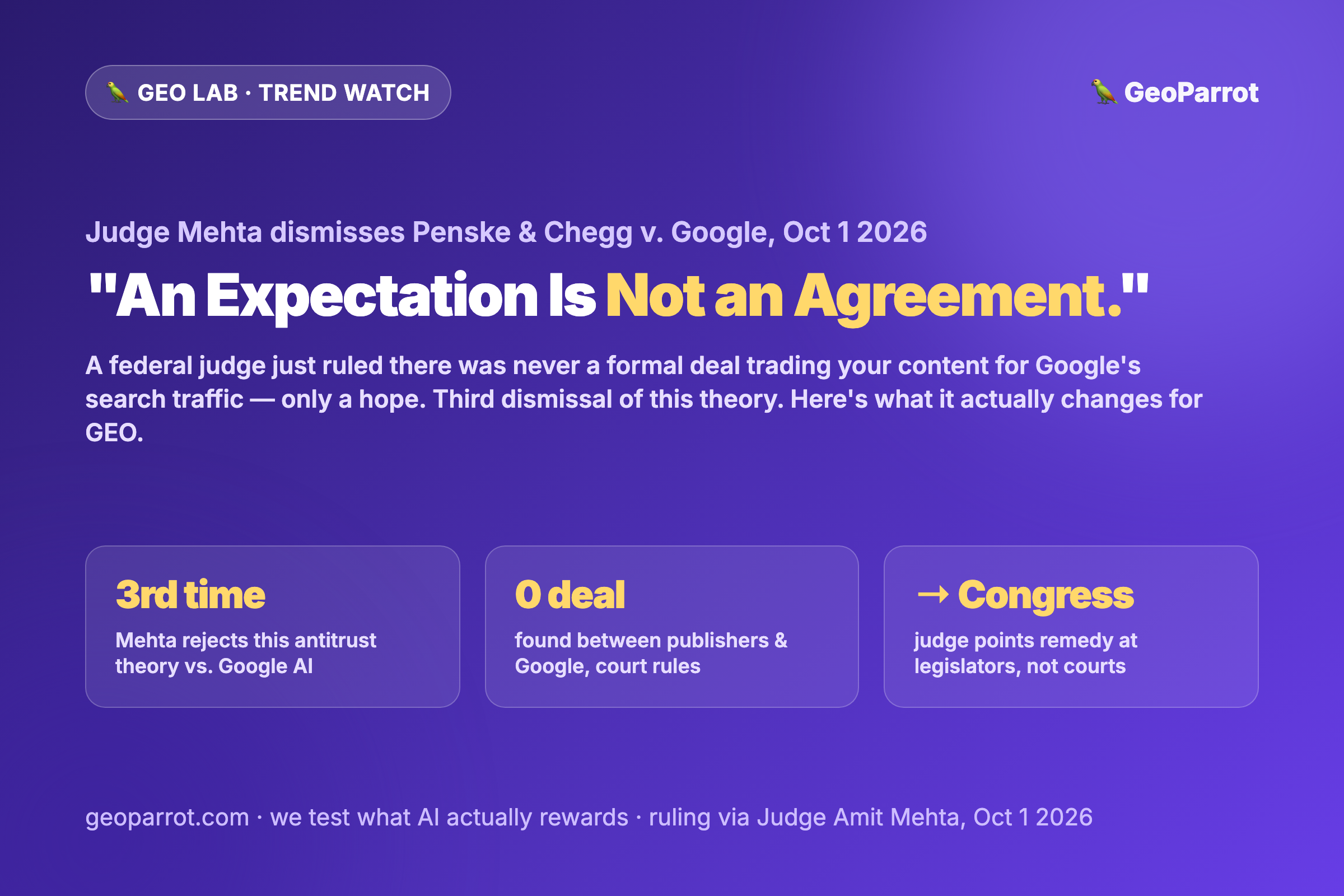
Quick answer: On October 1, 2026, US District Judge Amit Mehta dismissed antitrust lawsuits brought by Penske Media (Rolling Stone, Variety, Hollywood Reporter, Billboard) and Chegg against Google over AI Overviews. The ruling: publishers pleaded only that they had an “expectation” Google would send search traffic in exchange for letting Google crawl their content for free — and “an expectation is not an agreement.” With no proven mutual bargain, the Sherman Act claims collapsed. Mehta said he’s “not unsympathetic” to publishers whose content Google “takes and repurposes… without compensation,” but called antitrust law “not a substitute for a legislative body addressing economic dislocation caused by new innovation” — pointing the remedy at Congress, not the courts. It’s the third time Mehta has dismissed this theory against Google’s AI features. For GEO practitioners, the ruling doesn’t close a door you were relying on — it confirms a door that was never open.
Trend watch — published October 2, 2026. We read legal and policy news the way the GEO Lab reads any citation-economy story: separate what a ruling actually says from what people want it to mean, then ask what it changes for how you operate.
What did Judge Mehta actually rule?
Penske Media and Chegg argued that Google’s AI Overviews amount to anticompetitive “reciprocal dealing”: publishers let Google crawl and summarize their content for free, on the understanding that Google would keep sending them search traffic in return. When AI Overviews cut that traffic — Penske cited affiliate revenue down more than 30% — they framed it as Google breaking an implicit bargain and using its search monopoly to extract free content.
Mehta didn’t dispute that the harm is real. He dismissed the claim because the legal theory requires an actual agreement — “negotiated terms, promises, communications showing mutual assent, or other facts” — and the complaints had none. Publishers agreed to let Google crawl their sites at “zero price,” and separately hoped that would keep producing traffic. “Plaintiffs have pleaded only that they have an ‘expectation’ that Google will send them search traffic,” Mehta wrote. “But an expectation is not an agreement — it is simply how a general search engine works.” Without an agreement, there’s no reciprocal deal for Google to have broken, so both the Section 1 (conspiracy) and Section 2 (exclusionary conduct built on that deal) theories fell apart in the same stroke. This is the third time Mehta has thrown out this exact theory against a Google AI product — not a one-off reading of an unusual complaint.
Why point to Congress instead of ruling for publishers?
The more quotable line in the opinion: antitrust statutes are “not… a substitute for a legislative body addressing economic dislocation caused by new innovation.” Mehta is saying the Sherman Act was built to police agreements and monopolistic conduct around them — not to retrofit a compensation scheme onto a web ecosystem that was built on free, reciprocal crawling long before generative AI existed. If publishers want a legal right to AI-era compensation, his view is that it has to come from new law or regulation, not a new reading of a 1890 statute. That’s exactly the gap Google’s own AI Contribution pilot sits in: a voluntary program that pays roughly one-tenth of 1% of ad revenue to about 100 publishers, through a Search Console widget with no published formula. We covered that pilot’s first real payout numbers the day before this ruling. The coincidence is the lesson: Google can make that payout as generous or as thin as it likes, change the formula without notice, or cancel the program outright, precisely because no court has found an enforceable obligation underneath it. The ruling doesn’t create that discretion — it confirms it was there all along.
Does this mean AI Overviews are now legally untouchable?
No, and this is the overreach to watch for. This ruling kills one specific legal theory — implied reciprocal dealing under the Sherman Act — in front of one judge, for two specific plaintiffs. It says nothing about copyright claims, which run on entirely different legal reasoning and weren’t addressed here. It says nothing about regulatory tracks moving in parallel: the EU’s separate DSA-based scrutiny of AI search products doesn’t depend on proving a Sherman Act bargain, and Mehta’s own “talk to Congress” line is an invitation for exactly that kind of legislative fix, not a verdict against it. Treat this as one antitrust door closing three times in a row — not as a blanket ruling that publishers have no recourse, now or ever.
Why doesn’t this change what we tell you to do?
Because our playbook never assumed the bargain existed. Every experiment we’ve run points the same way: being cited doesn’t guarantee a click (presence isn’t ranking), AI traffic’s value swings wildly by use case rather than arriving as a reliable revenue stream (conversion rates vary by orders of magnitude), and our own randomized-trial coverage of forced AI Mode measured real, material clicks lost — down 18.8 percentage points — without any of that harm resting on a contract Google signed. We’ve been operating as if there was no enforceable deal since before this ruling existed, because the data never showed one. A federal judge agreeing, three times, just removes the temptation to wait for a court to fix it for you.
What should you actually do with this
- Stop budgeting around an implied bargain. “Google will keep sending traffic because I let it crawl me” is now, in writing, not a legal entitlement. Don’t let it quietly remain a planning assumption either.
- Treat any Google payout as discretionary, not contractual. The AI Contribution pilot can change its formula or disappear with no recourse on your part — this ruling is exactly why.
- Measure what you control. Track AI-referred sessions with your own first-party GA4 setup and the GSC generative-AI report, rather than relying on Google to self-report fairly.
- Keep the only lever that was ever yours. Earned citability beats owned syndication in every engine we’ve tested, and it doesn’t depend on Google granting you anything — it’s the one strategy this ruling can’t touch.
- If you’re weighing legal action, read the scoreboard. The reciprocal-dealing antitrust theory is 0-for-3 in front of this judge. A fourth refile with the same argument is a worse bet than the regulatory and legislative tracks Mehta himself pointed to.
The honest caveats
This is one federal judge’s ruling on one specific legal theory, for two named plaintiffs, as of this writing — not a final, unappealable word on Google and AI Overviews. Penske and Chegg could appeal, and other publishers could try different legal theories (copyright, state-law claims, or arguments built on better-pleaded facts) that this opinion doesn’t foreclose. The EU’s separate regulatory scrutiny of AI search runs on different law entirely and is untouched by a US antitrust dismissal. And Mehta’s sympathetic language about content being “taken and repurposed… without compensation” is exactly the kind of statement that tends to get quoted in the next legislative push — it’s an opening for a different kind of fix, not a closed case.
Frequently asked questions
What did Judge Mehta actually decide on October 1, 2026?
He dismissed antitrust lawsuits from Penske Media and Chegg against Google over AI Overviews, ruling that publishers only pleaded an “expectation” of search traffic in exchange for free crawling, not a proven formal agreement — and “an expectation is not an agreement.” Without an agreement, the Sherman Act claims had no reciprocal deal to rest on.
Does this ruling mean Google did nothing wrong?
No. Mehta explicitly said he’s “not unsympathetic” to publishers whose content Google “takes and repurposes… without compensation.” He ruled that current antitrust law isn’t the right tool to address that harm, and pointed to Congress as the proper venue for a legislative fix.
Does this affect every publisher’s legal options against Google?
Only this specific theory — implied reciprocal dealing under the Sherman Act. It’s the third time Mehta has rejected that argument against a Google AI feature, so it’s a weak bet going forward. Copyright claims, state-law claims, and the EU’s separate regulatory tracks are untouched by this ruling.
How does this connect to Google’s AI Contribution payouts?
The AI Contribution pilot pays publishers a voluntary, undisclosed amount for AI citations — and this ruling explains why it’s voluntary: no court has found an enforceable obligation behind it, so Google can change or cancel it at will. The two stories, reported a day apart, are the same underlying fact from different angles.
Should publishers change their GEO strategy because of this ruling?
Not materially. GEO strategy that assumes AI traffic and AI compensation are earned, not owed, was already correct before this ruling. What changes is confidence: the legal route to a guaranteed traffic deal is now a proven dead end, which makes earned, cross-engine citability the only lever worth investing in.
GeoParrot is a GEO Lab: we run experiments to test what AI search engines actually reward, and we grade the industry’s claims against first-party data. See the running scoreboard at our 2026 GEO benchmark.
Leave a Reply