
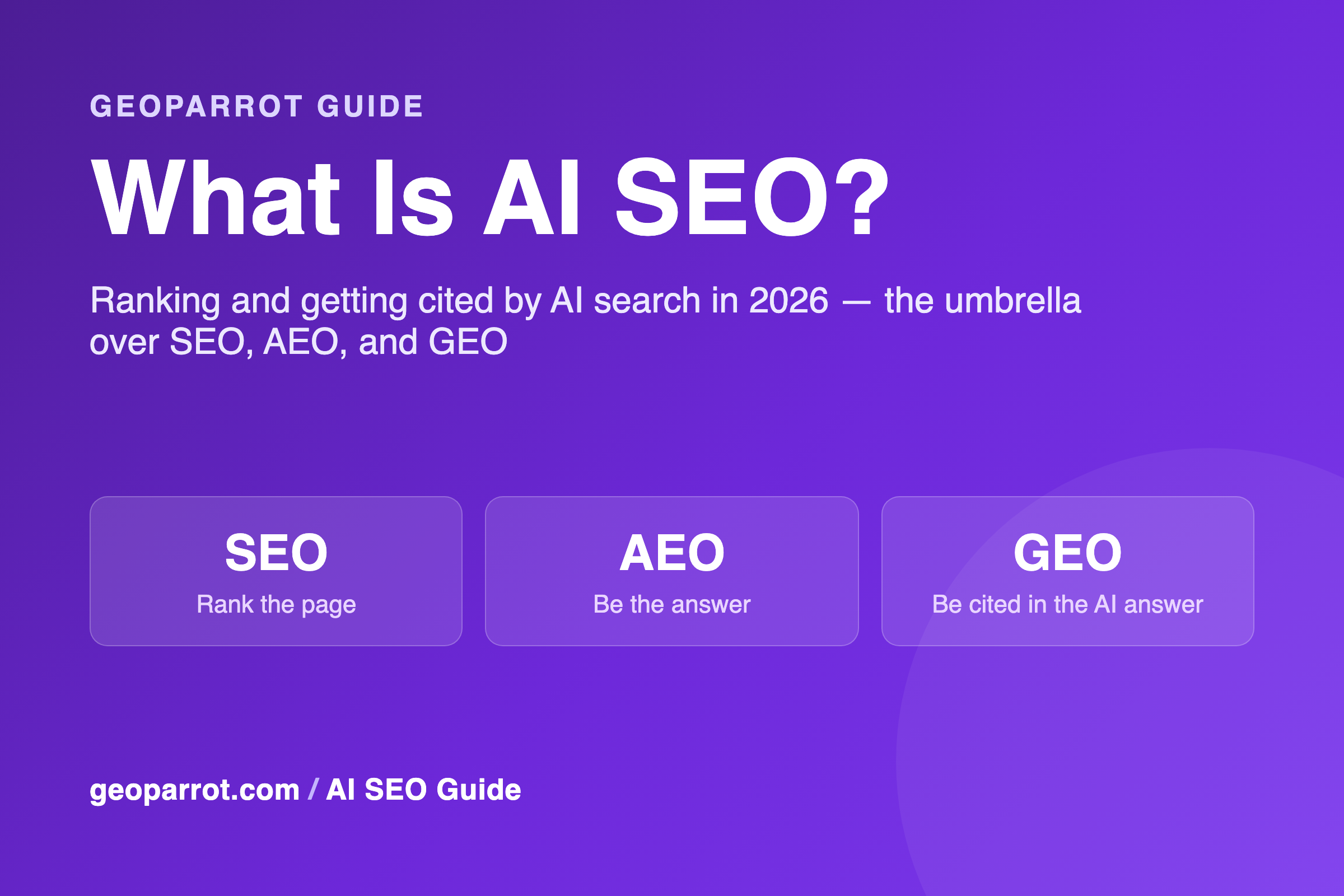
Quick answer: AI SEO is optimizing your content and brand so AI-powered search surfaces you — ranking in results, becoming the direct answer, and getting cited inside AI-generated responses from ChatGPT, Perplexity, Gemini, Copilot, and Google AI Overviews. It is an umbrella over three layers: classic SEO (rank the page), AEO (be the answer), and GEO (be cited in the AI answer). Do all three, in that order of foundation.
Last reviewed: August 2026.
What is AI SEO?
AI SEO (sometimes written “AI search optimization”) is the practice of making your content discoverable, trusted, and quotable by AI-powered search experiences. Where traditional SEO aimed to rank a page in a list of blue links, AI SEO also aims to get your brand named and cited when an AI assistant answers a question directly. It is a broad term that people use to cover everything from schema markup to getting mentioned by ChatGPT.
AI SEO vs. SEO: what changed?
Search is fragmenting from “a list of links” into “a synthesized answer.” Google AI Overviews now sit above classic results for many queries, and tools like ChatGPT Search and Perplexity are answer-first by default. So AI SEO adds two goals on top of ranking: being extracted as the answer, and being cited as a source. The fundamentals (clarity, authority, structure) carry over — the new work is making each passage self-contained, specific, and credible enough for a model to lift and attribute.
The three layers of AI SEO
| Layer | Goal | Deep-dive guide |
|---|---|---|
| SEO | Rank the page in results (the foundation) | Is SEO dead in AI search? |
| AEO (Answer Engine Optimization) | Become the direct answer — snippets, voice, AI Overviews | What is AEO? |
| GEO (Generative Engine Optimization) | Get cited inside an AI-generated answer | The 2026 GEO playbook |
You will also see the terms LLMO (LLM Optimization) and “LLM SEO” — these are vendor synonyms for GEO. We untangle all the acronyms in LLM SEO / LLMO explained, and compare the disciplines side by side in GEO vs. SEO vs. AEO.
How does AI search decide what to surface and cite?
No engine publishes its recipe, but patterns are consistent across AI search. Content tends to be surfaced and cited when it is structurally clean (clear headings, answer-first paragraphs), self-contained (a passage answers the question on its own), specific and verifiable (numbers, dates, named entities), authoritative (real expertise and corroboration), and fresh. One important nuance from our testing: engines cite different sources, so there is no single AI to optimize for.
The 2026 AI SEO playbook
- Fix SEO fundamentals. Crawlable, fast, well-structured, genuinely useful pages. Nothing else works without this.
- Write answer-first. Lead each section with a 40–60 word direct answer under a question-shaped heading. See answer-first writing.
- Add structured data. Article, FAQ, and Organization schema help machines understand your content. Follow schema markup for GEO.
- Earn citations with original substance. Proprietary data and first-hand testing get quoted because they cannot be found elsewhere.
- Optimize per engine. Tune for each platform with the per-engine checklist — ChatGPT, Perplexity, AI Overviews, Gemini, Copilot, and Grok all behave differently.
- Measure and iterate. Track citations and AI referral traffic (below).
AI SEO tactics per engine
- Get cited by ChatGPT Search
- Rank in Perplexity
- Show up in Google AI Overviews
- Optimize for Google AI Mode and Gemini
- Get cited by Microsoft Copilot
- Show up in Grok
Does AI SEO actually work? The data
We test these claims publicly instead of asserting them. A few first-party findings: across four engines and fifteen questions, only 0.5% of cited domains overlapped (optimize per engine); Reddit appears in 67% of Google AI answers but is the linked source only 4% of the time; and llms.txt is fetched by AI bots just 1.1% of the time. See all the numbers in the 2026 GEO Benchmark.
How to measure AI SEO
Measure two things: citations/mentions (are you named in AI answers?) and AI referral traffic. For citations, start with a visibility tracker — see the best GEO tools in 2026 (free options included). For traffic, set up AI-search traffic tracking in GA4. You can also baseline for free by asking the engines your top questions monthly and logging whether you are cited.
Frequently asked questions
Is AI SEO the same as GEO?
Not quite. AI SEO is the umbrella term for optimizing across all AI-powered search. GEO is one layer of it — getting cited inside AI-generated answers. AI SEO also includes classic SEO and AEO (becoming the direct answer).
Is traditional SEO still relevant for AI SEO?
Yes. AI engines discover and trust content partly through the same signals as classic search. Strong SEO is the foundation AI SEO builds on, not a replacement.
How long does AI SEO take to work?
Most brands see measurable citation and mention gains within three to six months of consistent work; individual page fixes (answer-first openings, schema, sourced stats) can help faster. See how long does GEO take?
Can a small business win at AI SEO?
Yes — often more easily than at classic SEO. Because citation is decided per question, a focused site with genuine, distinct expertise can be cited alongside or instead of much larger brands.
Do I need special AI SEO tools?
No. Tools measure; they do not do the work. Free options (Bing Webmaster Tools, manual querying) are enough to start. Add a paid tracker once you have a publishing rhythm.
The bottom line
AI SEO is not a replacement for SEO — it is SEO plus two new goals: be the answer (AEO) and be cited in the answer (GEO). Build on solid fundamentals, write answer-first, earn citations with original substance, optimize per engine, and measure. Start with the GEO playbook and the 2026 GEO Benchmark.
Leave a Reply