
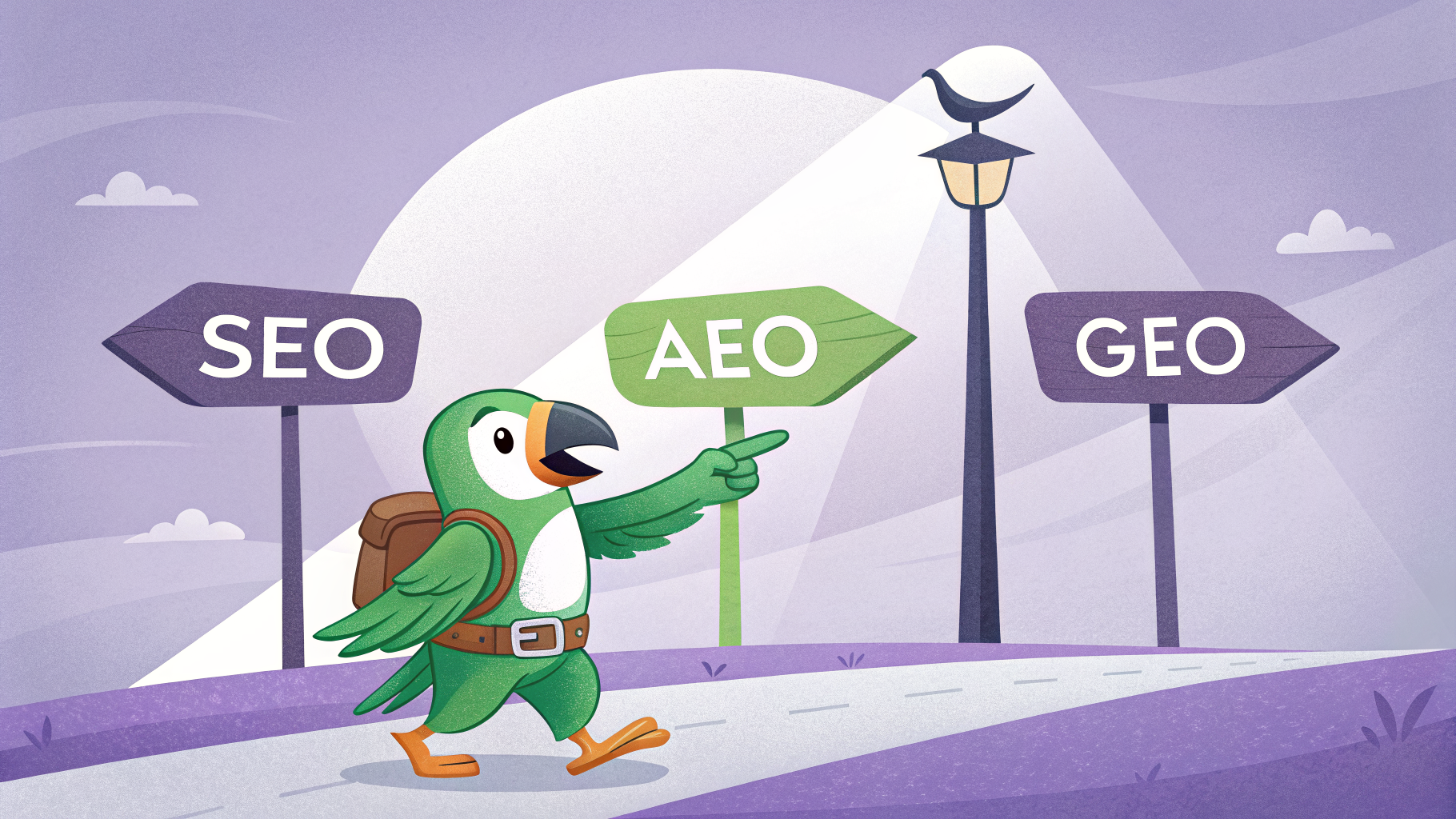
Quick answer: SEO optimizes to rank a page in search results. AEO (Answer Engine Optimization) optimizes to become the single direct answer — featured snippets, voice, and “People also ask.” GEO (Generative Engine Optimization) optimizes to get cited inside an AI-generated answer from ChatGPT, Perplexity, Gemini, or Google’s AI Overviews. They share fundamentals: build on SEO, layer AEO for question intent, and prioritize GEO if your audience increasingly asks AI instead of Google.
Last reviewed: August 2026.
Three acronyms, one underlying shift: search is moving from “a list of links” to “a synthesized answer.” Understanding how SEO, AEO, and GEO differ — and how they stack — tells you where to spend your next hour of effort. This guide gives you the side-by-side, a decision framework, and the tactics for each.
SEO vs. AEO vs. GEO at a glance
| SEO | AEO | GEO | |
|---|---|---|---|
| Goal | Rank a page in the results list | Become the one direct answer | Get cited inside a generated answer |
| Surface | Blue links, images, maps | Featured snippets, voice, PAA, AI Overviews | ChatGPT, Perplexity, Gemini, Copilot, Claude |
| Unit of win | A ranked link | The answer box | A cited sentence / named mention |
| Primary metric | Rankings, organic clicks | Snippet/answer capture | Citations, share of voice, AI referrals |
| Content shape | Comprehensive, keyword-aligned pages | Concise, direct answers to specific questions | Self-contained, citation-ready, well-sourced passages |
| Wins when | Users click through a results page | One concise answer is surfaced | An LLM synthesizes and attributes sources |
What is SEO?
Search Engine Optimization is the practice of ranking your pages in a search results list — mostly Google. It rewards relevance, authority (links and reputation), and a good page experience. SEO is still the foundation: AI crawlers discover and trust pages partly through the same signals. If your SEO is broken, GEO and AEO have nothing to stand on. See is SEO dead in the age of AI search? (short answer: no).
What is AEO?
Answer Engine Optimization is structuring content so it becomes the answer — the featured snippet, the voice-assistant response, the “People also ask” expansion, and increasingly the Google AI Overview. AEO rewards a crisp, direct answer to a specific question, usually placed right under a question-shaped heading. It’s the bridge between classic SEO and GEO. Full details in the complete AEO guide.
What is GEO?
Generative Engine Optimization is getting your brand cited inside an AI-generated answer, where the model synthesizes multiple sources and names a few. The unit of victory isn’t a ranked link — it’s being the source the AI repeats. GEO rewards self-contained, specific, credible passages a model can lift and attribute. The deep dive lives in the 2026 GEO playbook. You’ll also hear it called LLMO or “AI SEO” — we untangle those labels here.
How do they overlap?
They’re layers, not rivals. All three reward clarity, credible authorship, and clean structure. The differences are in shape and target:
- SEO → AEO is mostly a formatting shift: take a ranking page and add a direct, snippet-ready answer near the top.
- AEO → GEO is a credibility and corroboration shift: make each answer self-contained, specific, and backed by original substance so an LLM trusts it enough to cite.
- Google AI Overviews sit in the overlap — they need strong SEO to be selected, AEO-style answers to be extracted, and GEO-style credibility to be cited.
A worked example
Say you sell project-management software and target “how to run a sprint retrospective.”
- SEO: publish a thorough, well-linked guide that ranks for the keyword and its variants.
- AEO: open with a 40–60 word direct answer (“A sprint retrospective is a…”), add a step list and an FAQ, so you win the snippet and AI Overview.
- GEO: include an original data point (e.g., your own survey of 500 teams), clear authorship, and schema — so ChatGPT and Perplexity cite you by name when someone asks the question conversationally.
Which should you focus on?
Don’t pick one — sequence them by where your audience already is:
- Fix SEO fundamentals first. Crawlable, fast, well-structured, genuinely useful pages. Nothing else works without this.
- Layer AEO on your top question-intent pages. Answer-first openings, FAQ and Article schema, question-shaped headings. Cheap, fast wins. Start with answer-first writing and schema markup.
- Prioritize GEO if AI referrals are rising. Track how much traffic already comes from AI engines (set up GA4 tracking). If it’s growing, invest in original data, entity clarity, and per-engine tactics from the per-engine checklist.
One caution from our testing: there is no single “AI” to optimize for — engines cite different sources, so GEO is per-engine work.
Frequently asked questions
Is AEO just a subset of GEO?
They overlap heavily. AEO focuses on becoming the direct answer (snippets, voice, AI Overviews); GEO focuses on being cited inside a generated answer. Doing GEO well usually covers most AEO, because both reward clear, self-contained, credible answers.
Does SEO still matter if AI answers everything?
Yes. AI engines still discover and trust content through search-style signals, and classic search remains huge. SEO is the foundation GEO and AEO build on, not a replacement.
Which matters most for Google AI Overviews?
All three. AI Overviews need SEO to select your page, AEO-style direct answers to extract from it, and GEO-style credibility to cite it. See how to show up in Google AI Overviews.
Can a small site win at GEO and AEO?
Often more easily than at classic SEO. Answers and citations are decided per question, so a focused site with a crisp, credible answer can beat a bigger, vaguer one for that specific query.
The bottom line
SEO ranks the page, AEO becomes the answer, GEO gets you cited in the AI’s answer. They’re a stack, not a choice: solid SEO, AEO formatting on your question pages, and GEO credibility where AI referrals are growing. Build in that order and you cover every surface search is fragmenting into.
Keep reading
- The 2026 GEO playbook
- What is AEO? (complete guide)
- Best GEO tools 2026
- The 2026 GEO Benchmark (our experiment data)
Leave a Reply