
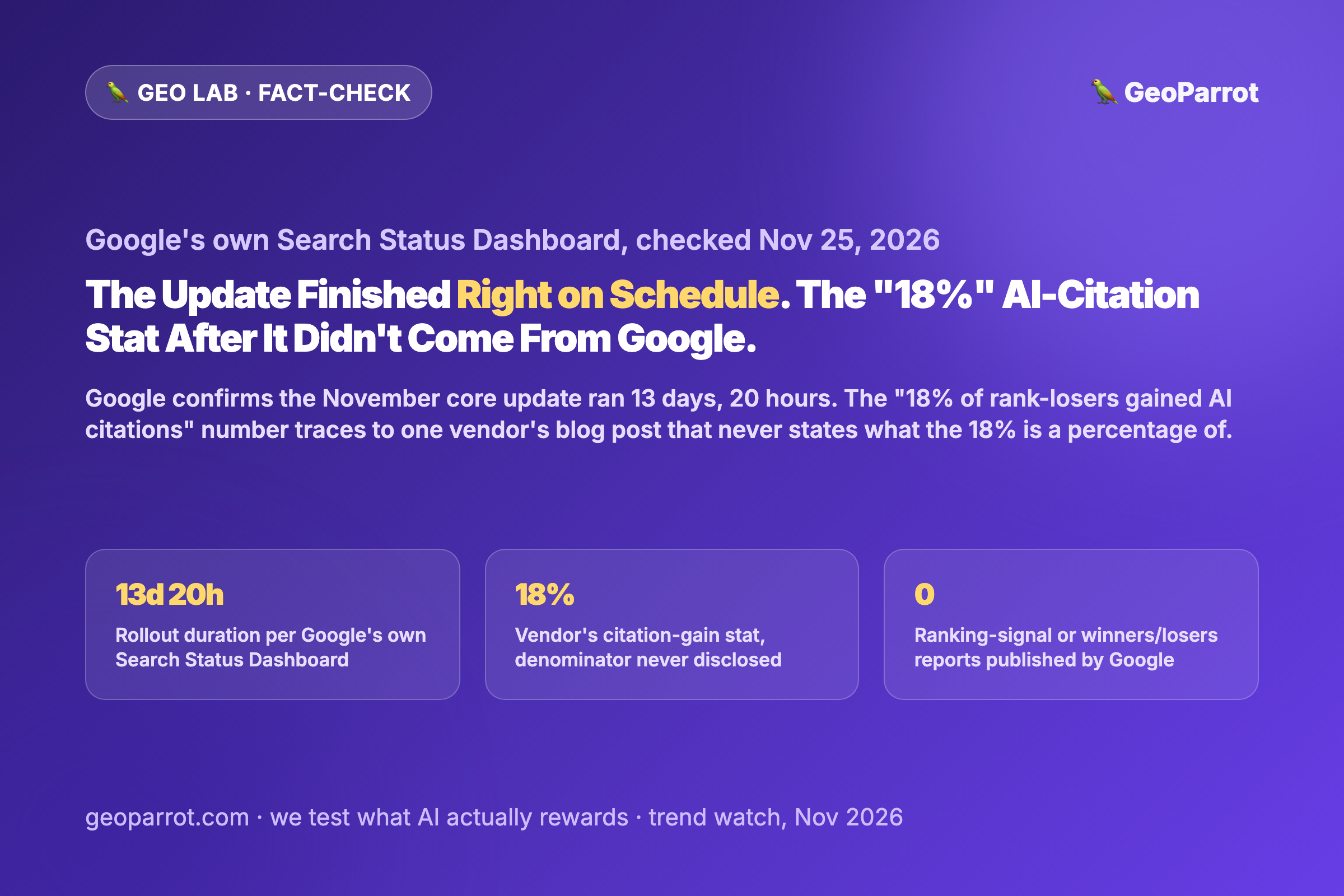
Quick answer: Google’s November 2026 core update is officially over. Google’s own Search Status Dashboard lists it as starting November 10 and running 13 days, 20 hours, which multiple outlets independently time to roughly 6:03am Pacific on November 24, right at the outer edge of the “up to two weeks” window Google announced when it started. That timing matches what we projected back on October 22 and confirmed on November 15. What hasn’t held up: a figure now spreading that “18% of domains which lost organic ranking positions actually gained AI Overview citations” during the update. It traces to a single blog post from the founder of a paid AI-visibility tool, and the post never says what the 18% is a percentage of. A second number from the same post, that AI citation volatility ran 31% higher than organic ranking volatility, is built from an undefined “temperature” metric and isn’t shown as a calculation anywhere in the text. Google has not published a ranking-signal list, a winners-and-losers report, or any AI-citation impact data of its own.
Trend watch, published November 25, 2026, in the GEO Lab. This closes out a prediction trail we’ve run since October: a model gave this update 96.8% odds within 30 days, the window opened on schedule, Google confirmed the start date two days early, and now the rollout itself is done.
Did Google’s November 2026 core update really finish on November 24?
Yes, and this is the one part of this story we can check without trusting anyone’s blog post. We pulled Google’s own Search Status Dashboard directly: it lists the November 2026 broad core algorithm update as starting November 10, 2026, with a total rollout duration of 13 days, 20 hours. Other outlets, cross-referencing the same dashboard data, put the precise end at 6:03am Pacific (9:03am Eastern) on November 24, which arithmetic from a November 10 start supports almost exactly. That lands the rollout right at the edge of the “up to two weeks” window Google announced when it confirmed the update on November 10, the slow end of its own stated range, not a quick in-and-out. We had already tracked this one in two earlier posts: a prediction model gave a Google update 96.8% odds inside 30 days back on October 22, and we confirmed the official start date on November 15, two days earlier than our prediction window had assumed, with completion projected for roughly November 24. That projection landed. The mechanism behind the update, whether it specifically targets scaled AI content the way some theories assumed, is still not confirmed by Google and remains outside what today’s dashboard entry tells us.
Where does the “18% of domains gained AI citations while losing rank” number come from?
From one source: a November 22, 2026 blog post on WhatsMyGeoScore, written by Calvin Ng, who the post identifies as the founder of Orion, the AI-citation tracking product the post is built around. The claim reads: “18% of domains that lost organic ranking positions during the Google November 2026 core update actually gained AI Overview citations.” The post describes a tracking run of “8,400 query snapshots (600 queries x 14 days)” and separately reports “127 instances (out of 8,400 query snapshots) where a domain ranked in the top 5 organically but wasn’t cited in the AI Overview.” Nowhere does the post state what population the 18% is measured against: 18% of the 600 tracked queries, 18% of some unstated count of domains that lost rank, or 18% of the 127 divergence instances it reports elsewhere, which would itself be a different and much smaller base. Those three readings produce very different real-world numbers, and the post doesn’t let a reader tell which one is intended. The author’s own product is pitched in the same piece as “the Search Console for AI citations,” which is the same self-interest pattern we flagged in the Podqi scam-site study on November 20 and the EPR noise-floor pilot on November 23: a vendor publishing a striking stat about AI search behavior, with no raw data released and a financial stake in the reader believing the stat.
Does the vendor’s own data support its “31% higher volatility” claim?
Not as published. The post reports AI Overview citation volatility at “11.9°F” against organic ranking volatility at “9.1°F” on November 13, using what it calls “a modified version of the MozCast methodology,” without defining what a degree represents in that modification or disclosing a formula. The difference between 11.9 and 9.1 works out to roughly 31% of 9.1, so the “31% higher” headline is at least arithmetically consistent with the two numbers given, but that calculation never appears in the post itself, and neither number carries a confidence interval, a sample size specific to that day, or any way for an outside reader to reproduce it. The post was also published November 22, two days before Google’s dashboard marks the rollout as actually finished, meaning the “Week 2” framing in its own title covers an update that was, by Google’s own later-confirmed timeline, still in progress. A single vendor’s mid-rollout snapshot, built on an unpublished variant of someone else’s methodology, is not the same thing as post-update impact data, no matter how precise the decimal point looks.
What’s the separate story about AI Overview links moving down the page?
It’s a different dataset entirely, and it’s worth knowing about precisely because it’s easy to mistake for the same story. David Konitzny of Peec AI, an AI-visibility monitoring company, shared data on LinkedIn and X showing that the first inline link in a Google AI Overview appeared in the first third of the answer 76.8% of the time on September 21, dropping to 51.8% by November 20, a 25-point decline over two months with two visible drops around October 9 and October 30. Search Engine Roundtable picked it up independently of Peec AI’s own promotion. The timeline runs well before the November 10 core update started and continues past it, so this is not a core-update effect, it’s a separate, slower trend in where AI Overviews physically place their first citation link. It also lands the same week Google’s own VP of Search, Elizabeth Reid, said publicly that “people don’t want purely AI, they want AI and the web,” while a second Google VP pushed users toward connecting more personal data into AI Mode. Whether Google’s product behavior matches that stated preference is a fair question; Peec AI’s own post doesn’t disclose a sample size or exact methodology either, so treat the 76.8%-to-51.8% trend as directionally interesting and independently sourced, not as a number with the same footing as Google’s dashboard timestamps.
| Claim | Source | Independently checkable? | Our read |
|---|---|---|---|
| Update ran Nov 10 to Nov 24, 13d 20h | Google’s own Search Status Dashboard | Yes, checked directly | Confirmed. Matches our Oct 22 prediction and Nov 15 report |
| 18% of rank-losers gained AI citations | WhatsMyGeoScore (Orion founder) | No, denominator never stated | Unverifiable as published, don’t repeat the figure |
| AI citation volatility 31% higher than organic | Same post, published Nov 22, before rollout finished | No, “temperature” units undefined, calculation not shown | Internally consistent arithmetic, undisclosed method |
| First AI Overview link in top third: 76.8% to 51.8% | Peec AI (David Konitzny), picked up by SER | Partial, independent pickup, vendor’s own methodology undisclosed | Directionally plausible, not a core-update effect, predates it |
| Official ranking-signal or winners/losers list | N/A | Not published, as with every core update to date |
What should you actually trust about this update right now?
- Trust Google’s own Search Status Dashboard for timing. Start date, duration, and completion status are the one part of this story Google publishes directly and that anyone can verify by loading the page.
- Treat single-vendor AI-citation impact numbers as marketing until a denominator is published. A percentage with no stated population, from the founder of the product being advertised in the same post, is not evidence, it’s a pitch with a number attached.
- Separate “this core update” claims from “this general trend” claims. The link-placement decline runs from September through November and isn’t specific to the November update; folding it into “core update impact” overstates what either dataset shows.
- Check publish dates against rollout dates before trusting a “final impact” framing. This vendor’s post ran two days before Google’s dashboard marks the rollout as actually complete.
- If you need real rank-vs-citation decoupling numbers, use a pre-registered test, not someone else’s unaudited snapshot. We measured our own blind rank-to-AI-citation overlap at 34% with the method locked before we ever opened a browser. That’s the bar a claim like “18% of rank-losers gained citations” would need to clear before we’d use it in our own analysis.
Frequently asked questions
Did Google’s November 2026 core update really finish on November 24?
Yes, per Google’s own Search Status Dashboard, which lists the update as starting November 10, 2026 and running 13 days, 20 hours in total, timing out to roughly November 24. That’s the one figure in this story that comes directly from Google and can be checked by anyone without trusting a third party.
What is the “18% of domains gained AI citations while losing rank” claim, and where does it come from?
It comes from a single November 22, 2026 blog post on WhatsMyGeoScore, written by the founder of Orion, the AI-citation tracking tool the post promotes. The post never states what population the 18% is a percentage of, so it can’t currently be verified or reproduced.
Why doesn’t the vendor’s “31% higher AI citation volatility” figure check out?
The post reports two numbers in an undefined “temperature” unit, 11.9 for AI citations versus 9.1 for organic rankings, and the 31% gap is arithmetically consistent with those two figures, but the post never shows the calculation, defines the unit, or discloses a sample size for that specific day. It was also published two days before Google’s dashboard marks the rollout as actually complete.
Is the separate claim about AI Overview links moving further down the page reliable?
It’s a different, independently sourced dataset from Peec AI, picked up by Search Engine Roundtable, showing the first inline link in AI Overviews dropped from the top third 76.8% of the time on September 21 to 51.8% by November 20. It predates the November core update and isn’t a measure of that update’s impact, and its own sample size and methodology aren’t fully disclosed either, so treat it as a directional trend, not a hard number.
What should I actually trust about this core update’s impact right now?
Only the timing, which Google itself confirms. No ranking-signal list, winners-and-losers report, or AI-citation impact data has been published by Google for this update. Any specific percentage circulating about what it did to AI citations currently traces back to a single vendor with an undisclosed denominator and a product to sell, not to Google or to an independently reproducible study.
GeoParrot is a GEO Lab: we pre-register our own predictions before testing AI citation behavior, and we hold other people’s AI-search numbers to the same standard. See the running scoreboard at our 2026 GEO benchmark. Related: the prediction model that called this update, our November 15 confirmation of its start date, and the same vendor-math problem we found in EPR Research’s ChatGPT noise-floor pilot.

Leave a Reply