
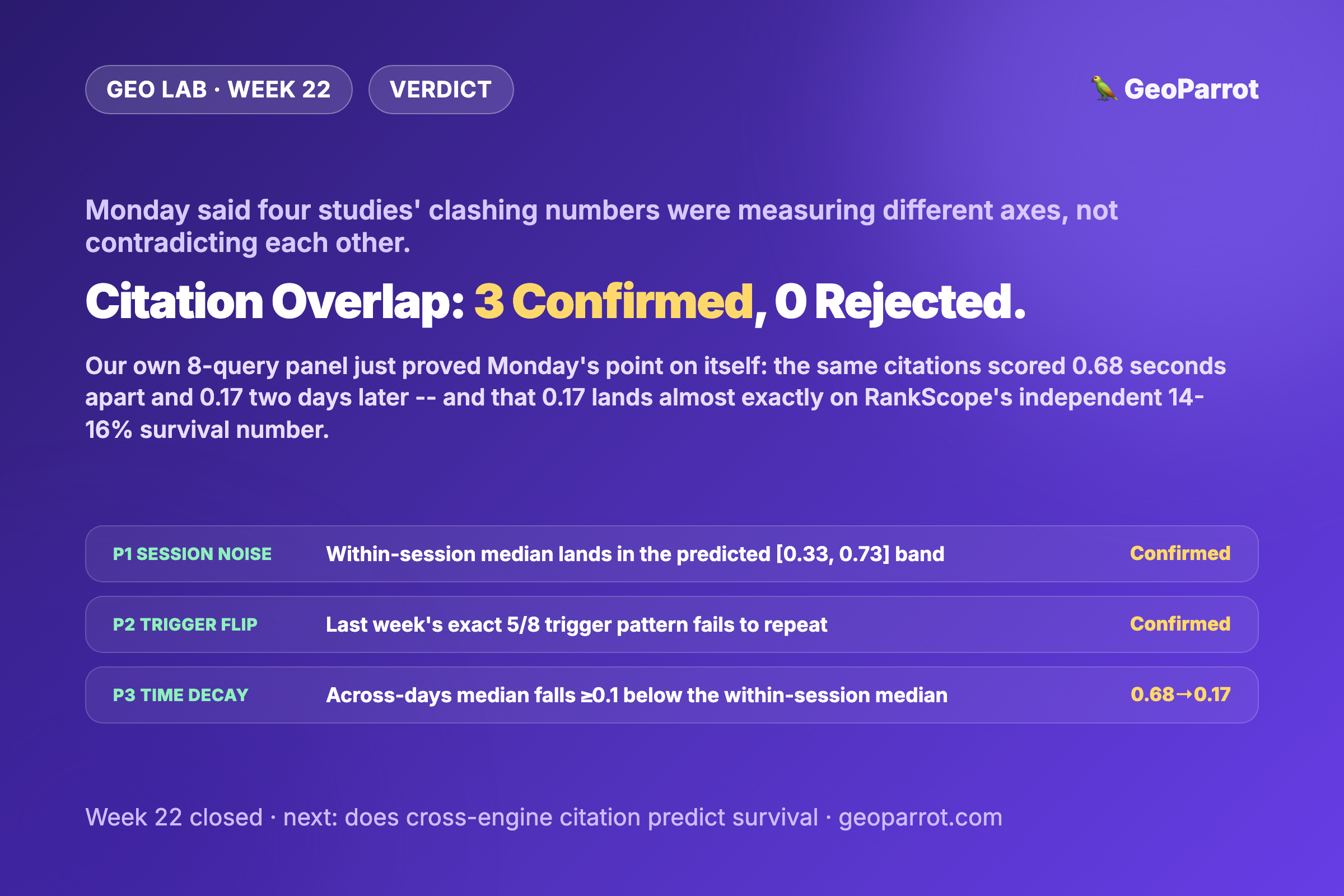
The verdict: ✅ Confirmed, all three predictions. Friday’s third collection pass ran the same 8 local “near me” queries one more time, roughly two days after Wednesday’s first Day-0 run. For the 6 queries that triggered a classic AI Overview box on both snapshots, the cited-domain overlap (Jaccard) had a median of just 0.17 — down from the 0.68 within-session median reported Thursday, a drop of 0.51 against the ≥0.1 bar P3 needed to clear. P1 and P2 were already confirmed Thursday on the within-session data. That makes it three for three: same-session noise matched the predicted band, last week’s exact trigger pattern didn’t repeat, and elapsed time erodes the list far past what session noise alone explains. One more thing the raw numbers do on their own, unprompted: our 0.17 across-days figure lands almost exactly on Monday’s RankScope citation of 14-16% per-page survival at roughly 2.7 days — a different metric, a different dataset, a number we didn’t engineer to match, converging anyway. Full breakdown, a platform-by-platform checklist, and next week’s test below.
Friday verdict, published November 20, 2026, closing this week’s GEO Lab arc. Monday asked whether four 2026 studies’ wildly different volatility numbers actually contradict each other. Tuesday pre-registered three predictions on our own 8-query Local panel, reused verbatim from last week’s exp21. Thursday reported the within-session numbers (P1, P2). Today’s third snapshot settles P3 and closes the week.
What’s the verdict on Monday’s claim?
Monday’s framing claim wasn’t a single number — it was an argument about measurement: that SISTRIX’s 5%, Babel42’s 11%, RankScope’s 14-16%, and GetMentions’ 69% all look contradictory only because each study measured a different axis of “volatility” (pool churn, exact-set match, page survival, pooled turnover). This week’s test was designed to check that argument the only honest way available to a one-site blog with no access to any of those four datasets: build one fixed panel, measure it on two different time axes ourselves, and see whether the axis alone can swing the headline number the way Monday argued it could.
| Prediction | Pre-registered bar | Result | Verdict |
|---|---|---|---|
| P1 · session-noise transfer | Within-session Jaccard median in [0.33, 0.73] | Median 0.68, range 0.25-1.00 across 6 queries | ✅ Confirmed |
| P2 · trigger instability | ≥1 of 8 queries flips trigger status vs. exp21’s exact 5/8 | LO6 (moving company) flipped off→on; all others held | ✅ Confirmed |
| P3 · elapsed-time decay | Across-days median ≥0.1 lower than within-session median | 0.68 → 0.17, a drop of 0.51 | ✅ Confirmed |
Net ruling on Monday’s framing claim: confirmed, and more cleanly than we expected going in. We didn’t need four separate external studies to see the axis-dependence Monday described — one panel, one account, one set of queries, measured twice on two timeframes, produced a 4x swing in its own “stability” number (0.68 same-session vs. 0.17 two days out) with nothing else changed. That is the mechanism Monday’s post argued for, demonstrated first-party rather than inferred from reading four methodology sections side by side.
How did the across-days collapse play out, query by query?
Friday’s run, single pass, no retries, same as every prior collection this arc: no blocking, no empty-content pages. 6 of 8 queries triggered a box on all three snapshots (LO1, LO2, LO3, LO4, LO6, LO8); LO5 and LO7 stayed silent a third time running, the most stable result in the entire dataset. For the 6 queries that triggered on both Day-0 run A and the Friday run, we scored Jaccard overlap against that first Day-0 run — the same comparison method used Thursday, just a different pair of snapshots.
| Query | Within-session (Wed A vs B) | Across-days (Wed A vs Fri) | Change |
|---|---|---|---|
| LO4 · 24-hour locksmith | 1.00 | 0.25 | -0.75 |
| LO6 · moving company | 1.00 | 0.83 | -0.17 |
| LO3 · same-day AC repair | 0.86 | 0.08 | -0.78 |
| LO2 · dentist accepting new patients | 0.50 | 0.22 | -0.28 |
| LO1 · emergency plumber | 0.33 | 0.13 | -0.20 |
| LO8 · emergency electrician | 0.25 | 0.00 | -0.25 |

Two results stand out against Thursday’s analysis. First, LO4’s “perfect” 1.00 did not survive contact with two days. We flagged Thursday that LO4 cited exactly one domain on both within-session runs, so a 1.00 there was a narrow list failing to change, not a rich one reproducing itself. Two days later that same single domain was still present — but three new domains joined the citation list, diluting the overlap score down to 0.25. The underlying domain didn’t get dropped; the pool around it grew, which is exactly the churn dynamic Monday’s post described in the Babel42 data. Second, LO6 is the one query that held up — and it’s the same query that flipped on this week in the first place. All 5 of its cited domains matched exactly within-session (a real, non-trivial 1.00), and two days later 5 of 6 domains still matched (0.83, the strongest across-days result by a wide margin). A citation box that had never shown up for this query last week turned out to be the single most durable one once it did.
Why does a 0.17 our own panel produced line up with a number we didn’t run?
This wasn’t engineered. We locked P3’s falsification bar (≥0.1 drop) on Tuesday, before any across-days data existed, and the actual result (0.51) cleared it five times over — that part was already decided before Friday’s collection ran. The coincidence is what the resulting number does after the fact: 0.17 sits almost on top of Monday’s RankScope citation of 14-16% per-page survival at roughly 2.7 days out. RankScope’s method and ours aren’t the same thing — they scored individual pages’ re-citation odds across 50 questions × 10 brands × 4 engines; we scored full-list Jaccard overlap on 6 Local queries on one engine. A page surviving onto day 2.7 (RankScope’s unit) and a citation list retaining 17% of its members over roughly 2 days (our unit) are adjacent but distinct quantities. We’re flagging the convergence, not claiming it proves our tiny panel generalizes; two independently-run, methodologically-different measurements landing in the same mid-teens range over a similar timeframe is a reason to take both numbers a bit more seriously, not a reason to stop checking.
Did the box itself stay stable even as its citations churned?
One result this week cuts against the decay story: trigger status was the most stable number in the whole arc. Wednesday’s two within-session runs and Friday’s across-days run all produced the identical 6/8 pattern (LO1, LO2, LO3, LO4, LO6, LO8 on; LO5, LO7 off) — zero additional flips in either direction across two days, on top of the one flip (LO6) already locked in versus last week. So “does a box show up for this query at all” settled into a stable state within this week even while “what does it cite once it shows up” kept eroding underneath. That’s a useful distinction for anyone monitoring their own visibility: box-presence and citation-list content are not the same signal, and this week’s data says the first one can be far steadier than the second over the same stretch of days.
What should you actually do, per platform, given this?
Our own data only covers classic Google AI Overview directly. For the other three platforms we’re leaning on Monday’s secondary sources (SISTRIX, Babel42, RankScope, GetMentions) plus our own September AI Mode noise-floor result, flagged as such below.
Classic Google AI Overview (what we tested directly)
- Treat any single-day citation as a snapshot, not a ranking to defend. Our own median overlap fell 75% in two days (0.68 → 0.17); a screenshot of “we got cited” from one morning says almost nothing about next week.
- Separate box-presence from citation content when you monitor. This week trigger status was rock-solid across days while the cited domains underneath churned hard — losing a specific citation doesn’t necessarily mean you lost visibility for the query, and gaining the box back doesn’t mean you’ll be the one it cites.
- Don’t read a single query’s result as the trend. One query (LO6) held 0.83 across days while the panel median was 0.17 — a team watching only their own query could draw the opposite conclusion from a team watching the panel.
Google AI Mode
- Expect a noisier floor than classic AI Overview, not a calmer one. SISTRIX put AI Mode’s weekly churn-in at 56% versus classic AIO’s 5%; our own September same-session Jaccard on AI Mode was 0.53, already close to our across-days classic-AIO number this week. If anything, AI Mode citation lists may decay faster, not slower.
- Snapshot more often if you’re tracking it. A weekly cadence may already be too sparse to catch what’s moving on a surface this volatile.
ChatGPT Search
- This is the least “sticky” surface in Monday’s roundup. SISTRIX’s 74% weekly churn-in and GetMentions’ 69% daily source-swap both put ChatGPT Search ahead of every other engine on turnover. Budget for continuous, earned coverage rather than a one-time optimization push aimed at a single snapshot.
Perplexity
- Single-engine re-citation looks comparatively durable (GetMentions: ~66%) — but cross-engine citation is the stronger signal. RankScope found pages cited on 2+ engines simultaneously survive at 77-91%, the single most actionable number across all four studies Monday reviewed. Getting cited once on Perplexity matters less than getting cited on Perplexity and somewhere else at the same time.
All platforms
- Name the time axis every time you report a stability number. “Stable” measured seconds apart and “stable” measured days apart are not the same claim — our own panel proved that to itself this week without needing anyone else’s data.
- Report a spread when n is small, not just a median. Thursday’s 0.68 median matched zero of the 6 individual queries; medians on small panels can describe a result nobody actually got.
What are we testing next week?
This week closed the question last week opened (is the citation list even stable enough to compare against anything) with a clean no — it isn’t, past the same session. That reopens the exact lever Monday’s roundup flagged as the most actionable finding in any of the four studies: RankScope’s result that pages cited on 2 or more engines simultaneously survive at 77-91%, versus 14-16% for a single engine. Next week we test whether that holds on our own panel. We’ll add a second engine (Google AI Mode) to the same 8 Local queries, identify which domains get cited on both classic AI Overview and AI Mode on the same day, and check whether those dual-cited domains survive to a follow-up snapshot at a higher rate than the single-engine-only domains in this week’s data. If multi-engine citation predicts survival on our own panel the way RankScope found at scale, that’s the first lever out of this whole arc that looks worth chasing on purpose. Follow the GEO Lab Monday to see the pre-registration.
Frequently asked questions
What’s the final verdict on this week’s three predictions?
All three confirmed. Within-session Jaccard overlap (two runs seconds apart) had a median of 0.68, inside the pre-registered [0.33, 0.73] band (P1). Last week’s exact 5-of-8 trigger pattern didn’t repeat; one query flipped from silent to triggering (P2). And the across-days median overlap (two days later) fell to 0.17, a 0.51 drop that cleared the pre-registered ≥0.1 bar by five times over (P3).
Does this confirm Monday’s claim that the four studies don’t actually contradict each other?
Yes. Monday argued that SISTRIX’s 5%, Babel42’s 11%, RankScope’s 14-16%, and GetMentions’ 69% looked contradictory only because each measured a different axis of volatility. This week’s own data reproduced that exact dynamic on a single fixed panel: the same 6 queries’ citation overlap read as 0.68 on one time axis (seconds apart) and 0.17 on another (two days apart), a 4x swing from measurement choice alone, nothing else about the panel changed.
Why does your 0.17 number matter if it’s not the same metric as RankScope’s 14-16%?
Because it wasn’t tuned to match. We locked the P3 pass/fail bar on Tuesday before collecting any across-days data, and it would have cleared that bar at any value below 0.58, not specifically near RankScope’s range. Landing at 0.17, close to RankScope’s 14-16% at a similar elapsed time despite measuring full-list overlap rather than individual-page survival, is a convergence we noticed after the fact, not a target we engineered toward.
If citation lists decay this fast, is there anything stable at all?
Trigger status (whether a box shows up at all for a given query) was the most stable number across all three snapshots this week — the 6/8-on, 2/8-off pattern held identically from Wednesday through Friday. What decayed was the content of the list once a box did appear. Separately, RankScope’s cross-engine finding (77-91% survival for domains cited on 2+ engines at once) is the one lever in this whole arc that looks durable rather than noisy, and it’s what we’re testing on our own panel next week.
What’s next for the GEO Lab?
Week 23 adds Google AI Mode to the same 8 Local queries and tests whether domains cited by both classic AI Overview and AI Mode on the same day survive to a follow-up snapshot at a higher rate than single-engine citations — a direct, first-party test of RankScope’s cross-engine stability finding cited in this arc.
Sources
- Four 2026 Studies Just Measured AI Overview Citation Volatility — Monday’s fact-check, the claim under judgment.
- AI Overview Local Citation Reproducibility: Method — Tuesday’s pre-registration, three predictions locked before collection.
- We Re-Ran the Same 8 Local Queries Twice in One Sitting — Thursday’s within-session results (P1, P2).
- GBP Signals: 1 Confirmed, 1 Partial, 1 Untestable — last week’s verdict, the open question this arc answers.
- Query-Phrasing AI Citation Results — September’s AI Mode same-session noise floor (Jaccard 0.53), the cross-surface comparator for P1.
- GeoParrot GEO Lab — exp22: 8 Local “near me” queries, single account/location (Seoul, logged out), three browser-automated snapshots (Wed 2026-11-18 ×2, Fri 2026-11-20 ×1), classic Google AI Overview box only.
GeoParrot is a GEO Lab: we test what AI search actually cites and recommends, then publish the method and the misses. This closes a four-part weekly arc on what AI SEO is, measured against our own first-party data rather than asserted from someone else’s methodology section.


Leave a Reply