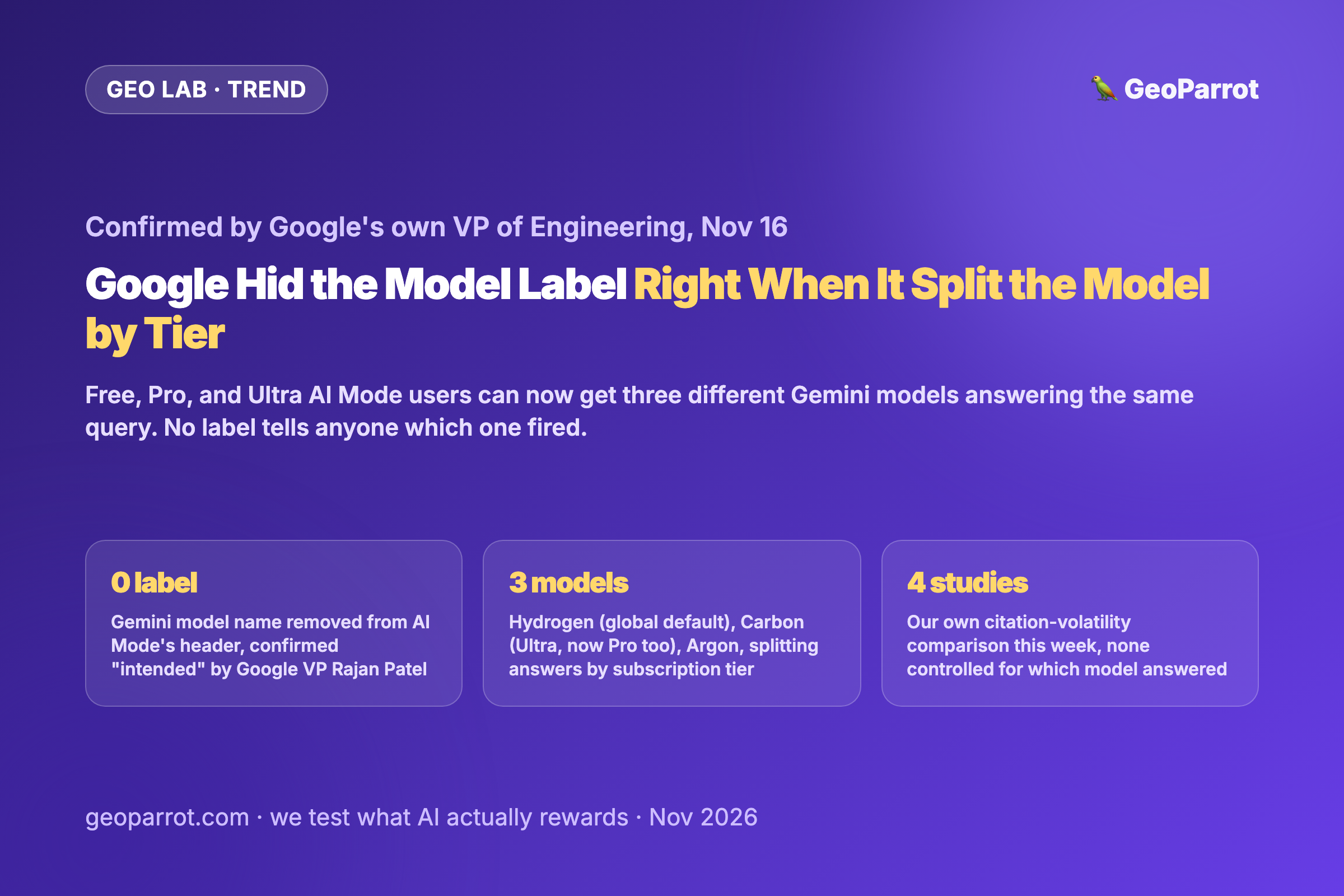
Quick answer: On November 16, SEO watcher Gagan Ghotra spotted that Google’s AI Mode header no longer shows which Gemini model answered a query, just the words “AI Mode.” Google’s VP of Engineering for Search, Rajan Patel, confirmed it was deliberate: “Intended, but we’re thinking through the right way to bring back an indicator.” The same week, Google expanded Gemini 4 Carbon, its strongest and slowest model, from $99.99 Ultra subscribers down to $20 Pro subscribers inside AI Mode, while Gemini 4 Hydrogen, a faster distilled model, had already become the global AI Mode default on November 12. Put together: free, Pro, and Ultra users can now get three different Gemini variants answering the identical query, and as of this week, nobody outside Google can see which one fired. That is a real confound for the four citation-volatility studies we just compared, none of which controlled for, or even mentioned, which model generated the answer they were measuring.
Published November 17, 2026, in the GEO Lab. We opened this week’s arc by comparing four 2026 studies that measured AI Overview citation volatility and landed on four different numbers, 5%, 11%, 14-16%, and 69%, detailed in Monday’s post. None of those methodologies logged which Gemini model answered any given snapshot. This week’s model-routing news is a second reason those numbers might diverge, on top of the four measurement-definition reasons we already found.
What exactly changed this week?
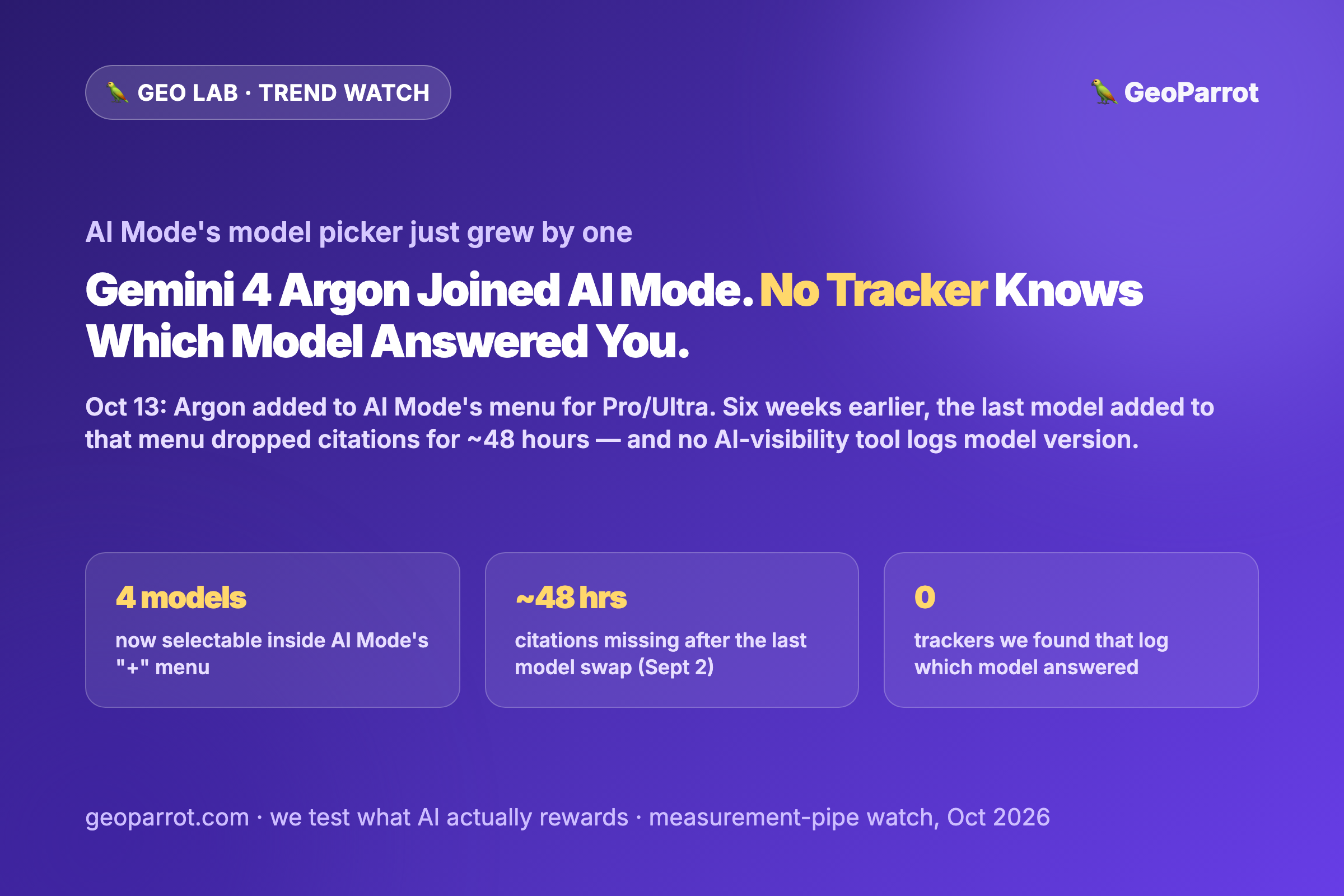
Two separate changes landed days apart, both inside Google AI Mode. On November 12, Google made Gemini 4 Hydrogen, a distilled, speed-optimized model built from Gemini 4 Carbon, the default model across AI Mode for everyone, globally, and the model Google says handles “your hardest questions” inside classic AI Overviews. Google did not define a threshold for what counts as hardest, or say what share of Overviews actually route to it. On November 16, Google rolled out Gemini 4 Carbon itself, its strongest, slowest, most expensive-to-run model, to $20-a-month Pro subscribers inside AI Mode; it had been available only to $99.99-a-month Ultra subscribers until that point. In the same window, the model name disappeared from the AI Mode interface header entirely. Patel confirmed both changes directly: the label removal is “intended,” and the Carbon expansion is “not a bug.”
Who you are
Model answering your AI Mode query, as of Nov 16
Shown in the UI?
Free / non-subscriber
Gemini 4 Hydrogen (default since Nov 12)
No, header just says “AI Mode”
Google AI Pro ($20/mo)
Gemini 4 Hydrogen or newly added Gemini 4 Carbon
No, label removed Nov 16
Google AI Ultra ($99.99/mo)
Gemini 4 Carbon (had it first) or Hydrogen
No, label removed Nov 16
Based on seroundtable.com reporting of Rajan Patel’s confirmations, Nov 12-16, 2026. Google has not published the exact routing logic between Hydrogen and Carbon within a tier, or what share of queries in AI Overviews route to Hydrogen versus a lighter model.
Why does a hidden model label matter for citation measurement?
Every citation-tracking tool we compared this week, SISTRIX’s 82,619-prompt tracker, Babel42’s 15-day daily audit, RankScope’s three-run re-ask test, GetMentions’s 530,875-citation pool, runs its queries from one automated account or profile. None of them disclosed which Gemini variant was answering, because until this week there was no public confirmation that AI Mode even varied the model by subscription tier mid-rollout. A tool scraping from a free-tier or single Pro-tier account for weeks is now, confirmed by Google itself, sampling from a shifting mix of at least two different models without knowing it. That is a new variable sitting underneath every one of the four volatility numbers we logged three days ago, on top of the four different definitions of “volatility” those studies were already using.
This is not a hypothetical we are inventing to manufacture a connection. It is the same pattern we flagged in Google’s November 12 definitions-auto-expand change, detailed in that week’s post: Google states a behavior applies to some identifiable slice of queries, “definition queries,” “hardest questions,” without publishing the boundary of that slice or the percentage affected. A researcher outside Google cannot control for a variable Google has not sized.
Does this explain our own 0.53 noise floor?
Not provably, and we want to be precise about that. Our September query-phrasing experiment found that running the identical Google AI Mode query twice in a row, seconds apart, from the same account, already produced a Jaccard overlap of only 0.53, meaning roughly half the cited domains changed with no delay and no reworded query. If Google were silently switching between Hydrogen and Carbon mid-session on that account, that alone could explain some of that drop; a different model can retrieve, weigh, and phrase a citation list differently even for the same prompt. But we ran that test in September, two months before Google confirmed this routing existed, so we have no model-identity log for those specific sessions to check against. What we can say is that a variable we did not think to control for in September turned out, this week, to be real and confirmed by Google’s own VP of Engineering. That raises, rather than answers, the question Tuesday’s locked-prediction post needs to account for.
Checklist: what to do with a hidden model variable
Don’t treat a single AI Mode account as representative. Free, Pro, and Ultra accounts can now legitimately see different citation behavior for identical queries, for a reason that has nothing to do with your content.
If you run a citation tracker, log the account tier you’re scraping from. A tool that doesn’t record tier, and ideally tries to detect the model, can’t separate “the AI changed its mind” from “a different model answered.”
Don’t assume Google will keep the label hidden. Patel said Google is “thinking through the right way to bring back an indicator,” which suggests this is a temporary gap, not a permanent design choice.
Re-read volatility statistics with a model-routing asterisk. Every number in Monday’s four-study comparison was collected before this routing was confirmed publicly; none of the four controlled for it.
Frequently asked questions
Why did Google remove the Gemini model label from AI Mode?
Google has not given a reason beyond confirming the removal was deliberate. Rajan Patel, Google’s VP of Engineering for Search, told X user Gagan Ghotra it was “intended, but we’re thinking through the right way to bring back an indicator for your selected model,” which implies the removal is likely temporary rather than a permanent decision to hide model identity.
Which Gemini model answers my Google AI Mode query right now?
You cannot tell from the interface as of November 16, 2026. Gemini 4 Hydrogen became the global AI Mode default on November 12. Gemini 4 Carbon, previously exclusive to $99.99 Ultra subscribers, rolled out to $20 Pro subscribers on November 16. Google has not published the exact logic for when a Pro or Ultra session gets Carbon versus Hydrogen for a given query.
Does this mean AI Overview citation volatility studies are wrong?
Not wrong, incomplete. The four studies we compared this week (SISTRIX, Babel42, RankScope, GetMentions) each measured a real, different axis of volatility. None of them logged or disclosed which Gemini model variant generated the answers they tracked, because that routing wasn’t publicly confirmed until this week. That’s a variable future studies, and our own ongoing test, now need to account for.
Is Gemini 4 Carbon stronger than Gemini 4 Hydrogen?
They’re built for different trade-offs rather than a strict better-or-worse ranking. Carbon is Google’s strongest and slowest model, built for the hardest problems. Hydrogen is a distilled, speed-optimized model derived from Carbon, built to match or beat the mid-tier Argon model on intelligence while running faster. Google uses Hydrogen as the broad default and reserves Carbon for its highest-paying subscribers and, per its own statements, the hardest AI Overview questions.
Will Google bring back the model label in AI Mode?
Google has not committed to a timeline, but Patel’s own wording, that the team is “thinking through the right way to bring back an indicator,” suggests some form of model identification is likely to return rather than stay permanently hidden.
GeoParrot is a GEO Lab: we run experiments to test what AI search engines actually reward, and we grade the industry’s claims, including our own prior calls, against what was actually confirmed. See the running scoreboard at our 2026 GEO benchmark. Related: this week’s four-study volatility comparison, and the September experiment where our own 0.53 same-session noise floor first came from.



Leave a Reply