
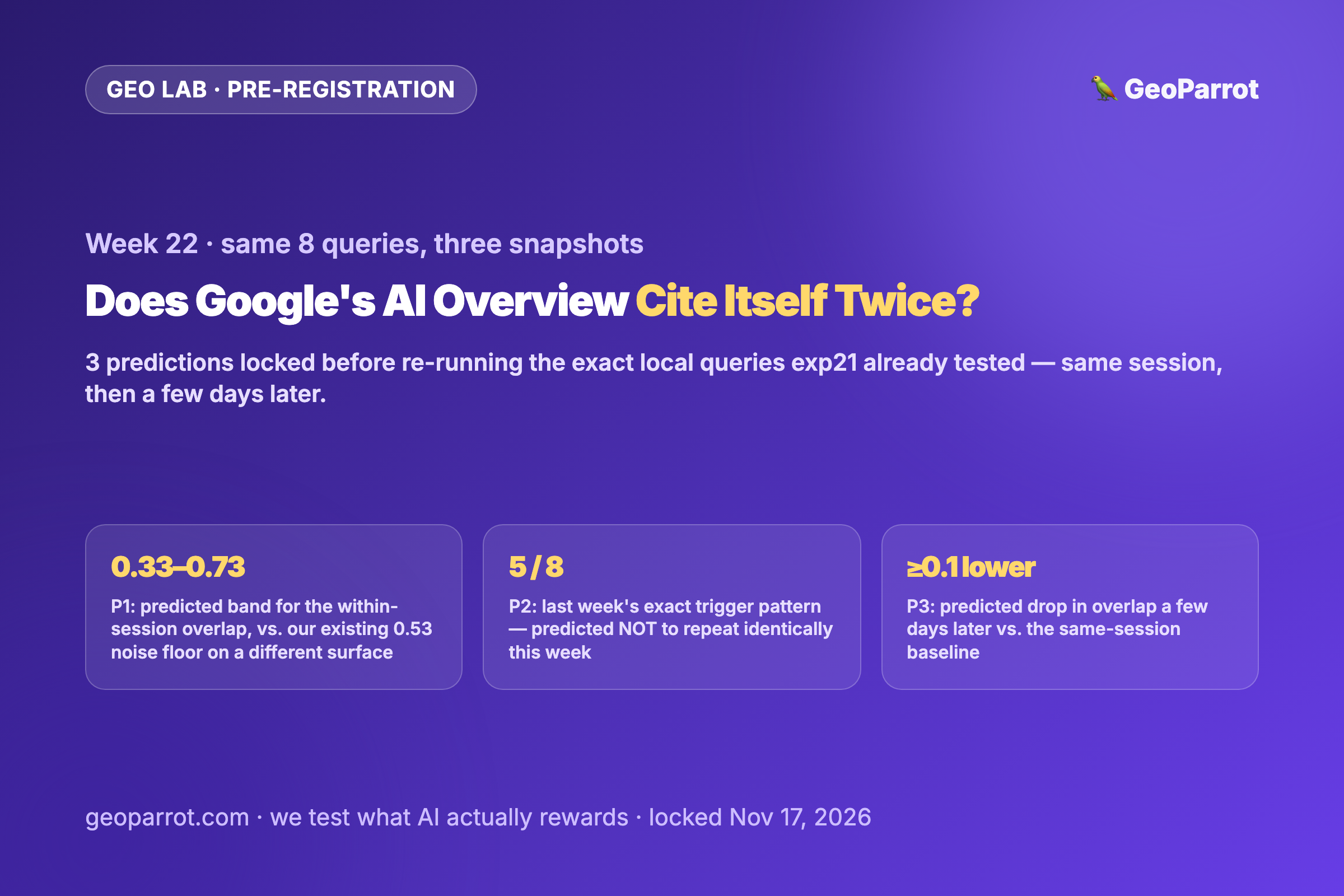
Quick answer: On November 17, 2026, before collecting any data, we locked three predictions about whether a classic Google AI Overview box’s local citation list can reproduce itself — a question Friday’s post flagged as a confound before chasing Google Business Profile signals any further, and Monday’s fact-check reinforced by showing four 2026 studies report “volatility” numbers from 5% to 89% because each measures a different thing. P1: re-running the same 8 “near me” queries twice, seconds apart, will land somewhere in a wide band (Jaccard 0.33-0.73) around last week’s existing 0.53 same-session noise floor — a number measured on a different surface (AI Mode, buyer-intent queries), so we are testing whether that floor transfers, not assuming it does. P2: the exact 5-of-8 trigger pattern from last week (5 queries showed a classic AI Overview box, 3 didn’t) will not repeat identically — trigger status itself is unstable, a more basic failure than citation-set overlap. P3: the citation-set overlap measured a few days later will be at least 0.1 lower than the same-session overlap from P1 — real elapsed time erodes a citation list beyond pure session noise. Three snapshots, full schedule below, no data collected yet.
Published November 17, 2026, in the GEO Lab. This is Tuesday in the arc Monday’s post opened, and the test Friday’s close of Week 21 said should run before chasing GBP signals any further. Collection runs across the rest of this week; the schedule is part of what’s being tested.
What exactly are we testing, and why does it matter before anything else?
Friday closed Week 21 with a 33% match rate between what a classic AI Overview box cited and the businesses in that query’s own Google Maps Local Pack, and flagged the obvious next check before reading too much into that number: if the AI Overview box can’t even reproduce its own citation list from one run to the next, some of that 33% gap is explained by the box’s own instability, not by anything about Google Business Profile signals. Monday’s fact-check made the same question more urgent from a different angle — SISTRIX, Babel42, RankScope, and a vendor study each measured something they called “AI Overview citation volatility” in 2026 and reported 5%, 89%, 14-91%, and 69% respectively, because each measured a different axis entirely (weekly pool churn, exact daily set match, per-page survival, and multi-engine pooling). None of those four studies ran our specific test: the same fixed query set, on the classic AI Overview surface, measured within one session and again a few days later. That’s the gap this arc fills with first-party data.
- P1 (session-noise transfer): the within-session Jaccard overlap for this week’s 8 Local queries, re-run seconds apart, will fall between 0.33 and 0.73 — a wide band around the 0.53 noise floor we measured in September on a different surface and query type.
- P2 (trigger instability): last week’s exact pattern of which queries trigger a classic AI Overview box at all (5 of 8 did) will not repeat identically this week.
- P3 (elapsed-time decay): the citation-set overlap measured a few days after Day 0 will be at least 0.1 lower than the within-session overlap from P1 — time erodes the list beyond what pure session wobble already explains.
Three separate predictions because they test three separate claims that “AI Overview citations are unstable” could actually mean: P1 asks whether same-session wobble is a general property of AI-generated citation boxes or specific to the surface we happened to measure it on first; P2 asks whether the box reproducibly decides to show up at all, a more basic question than what it cites once it does; P3 asks whether real elapsed time adds anything on top of P1’s baseline, or whether the whole “decay” story is just session noise wearing a calendar.
Why reuse last week’s exact 8 queries instead of a fresh set?
This arc is explicitly testing whether one specific panel reproduces itself, so swapping in new queries would defeat the point. geo-lab/exp22/questions.json carries the identical 8 Local “near me” queries from exp21 — emergency plumber, dentist accepting new patients, same-day AC repair, 24-hour locksmith, hair salon, moving company, pet grooming, emergency electrician — each tagged with its exp21 trigger status, so this week’s pattern can be checked against last week’s line by line.
| Query | Exp21 trigger status |
|---|---|
| “emergency plumber near me” | Triggered (single-business redirect, exp21 flagged thin) |
| “dentist accepting new patients near me” | Triggered |
| “same day ac repair near me” | Triggered (2-business pack, exp21 flagged thin) |
| “24 hour locksmith near me” | Triggered |
| “hair salon near me” | Did not trigger |
| “moving company near me” | Did not trigger |
| “pet grooming near me” | Did not trigger |
| “emergency electrician near me” | Triggered |
We’re also holding the surface fixed — classic AI Overview only, no AI Mode, same box-identification method exp20’s collect.py already validated. Mixing in a second surface would confound the within-surface reproducibility question this arc exists to answer, the same reasoning the original decay arc used to hold one engine fixed back in September.
What’s the actual collection schedule, and why does Friday carry two jobs?
Full disclosure on timing, because the schedule is the experiment this week, not just the method for running it:
- Day 0, same session — Wednesday, November 19. Run all 8 queries once, then immediately re-run all 8 a second time, seconds to low-minutes apart, same account and browser profile, single pass each, no retries. This pair of runs produces the within-session Jaccard P1 is scored against.
- Day 0 + ~2 days — Friday, November 21. Run all 8 queries once more, single pass, no retries, the same morning the verdict post is written. Compared back to the first Day-0 run, this produces the across-days Jaccard P3 needs.
- Thursday’s results post reports the Day-0 session-baseline numbers and the trigger-rate replication — P1 and P2, with real data. P3’s across-days number necessarily lands Friday, the same day as the verdict, since “a few days later” can’t fit inside the Wed-collect/Thu-results slot this series otherwise uses. We’re naming that constraint now rather than discovering it after Thursday is already published.
Each of the three passes above is a single attempt, no retry. That discipline comes directly from a prior arc’s failure: a September attempt at this same decay question got silently blocked by Google’s bot defenses on its first query, and a retry four days later hit the identical wall. If any pass this week returns empty content on an otherwise normal page — the exact silent-block signature that arc documented — we log the block and report it directly instead of retrying into it. The collection method itself (a logged-in Chrome profile driven through browser_agent, not a bare scraper) is the same one exp21 already ran cleanly without triggering a block, which is the whole reason we’re attempting this question again now rather than waiting longer.
Why compare against 0.53 if it came from a different surface?
Because it’s the only same-session noise-floor number we have, and pretending it doesn’t exist would mean reinventing a baseline from scratch instead of testing whether the one we already have generalizes. In September, re-asking an identical query seconds apart on Google AI Mode, across eight buyer-intent commercial and informational queries, kept 53% of the cited domains (Jaccard 0.53) — the number Monday’s fact-check cited as our own cross-check against the four external studies. That number came from a different surface (AI Mode, not the classic AI Overview box) and a different query type (commercial/informational, not Local). P1 does not assume 0.53 transfers to this week’s surface and query type; it predicts a wide band (0.33-0.73) specifically because we expect some difference between surfaces, and a result outside even that generous band would be the more interesting finding — it would mean the two surfaces need entirely separate noise floors in every future comparison, not just a footnote.
What counts as confirmed, rejected, or inconclusive for each prediction?
All three lines were written down November 17, before any of this week’s queries were re-run:
| Prediction | Confirmed if | Rejected if |
|---|---|---|
| P1 (session noise transfers, wide band) | Within-session Jaccard (Day-0 run A vs run B, queries triggering both times) falls in [0.33, 0.73] | Falls below 0.33 (far noisier than AI Mode) or above 0.73 (far more stable) |
| P2 (trigger status is unstable) | At least 1 of the 8 queries flips its trigger status versus exp21’s exact 5/8 pattern | The identical 5/8 pattern repeats exactly |
| P3 (elapsed time erodes beyond session noise) | Across-days median Jaccard is ≥0.1 lower than the within-session median from P1 | Across-days median is equal to or higher than the within-session median |
Inconclusive is a real, allowed outcome per prediction if fewer than 3 queries trigger on the relevant pair of snapshots being compared — too small a sample to read a median with any confidence. Given exp21’s 5/8 baseline trigger rate, that’s a live possibility for P1 and P3, and we’re not pretending otherwise going in.
What should you do with this before Friday’s verdict?
- Don’t treat a single “we’re cited” screenshot as a stable fact. Whatever this week finds, the four studies Monday’s post fact-checked already agree on one thing: citation lists move. A screenshot from today tells you about today.
- If you track AI citations with any automated tool: ask it directly how often it re-samples the same query, and whether it distinguishes a real citation loss from the kind of session-to-session wobble this arc is measuring. A tool that samples once a week and reports deltas could be reporting noise.
- If you want to replicate this yourself: the full 8-query list, the three-snapshot schedule, and every pass/fail line are in this post, nothing held back pending results. Run your own category’s version and see if your band looks like 0.33-0.73 too.
Frequently asked questions
What three predictions did GeoParrot lock for this arc?
P1: re-running the same 8 local queries twice, seconds apart, will produce a within-session Jaccard overlap between 0.33 and 0.73, a wide band around a 0.53 noise floor measured on a different surface in September. P2: last week’s exact pattern of which queries trigger a classic AI Overview box (5 of 8 did) will not repeat identically. P3: the overlap measured a few days later will be at least 0.1 lower than the within-session overlap, meaning elapsed time erodes a citation list beyond pure session noise.
Why reuse the exact same 8 queries from last week instead of new ones?
Because this arc tests whether one specific panel’s results reproduce, not whether a new, wider sample shows some pattern. Swapping in fresh queries would make reproducibility unmeasurable. The same 8 “near me” queries from exp21 are reused verbatim, each tagged with its exp21 trigger status for a direct line-by-line comparison.
Why does the schedule run Wednesday, then again Friday, instead of daily?
Wednesday’s pass is two back-to-back runs (within-session baseline). Friday’s pass, a few days later, produces the across-days comparison. That means the across-days number (P3) lands the same day as the verdict rather than Thursday’s results post — a scheduling constraint we’re naming upfront rather than discovering after the fact.
Why only a single collection pass each time, with no retries?
A September attempt at a similar decay question got silently blocked by Google’s bot defenses on its first query, and a retry days later hit the identical wall. Retrying into a soft block risks turning it permanent. Each pass this week is one attempt; if a pass comes back empty on an otherwise-normal page, we log it as a block and report that directly instead of forcing more attempts.
When do results and the verdict publish?
Thursday, November 20 reports the Day-0 session-baseline numbers (P1) and the trigger-rate replication (P2). Friday, November 21 reports the across-days comparison (P3) and scores all three predictions against the lines locked in this post.
Sources
- The Verdict: GBP Signals Explain the Loudest Citation in a Query, Not the Quiet Second One — Friday’s close of Week 21, source of the 33% match rate and the reproducibility confound this arc tests directly.
- Four 2026 Studies Just Measured AI Overview Citation Volatility. One Says 5%. Another Says 89%. Both Are Right. — Monday’s post, the arc this pre-registration belongs to.
- Which Google Business Profile Signals Actually Correlate With Local AI Overview Citation? — exp21, source of this week’s reused 8-query panel and its exact trigger status.
- Does Query Phrasing Change What AI Cites? The Results. — source of the 0.53 same-session noise floor P1 tests against.
- Rented, Not Owned? Our Pre-Registered Test of Whether an AI Citation You Win Today Is Still There Next Week — the original attempt at this question, held one engine fixed for the same reason this arc does.
- The Verdict: Our Pre-Registered AI-Citation Decay Test Never Ran — Google’s Bot Defense Blocked Every Snapshot — source of the single-attempt, no-retry collection discipline this arc follows.
- Does Google’s AI Overview Box Actually Cite by Rank? — source of the box-identification collection method this arc reuses.
- GeoParrot GEO Lab index — the running weekly arc this test belongs to.
GeoParrot is a GEO Lab: we test what AI search actually cites and recommends, then publish the method and the misses — including our own. Wednesday we collect; Thursday reports the session-baseline numbers; Friday reports the across-days comparison and the verdict against the exact lines locked in this post.


Leave a Reply