Evidence-first case study · sports brand SEO + GEO series, part 17 of 20
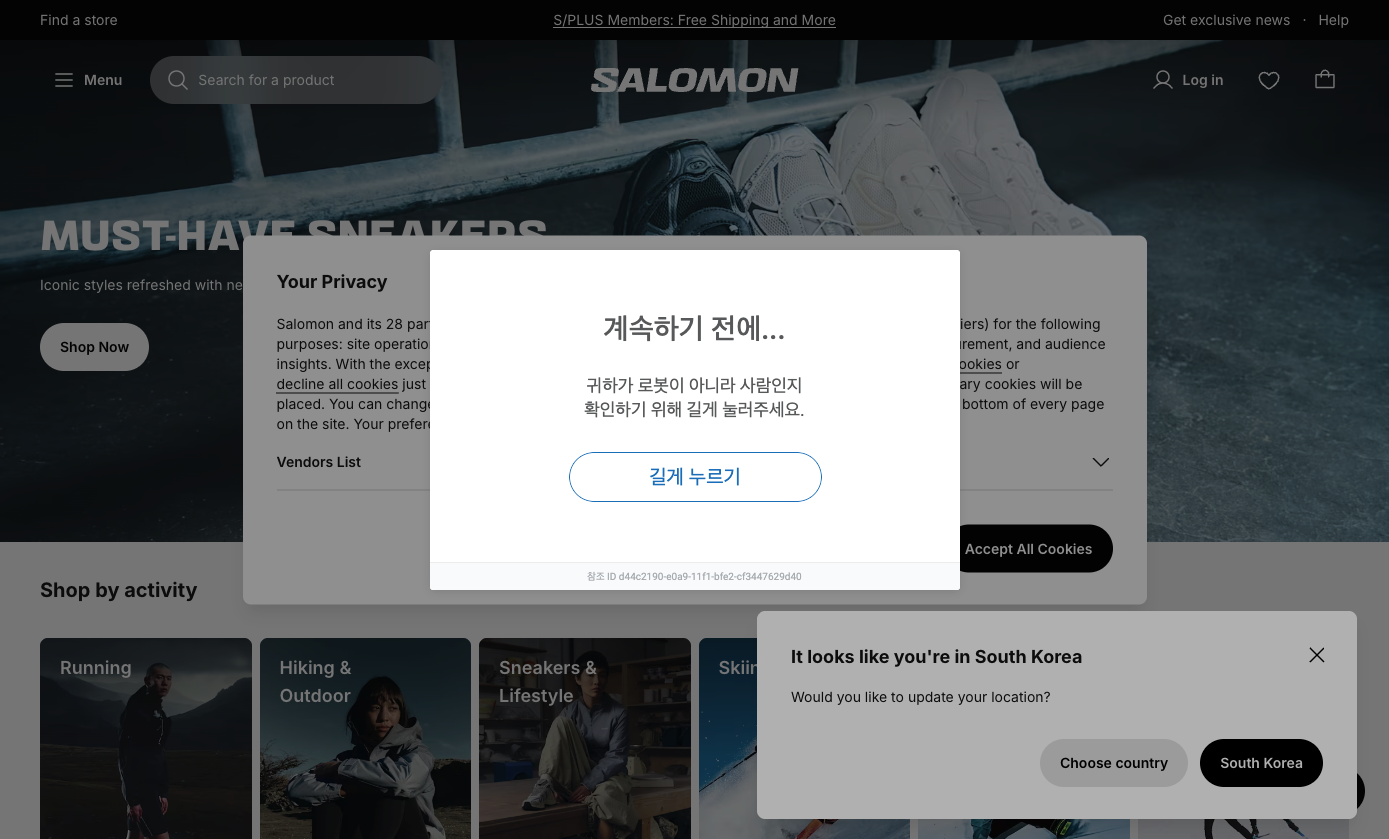
Salomon’s US flagship, salomon.com, didn’t just block us with a captcha — it escalated mid-session. Our first visit rendered the real homepage with a PerimeterX “press and hold” challenge (localized into Korean) laid over it as an overlay; every subsequent request in the same session, to the same URL, instead returned a hard server-side block page before any content loaded at all. The category, product and help pages were blocked the same hard way throughout. Meanwhile salomon.co.kr — run directly by Amer Sports Korea, Salomon’s own subsidiary — is a clean, fully measurable Shopify storefront with the same “UCP/MCP agent commerce” boilerplate we’ve now seen on three different brands in this series. Google AI Mode cited a Salomon domain in 4 of our 10 test queries.
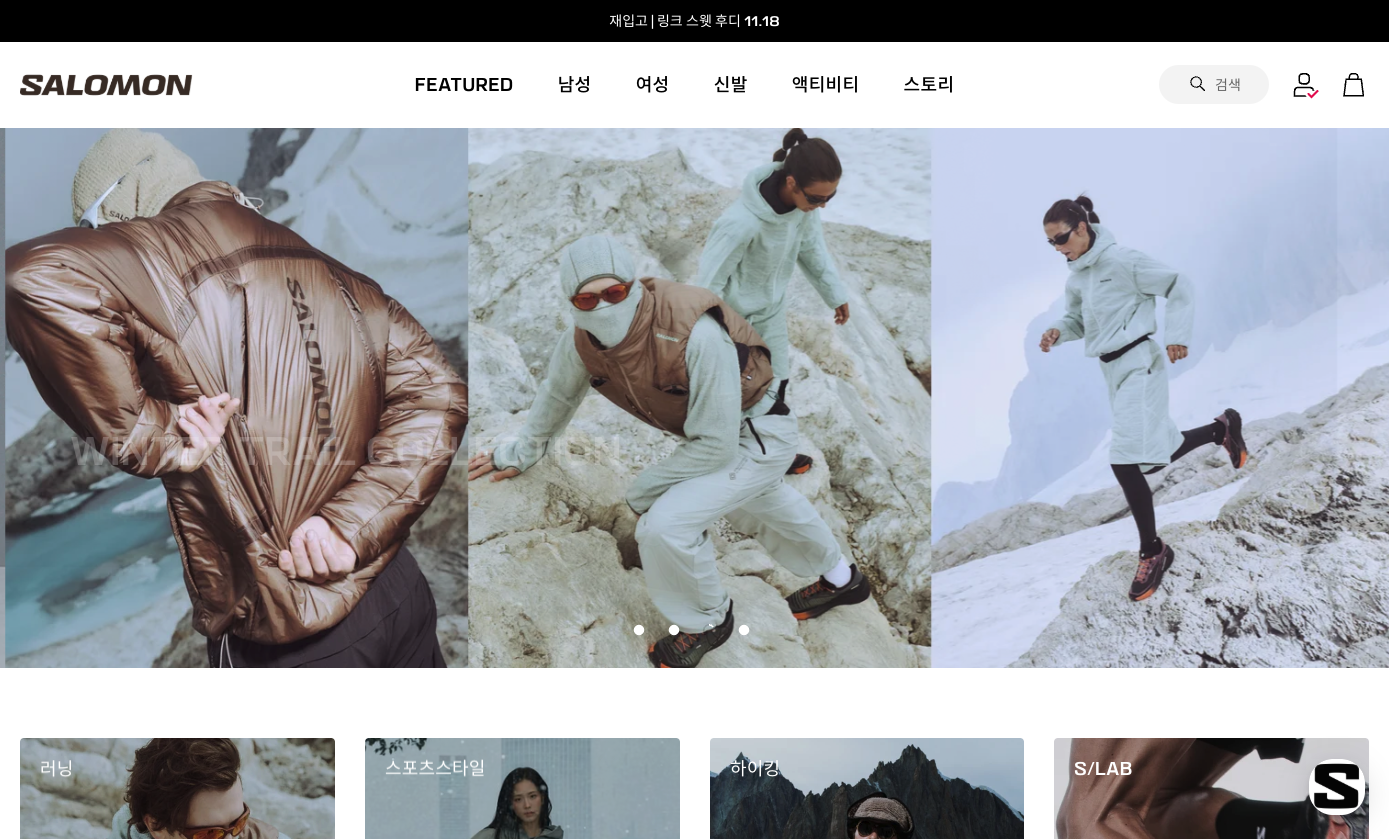
Three overlays stacked on one page load: cookie consent, a “you appear to be in South Korea” prompt, and a PerimeterX press-and-hold challenge rendered in Korean. The captcha iframe absorbed every click we tried, including on the geolocation popup’s own close button.
What is Salomon trying to do — and why audit it seventeenth?
This is part 17 of GeoParrot’s sports-brand series, running the same evidence-first method we used on FILA, Columbia Sportswear and fifteen other major brands. Salomon was founded in 1947 in Annecy, France, originally making ski bindings before becoming one of the defining names in trail running and technical hiking footwear (the Speedcross and XA Pro lines). Since 2019 it has been part of Amer Sports, a Finland-headquartered group taken private that year by a consortium led by China’s ANTA Sports (alongside Lululemon founder Chip Wilson’s family office, FountainVest Partners and Tencent), then re-listed on the NYSE in February 2024. It earns the seventeenth slot because its US storefront produced the clearest real-time escalation of a bot challenge we’ve documented since Lululemon in early November, while its Korean operation — run in-house, not by an external licensee — gives us a second clean comparison point.
Brand category French heritage trail-running and outdoor-footwear brand (founded 1947), owned since 2019 by Amer Sports — majority-controlled by China’s ANTA Sports, NYSE-listed since February 2024.
Primary user job Research a trail running shoe (the XA Pro 3D or Speedcross 6), check real reviews and sizing, and work out whether it’s actually possible to buy direct from salomon.com given the bot-check wall in front of every product page.
SEO + GEO challenge The US flagship’s challenge state visibly escalated within a single audit session — from an overlay on real content to a full block — while the Korean subsidiary’s Shopify store runs clean, measurable pages with valid (if incomplete) product schema.
The product we tracked: XA Pro 3D, same SKU on both sides
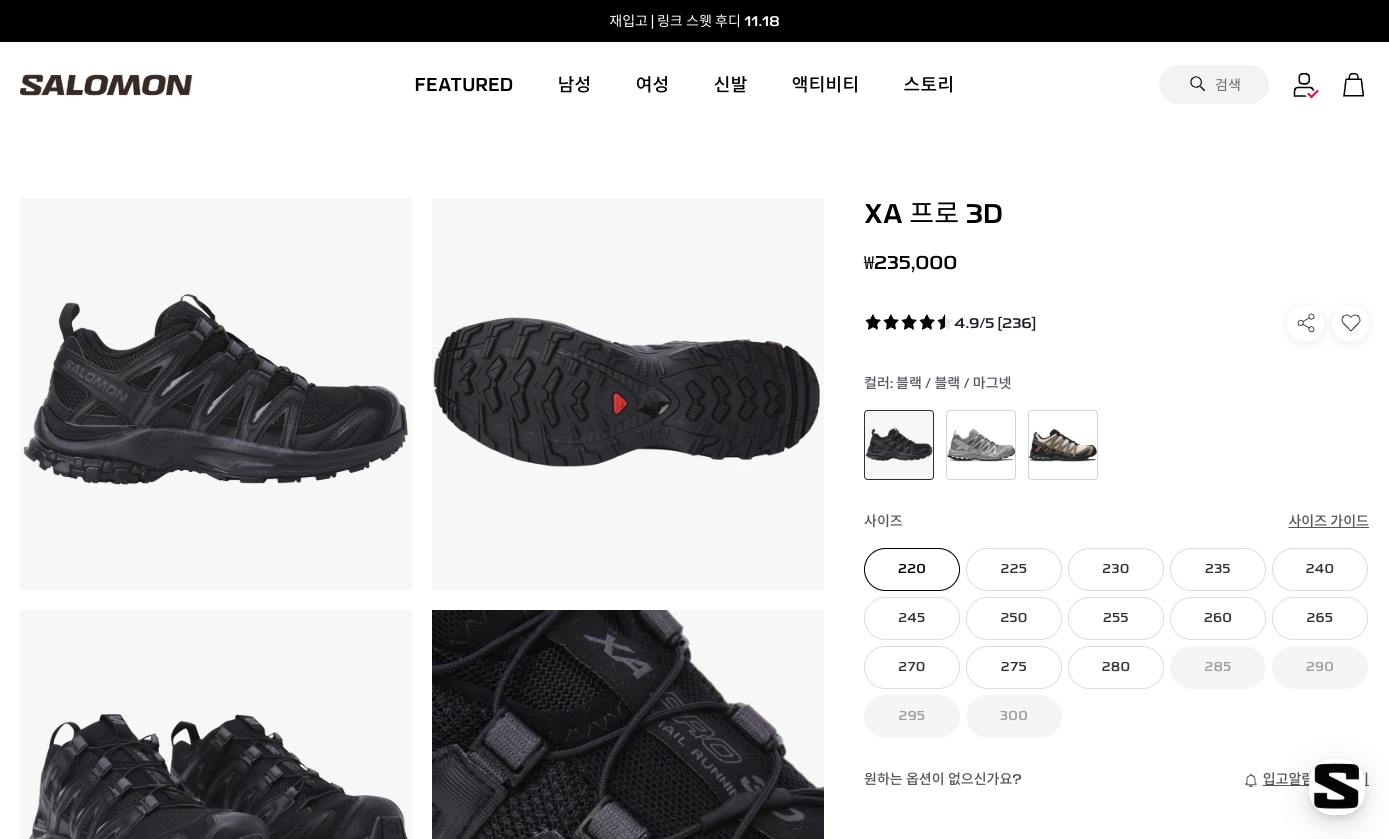
We tracked the same exact product — SKU L41617400, the XA Pro 3D in black — on both the US and Korean sites, the same same-SKU comparison method we used on Nike and Adidas. The US page never rendered for us past the bot-check wall. The Korean page rendered cleanly, listing ₩235,000 and a 4.9/5 rating from 236 reviews on screen.
The Korean PDP for SKU L41617400: ₩235,000, full Korean size run, 4.9/5 from 236 reviews on screen — though as the G-score section below shows, that rating never makes it into the page’s structured data.
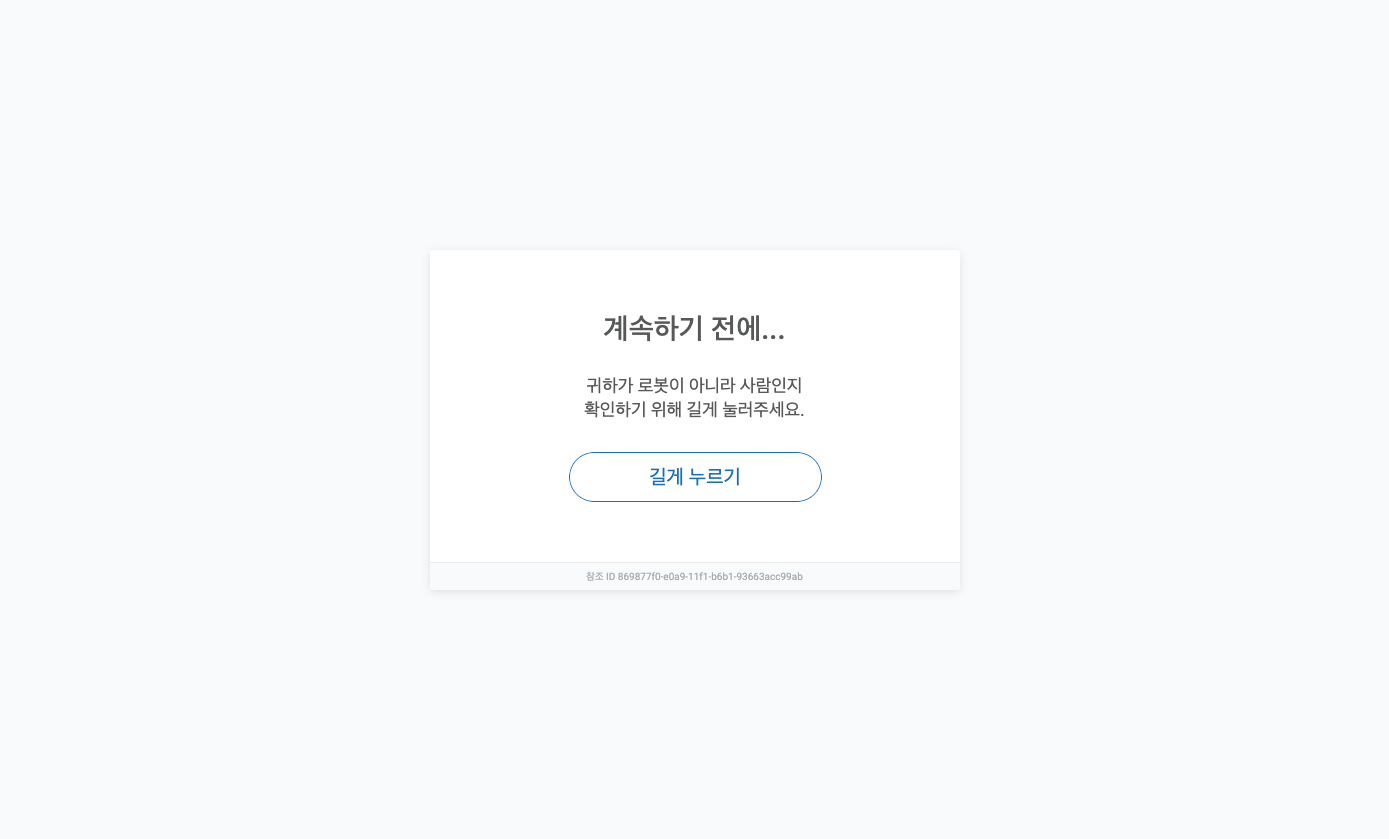
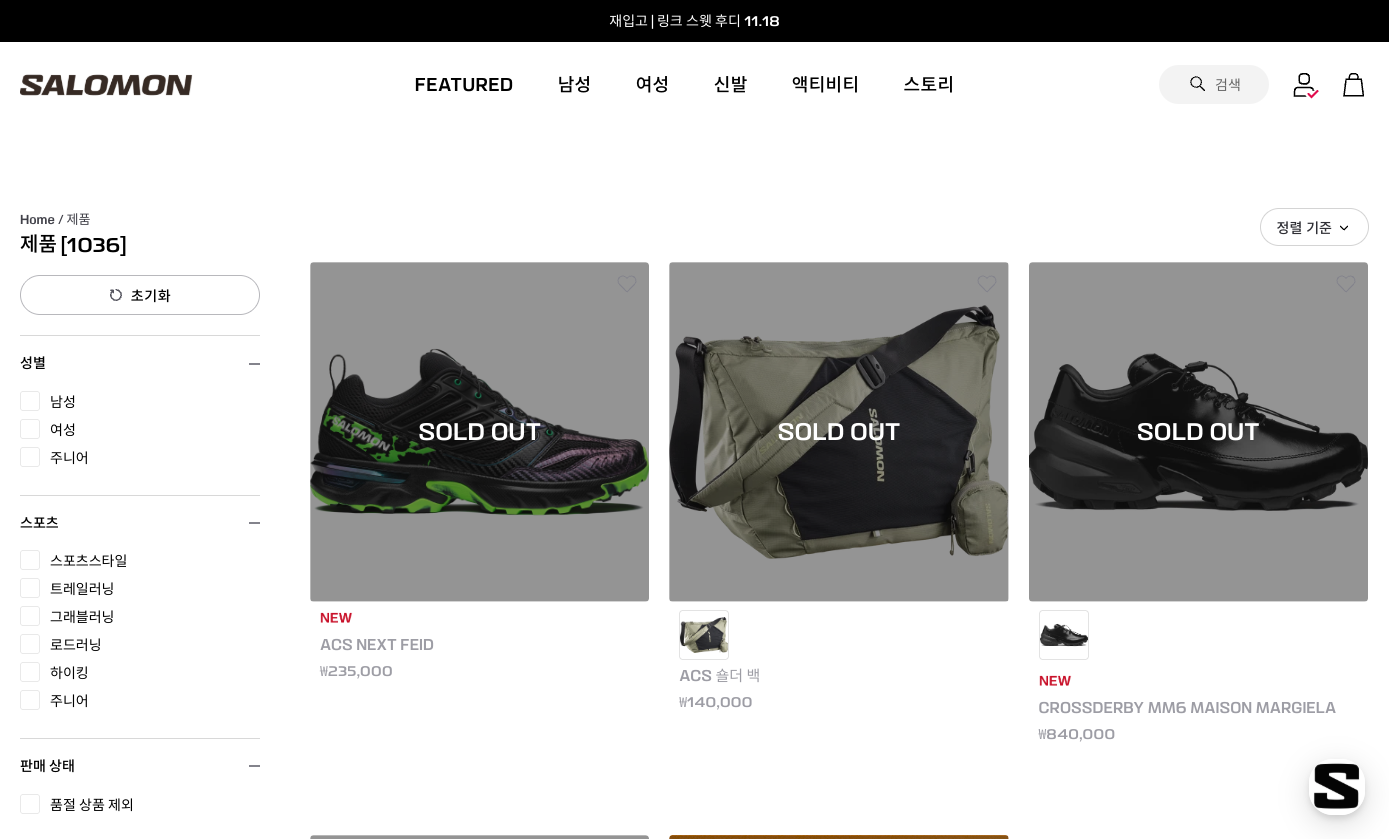
The same SKU’s US page (L41617400): a full-page PerimeterX challenge, every time we tried it.Salomon Korea’s full catalogue page — live, priced, and fully crawlable in the same session where every equivalent US path was blocked.
Salomon Korea’s homepage — operated directly by Amer Sports Korea, the brand’s own Korean subsidiary, not a third-party licensee.
AI citation snapshot: 10 real queries, Google AI Mode
We sent 10 verbatim queries to Google AI Mode (udm=50) and checked direct a[href] links, counting a citation only when either salomon.com or salomon.co.kr appeared.
bettertrail.com, reddit.com, runrepeat.com, hikingfeet.com, nytimes.com, trustpilot.com, mytheresa.com — reviewer and retailer sites, no brand domain
salomon vs hoka
❌ No
hikeheaven.com, mountaineerjourney.com, reddit.com, runningforthehills.com, runningshoesguru.com, yahoo.com — no Salomon or Hoka-owned domain, matching this series’ recurring pattern on brand-vs-brand queries
salomon return policy
✅ Yes
reddit.com — both salomon.com’s and salomon.co.kr’s own returns pages were cited directly alongside a Reddit discussion
amersports.com, frontofficesports.com, wikipedia.org, worseonpurpose.com — the ownership question is answered by Salomon’s own parent company’s site and third-party sources, but not by salomon.com or salomon.co.kr themselves, the same pattern we saw on FILA yesterday
how to clean salomon shoes
✅ Yes
reddit.com, hikingboots.blog, tiktok.com, a South African retailer domain — salomon.com’s own care-guide content was cited alongside these
salomon sizing guide
✅ Yes
a South African retailer domain, whentocop.com, reddit.com, tiktok.com — both salomon.com and salomon.co.kr cited together
runrepeat.com, packstack.io, livefortheoutdoors.com, treelinereview.com, fellrunningguide.co.uk, bettertrail.com, reddit.com, backpackers.com — the one query most directly about the exact product we tracked, and no Salomon domain of any kind surfaced
Result: a Salomon domain cited in 4/10 queries (Nike 5/10, Adidas 4/10, Puma 5/10, Under Armour 8/10, New Balance 6/10, ASICS 7/10, Skechers 4/10, Lululemon 8/10, Reebok 7/10, Converse 7/10, On Running 6/10, Hoka 5/10, Vans 8/10, The North Face 9/10, Columbia 7/10, FILA 2/10) — mid-to-low in the series, tied with Adidas and Skechers. All four hits were direct, informational queries (return policy, care instructions, sizing, country of manufacture) where a brand page was the most literal source; every comparison, “best of” and opinion query missed, and — notably — so did the one query naming the exact product we spent this audit tracking.
G-score audit: the 8-pillar hygiene checklist
We scored three measurable URLs with the same 8-pillar static-HTML checklist (JSON-LD present, FAQ content, visible date, author byline, concrete data points, table/list structure, 3+ subheadings, a 30-500 character early answer) used in our Week 17 quality-score experiment and on all sixteen prior brands. All four US targets — homepage, category, the tracked product page, and help — were attempted and excluded: every one returned a PerimeterX challenge page instead of real content.
Page
Fetch method
G-score
Notable pillars
KR homepage
Browser-rendered (200 OK)
0.5
Visible date signal, data points, list structure, 3+ subheadings; zero JSON-LD on the homepage template itself, no FAQ, no author
KR XA Pro 3D PDP (SKU L41617400)
Browser-rendered (200 OK)
0.625
One valid, parseable Product JSON-LD block with per-variant Offers (price, SKU, availability); no aggregateRating or review field anywhere in it despite the 4.9/236 rating shown on screen; no FAQ, no author
KR category — all products
Browser-rendered (200 OK)
0.5
Same pattern as the homepage — data points, list structure, subheadings; no JSON-LD, no FAQ, no author
US homepage / category / XA Pro 3D PDP / help
PerimeterX challenge, all four
n/a
Excluded from the average — there is only a bot-check page to evaluate, not real content. See the escalation note below.
Three-page average: 0.5417 (Nike: 0.4375, Puma: 0.354, Under Armour: 0.5208, New Balance: 0.5833, Adidas: 0.6458, ASICS: 0.4583, Reebok: 0.5417, Converse: 0.5208, On Running: 0.4583, Hoka: 0.6, Vans: 0.425, The North Face: 0.525, Columbia: 0.525, FILA: 0.525) — tied exactly with Reebok, mid-pack. The headline gap here isn’t between US and Korea (we have no US score to compare) — it’s inside the one page that did score well: the Korean PDP’s Product JSON-LD is valid and parses cleanly, but it carries no rating or review data at all, even though the page itself displays “4.9/5 (236)” directly above it.
An escalating captcha, a brand’s own subsidiary running clean Shopify infrastructure, and an ownership story that loops back to yesterday
The US homepage’s bot challenge escalated within a single audit session — Our first visit to salomon.com/en-us rendered the real, SSR’d homepage with a PerimeterX “press and hold” modal localized into Korean laid over it as a client-side overlay. Every later request to the identical URL in the same session instead returned a hard server-side block (<title>Access to this page has been denied</title>) before any homepage content loaded at all. We did not attempt to solve the challenge at any point. This is the second time in this series we’ve watched a brand’s bot defense escalate in real time mid-audit — the first was Lululemon in early November, a completely unrelated company on different infrastructure.
The captcha iframe trapped every click on the page, including on an unrelated popup’s own close button — While the PerimeterX overlay was active, we could not click the “X” on the separate geolocation popup sitting behind it; Playwright’s own error log confirmed the captcha’s iframe was “intercepting pointer events” across the full page. A visitor facing this screen has no way to dismiss any of the three stacked prompts without passing the bot check first.
salomon.co.kr runs the same Shopify “agent commerce” boilerplate we’ve now seen three times in this series — Its robots.txt points AI agents to an agents.md file, a UCP (Universal Commerce Protocol) discovery endpoint and a working MCP server address, nearly word-for-word the same template Shopify ships on every store that opts in — we saw the identical structure on FILA Korea and on Reebok’s Shopify migration earlier in this series. It’s platform-level infrastructure, not something Salomon built bespoke.
The Korean PDP’s on-screen rating never reaches its structured data — The page displays “4.9/5 (236)” directly under the product name, but the Product JSON-LD block — which does parse cleanly and does carry real per-variant Offers — has no aggregateRating or review field of any kind. A crawler reading only the structured data would have no way to know this product has reviews at all.
salomon.com’s robots.txt names no AI crawler at all, in either direction — Unlike brands in this series that explicitly welcome (New Balance, Vans) or explicitly block (Reebok Korea, Columbia Korea) crawlers like GPTBot or ClaudeBot by name, Salomon’s robots.txt is silent on the subject entirely — just a long list of generic scraping and SEO-tool bots blocked by name, none of them AI-specific.
Salomon is run in-house in Korea, and its ownership loops back to yesterday’s FILA audit through a different entity — salomon.co.kr is operated directly by Amer Sports Korea (business registration 120-81-57446, representative Kim Hun-do), Salomon’s own subsidiary, not a third-party licensee. Amer Sports itself has been majority-controlled since 2019 by a consortium led by China’s ANTA Sports. Note this is a different company than the one behind yesterday’s audit: FILA Holdings Corp in Seoul owns the global FILA trademark and runs fila.co.kr directly, while FILA China is a separate operation ANTA has owned since 2009 — and by ANTA’s own account, FILA China’s profits (it accounted for close to half of ANTA’s total profit between 2019 and 2021) were a major part of what funded and justified ANTA’s 2019 purchase of Amer Sports, Salomon’s parent. Two consecutive case studies, linked by real corporate history rather than a repeated “owned in Asia” narrative.
What works / What to verify
WHAT WORKS
Salomon Korea’s salomon.co.kr: a fully reachable, fast Shopify storefront with valid Product/Offer JSON-LD, a real llms.txt and agents.md, and a working UCP/MCP endpoint, operated directly by the brand’s own regional subsidiary rather than an outside licensee.
WHAT TO VERIFY
Whether salomon.com’s escalating PerimeterX challenge is a stable new default or a temporary response to flagged traffic from our session; whether the missing aggregateRating on the Korean PDP is a template-wide gap across the catalogue or isolated to this one product; and whether US shoppers without a VPN or unusual traffic pattern experience the same hard block we did.
Target query check — reported honestly, not inflated
We have not re-measured “salomon seo” or “salomon geo audit” query volume this session. Per the pattern already confirmed across sixteen earlier subjects in this series on October 20, 2026 (Keyword Planner, US) — the large majority showed no measurable search volume at all for “[brand] SEO/GEO audit” phrasing — we’re not claiming this title drives ranking-based traffic. The distribution case for this series rests on internal links, our own index, and readers already following the GEO Lab arc, not on search demand for “[brand] SEO audit” as a query.
Frequently asked questions
Is Salomon’s US captcha the same PerimeterX challenge we saw on Vans, The North Face and Columbia?
It presents the same style of ‘press and hold’ challenge and the same vendor branding in the page source, yes — but Salomon is not affiliated with VF Corporation (Vans and The North Face’s parent) or with Columbia Sportswear. This is now the fourth independent company in this series using the identical bot-check vendor, which supports a shared-vendor explanation over a shared-ownership one.
What does it mean that the challenge escalated mid-session?
Our first request to salomon.com/en-us returned the real homepage with a client-side challenge overlaid on top of it. Every later request to the exact same URL, in the same browser session, returned a hard server-side block page instead, before any real content loaded. We can’t confirm from the outside whether this reflects a traffic-pattern flag specific to our session or a site-wide tightening — only that we watched it happen, the same kind of live escalation we first documented on Lululemon.
Who owns Salomon, and is that the same FILA we covered yesterday?
Salomon’s parent, Amer Sports, has been majority-controlled since 2019 by a consortium led by China’s ANTA Sports. ANTA also owns FILA China, a separate business from FILA Holdings Corp in Seoul (yesterday’s audit subject), which holds the global FILA trademark. The two are genuinely connected: FILA China’s profits were a major contributor to funding ANTA’s 2019 Amer Sports purchase — a real corporate link, not a coincidence of two brands both having Asian ownership.
Does Salomon Korea’s cleaner schema and UCP/MCP setup mean it gets cited more by AI than other brands in this series?
No — consistent with sixteen prior audits. Salomon’s overall AI citation rate (4/10) sits below several brands with messier or entirely absent schema, including Vans (8/10) and The North Face (9/10), both of which were also behind PerimeterX walls for most of their US pages. Our Week 17 experiment already found hygiene and technical-structure scores were not a dependable predictor of AI citation, and this audit doesn’t change that conclusion.
Audit evidence, scope and limits
Inspected: November 2026, public logged-out access from a Korea-based IP (real headed-browser session used for screenshots, G-score rendering and citation testing; plain HTTP fetches used curl with a standard desktop user agent). Screens: the US homepage (PerimeterX overlay, then hard block on repeat visits), the trail-running-shoes category, the XA Pro 3D product page (SKU L41617400, blocked) and help/support (all blocked) — plus the Salomon Korea homepage, its llms.txt and robots.txt, the matching Korean XA Pro 3D page (same SKU), a full catalogue page, a 10-query Google AI Mode citation snapshot, and an 8-pillar G-score scored on three measurable Korean pages (all four US targets were attempted and excluded as bot-blocked).
Not measured: rankings, Search Console performance, analytics, conversion, signed-in/member flows, ChatGPT citations (not attempted, given the composer failures flagged on earlier audits in this series), whether salomon.co.kr’s UCP/MCP endpoint actually responds to a live agent request, whether the US challenge escalation is permanent or session-specific, or the complete product/locale catalogue beyond the one SKU and eight URLs sampled here. This is a public-signal snapshot, not a performance claim or a full-catalogue crawl.
This is part 17 of a daily series. Every day, GeoParrot runs this same evidence-first method — real screenshots, a 10-query AI citation snapshot, an 8-pillar G-score audit, and an honest target-query check — against one more major sports and athletic-wear brand. Next: Decathlon.


Leave a Reply