Evidence-first case study · sports brand SEO + GEO series, part 13 of 20
Vans is the first brand in this series where our standard, real-browser evidence-gathering method itself hit an explicit captcha — a PerimeterX “Press & Hold” human-verification challenge on the homepage, category page, product page and support page alike. We did not attempt to solve it. Separately, Vans Korea runs on a completely different platform at vans.co.kr — fully open to plain HTTP requests, and its robots.txt explicitly names and allows GPTBot, ChatGPT-User, Google-Extended, anthropic-ai, ClaudeBot and PerplexityBot by name. Yet across every Korean-site page we checked — home, category, the Old Skool product page, even the FAQ center — we found zero JSON-LD structured data. Despite the US-side block, Google AI Mode still cited vans.com or vans.co.kr in 8 of our 10 test queries, tied for the highest rate in this series so far.
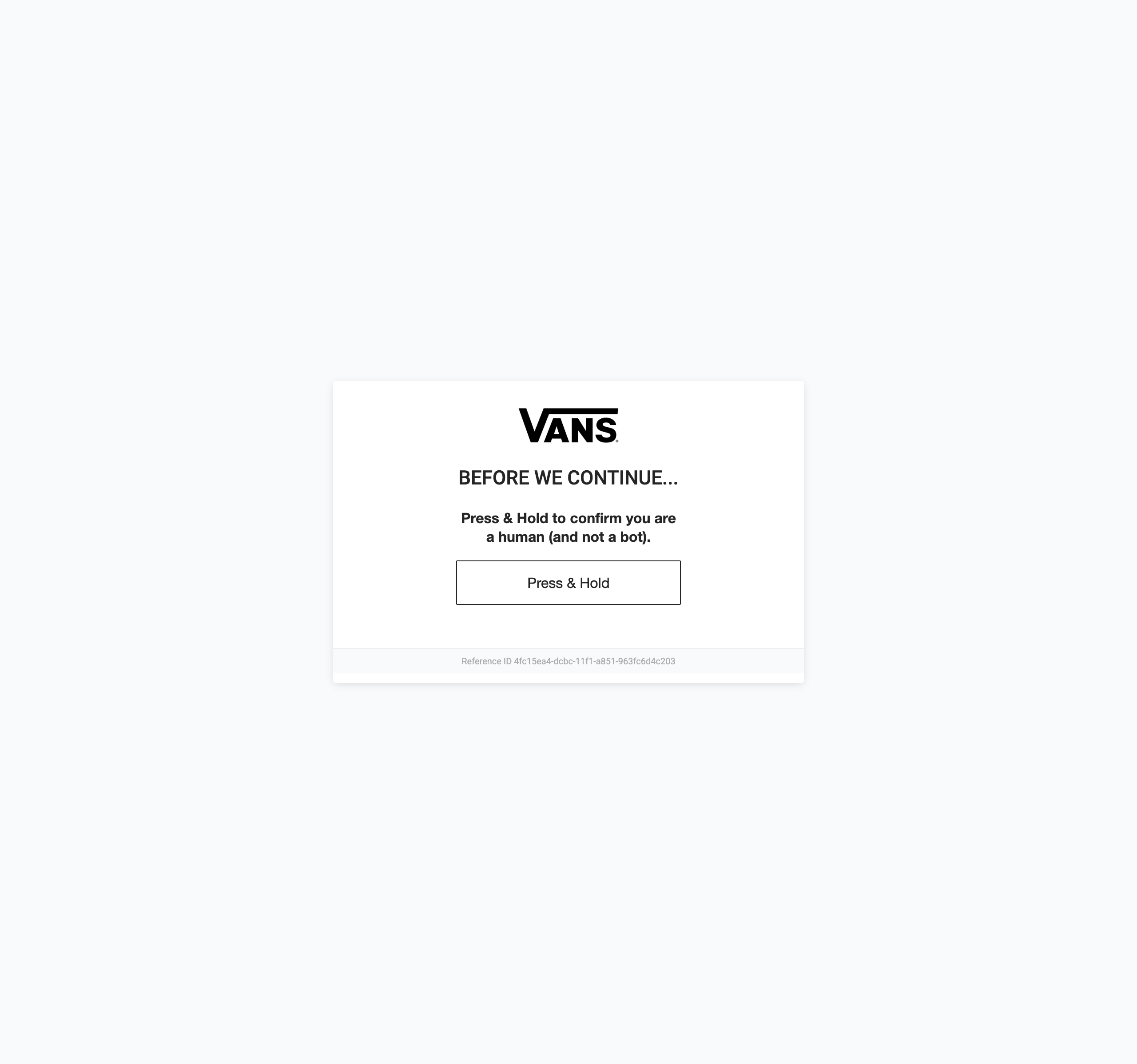
Requesting the US Men’s Shoes category page in a real, headed browser: an interactive “Press & Hold” captcha, not a static block page.
What is Vans trying to do — and why audit it thirteenth?
This is part 13 of GeoParrot’s sports-brand series, running the same evidence-first method we used on Hoka, On Running and eleven other major brands. Vans is a Southern California skate and street-culture shoe company, now owned by VF Corporation, best known for the checkerboard pattern and silhouettes like the Old Skool, Sk8-Hi and Authentic. It earns the thirteenth slot for a reason none of the first twelve brands produced: every US storefront page we targeted returned a genuine, interactive bot-verification captcha to our real browser session — not an “Access Denied” message, not a redirect, an actual “press and hold” gesture check.
Brand category Skate and street-culture footwear and apparel company, founded 1966 in Anaheim, California, now owned by VF Corporation (which also owns The North Face and Timberland).
Primary user job Find and buy a classic silhouette — Old Skool, Sk8-Hi, Authentic — in the right size and colorway, with confidence it’s an authentic retail price rather than a resale markup.
SEO + GEO challenge A real, headed browser session consistently serving an interactive PerimeterX challenge on every storefront page type, a Korean storefront that explicitly welcomes AI crawlers by name but ships zero structured data, and a sitemap.xml that is itself challenge-gated.
The product we tracked: Old Skool (style VN000D3HY28)
We used the Old Skool — Vans’ best-known silhouette — as the tracked product across both storefronts. The US product page, at the exact same URL pattern we used successfully on eleven prior brands, returned the Press & Hold challenge every time we requested it in our headed browser session; we were only able to capture it on Vans Korea’s separate platform.
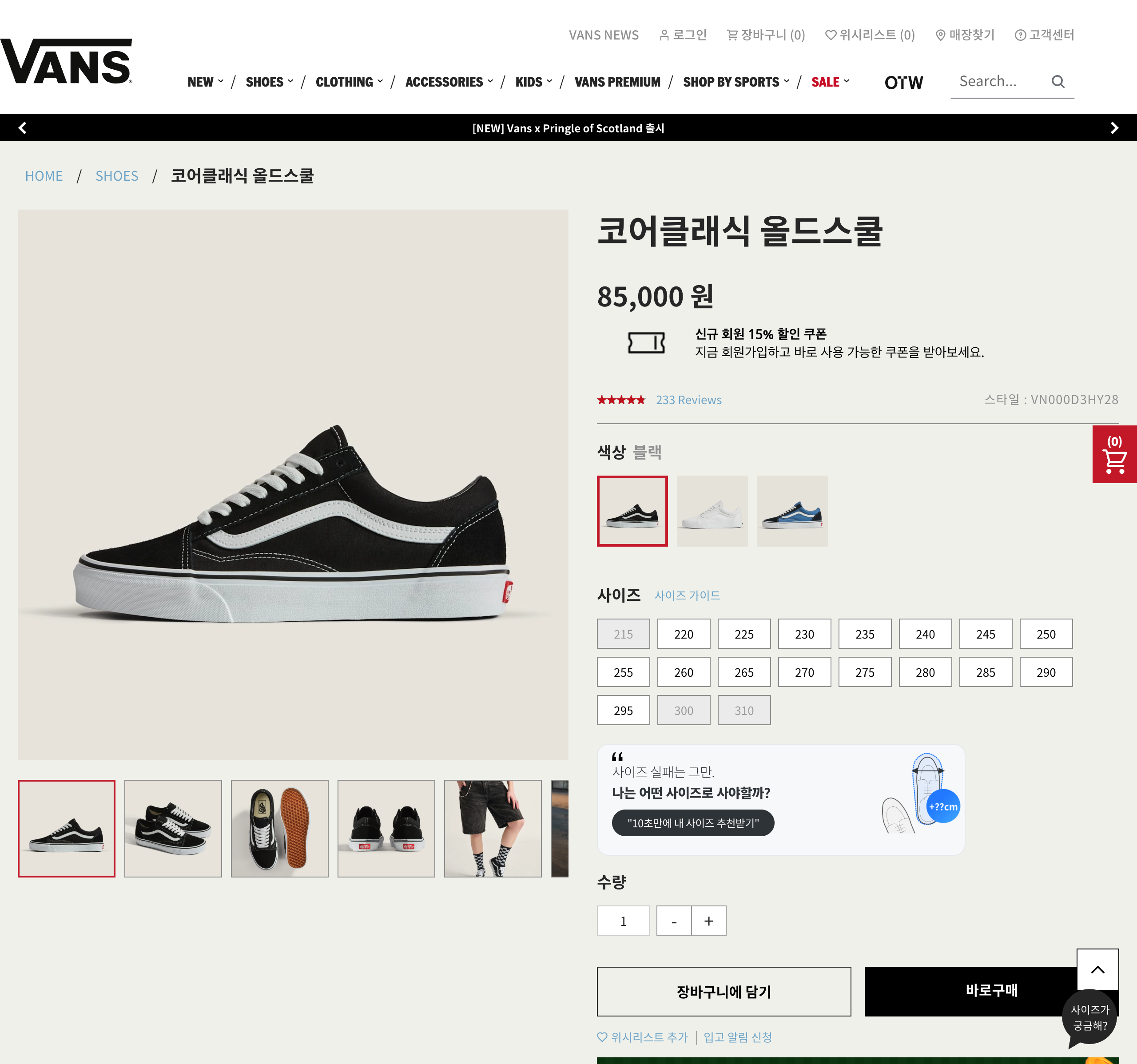
The Old Skool on vans.co.kr, same style code VN000D3HY28 as the US SKU: 85,000 won, 5-star average across 233 reviews — but see the G-score section below for why this page scores low on structured data.
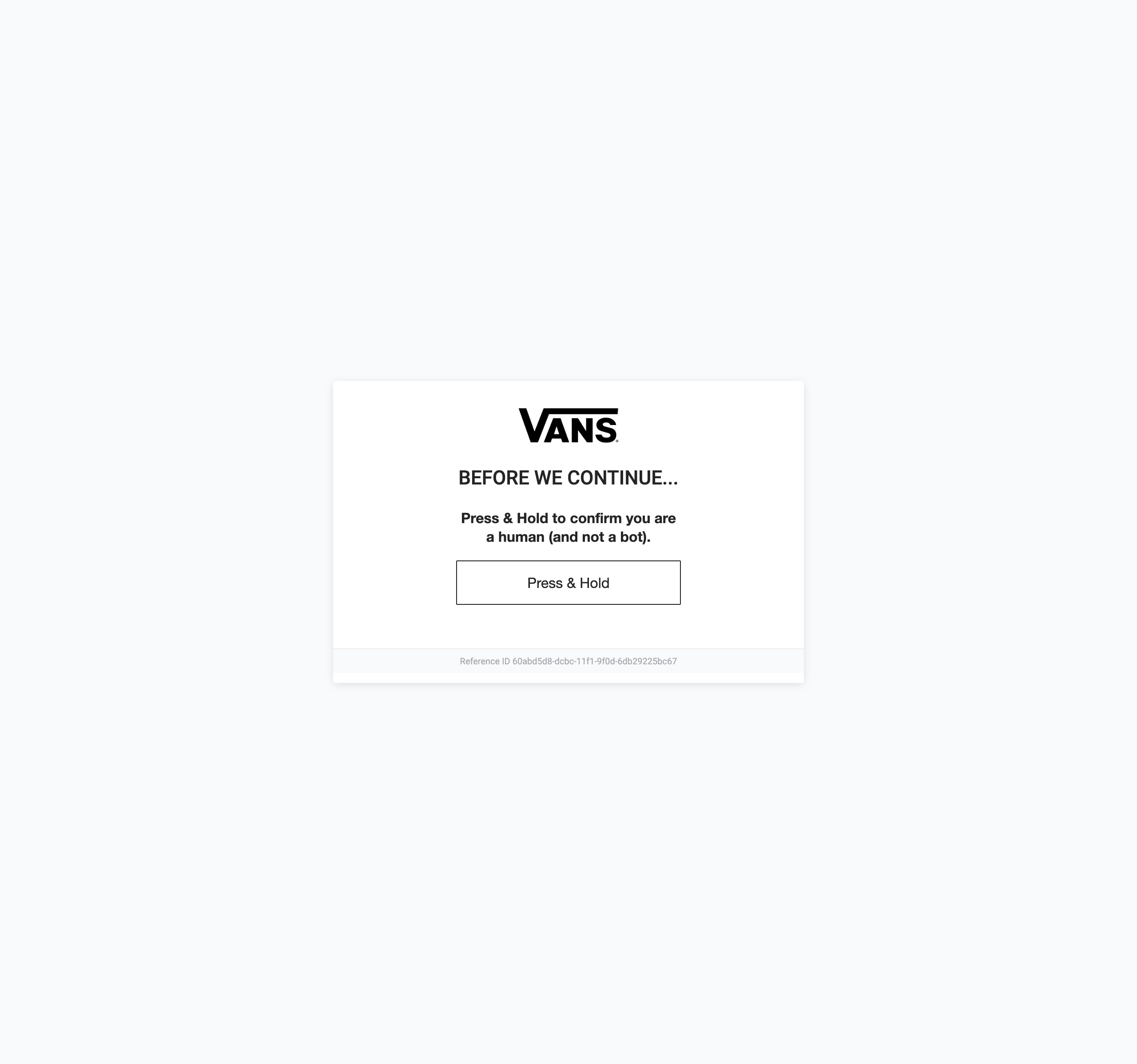
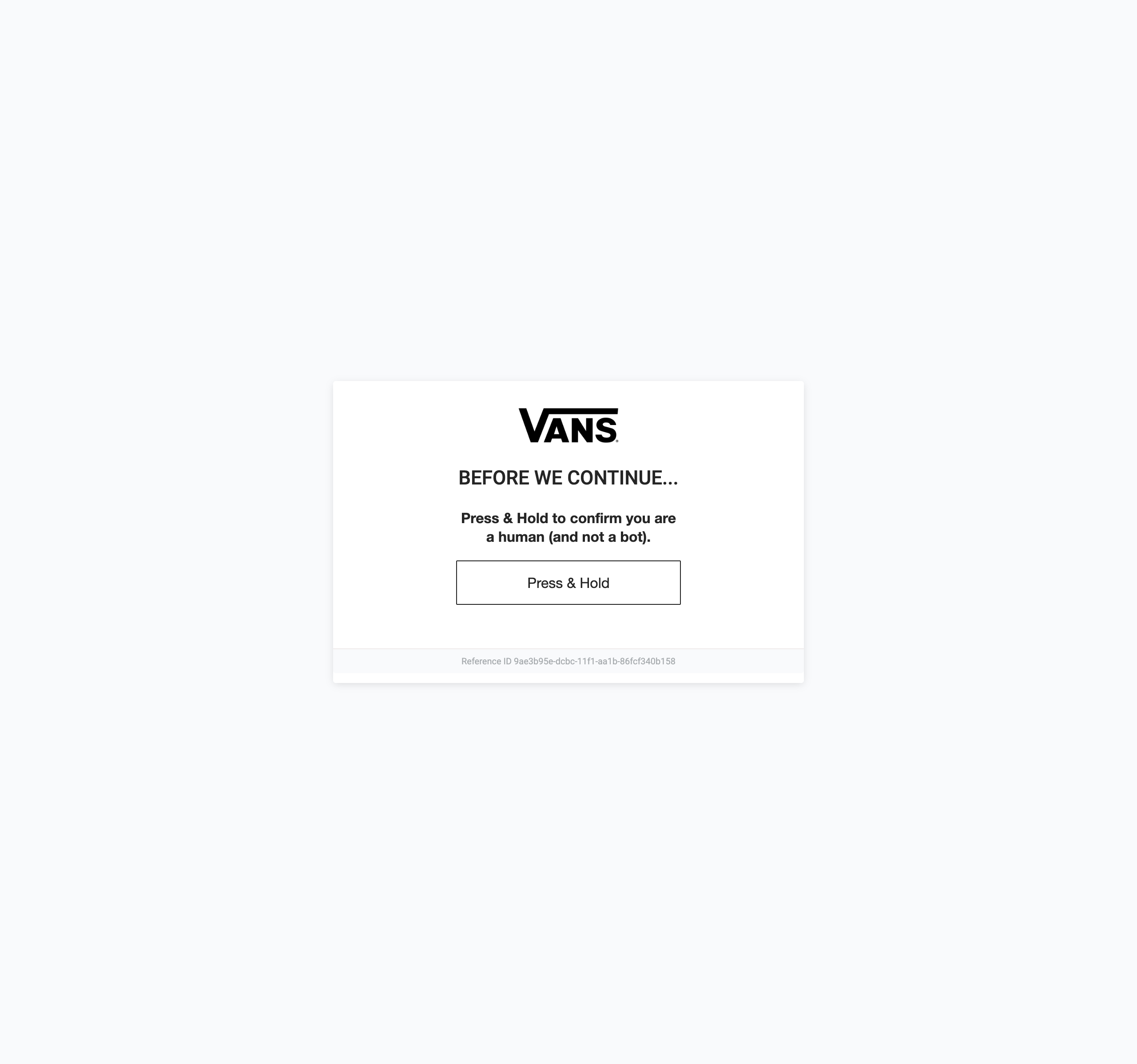
The US Old Skool product page URL: the same challenge, not the product.The US Customer Service / Support page: the same challenge again.
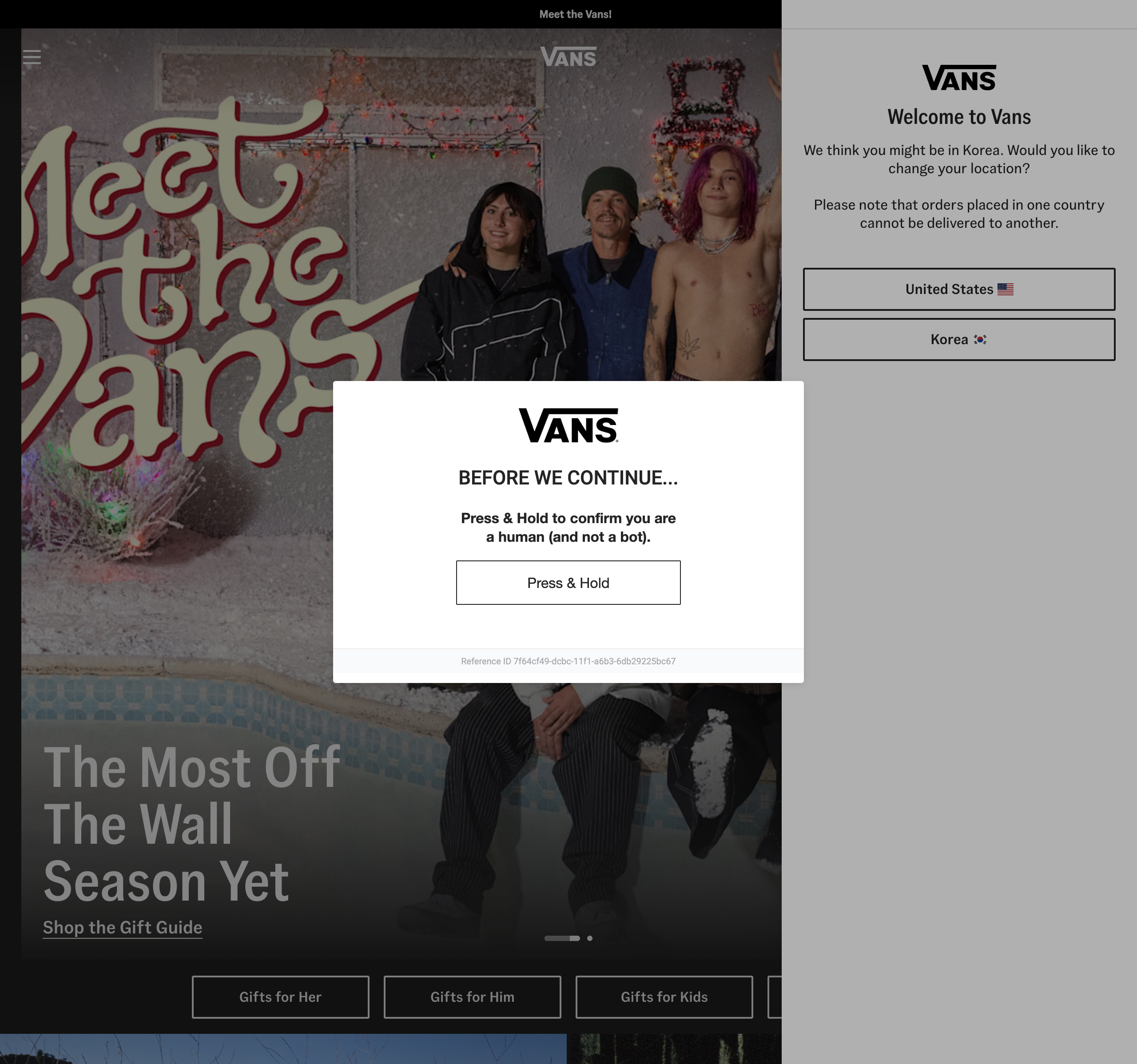
The homepage was the one US page where real content rendered behind the overlay — including a geolocation prompt asking us to choose “United States” or “Korea,” stacked under the same Press & Hold box. We closed neither; both remained a block to a clean capture.
AI citation snapshot: 10 real queries, Google AI Mode
We sent 10 verbatim queries to Google AI Mode (udm=50) and checked direct a[href] links, counting a citation when either vans.com or vans.co.kr (any Vans-owned registrable domain) appeared.
Query
Vans domain cited?
Who else showed up
vans old skool review
❌ No
runrepeat.com, tactics.com, zappos.com — continuing this series’ pattern of named-product review queries rarely citing the brand’s own domain
are vans good for skateboarding
✅ Yes
aa1982.com, reddit.com, facebook.com, quora.com, skatewarehouse.com, tactics.com — vans.com cited alongside forums and a third-party skate shop
vans vs converse
✅ Yes
reddit.com, vans.co.kr, naver.com — both vans.com and vans.co.kr appeared in the same result, alongside a Korean blog and forum
vans shoes return policy
✅ Yes
vans.com.au, reddit.com — vans.com cited alongside its own Australian storefront and a forum thread
best vans shoes for wide feet
✅ Yes
rotationdept.com, reddit.com, tiktok.com — cited alongside a reseller and social sources
vans old skool vs sk8-hi
✅ Yes
vans.co.kr, reddit.com, naver.com — the Korean storefront cited directly for this line-comparison query, with vans.com also appearing
who owns vans shoes
❌ No
wikipedia.org — the correct answer (VF Corporation) is publicly verifiable, but no Vans-owned domain surfaced
how to clean vans shoes
✅ Yes
reddit.com, facebook.com — vans.com’s own care guidance cited directly
vans sizing guide
✅ Yes
runrepeat.com, insport.com.au, fascinate-online.com, footshop.eu, reddit.com, opumo.com, empireskate.co.nz, soleretriever.com — vans.com cited in a crowded field of retailers and buying guides
vans shoes made in what country
✅ Yes
facebook.com, arcgis.com, wikipedia.org, wearablyweird.com — vans.com cited alongside a mix of reference and social sources
Result: a Vans domain cited in 8/10 queries (Nike 5/10, Adidas 4/10, Puma 5/10, Under Armour 8/10, New Balance 6/10, ASICS 7/10, Skechers 4/10, Lululemon 8/10, Reebok 7/10, Converse 7/10, On Running 6/10, Hoka 5/10) — tied with Under Armour and Lululemon for the highest rate measured in this series so far. As in most prior audits, the single named-product review query (“vans old skool review”) and the ownership-fact query (“who owns vans shoes”) were the two misses — a pattern now consistent across nearly every brand in this series regardless of how blocked or open the brand’s own site is to plain crawling.
G-score audit: the 8-pillar hygiene checklist
We scored five measurable URLs with the same 8-pillar static-HTML checklist (JSON-LD present, FAQ content, visible date, author byline, concrete data points, table/list structure, 3+ subheadings, a 30-500 character early answer) used in our Week 17 quality-score experiment and on all twelve prior brands. Three more US pages were attempted and excluded: the Men’s Shoes category, the Old Skool PDP and the Customer Service page all returned the Press & Hold challenge instead of page content, in our real headed-browser session, every time we tried.
Page
Fetch method
G-score
Notable pillars
US homepage
Browser-rendered (behind challenge overlay)
0.625
1 JSON-LD block; has a visible date and data points; no FAQ, no author
KR homepage
Plain fetch (200 OK)
0.375
0 JSON-LD blocks, no visible date, no author
KR Old Skool PDP (VN000D3HY28)
Plain fetch (200 OK)
0.375
0 JSON-LD blocks despite a live price, 233 reviews and a star rating all visible on-page
KR Men’s Classic category
Plain fetch (200 OK)
0.5
Has a visible date and 3+ subheadings; no JSON-LD
KR Customer Service FAQ center
Plain fetch (200 OK)
0.25
Only 6,149 characters of plain text despite being the FAQ hub — likely JS-rendered content a static fetch can’t see; no FAQPage schema, no JSON-LD
US Men’s Shoes category / Old Skool PDP / Customer Service
Browser-rendered — blocked
n/a
All three returned the Press & Hold challenge instead of page content on every attempt; excluded from the average rather than scored as 0
Five-page average: 0.425 (Nike: 0.4375, Puma: 0.354, Under Armour: 0.5208, New Balance: 0.5833, Adidas: 0.6458, ASICS: 0.4583, Reebok: 0.5417, Converse: 0.5208, On Running: 0.4583, Hoka: 0.6) — the second-lowest full-page average measured in this series so far, ahead of only Puma. Every Korean-site page we scored came back with zero JSON-LD blocks, including the product page carrying a live price and 233 visible reviews.
A captcha-gated US site, and a Korean site that welcomes AI crawlers by name but ships no schema
Every US storefront page type challenges our real browser session — The homepage, Men’s Shoes category, Old Skool product page and Customer Service page all returned an interactive PerimeterX “Press & Hold” verification — not a static “Access Denied” message like some brands in this series, an actual human-gesture captcha. This is the first brand in thirteen audits where our standard headed-browser evidence method hit this, rather than a silent block or JS challenge page a browser can render past.
sitemap.xml and sitemap_index.xml are also challenge-gated — Both URLs returned the same Press & Hold page in our headed browser, meaning URL discovery via sitemap hits the identical wall as requesting a page directly.
robots.txt is readable (via browser, not via plain curl) and names no AI crawler — A standard VF Corp template disallowing cart, checkout, search, sort and filter parameters for User-agent: *, plus an explicit full disallow for AmazonProductDiscoverybot. No AI crawler (GPTBot, ClaudeBot, PerplexityBot, Google-Extended) is named anywhere, positive or negative.
llms.txt is a clean, ordinary 404 — Unlike some brands in this series where llms.txt resolves to a repurposed generic error template, Vans’ llms.txt path serves the site’s standard “404 – NOT FOUND” page with its normal navigation and footer intact. There’s no llms.txt, but at least the 404 is a real 404.
Vans Korea explicitly welcomes six named AI crawlers — vans.co.kr’s robots.txt lists GPTBot, ChatGPT-User, Google-Extended, anthropic-ai, ClaudeBot and PerplexityBot by name under Allow: /, alongside Naver, Daum and Zum’s Korean crawlers — one of the more explicit AI-crawler welcomes we’ve seen in this series.
…but ships zero JSON-LD anywhere we checked on that same Korean site — Home, category, the Old Skool product page (with a live price, star rating and 233 reviews all visible in the rendered HTML) and the FAQ center all came back with 0 JSON-LD blocks in a plain fetch. The welcome mat is explicit; there’s nothing structured laid out on it.
What works / What to verify
WHAT WORKS
An explicit, named AI-crawler allowlist on the Korean robots.txt (rare in this series), a clean standard 404 at the llms.txt path rather than a confusing error shell, and an 8/10 AI citation rate tied for the best we’ve measured across thirteen brands.
WHAT TO VERIFY
Whether the Press & Hold challenge on every US storefront page type also catches Google’s and other major AI engines’ retrieval infrastructure the way it caught our browser, why the Korean site’s FAQ center returns so little plain-fetchable text relative to its purpose, and why a product page with a live price and 233 reviews carries no Product, Offer or AggregateRating schema at all.
Target query check — reported honestly, not inflated
We have not re-measured “vans seo” or “vans geo audit” query volume this session. Per the pattern already confirmed across twelve earlier subjects in this series on October 20, 2026 (Keyword Planner, US) — the large majority showed no measurable search volume at all for “[brand] SEO/GEO audit” phrasing — we’re not claiming this title drives ranking-based traffic. The distribution case for this series rests on internal links, our own index, and readers already following the GEO Lab arc, not on search demand for “[brand] SEO audit” as a query.
Frequently asked questions
Why couldn’t you get a real screenshot of the Vans US product or category page?
Every attempt, across every US page type we tried (homepage, category, product, customer service), returned an interactive PerimeterX “Press & Hold” verification challenge in our standard headed-browser session instead of page content. We did not attempt to solve it; this audit reports and shows the challenge screen itself as the finding, rather than working around it.
Is Vans Korea the same website as the US Vans site?
No. vans.co.kr runs on an entirely separate platform from vans.com — different URL structure (/PRODUCT/<style-code> rather than /catalog/<style-code>), different sitemap format, and it’s fully accessible via a plain, non-browser HTTP request where the US site is not.
Does Vans Korea’s robots.txt actually name AI crawlers like GPTBot and ClaudeBot?
Yes. Its robots.txt lists GPTBot, ChatGPT-User, Google-Extended, anthropic-ai, ClaudeBot and PerplexityBot by name, all under an explicit Allow: / alongside Googlebot, Bingbot and several Korean search crawlers. It’s one of the more explicit AI-crawler allowlists we’ve seen in this series — though, as the G-score section shows, there’s no structured data on the pages those crawlers would be allowed to read.
Does an 8/10 AI citation rate mean Vans’ US-side blocking doesn’t matter for AI visibility?
Not reliably — this audit is itself a data point against that conclusion, consistent with twelve prior brands in this series. Our Week 17 experiment found hygiene and technical-structure scores were not a dependable predictor of AI citation, and here a brand with a near-complete block on real-browser access to its own storefront pages still tied for the highest citation rate we’ve measured. A likely explanation is that Google’s own crawling and retrieval infrastructure isn’t subject to the same interactive challenge that stopped our browser — but our 10-query snapshot measures the domain family, not individual URL citation, so we can’t confirm that specific mechanism from this data alone.
Audit evidence, scope and limits
Inspected: November 2026, public logged-out access from a Korea-based IP (real headed-browser session used for screenshots, G-score rendering and citation testing; plain HTTP fetches used urllib with a standard desktop user agent). Screens: the US homepage, Men’s Shoes category, Old Skool product page and Customer Service (all challenge-gated), llms.txt, plus the Vans Korea homepage and the same Old Skool product on vans.co.kr — plus robots.txt (both domains), sitemap.xml/sitemap_index.xml checks, a 10-query Google AI Mode citation snapshot, and an 8-pillar G-score scored on five measurable target pages (three more US pages were attempted and excluded as challenge-gated).
Not measured: rankings, Search Console performance, analytics, conversion, signed-in/member flows, ChatGPT citations (not attempted, given the composer failures flagged on earlier audits in this series), whether the Press & Hold challenge is triggered by our specific IP/request pattern versus all automated traffic generally, or the complete product/locale catalogue beyond the one shoe line and seven URLs sampled here. We did not attempt to solve the Press & Hold challenge at any point. This is a public-signal snapshot, not a performance claim or a full-catalogue crawl.
This is part 13 of a daily series. Every day, GeoParrot runs this same evidence-first method — real screenshots, a 10-query AI citation snapshot, an 8-pillar G-score audit, and an honest target-query check — against one more major sports and athletic-wear brand. Next: The North Face.




Leave a Reply