Quick answer: On November 6, 2026, ecommerce analyst Juozas Kaziukėnas posted a LinkedIn screenshot of a “Claim your business in ChatGPT” banner — a feature he says he first saw early signs of back in August. OpenAI hasn’t announced it, priced it, or dated a launch. What the leaked walkthrough shows is narrow: businesses verify ownership (e.g., by connecting a Shopify store), then see a daily chart of two numbers — impressions (how often they’re mentioned in ChatGPT responses) and clicks (to their website). Explicitly absent: prompt-level data, user data, and any competitive benchmark or ranking. Press is already calling this “ChatGPT’s Search Console,” but it ships less diagnostic detail than that name implies — and it arrives three months after ChatGPT Ads crossed a $1 billion annualized run rate, which is the more useful fact for guessing what it’s actually for.
Trend watch — published November 8, 2026, in the GEO Lab. The tool everyone’s wanted since AI answers started eating clicks just surfaced in a leaked screenshot, unconfirmed by OpenAI. We checked exactly what it shows, what it doesn’t, and what that gap tells you.
What actually leaked, and when?
Juozas Kaziukėnas, who runs the ecommerce-analytics newsletter Marketplace Pulse, shared a screenshot on LinkedIn on November 6 showing a “Claim your business in ChatGPT” banner inside the ChatGPT product. His own framing: “The feature is a work in progress and I saw its first steps as early as August. It seems to be getting close to launch because today I saw this banner.” That’s the entire evidentiary basis for this story — one analyst’s screenshot, no OpenAI blog post, no press release, no pricing page. Search Engine Roundtable and a handful of SEO outlets picked it up the same day. OpenAI has made no statement confirming the feature exists, what it will be called at launch, or when (or whether) it ships broadly.
What does the dashboard actually show?
Based on the leaked walkthrough, claiming a business requires verifying ownership — connecting a Shopify store is the example cited — after which you get three things: a chart of daily impressions (the count of times your business was mentioned or surfaced in a ChatGPT conversation), a parallel count of clicks to your website, and tools to keep your business information current and feed a “business agent” that answers customer questions with context you control. That’s meaningfully more than nothing — right now there is no official, OpenAI-sourced way to know how often ChatGPT mentions your business at all. But three things a real diagnostic tool would include are explicitly not there in what’s leaked so far: no prompt-level data (which queries triggered the mention), no user data, and no competitive benchmark or ranking against other businesses in the same category.
Is this actually a “Search Console,” or something else?
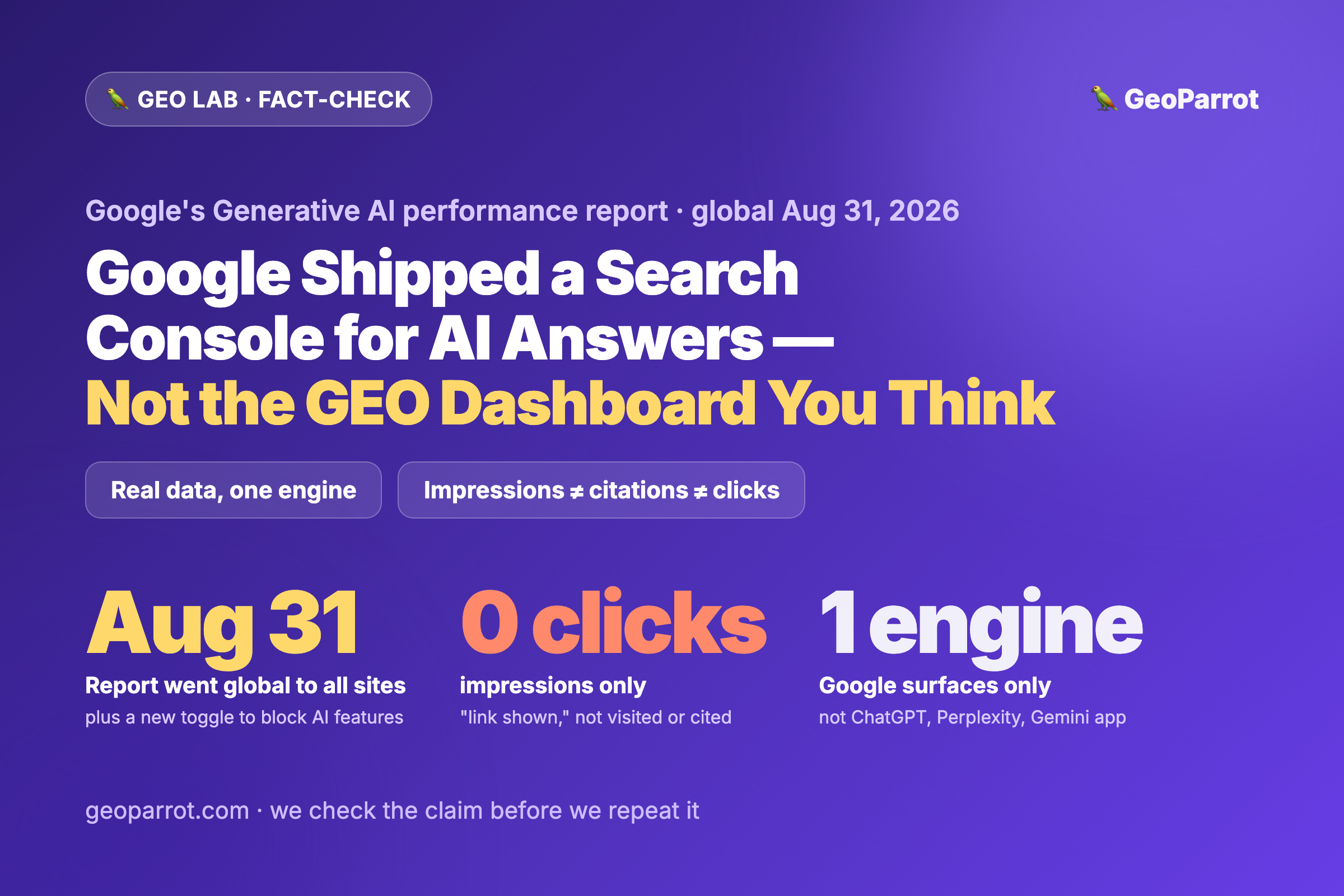
It’s a fair nickname for the shape of the UI — a dashboard, a chart, a verified-property model — but it undersells what Google Search Console gives you even in its AI-specific report. When Google’s own Generative AI performance report went global on August 31, 2026, it shipped impressions only, explicitly no clicks, and covered Google’s AI surfaces alone. The leaked ChatGPT tool would actually beat that on one axis — it adds clicks, which Google and Bing both withhold from their own AI reporting. One analysis published the same day as the leak, from Aaron’s Newsletter, reads that choice as strategic rather than generous: “Search Console is free. It shows you where you rank, gets you hooked on the numbers and, sooner or later, sends you to Google Ads.” The same piece lines up the timeline — ChatGPT Ads launched in February 2026, a self-serve Ads Manager opened in May, and OpenAI disclosed a $1 billion annualized ad run rate by August — and predicts that within a year, this free dashboard sits next to a “Reach more customers” button. Showing clicks, in that reading, isn’t a diagnostic feature; it’s proof ChatGPT is “a real traffic source,” which is exactly the claim that makes a business buy ads on it.
Why does the missing data matter more than the dashboard itself?
Because it’s the same gap we keep finding whenever a platform ships its own AI-visibility number. We’ve already shown that Google’s own “position” metric for AI surfaces isn’t a rank you can move — every link inside an AI Overview block gets the position of the whole block, not its own spot. We’ve also laid out the counted-vs-inferred distinction for exactly this situation: an impression count a platform discloses about itself is counted, but “why you got mentioned” and “how you rank against competitors” are the inferred questions that actually drive strategy, and no vendor dashboard — OpenAI’s included — is positioned to answer them for free. When we ran our own controlled test of whether AI Overview citations follow organic rank, 100% of the citations we could rank-match sat in the organic top 10 — a finding we only got by running the experiment ourselves, because no platform dashboard reports citation-to-rank attribution. A tool that shows impressions and clicks but not prompts or competitors will tell you traffic moved. It won’t tell you why, and it won’t tell you if a competitor is capturing the mentions you’re not.
What to actually do with this right now
Don’t build a Q1 plan around an unconfirmed, unpriced, undated feature. This is one analyst’s screenshot. OpenAI could ship it broadly next month, gate it behind the $200/month Max-style tier, or quietly shelve it.
If it does ship, claim your business the first week it’s available. We’ve seen this pattern before — early registration in platform-run programs (Google’s AI Contribution pilot, Connected Apps Platform’s waitlist) has consistently rewarded whoever shows up first, even when the selection mechanism stays opaque.
Keep your own first-party tracking regardless. Impressions-and-clicks from OpenAI, if it ships, is a second data point to triangulate against — not a replacement for AI-referral tracking in your own analytics, which is the only “counted” number you fully control.
Watch for the ads upsell, not just the launch announcement. If the free dashboard appears alongside or shortly before an ads pitch, that confirms the funnel reading; if OpenAI ships it with no ads cross-sell for an extended period, that’s evidence against it.
Frequently asked questions
Did OpenAI officially announce a Search Console for ChatGPT?
No. The only evidence is a screenshot ecommerce analyst Juozas Kaziukėnas posted to LinkedIn on November 6, 2026, showing a “Claim your business in ChatGPT” banner. OpenAI has not confirmed the feature, named it officially, priced it, or set a launch date.
What does the leaked tool actually show businesses?
After verifying ownership of a business (connecting a Shopify store is the example shown), the dashboard displays a daily chart of impressions (how often the business is mentioned in ChatGPT responses) and clicks (to the business’s website), plus tools to keep business information current for a business agent that answers customer questions.
Is it really comparable to Google Search Console?
Only loosely. It adds one thing Google’s own AI report in Search Console withholds — clicks — but it’s missing prompt-level data, user data, and any competitive benchmark or ranking, which the leaked walkthrough shows are explicitly absent. Google’s AI-specific report has the same gaps in reverse: impressions only, no clicks, Google surfaces only.
Why would OpenAI give this away for free?
One widely-read analysis published the same day as the leak argues it follows Google’s own playbook: a free dashboard that proves a platform drives real traffic, builds advertiser confidence in the numbers, and sets up a later upsell into paid ads. ChatGPT Ads launched in February 2026, opened self-serve in May, and reportedly hit a $1 billion annualized run rate by August 2026 — three months before this dashboard surfaced.
Should GEO practitioners change their measurement approach now?
Not yet. Treat this as a feature to watch, not a tool to plan around — it isn’t live, confirmed, or priced. Keep relying on your own first-party AI-referral tracking and controlled experiments, which remain the only citation data you can fully audit, regardless of what any single platform decides to disclose about itself.


Leave a Reply