Evidence-first case study · sports brand SEO + GEO series, part 8 of 20
Lululemon was cited in 8 of 10 Google AI Mode queries — tied with Under Armour for the highest rate in this series — yet its US commerce site (shop.lululemon.com) has zero JSON-LD structured data on its Align Pant product page, and scrolling to the reviews section triggered a raw Akamai bot-defense error that replaced the entire page body mid-audit. Meanwhile the separate Korea storefront, running on an entirely different e-commerce platform, carries full Product and AggregateRating schema (4.92 stars, 165 reviews) that the US flagship site doesn’t have.
Actual public homepage captured during this audit, November 4, 2026.
What is Lululemon.com trying to do — and why audit it eighth?
This is part 8 of GeoParrot’s sports-brand series, running the same evidence-first method we used on Skechers, ASICS, New Balance, Under Armour, Puma, Adidas and Nike. Lululemon is a useful eighth name because it isn’t a traditional “sports brand” in the Nike/Adidas sense — it’s a premium athleisure retailer whose entire positioning rests on product quality and community, which makes its technical SEO/GEO hygiene (or lack of it) a sharper test of whether brand strength alone can carry AI citation.
Brand category Vancouver-based premium athleisure brand built on proprietary fabrics (Luon, Nulu, Everlux) and its signature Align legging line, sold direct-to-consumer with minimal discounting outside “We Made Too Much.”
Primary user job Find the right Align style/length/fit, compare US vs local pricing and sizing, and get order/return support.
SEO + GEO challenge A high AI-citation rate that appears to run almost entirely on brand reputation and third-party content (Reddit, review sites), not on the US site’s own structured data — which is effectively absent on the product page we tracked.
The product we tracked: Align No-Line High-Rise Pant
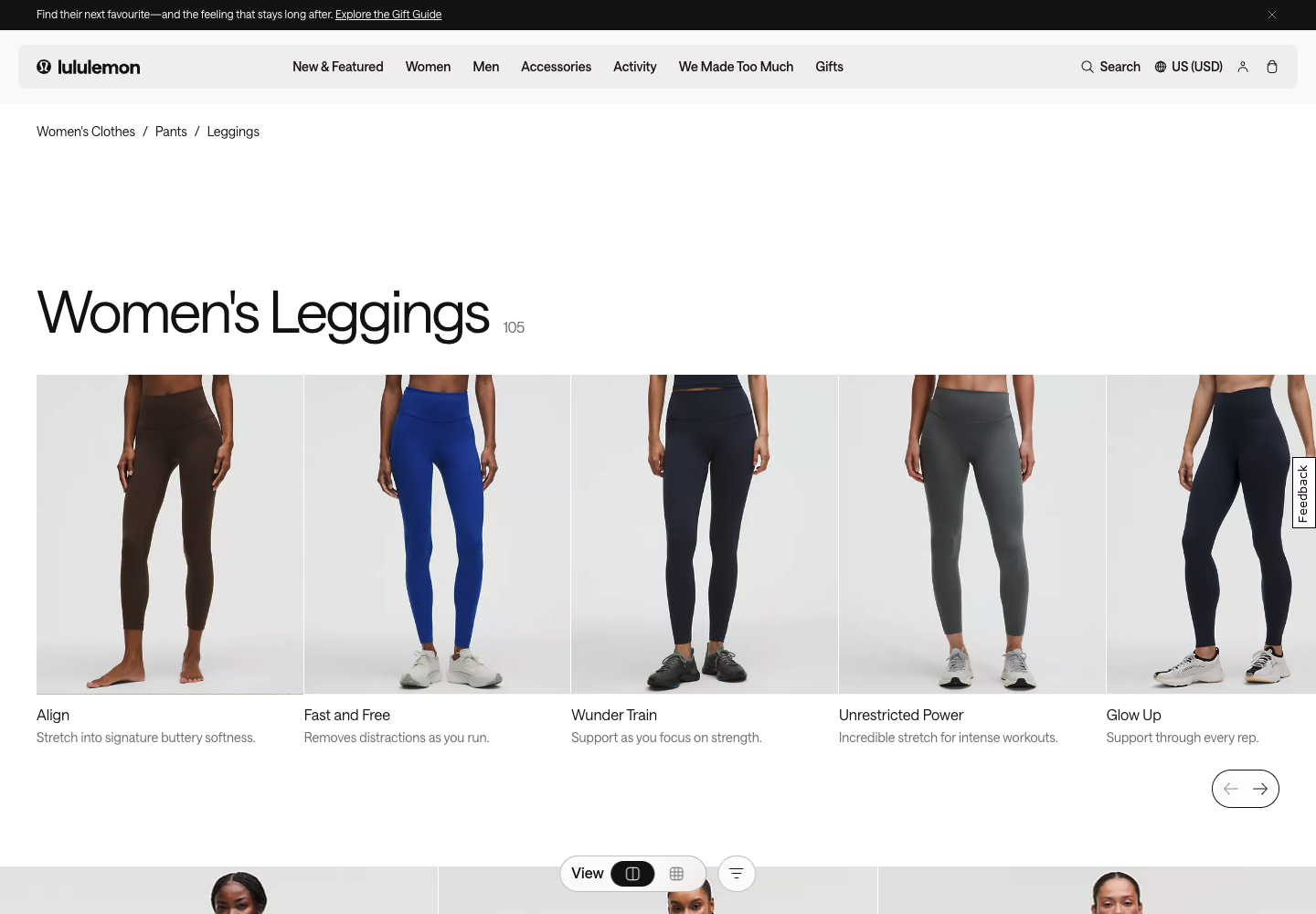
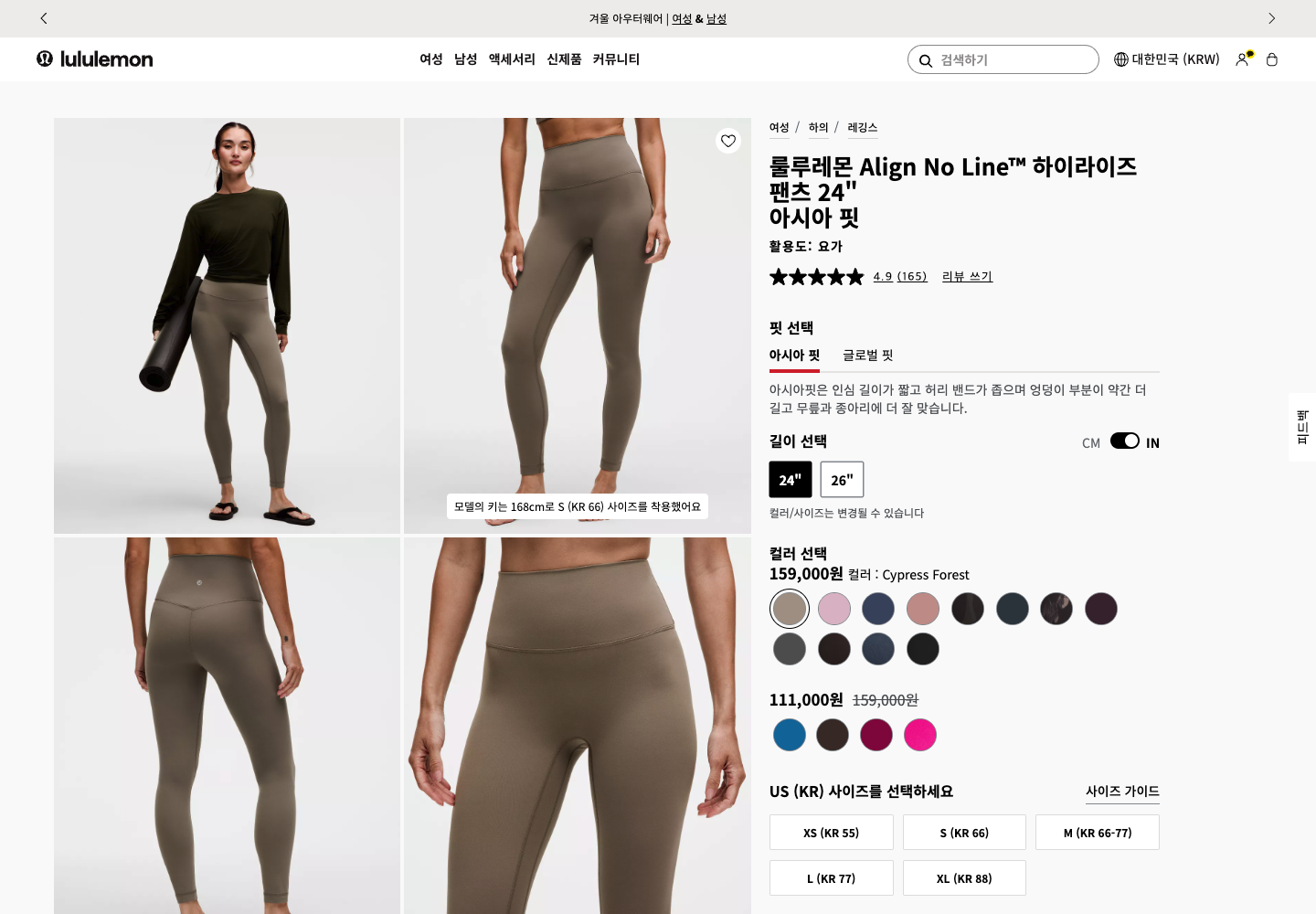
US category page: “Women’s Leggings,” 105 results, with Align (“Stretch into signature buttery softness”) as the first featured collection tile.The same Align line on the Korea site: 4.9 stars (165 reviews), 159,000₩ marked down to 111,000₩, and an “Asia Fit vs. Global Fit” toggle the US site doesn’t expose.
We attempted the equivalent top-of-page and reviews screenshots on the US Align Pant product page (shop.lululemon.com/p/lululemon-align-no-line-high-rise-pant-25/). The first visit loaded normally and confirmed zero JSON-LD and zero Open Graph meta tags (see Technical check below). On a later visit in the same audit session, scrolling toward the reviews section triggered the failure documented in the next section — after which the entire shop.lululemon.com domain stopped responding to further automated requests for the rest of this audit, so we could not recapture a clean top-of-page screenshot.
A reproducible bug: the reviews section that serves raw error JSON
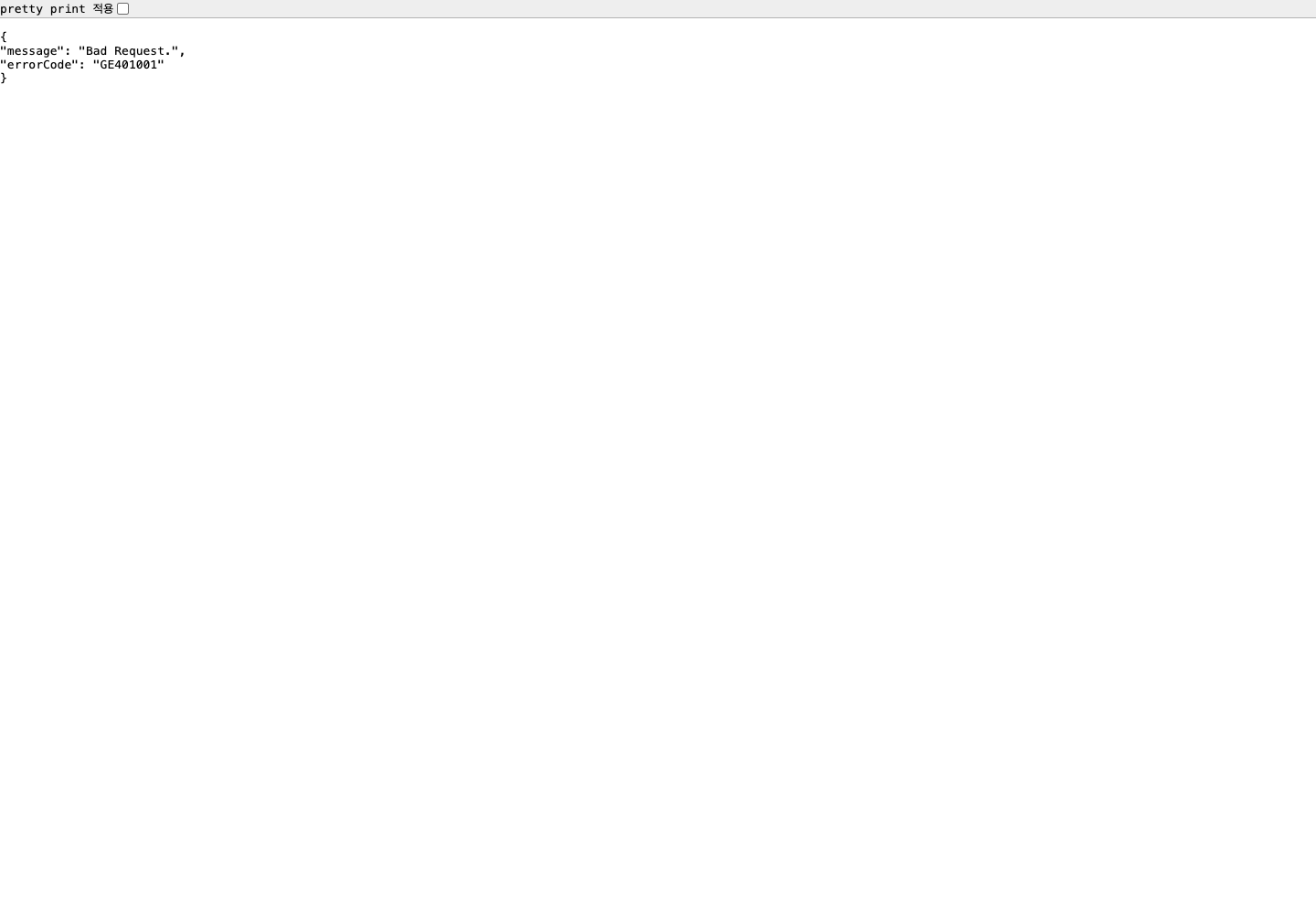
Scrolling toward the reviews section of the Align Pant page three separate times, across three different scroll methods (instant JS scroll, incremental JS scroll, human-like mouse-wheel scroll), produced the identical result: the entire page body replaced by {"message": "Bad Request.", "errorCode": "GE401001"} — the same Akamai error code that made this brand’s site completely inaccessible in last week’s queued attempt.
This matches our earlier finding exactly: a prior scheduled run of this series could not access any part of lululemon.com at all and the audit was deferred. Today the site loaded normally at first — the homepage, category page and Help Centre all rendered cleanly — but repeated automated navigation within the same session progressively tripped Akamai’s bot defense, first on a specific sub-resource fetch (the reviews widget) and eventually on the entire shop.lululemon.com domain, which stopped responding to any further request for the rest of the audit. We report this as what it is: an intermittent, escalating block tied to request volume and pattern within a session, not a permanent outage — and it’s the reason three of our planned seven G-score pages (US homepage, category and product page) could not be re-scored after the initial pass.
AI citation snapshot: 10 real queries, Google AI Mode
We sent 10 verbatim queries to Google AI Mode (udm=50) and checked both direct a[href] links and citation chip aria-labels for lululemon.com and lululemon.co.kr.
Query
Lululemon domain cited?
Who else showed up
lululemon align leggings review
✅ Yes
Gulf News, thatfitfriend.com, Reddit, Yahoo, Outdoor Gear Lab, herbarbell.com — third-party review sites dominate the result set alongside the brand chip
lululemon vs athleta leggings
✅ Yes
lululemon.me, Verywell Fit, Gap.com (Athleta’s parent), Shape.com — a direct brand-vs-brand query where both companies’ own domains were captured
is lululemon worth the price
❌ No
Reddit, bychloewen.com, Medium, fibre2fashion.com, Her World, theadultman.com — an opinion/value question answered entirely by third-party commentary, not the brand
lululemon return policy
✅ Yes
Both lululemon.com and lululemon.co.kr chips captured directly, alongside GOBankingRates
best lululemon leggings for running
✅ Yes
Coach Web, Reddit, lululemon.co.uk, ShopBack — three lululemon regional domains surfaced on one query
lululemon align pant how do they fit
✅ Yes
thatfitfriend.com, Taobao, herbarbell.com, Reddit, alexgoesglobal.com — a fit-guide query the brand’s own page still broke through on, unlike the sizing queries that failed for every other brand in this series
lululemon we made too much sale
✅ Yes
Forbes, lululemon.co.kr, Instagram — a brand-specific program name that the brand’s own domain naturally dominates
Reddit, Yahoo, Facebook, SMH.com.au, olaben.com, New York Post — a product-quality controversy query the brand’s own domain still appeared on
lululemon vs nike yoga pants
❌ No
nike.com, Reddit, PureWow — on this head-to-head comparison, Nike’s own domain appeared and Lululemon’s did not
Result: Lululemon cited in 8/10 queries (Nike 5/10, Adidas 4/10, Puma 5/10, Under Armour 8/10, New Balance 6/10, ASICS 7/10, Skechers 4/10) — tied with Under Armour for the highest rate measured in this series so far. The two misses are notable: a pure opinion/value question (“worth the price”) and the one query that pitted Lululemon directly against a single named competitor on its own turf (yoga pants vs. Nike) — on that query, the competitor’s domain appeared and Lululemon’s didn’t.
G-score audit: the 8-pillar hygiene checklist, what we could measure
We scored seven representative Lululemon URLs (US home, category, Align PDP, Help Centre; Korea home, category, Align PDP) with the same 8-pillar static-HTML checklist (JSON-LD present, FAQ content, visible date, author byline, concrete data points, table/list structure, 3+ subheadings, a 30-500 character early answer) used in our Week 17 quality-score experiment and on every brand in this series. Three of the seven — the US homepage, category and product pages — could not be scored: by the time we re-fetched their HTML for scoring, the Akamai block documented above had taken hold, and every request to shop.lululemon.com returned the same error JSON instead of the real page. We report that honestly below rather than scoring an error page as a 0.
Page
G-score
Passes
Fails
US homepage
Blocked
Not scoreable — Akamai error page returned instead of content on re-fetch
Women’s Leggings category (US)
Blocked
Not scoreable — same block
Align Pant product page (US)
Blocked
Not scoreable — same block (confirmed separately: 0 JSON-LD, 0 OG meta on the one clean load, see Technical check)
Help Centre (US)
0.625
Date, data points, lists, subheadings, early answer
JSON-LD, FAQ, author
Korea homepage
0.75
JSON-LD, FAQ, author, data points, lists, subheadings
Date, early answer
Korea leggings category
0.5
JSON-LD, FAQ, lists, subheadings
Date, author, data points, early answer
Korea Align Pant product page
0.875
JSON-LD, FAQ, date, author, data points, lists, subheadings
Early answer
Average across the four pages we could actually measure: 0.6875 (Nike: 0.4375, Puma: 0.354, Under Armour: 0.5208, Adidas: 0.6458, New Balance: 0.5833, ASICS: 0.4583, Skechers: 0.4375). We’re not presenting this as a clean series comparison — three of Lululemon’s seven pages are missing data, not zero, so ranking this average against brands with a full seven-page set would overstate it. The one page we could compare directly, the Korea Align product page (0.875), would be the highest single-page score recorded in this series so far.
robots.txt (shop.lululemon.com) — Returns 200 via a real browser session (a plain curl request hangs indefinitely with no response at all — Akamai appears to drop non-browser TLS fingerprints outright rather than returning an HTTP error). The file disallows search, pricing-parameter and internal API paths, and carries two explicit AI/social-crawler rules: User-Agent: meta-externalagent and User-Agent: meta-webindexer are both fully disallowed. No rule for GPTBot, ClaudeBot, PerplexityBot or Google-Extended appears anywhere, positive or negative — Meta’s crawlers are the only ones named at all. A working Sitemap: https://shop.lululemon.com/sitemap.xml directive is present.
sitemap.xml (shop.lululemon.com) — works, locale-segmented — Returns 200, a sitemap index listing separate Category, Help, Homepage and Product sub-sitemaps for each of three locales (en_CA, en_US, fr_CA) — a cleanly organized structure.
llms.txt (shop.lululemon.com) — missing — Returns a standard 404 (“This page took a rest day. We can’t find the page you are looking for.”). See our explainer on what llms.txt actually does before treating its absence as a ranking factor — Google Search doesn’t read it regardless.
Product schema on the US Align PDP — absent entirely — On the one clean load of the Align Pant page before the Akamai block took hold, we checked for application/ld+json script tags and Open Graph meta tags: zero of either. No Product schema, no AggregateRating, no og:title/og:description/og:image — nothing. This is on a page displaying a size selector, color swatches and an “Add to bag” button to a real shopper; a crawler or AI system reading the raw HTML gets none of that structured.
robots.txt (Korea, lululemon.co.kr) — Returns 200, a materially different file from the US one: a Crawl-delay: 10 directive, explicit Allow: / for Naver’s Yeti bot and for NaverBot by name, and the same meta-externalagent: Disallow: / rule as the US file. Sitemap directive points to sitemap_index.xml, not sitemap.xml — requesting the latter returns a hard connection failure rather than a redirect.
llms.txt (Korea) — HTTP 410, not 404 — lululemon.co.kr/llms.txt returns status 410 Gone (a deliberate “permanently removed” signal rather than a generic “not found”) while serving the site’s standard Korean-language 404 page content. We haven’t seen another brand in this series use 410 for a missing llms.txt specifically.
sitemap_index.xml (Korea) — works — Returns 200, three sub-sitemaps (product, category, and a third general sitemap).
Product schema on the Korea Align PDP — present and detailed — A BreadcrumbList, a ProductGroup block (name, image, description, brand, 90 size/color variants via hasVariant) with a nested AggregateRating (ratingValue: "4.92", reviewCount: "165"), and a separate review block. Full Open Graph tags (og:title, og:description, og:url, og:site_name) are also present — everything the US page is missing.
Two different e-commerce platforms, not just two locales — The US site’s URLs and component class names (shop.lululemon.com/p/.../voifnqeejx, React class names like meganav_, modal_) point to a modern custom Next.js storefront. The Korea site’s URLs (/p/.../prod11680318.html?dwvar_prod11680318_color=...) carry the unmistakable dwvar_ parameter signature of Salesforce Commerce Cloud (Demandware) — an entirely different commerce platform. That platform split plausibly explains why the structured-data gap is this wide: it isn’t a content decision made twice, it’s two separate engineering teams on two separate stacks.
Locale-specific product variant the US site doesn’t have — The Korea Align PDP exposes an “Asia Fit vs. Global Fit” toggle (아시아 핏 / 글로벌 핏) directly on the product page, with copy explaining the inseam and waistband differences. The equivalent US page offers no such regional-fit selector.
Review count and rating — consistent across both surfaces — The Korea PDP’s visible star rating (4.9, 165 reviews) and its JSON-LD aggregateRating (4.92, 165 reviews) match closely (the 4.9 vs. 4.92 difference is simple display rounding) — unlike several other brands in this series where the on-page number and the schema number diverged or one was entirely absent.
What works / What to verify
WHAT WORKS
An 8/10 AI citation rate — tied for the best in this series — that holds up even on several queries the brand’s own site structured-data wouldn’t obviously support; a Korea product page with genuinely complete Product/AggregateRating schema and matching on-page numbers; and a well-organized, locale-segmented sitemap on the US side.
WHAT TO VERIFY
Whether the US flagship product page’s complete absence of JSON-LD and Open Graph tags is a platform migration in progress or a longstanding gap; whether the Akamai block we tripped mid-audit is a standard anti-scraping threshold that any repeated automated access (including legitimate AI crawlers doing multi-page runs) would also hit; and whether the “worth the price” and head-to-head-vs-Nike query misses reflect a broader pattern across more comparison and opinion queries than the two we tested.
Target query check — reported honestly, not inflated
We have not re-measured “lululemon seo” or “lululemon geo audit” query volume this session. Per the pattern already confirmed across ten earlier subjects in this series on October 20, 2026 (Keyword Planner, US) — the large majority showed no measurable search volume at all for “[brand] SEO/GEO audit” phrasing — we’re not claiming this title drives ranking-based traffic. The distribution case for this series rests on internal links, our own index, and readers already following the GEO Lab arc, not on search demand for “[brand] SEO audit” as a query.
Frequently asked questions
Why does Lululemon’s US product page have zero structured data while Korea’s has full schema?
We can only report what we observed, not confirm intent: the two sites run on different e-commerce platforms entirely (a custom Next.js build on shop.lululemon.com vs. Salesforce Commerce Cloud on lululemon.co.kr), which means Product schema isn’t something that was written once and skipped on one side — it’s two separate implementations, and only one of them includes it. We did not investigate Lululemon’s internal engineering organization or roadmap.
Is the Akamai block we hit a sign Lululemon is actively hostile to AI crawlers?
Not necessarily. The US robots.txt only explicitly disallows Meta’s crawlers by name and says nothing about GPTBot, ClaudeBot or PerplexityBot — it isn’t written to exclude AI traffic broadly. What we observed is a behavioral bot-defense system (Akamai) that progressively restricted an automated session making repeated requests within a short window, which is a common and reasonable anti-scraping posture, not evidence of a deliberate anti-AI policy. We can’t say from this audit alone whether a well-behaved AI crawler making paced, robots.txt-compliant requests would trip the same defense.
Does an 8/10 AI citation rate mean Lululemon’s GEO setup is strong?
Not by itself — ASICS scored 7/10 in this series despite llms.txt and sitemap.xml redirect loops, and Skechers scored only 4/10 despite one of the more deliberately written llms.txt files we’ve reviewed, a pattern we first confirmed doesn’t track technical hygiene in our Week 17 experiment. Lululemon’s high citation rate looks driven substantially by brand reputation and third-party coverage (Reddit, review blogs, press) rather than by the US site’s own structured data, which in the one page we could fully check was completely absent.
Why only four of seven planned pages in the G-score table?
Because the other three (US home, category, product page) became inaccessible mid-audit when repeated automated requests tripped Akamai’s bot defense — every subsequent request to shop.lululemon.com returned the same error JSON instead of real content. We chose to report that gap explicitly rather than score an error page as a 0, which would misrepresent what we actually measured.
Audit evidence, scope and limits
Inspected: November 4, 2026, public logged-out access from a Korea-based IP (real browser session used throughout for screenshots and citation testing; a plain curl request to shop.lululemon.com returns no response at all, confirming Akamai blocks non-browser TLS fingerprints outright). Screens: US homepage, Women’s Leggings category, the Align Pant product page (top-of-page view lost to the Akamai block before a clean screenshot could be retaken; reviews-section view captured as the error-page screenshot shown above), US Help Centre, Korea homepage, the Korea leggings category, and the Korea Align Pant product page — plus robots.txt, sitemap.xml/sitemap_index.xml and llms.txt checks on both domains, a 10-query Google AI Mode citation snapshot, and an 8-pillar G-score attempted on seven pages (four successfully scored).
Not measured: rankings, Search Console performance, analytics, conversion, signed-in/member flows, ChatGPT citations (not attempted, given the composer failures flagged on earlier audits in this series), or the complete product/locale catalogue beyond the one legging family and seven URLs sampled here. This is a public-signal snapshot, not a performance claim or a full-catalogue crawl.
This is part 8 of a daily series. Every day, GeoParrot runs this same evidence-first method — real screenshots, a 10-query AI citation snapshot, an 8-pillar G-score audit, and an honest target-query check — against one more major sports and athletic-wear brand. Next: Reebok.





Leave a Reply