
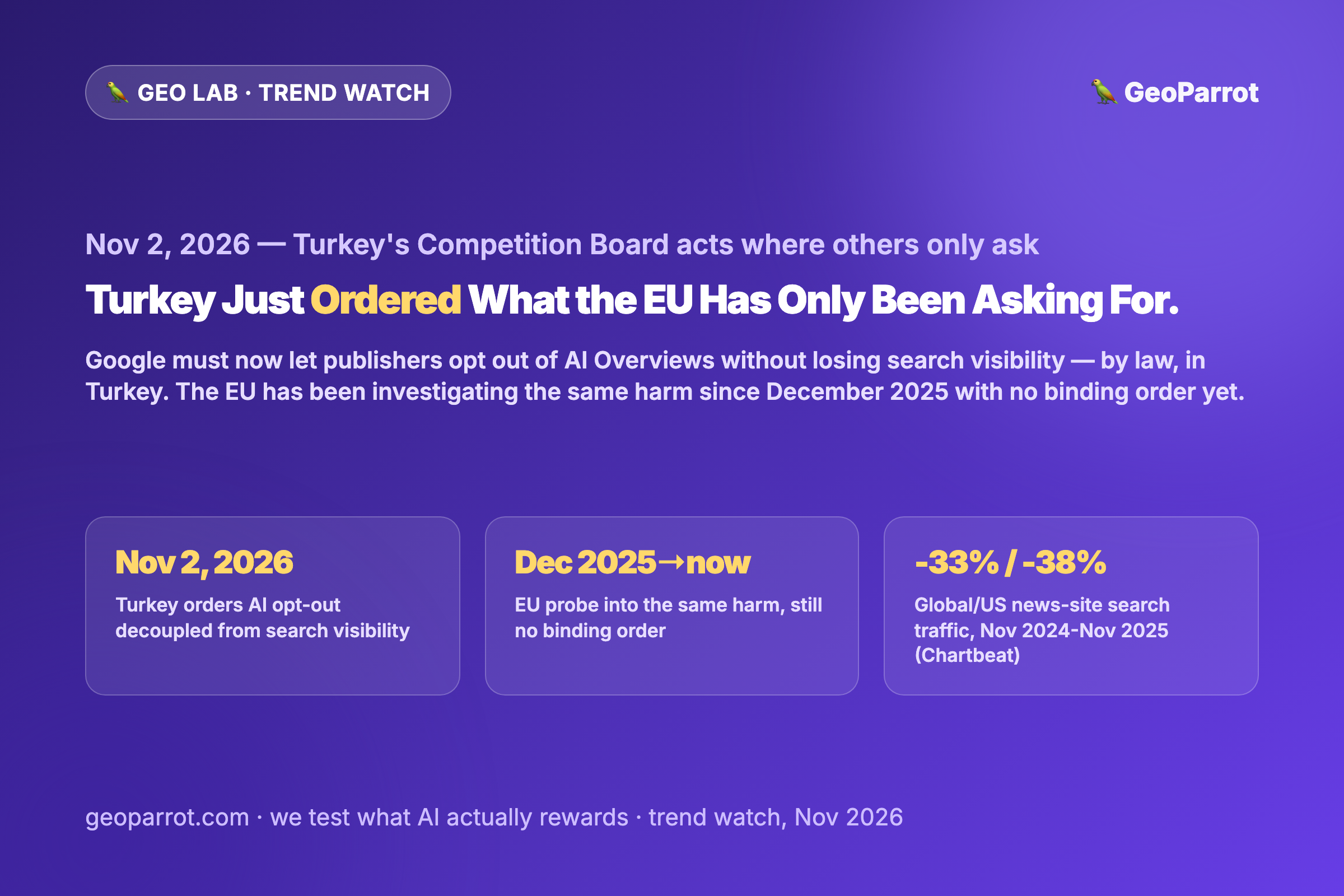
Quick answer: Turkey’s Competition Board (Rekabet Kurulu) announced on November 2, 2026 that it opened an abuse-of-dominance investigation into Google’s AI Overviews and AI Mode, and — unusually — paired it with immediate interim measures rather than waiting for a final ruling. Google must now offer publishers non-discriminatory terms that reflect the economic value of their content, and critically, a publisher’s choice about whether its content feeds AI Overviews and AI Mode has to stay independent of that publisher’s visibility and indexing in ordinary Google search. That’s the exact coupling — “opt out of AI and you quietly lose search traffic too” — that publishers in the EU and UK have been complaining about since at least December 2025, without either regulator yet forcing Google to sever it by order. Turkey just did, by law, inside Turkey only.
Trend watch — published November 3, 2026, in the GEO Lab. We test our own citation data most days; this one is about the regulatory floor underneath all of it.
What did Turkey’s Competition Board actually order on November 2?
The Rekabet Kurulu opened a formal abuse-of-dominance case against Alphabet, Google Ireland, Google LLC, Google International, and Google’s Turkish advertising entity, following a preliminary inquiry that had been running since August 2025 into how AI Overviews and AI Mode affect publisher traffic, content-licensing terms, and competing AI assistants. What makes this one different from every other open Google-AI probe worldwide isn’t the investigation — it’s that the board didn’t wait for a conclusion to act. It issued interim measures effective immediately, with three concrete requirements: non-discriminatory terms between publishers, terms that reflect the actual economic value of the content being used, and — the part that matters most for GEO — a publisher’s decision on whether to allow AI use of its content has to be kept separate from that publisher’s visibility and indexing in standard Google search results. In plain terms: Google can no longer make “stay findable in search” and “let us use your content in AI Overviews” the same checkbox, at least not in Turkey.
How far ahead of the EU and UK is this, really?
Further than the headline “another country opens a probe” suggests. The European Commission opened its own formal antitrust investigation into the identical alleged harm — AI Overviews and AI Mode using publisher content without compensation or a working opt-out — on December 9, 2025, nearly a year before Turkey’s order. Google announced an opt-out option in June 2026, the same day the UK’s CMA ordered Google to offer one under its Strategic Market Status powers. Neither regulator has yet forced Google to explicitly decouple that opt-out from search visibility the way Turkey’s interim order just did, and the EU is still mid-process: it gave publishers until August 28, 2026 just to submit feedback on Google’s opt-out design. The clearest sign the gap hasn’t closed: five French publisher organizations filed a fresh complaint with the European Commission on October 29, 2026 — four days before Turkey’s order — arguing publishers still can’t block Google’s AI use of their content without effectively losing search visibility. Turkey heard the same complaint and answered it with an enforceable order in days, not years.
| Regulator | Status as of Nov 3, 2026 | Decoupled opt-out from visibility by order? |
|---|---|---|
| Turkey — Rekabet Kurulu | Interim measures issued Nov 2, 2026, inside a new investigation | Yes, explicitly, immediately |
| EU — European Commission | Formal probe open since Dec 9, 2025; still gathering publisher feedback as of Aug 2026; fresh complaint filed Oct 29, 2026 | No binding order yet |
| UK — CMA | Ordered a Google opt-out option in June 2026 under Strategic Market Status; opened a separate Meta probe Oct 30, 2026 | Opt-out exists; decoupling from visibility not confirmed by order |
Why does “independent of visibility” matter more than it sounds?
Because the underlying numbers are the reason any of this is happening. Chartbeat data covering 2,576 news sites, cited in the Reuters Institute’s Trends and Predictions 2026 report, shows Google organic search traffic to those sites fell 33% globally and 38% in the US between November 2024 and November 2025 — though the Reuters Institute itself is careful to say it can’t isolate how much of that drop is AI Overviews specifically versus other search changes. That ambiguity is exactly why the coupling matters: if blocking AI use of your content also dents your ordinary ranking, no publisher can test whether AI Overviews are the cause, because opting out costs them the control group. Forcing the two apart doesn’t just protect revenue — it’s the only way anyone ever gets a clean before/after instead of guessing at the effect size the way the Reuters Institute currently has to.
Haven’t we already been flagging this exact coupling problem?
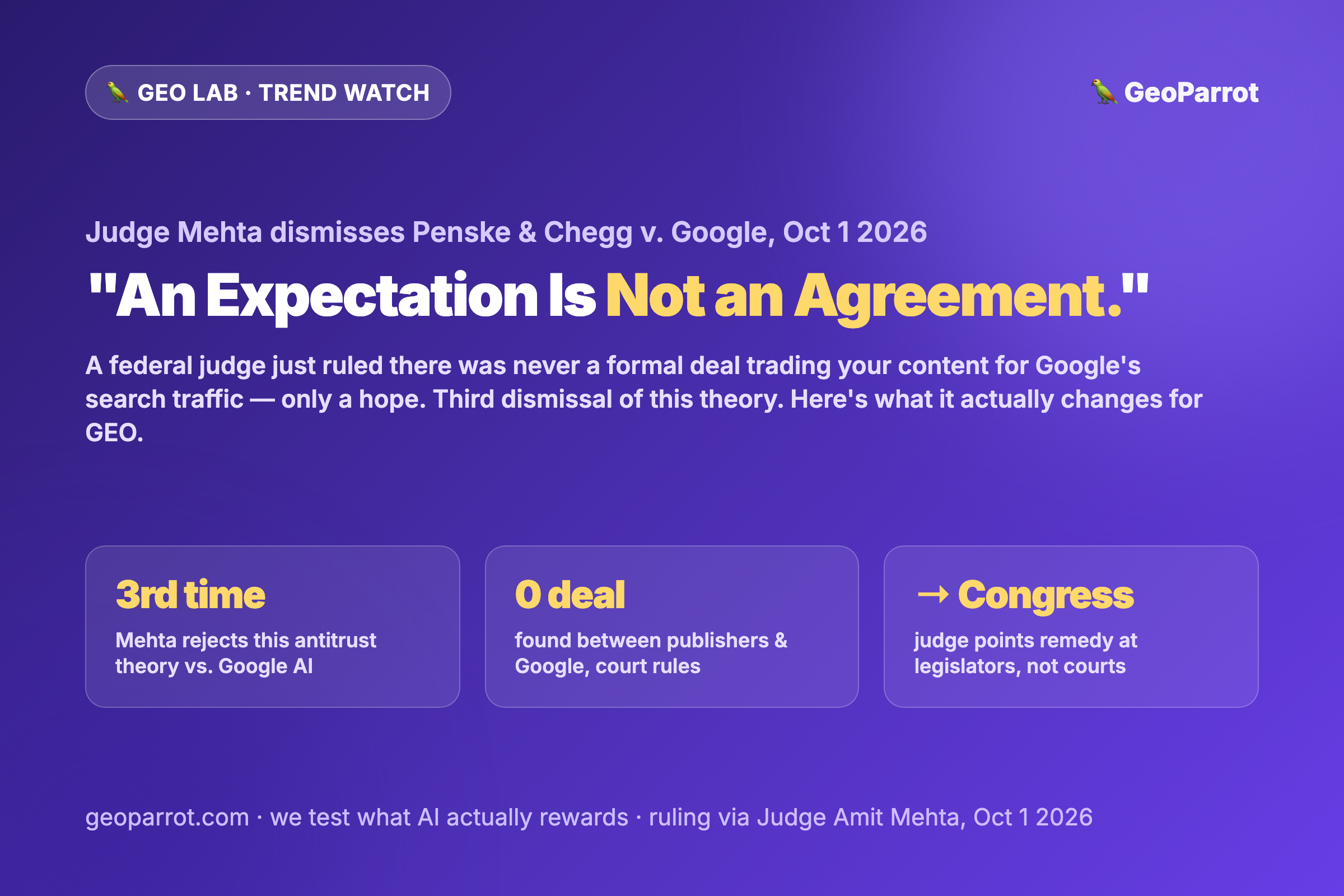
Three times this quarter, in three different mechanisms. When four AI companies agreed on a shared robots.txt AI-training opt-out token, we found that using it alone on Google also removed a site from Gemini citation eligibility — training opt-out and citation opt-out turned out entangled by default, not separate. When Google opened its Connected Apps Platform, the finding was the inverse entanglement: being technically eligible for a feature never meant being selected into it. And the day before this story, we covered AI Overviews structurally displacing the News Box on the exact publisher-facing SERP real estate this dispute is about. Turkey’s order is the first time anyone with legal authority has looked at this family of entanglements and simply ordered two of them apart. It’s also a sharp contrast with the US: a federal judge dismissed Penske’s and Chegg’s antitrust claims against Google over AI Overviews on October 1, 2026, ruling publishers only ever had an “expectation” of traffic, not a contract. Courts in the US found no obligation to enforce. A regulator in Turkey just created one, by order.
What should you actually check this week?
- If you have no Turkish audience, this order doesn’t apply to you directly — it’s an interim measure inside a Turkish Competition Board case, not a global Google policy change. Don’t act as if Google-Extended or AI Overviews opt-out behavior changed everywhere on November 2.
- If you do serve Turkish users or publish through a Turkish entity, watch for Google’s actual implementation of the interim order, not just the announcement — an order and a shipped mechanism are two different events, and we don’t yet have confirmation of the latter.
- Everywhere else, track the EU case instead. The Commission’s investigation covers the same alleged harm at a much larger scale (every EU publisher) and the October 29 French complaint is a sign it’s still live, not resolved — that’s the case whose outcome would actually change policy for most of this blog’s readers.
- Don’t assume “opt-out available” means “opt-out costs you nothing.” Until a regulator or your own A/B test confirms visibility is unaffected, treat any AI-content opt-out the same way we treated the robots.txt training token: read the specific company’s documented behavior, don’t assume it generalizes to the next one.
Frequently asked questions
Does Turkey’s order change how Google AI Overviews or AI Mode behave outside Turkey?
No, not directly. It’s an interim measure inside a Turkish Competition Board investigation into Google’s conduct in the Turkish market. It has no binding effect on Google’s behavior in the EU, UK, US, or anywhere else, though regulators do sometimes cite each other’s actions as precedent.
Is Turkey’s order final?
No. Interim measures are temporary, issued while the underlying abuse-of-dominance investigation continues; they are not the board’s final decision. The full investigation, which began as a preliminary inquiry in August 2025, is still ongoing.
Has the EU or UK ordered the same decoupling of AI opt-out from search visibility?
Not by binding order as of this writing. The European Commission has been investigating the same alleged harm since December 9, 2025 and was still collecting publisher feedback on Google’s voluntary opt-out design as of August 2026; five French publisher groups filed a fresh complaint on October 29, 2026 arguing the problem persists. The UK’s CMA ordered Google to offer an opt-out option in June 2026, but we found no confirmation that order explicitly severs the opt-out from search visibility the way Turkey’s interim measures do.
Does AI Overviews actually cause the traffic decline publishers are citing?
That’s unresolved, and worth being precise about: Chartbeat data cited in the Reuters Institute’s Trends and Predictions 2026 report shows a 33% global and 38% US drop in Google organic traffic to 2,576 news sites between November 2024 and November 2025, but the Reuters Institute itself says it can’t isolate how much of that is specifically attributable to AI Overviews versus other search changes. Treat the traffic numbers as real and the causal attribution as still an open question.

Leave a Reply