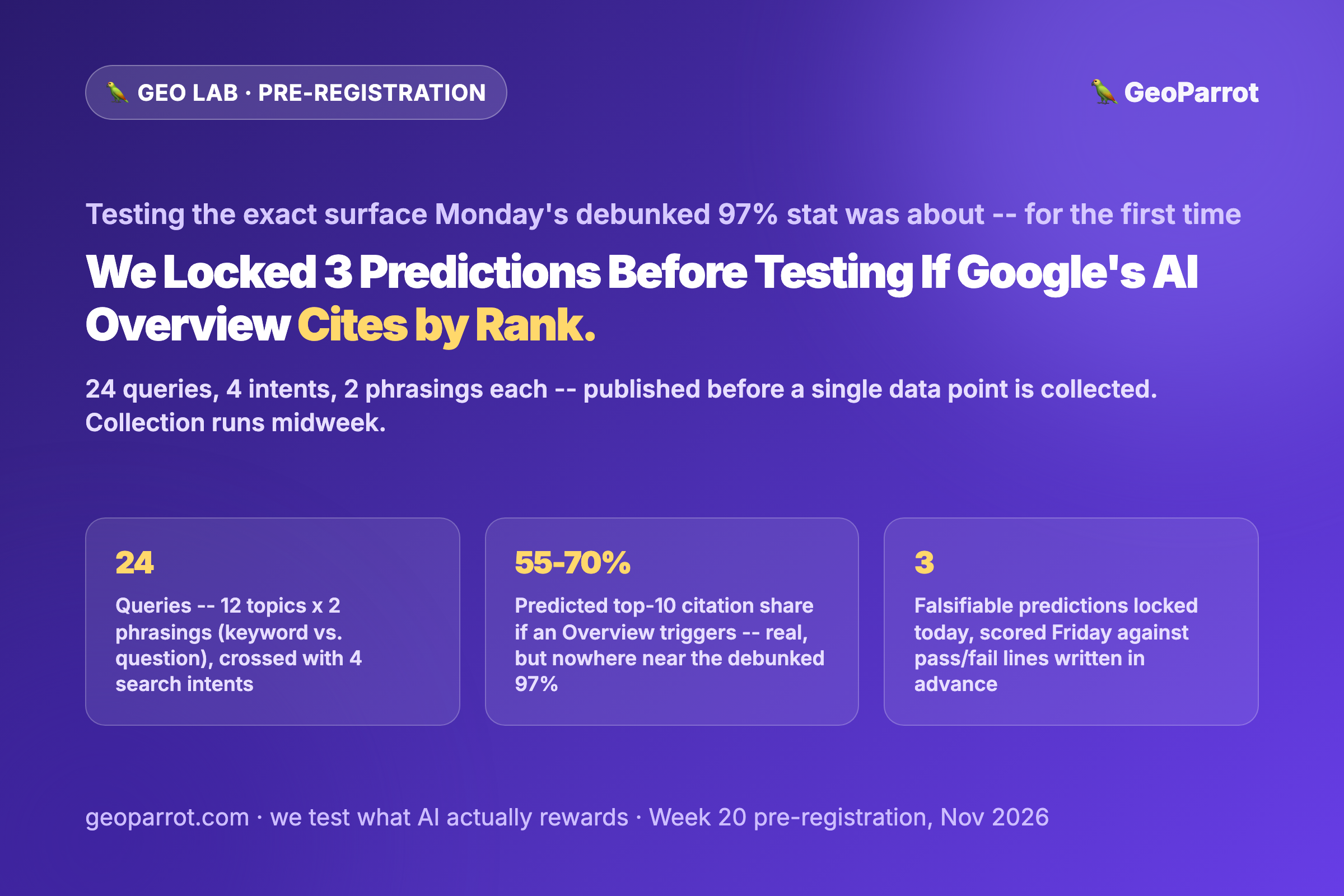
Quick answer: On November 3, 2026, before collecting any data, we locked three predictions about whether Google’s classic AI Overview box cites sources by organic rank — a question Monday’s post opened after we found a “97% from top-20 pages” stat that doesn’t actually appear in the Semrush study it’s credited to. P1: among queries that trigger an Overview, citations will concentrate in the top 10 at a 55-70% rate — real, but nowhere near 97%. P2: Local (“near me”) queries will trigger an Overview less often than Product, Informational, or How-to queries, and show the weakest rank-citation pattern when they do. P3: question-phrased queries will trigger an Overview more often than short-keyword versions of the same topic, but phrasing won’t change how closely citations track rank once one appears. 24 queries, 12 topics, each run as a keyword and a question. Collection runs midweek; this post is the full protocol, not the result.
Published November 3, 2026, in the GEO Lab. This is Tuesday in the arc Monday’s post opened. Unlike last week’s protocol, which sat locked-but-unpublished for five days before anyone outside the lab could see it, this one locks and publishes the same day — there’s no backlog to apologize for this time.
What exactly are we locking today, and why three predictions instead of one?
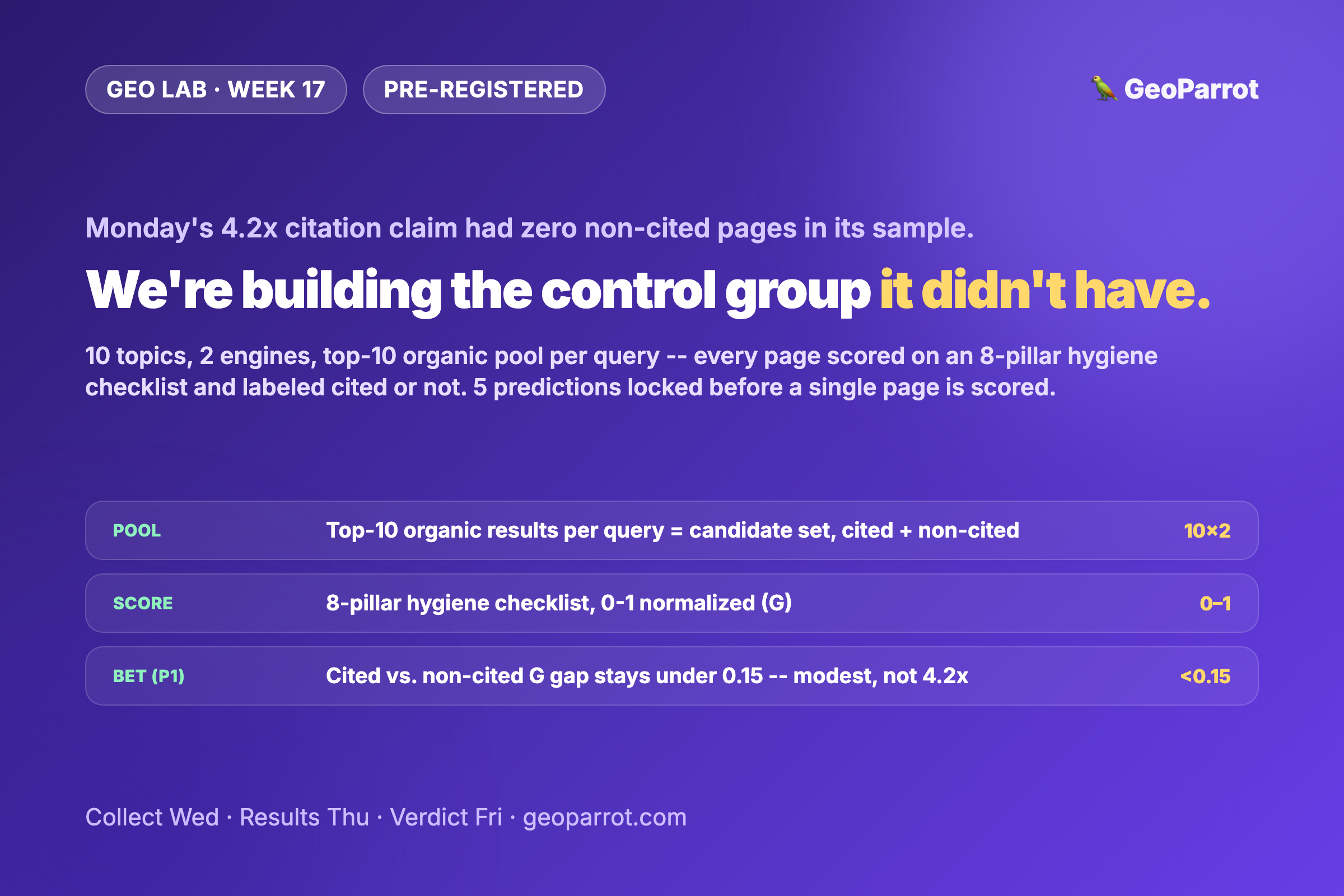
Monday’s post found that a specific, citable-sounding statistic — “97% of AI Overview citations come from top-20 organic pages, position one cited over half the time” — is not present in the Semrush study it’s credited to. That left the actual question open: does the classic AI Overview box cite by rank at all, and if so, by how much? None of GeoParrot’s prior rank-citation arcs answer this directly. Our 46.2% vs. 8.3% retention numbers are from Google AI Mode, a different surface with a different interface and likely a different selection process. Our 34% blended overlap figure covers ChatGPT, Perplexity, and AI Mode — still not the classic Overview box that sits directly in Google’s own search results page. This arc runs the test on that exact surface for the first time.
P1 (magnitude): on queries where a classic AI Overview appears, cited sources will concentrate in the top 10 organic results at a 55-70% rate — real rank correlation, but far short of 97%, and in the neighborhood of the 5.6x gap our AI Mode data already shows between top-3 and sub-top-20 retention.
P2 (intent split): Local “near me” queries will trigger a classic AI Overview less often than Product, Informational, or How-to queries, because Google tends to answer local-service intent with the Local Pack instead — and on the Local queries that do get an Overview, rank-citation correlation will be the weakest of the four buckets.
P3 (phrasing split): question-phrased queries will trigger an Overview more often than short-keyword phrasings of the same topic, but phrasing won’t meaningfully change how closely citations track rank once an Overview does appear — phrasing moves whether one shows up, not how it cites.
Three predictions instead of one because they’re about different mechanisms: P1 is about magnitude (how strong is the rank effect, really), P2 is about which queries even get an Overview to measure, and P3 is about whether the words you type change the answer independent of what you’re asking about. Collapsing all three into “does rank matter, yes or no” would hide which part of that question actually holds.
Why these 24 queries, and why run each topic as both a keyword and a question?
Every prior overlap-style arc varied one axis at a time — exp19 varied intent (Product/Informational/How-to/Local) without touching phrasing, and exp14 varied phrasing (rewording the same intent) without a dedicated intent cross-cut. This arc crosses both in the same 24-query set: 12 topics, 3 per intent bucket, each run once as a short keyword phrase and once as a full question.
Intent bucket
Topics (n)
Keyword example
Question example
Product
3
“crm for small business”
“what is the best crm for small business”
Informational
3
“vitamin d deficiency signs”
“what are the signs of vitamin d deficiency”
How-to
3
“improve credit score fast”
“how do I improve my credit score quickly”
Local
3
“emergency plumber near me”
“who is the best emergency plumber near me”
12 topics x 2 phrasings = 24 queries. Full list, verbatim, in exp20/questions.json in our lab repo.
Local topics are deliberately generic “near me” service searches (plumber, dentist, HVAC) rather than city- or brand-specific, matching the same logic exp19 used for its Local bucket — the question is whether the category of intent changes the pattern, not whether one city’s results happen to be noisy.
How are we actually collecting this — and what are we not controlling for?
Full dogfooding disclosure, because this is the part that determines whether the result means anything: for each of the 24 queries, we run a single Google Search (desktop, logged out, one account, one location — Seoul, KR) and record three things — whether a classic AI Overview box renders at all, every URL cited inside it if one does, and that URL’s own organic rank position (1-20) in the same page’s non-AI results. That’s it. One run, one location, no retries if an Overview doesn’t appear.
What this does not control for: AI Overview rendering is known to vary by account history, device, and geography, and we are measuring from a single vantage point, the same limitation every prior GeoParrot arc has carried. A query that shows no Overview from Seoul on a logged-out session might show one from a different account or location. We’re not claiming this measures “the” AI Overview behavior universally — only what we can observe directly, reported with the pass/fail lines below locked before we look.
What counts as confirmed, rejected, or inconclusive for each prediction?
All three lines were written down November 3, before any of this week’s queries were run:
Prediction
Confirmed if
Rejected if
P1 (magnitude)
Top-10 citation share lands at 55-70% or higher, AND top-3 pages are cited ≥2x as often as positions 11-20
Top-10 share falls below 55%, or the top-3-to-11-20 ratio is under 2x (citations spread roughly evenly by rank)
P2 (intent split)
Local bucket has strictly the fewest Overview triggers of the 4 buckets, AND (if ≥2 Local Overviews trigger) their rank-citation pattern is visibly weaker than the other 3 buckets
Local triggers as often or more often than another bucket, or its pattern is comparable to or stronger than the others
P3 (phrasing split)
Question-phrasing triggers an Overview in ≥2 more of the 12 topic pairs than keyword-phrasing, AND the top-10 share gap between phrasing groups (among triggered queries) is under 10 points
Keyword-phrasing triggers equally or more often, or the top-10 share gap between phrasing groups is 10+ points
Pass/fail lines locked before collection. Thursday reports the raw trigger and citation numbers; Friday scores them against these exact lines, with no retroactive adjustment.
Inconclusive is a real, allowed outcome here — AI Overview coverage is partial, and if too few of the 24 queries trigger one at all, some buckets may not have enough triggered queries to read a pattern with confidence. We’ll say that plainly rather than forcing a verdict out of two or three data points.
What should you do with this right now?
If you’re deciding whether rank alone is enough to get cited: don’t wait for Friday to act on direction. Every adjacent number we’ve already measured — 46.2% vs. 8.3% on AI Mode, 34% blended overlap — points toward rank mattering a lot, but well short of “if you’re not top-20, you’re invisible.” Keep investing in both rank and the other citation signals we’ve tracked (freshness, schema, original data).
If your category is local-service (“near me”) search: P2’s logic — that Google tends to answer those queries with the Local Pack rather than an AI Overview — is itself actionable regardless of Friday’s verdict. If true, optimizing for an AI Overview citation in a local-service category may simply be optimizing for a surface that rarely appears for your queries.
If you want to replicate this yourself: the full 24-query list and every pass/fail line are in this post, nothing held back pending results. Run your own category’s version and see if the pattern holds.
Frequently asked questions
What three predictions did GeoParrot lock for this arc?
P1: among queries where a classic AI Overview appears, citations will concentrate in the top 10 organic results at a 55-70% rate. P2: Local “near me” queries will trigger an Overview less often than Product, Informational, or How-to queries, and show the weakest rank-citation pattern when they do. P3: question-phrased queries will trigger an Overview more often than keyword phrasings of the same topic, but phrasing won’t change how closely citations track rank once one appears.
Why does this test the classic AI Overview box specifically, instead of AI Mode or ChatGPT?
Because none of our prior arcs have, and the fabricated “97% from top 20” stat Monday’s post fact-checked was specifically about the classic AI Overview box — the one embedded directly in Google’s regular search results page, not the separate AI Mode tab or a chat assistant.
How many queries, and how are they split?
24 total: 12 topics (3 Product, 3 Informational, 3 How-to, 3 Local), each run twice — once as a short keyword phrase, once as a full question. This is the first GeoParrot arc to cross an intent axis and a phrasing axis in the same query set.
What isn’t this experiment controlling for?
Account history, device, and geography all affect whether and how an AI Overview renders. This arc measures from one account, one location (Seoul, KR), one run per query, logged out — the same single-vantage-point limitation every prior GeoParrot arc has carried. It’s not a claim about universal AI Overview behavior, only what we can observe directly against predictions locked in advance.
When do results publish?
Collection runs midweek (Wednesday). Thursday reports the raw trigger rates and citation-rank numbers for all three predictions. Friday is the verdict, scored against the pass/fail lines locked in this post.
2026 GEO Benchmark — the full first-party scorecard this arc feeds into.
GeoParrot is a GEO Lab: we test what AI search actually cites and recommends, then publish the method and the misses — including our own. Wednesday we collect; Thursday reports the raw numbers; Friday is the verdict against the exact lines locked in this post.




Leave a Reply